Tag: twitter blue

  • Twitter introduces content monetisation, paying influencers from advertising revenues

    Twitter introduces content monetisation, paying influencers from advertising revenues

    Elon Musk’s social media platform, Twitter, has taken a significant step by initiating payments to content creators from advertising revenues for the first time. This development has caught the attention of numerous influencers; however, not all users are eligible to receive compensation from the platform.

    Influencers such as Ian Miles Cheong, Benny Johnson, and Ashley St. Claire, who are considered high-profile figures within the far-right community, shared details of their Twitter earnings prior to the official announcement of monetiation.

    “Wow. Elon Musk wasn’t kidding. Content monetisation is real,” tweeted a user named End Wokeness, boasting 1.4 million followers, showcasing earnings surpassing $10,400.

    Users who have subscribed to Twitter Blue and have accumulated over 5 million tweet impressions per month for the past three months are eligible to receive earnings.

    Elon Musk, who also serves as the CEO of SpaceX and Tesla, stated that an initial sum of $5 million will be distributed, accumulating from February onwards. However, the program is only accessible in countries where Stripe, a payment platform, supports payouts.

    Renowned writer Brian Krassenstein, boasting approximately 750,000 followers, claimed to have received $24,305 from Twitter. Similarly, SK, another creator with around 230,000 followers, reportedly earned $2,236, while political commentator Benny Johnson, with 1.7 million followers, disclosed earnings of $9,546. Ashley St. Clair, a writer for Babylon Bee, shared that she earned $7,153.

    Who will not benefit from Twitter monetisation? According to Twitter’s content monetisation standards, sexual content, as well as pyramid schemes, violence, criminal behaviors, gambling, drugs, and alcohol-related content, cannot be monetised.

    In a blog post, Twitter explained that creators’ share of advertising revenue would be determined based on the number of replies to their posts and monthly impressions.

    According to a report by The Washington Post, some non-political contributors expressed frustration with the company’s lack of transparency during the program’s rollout.

    “My tweets have generated hundreds of millions of impressions for Twitter every year,” stated Matt Navarra, a social media strategist who runs the tech-focused newsletter and community Geekout. He further added, “And I’ve been on the platform for 15+ years. It’s pretty lame that there is no payout coming my way. Twitter has never generated any income directly from all the content I have contributed.”

    This development comes shortly after Twitter faced fierce competition from its rival Meta-owned Threats, which witnessed millions of sign-ups within hours of its launch.
  • No more blue ticks for Twitter users who don’t pay for verification

    No more blue ticks for Twitter users who don’t pay for verification

    On Thursday, Elon Musk’s social media platform followed through on its promise to eliminate blue verification checks from accounts that don’t pay a monthly fee. The blue checks have been removed from the accounts of many prominent public figures and celebrities on Twitter, including Oprah Winfrey, Lady Gaga, Beyonce, Pope Francis, and Donald Trump.

    The purge came after Musk introduced Twitter Blue, a paid service that aims to democratize journalism and empower the people’s voice. Before Musk ended the verification system, roughly 300,000 users had the blue check mark, which helped differentiate real public figures from impostors and protected against fake news.

    Following the change, some users, such as Stephen King, still have the blue check mark but claimed not to have paid for the new service. Musk responded to King’s tweet with “You’re welcome namaste” and revealed that he’s “personally paying for a few [accounts].” Musk has been attempting to increase Twitter’s revenue by offering subscription and premium services since buying the social media company for $44 billion last October. Musk previously described the system that assigned the check marks as “corrupt and nonsensical.”

    Twitter began tagging users with a blue check mark roughly 14 years ago. After Twitter Blue’s introduction, numerous fake accounts emerged, including some impersonating Musk’s Tesla and SpaceX. Twitter temporarily suspended the service days later. The cost to display the verified check mark under the new service ranges from $8 per month for individuals to $1,000 per month for organisations.

    Politicians and official bodies have also been affected by the Thursday purge, with concerns raised that the public will be unable to identify which Twitter accounts provide information about natural disasters. US Senator Brian Schatz tweeted, “There really ought to be a way for emergency managers to verify that they are real on this website or imposters will cause suffering and death.” According to digital intelligence platform Similarweb, only 116,000 accounts signed up for Twitter Blue last month.

  • Twitter to relaunch its subscription service on Monday at higher price for Apple users

    Twitter to relaunch its subscription service on Monday at higher price for Apple users

    After many failed attempts, Twitter announced on Saturday that its subscription service, which features a procedure for platform account authentication, will be relaunched on Monday.

    “We’re relaunching TwitterBlue on Monday — subscribe on web for $8/month or on (Apple’s) iOS for $11/month to get access to subscriber-only features, including the blue checkmark,” the company tweeted.

    In an attempt to prevent impersonation and false information, Twitter now only allows organisations and public figures to use the blue checkmark that signifies their accounts have been verified.

    Elon Musk announced his plan to diversify Twitter’s revenue source beyond advertising after purchasing the firm in October. He would do this by implementing additional payment methods for premium services.

    Ten days after Musk assumed leadership at the beginning of November, the first version was released, but there was a stir when several phoney accounts that claimed to represent businesses or celebrities started to appear.

    The version was abruptly halted.

    As part of the new deal, Twitter will once more assess accounts that want blue checkmarks, according to the company. Later in the week, the checkmark will change from grey for government organisations to gold for companies.

    Additionally, subscribers will have access to features like the ability to download higher-quality videos and modify tweets after they are published.

    “Thanks for your patience as we’ve worked to make Blue better,” the company tweet said.

    Musk first stated that Twitter Blue will be back by the end of November but then revealed a few days later that the project had been put on hold temporarily as specialists worked to create a method to combat impersonation.

  • Twitter may introduce different colour checks for organisations and individuals

    Twitter may introduce different colour checks for organisations and individuals

    Elon Musk, the new owner of Twitter, announced on Monday that the social media platform is delaying the resumption of its blue check subscription service, deviating from his initial tentative timetable to do so.

    “Holding off relaunch of Blue Verified until there is high confidence of stopping impersonation,” Musk said in a tweet.

    “Will probably use different color check for organisations than individuals.”

    Earlier, only verified accounts of prominent figures including journalists, legislators, and well-known people could display the coveted blue check mark.

    But earlier this month, Twitter launched a membership option that is available to anybody willing to pay in order to increase income as Musk battles to keep advertisers.

    Due to the proliferation of bogus accounts, Twitter stopped the newly introduced $8 blue check membership service and indicated that it will resume on November 29.

    Musk noted in another tweet that the 1.6 million new users on Twitter during the last week were “another all-time high.”

    As they adjust to the new leader, Twitter advertisers, including major corporations like General Motors, Mondelez International, and Volkswagen AG, have suspended their campaigns.

    According to estimates, hundreds of Twitter employees left their jobs last week after Musk gave them until Thursday to sign up for “long hours at high intensity” or go.

  • Twitter halts $8 subscription program after fake accounts abuse service to impersonate major brands

    Twitter halts $8 subscription program after fake accounts abuse service to impersonate major brands

    After users started misusing it to impersonate major companies and known personalities, Twitter appears to have suspended its $7.99/month Blue membership service, which allowed customers to pay for a verification check mark.

    This week, Twitter introduced a feature that lets users purchase a checkmark that had previously been used to denote a verified or official account in its iPhone app. Friday saw the removal of the Twitter Blue sign-up option from the iPhone app.

    The swift suspension of the service shows that, at least right now, CEO Elon Musk’s grand strategy to attract new user-based revenue isn’t succeeding as anticipated.

    According to NBC, due to the expensive subscription service, many pranksters started setting up fake Twitter accounts. It made the site even more conducive to false information, and numerous easily obtained checkmarks were used to discredit corporations, governments, and celebrities.

    According to a current Twitter sales employee, the company decided to reduce Twitter Blue verification due to the influx of impersonators.

    The employee, who wanted to remain anonymous because they were not allowed to speak on behalf of Twitter, said that a fake Eli Lilly account that tweeted that “we are excited to announce insulin is free now” caused a major issue.

    Before it was deleted, the tweet remained visible for several hours. Later, the genuine Eli Lilly account tweeted, “We regret to individuals who have received a false message from a bogus Lilly account.

    Following the fraudulent message’s publication, the stock price of Eli Lilly and other pharmaceutical firms, notably AbbVie, which was also the target of a Twitter impersonation, both fell precipitously. Major stock indices were then rising during a market surge.

    Another imposter mocked Elon Musk’s electric car company Tesla by mimicking the blue subscription checkmark for paid subscribers. In a barrage of insulting tweets, a user whose name looked to be “@TeslaReal” claimed, “honestly the 53 per cent reduction in stock price doesn’t phase[sic] us. We are the ones who are most knowledgeable about Crashing.

    For marketers, the impact of so many changes to the Twitter platform is a significant challenge; several have already suspended their expenditure there.

    Some users who had already paid for the programme also reported that their freshly acquired blue checkmarks had vanished from their accounts.

    No one from Twitter was immediately available for comment. Musk was unavailable for comment right away.

    The removal of Twitter Blue verified comes as Musk and Alex Spiro, who is currently serving as Twitter’s top lawyer, are attempting to reassure staff, clients, and regulators that they will abide by all legal requirements and the terms of an earlier FTC consent decree.

    “I cannot emphasize enough that Twitter will do whatever it takes to adhere to both the letter and spirit of the FTC consent decree,” Elon Musk wrote in a company-wide email that CNBC was able to get on Thursday night.

    In a subsequent email, Spiro stated that his team had communicated with FTC officials on Thursday and that Twitter would soon be subject to the agency’s “initial forthcoming compliance check.” He made it clear that any violations would be the responsibility of Twitter, not “those who work at Twitter.”

  • $8 for Starbucks coffee is cool, but a Twitter badge is not? Netizens react to Musk’s meme

    $8 for Starbucks coffee is cool, but a Twitter badge is not? Netizens react to Musk’s meme

    Elon Musk’s intentions to charge an additional $8 per month for the Twitter Blue service have both amused and incensed online users. This may be the rationale behind Musk’s defense of his choice to charge verified users for their Twitter blue tick badge.

    Musk appears to have turned to memes in an effort to spread the word about his lofty goal of turning Twitter into a revenue-generating platform. The head of SpaceX, who is renowned for his blunt assessment of everything on Earth, has been jokingly outlining his new plan.

    https://twitter.com/Therealdavedfs1/status/1587894312838529024

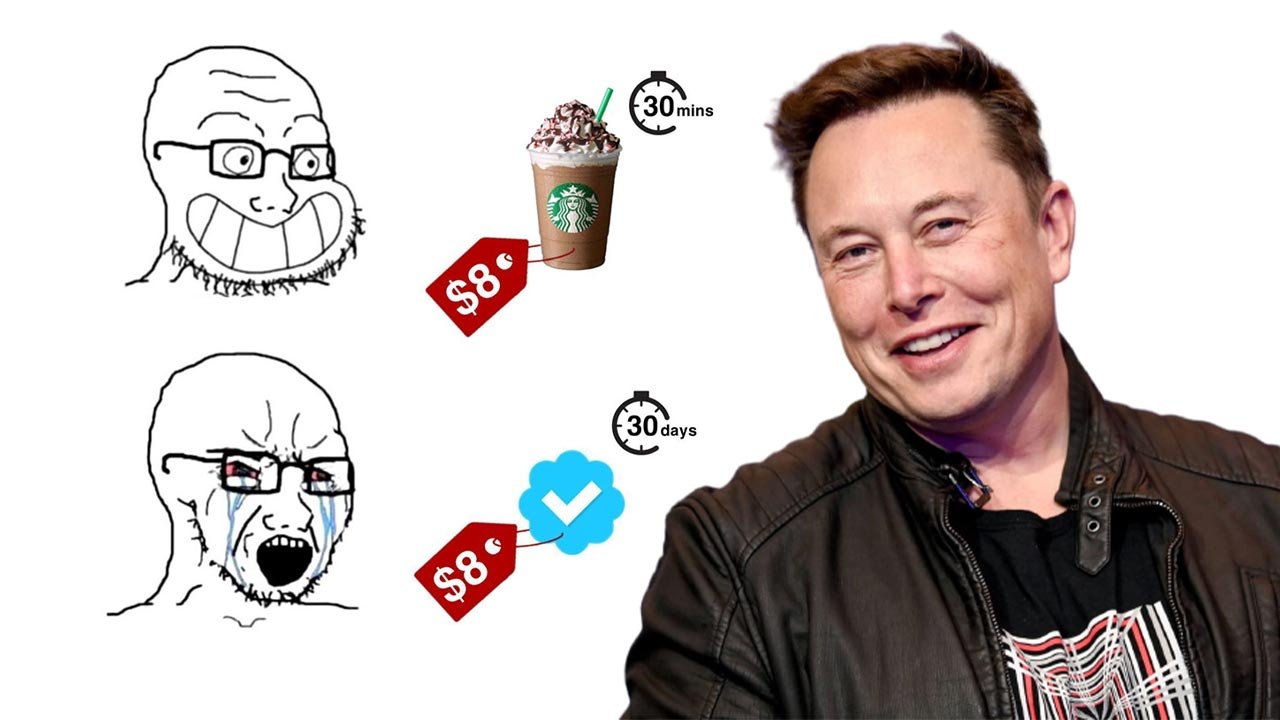
    In one of his tweets, he posted a meme depicting individuals enjoying their $8 Starbucks coffee while grumbling about having to spend the same amount to maintain their Twitter verification badge.

    Users reacted strongly to the meme that compared the cost of coffee to that of a Twitter subscription. Some people praised the choice, while others criticised the millionaire.

    “They don’t see the vision Mr Musk. I’d pay $80 for a checkmark for even just 30 minutes. Everybody hating on Elon should instead be grateful for the service he is doing for us. He doesn’t get enough appreciation,” said a user. “Mocking of users will continue until profits improve,” chimed in another user.

    Another meme posted by the Tesla CEO depicts two characters discussing shelling out $8 for freedom of speech. Another responds to the question of why pay $8 for Twitter verification by stating that he can still use Twitter for free without the advantages.

    He claimed that Twitter is a fascinating site in another tweet. “Twitter is simply the most interesting place on the Internet. That’s why you’re reading this tweet right now,” read his tweet. In another tweet, Musk said it was good to be attacked by right and left at the same time. “Being attacked by both right & left simultaneously is a good sign,” he wrote.

    On November 1, Musk announced the $8 per month subscription plan for Twitter on his Twitter account. The new CEO continued by outlining several premium services to which users will have access.

    According to him, platform users will be able to publish long videos and audio files as well as receive priority treatment for replies and remarks. Additionally, there won’t be many adverts on subscribers’ feeds.