Tag: UAE

  • Amid political chaos, UAE President telephones army chief

    Amid political chaos, UAE President telephones army chief

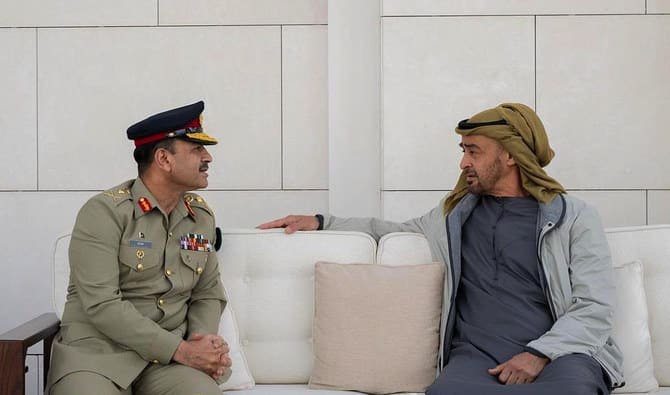
    United Arab Emirates (UAE) President Mohammed bin Zayed Al Nahyan has telephoned Chief of Army Staff (COAS) General Asim Munir.

    According to media reports, bilateral defense and military relations were discussed, with both emphasising the need to further promote mutual defense and military cooperation.

    The conversation has taken place while the country is gripped in political chaos. Recently, after Pakistan Tehreek-e-Insaf (PTI) Chairman Imran Khan’s arrest, his supporters attacked military installations.

    Khan has also openly named COAS Munir for his arrest and accused him of spreading anarchy just to save his seat.

  • Saudi Arabia and UAE pledge $3 billion to Pakistan as IMF agreement nears

    Saudi Arabia and UAE pledge $3 billion to Pakistan as IMF agreement nears

    On Monday, Finance Minister Ishaq Dar stated that Pakistan has fulfilled all conditions set by the International Monetary Fund (IMF). He expressed hope that the IMF would soon sign the staff-level agreement, which would allow for the release of the $1.1 billion tranche.

    Since February, the two parties have been negotiating various conditions and external financing from friendly nations before signing the agreement. Speaking to Geo News, Dar stated that Saudi Arabia and the United Arab Emirates (UAE) have informed the IMF of their commitments to provide $3 billion to Pakistan.

    Riyadh has pledged $2 billion, while Abu Dhabi has promised $1 billion. The IMF has also been notified of this, according to Dar. The finance minister emphasized that all conditions for the staff-level agreement have been met, and he expressed optimism that the IMF’s Executive Board would approve it soon.

    The country’s foreign exchange reserves have dwindled to cover barely a month of imports since the IMF funding stalled in November. Pakistan must resume the bailout package, which was agreed upon in 2019 and is worth $6.5 billion, to avoid risking default on external payment obligations.

    Pakistan had to take several steps demanded by the IMF, including reversing subsidies in its power, export, and farming sectors, raising energy and fuel prices, imposing a permanent power surcharge, among other measures.

    These moves have pushed Pakistan’s inflation to its highest level ever, rising to over 35 per cent YoY in March. The IMF programme will disburse another tranche of $1.4 billion to Pakistan before it ends in June, and it will unlock other bilateral and multilateral financing for the cash-strapped country.

    In recent weeks, neighbouring China has rolled over $2 billion and refinanced another $1.3 billion.

  • IMF seeks further assurances from Pakistan despite Saudi Arabia and UAE confirmation

    IMF seeks further assurances from Pakistan despite Saudi Arabia and UAE confirmation

    The International Monetary Fund (IMF) is seeking further assurances from Pakistan, despite confirmation of financial assistance from Saudi Arabia and the United Arab Emirates (UAE), to ensure that Pakistan has met the condition of arranging $6 billion financing in order to reach a staff-level agreement.

    Nathan Porter, the IMF’s Mission Chief to Pakistan, welcomed the announcement of financial assistance from the two “key” friendly countries, stating that the IMF supports the efforts of the Pakistani authorities. A Pakistani delegation is currently in Washington attending the Spring meetings of the IMF to discuss the revival of the loan programme. Pakistan’s Finance Minister Ishaq Dar was unable to attend due to domestic issues.

    Pakistan had been asked to arrange $6 billion in external financing, which it needed from now until June to avoid default. Saudi Arabia has pledged $2 billion, while the UAE has committed $1 billion, thus reducing the now-required amount to $3 billion. Pakistan’s foreign exchange reserves have fallen to cover barely a month of imports after the IMF funding stalled in November, hit by snags over fiscal policy adjustments after officials of the lender visited Islamabad in February for talks. The IMF programme will disburse another tranche of over $1 billion to Pakistan before it concludes in June.

    IMF’s Director of the Middle East and Central Asia Department, Jihad Azour, during a press conference, briefed the media about the current status of the $6.5 billion programme with Pakistan, saying that Pakistan is at a critical juncture and decisive actions are required to stabilise the economy. Azour emphasized the need for Pakistan to address inflation, reduce the constraints on trade and export, and maintain macroeconomic stability. He also stated that financing is required, and the financing needs are about what is currently in the programme, and the IMF is working with the authorities and bilateral supporters of Pakistan to ensure that the financing needs for the programme and beyond are assured.

    Central bank governor Jameel Ahmad told investors in Washington at the spring meetings of the lender and the World Bank that programme loans from other multilateral agencies await completion of the IMF review. Pakistan is at a critical juncture, and decisive actions are required to stabilise the economy.

  • IMF receives assurance of $1 billion from UAE to support Pakistan’s economy

    IMF receives assurance of $1 billion from UAE to support Pakistan’s economy

    In a significant development towards reviving the stalled bailout programme, the authorities in the United Arab Emirates (UAE) have pledged to provide $1 billion in bilateral support to Pakistan, according to Finance Minister Ishaq Dar.

    Dar tweeted, “UAE authorities have confirmed to the IMF for their bilateral support of $1 billion to Pakistan.” He also stated that the State Bank of Pakistan is currently in the process of completing the necessary documentation to receive the deposit from the UAE authorities.

    Pakistan was required to provide assurance that its balance of payments deficit is fully financed for the remaining period of the IMF programme, which has been stalled since November last year. Last month, the IMF’s Director of Strategic Communications, Julie Kozack, emphasised that “timely financial assistance from external partners will be critical to support the authorities’ policy efforts and ensure the successful completion of the review [with Pakistan].” She added, “Ensuring that there is sufficient financing to support the authorities is the paramount priority. A Staff Level Agreement (SLA) will follow once the few remaining points are closed.”

    Earlier this month, Saudi Arabia also pledged to provide a $2 billion loan to Pakistan, according to Pakistan’s Minister of State for Finance Aisha Ghaus Pasha. The country’s economic situation has been further exacerbated by months of political and economic turmoil, crippling floods last year and record inflation. Pakistan has been grappling with a debt crisis and foreign exchange reserves have fallen to less than four weeks of imports.

    In an effort to ease the situation, China has agreed to refinance $2 billion, of which $1.7 billion has already been credited to Pakistan’s central bank. China also rolled over a $2 billion loan last month, providing relief during Pakistan’s acute balance of payments crisis. However, talks with the IMF for a delayed $1.1 billion loan tranche, part of the bailout agreed in 2019, have been ongoing.

  • Pakistan to receive written guarantee from UAE for $1 billion loan

    Pakistan to receive written guarantee from UAE for $1 billion loan

    Pakistan is making progress towards securing a loan from the International Monetary Fund (IMF) with a $1 billion financing pledge from the United Arab Emirates (UAE) expected this week. Sources suggest that the UAE will provide written confirmation of the financing to the IMF through the Finance Secretary during the current annual meeting in Washington.

    To secure external financing for this fiscal year, the IMF has asked Pakistan to seek assurances from friendly countries and multilateral partners for funding its balance of payment gap. In addition to Saudi Arabia’s $2 billion pledge, the agreement with the IMF is also contingent on the UAE’s $1 billion commitment.

    According to sources within the Ministry of Finance, the UAE has finalised the agreement, and as soon as Pakistan receives a written guarantee from the Gulf state, the IMF will also be informed. This development follows requests from Pakistan’s Prime Minister and Finance Minister to UAE officials to complete the necessary prerequisites for the Fund.

    Pakistan is currently facing one of the most severe economic crises in its history, with consumer prices at a record high and interest rates raised to an all-time high. Due to a dollar shortage, the IMF has revised its growth forecast for Pakistan to 0.5% from the earlier estimate of 2%, causing supply chain disruptions and companies to halt production.

    The IMF is also assessing the coalition government’s proposed fuel discount for lower-income groups, which is planned to be financed by raising fuel prices for wealthier motorists. The finance minister has assured that the IMF has received all the required information.

    The finance minister had cancelled his scheduled in-person meetings with IMF officials in Washington but has repeatedly claimed that the staff-level agreement with the lender would be reached soon. Islamabad has been hosting an IMF mission since January to negotiate policy measures and secure $1.1 billion in funding for the cash-strapped economy, which is on the verge of collapse.

    The funds are part of a $6.5 billion bailout package approved by the IMF in 2019, which analysts argue is crucial for Pakistan to avoid defaulting on external payment obligations. The deal will also unlock other financing options to shore up Pakistan’s foreign exchange reserves, which have fallen to four weeks’ worth of import cover and help resolve the balance of payment crisis.

  • Pakistan’s hopes for IMF agreement rise as Saudi Arabia confirms $2 billion in additional deposits

    Pakistan’s hopes for IMF agreement rise as Saudi Arabia confirms $2 billion in additional deposits

    The International Monetary Fund (IMF) has informed Pakistan that Saudi Arabia has confirmed $2 billion in additional deposits, which has rekindled hopes of an early agreement signing. Since January, Islamabad has been negotiating with the IMF for the release of $1.1 billion from a $6.5 billion bailout package that was agreed upon in 2019.

    To unlock the funding, the Pakistani government has cut back on subsidies, removed an artificial cap on the exchange rate, added taxes, and raised fuel prices. However, assurances from friendly nations for additional funds have delayed the agreement.

    The lender has informed Pakistani authorities of the development and the Fund staff is reportedly satisfied with the latest confirmation. The report states that the Saudi authorities are set to make a public announcement, possibly during the upcoming visit of Prime Minister Shehbaz Sharif to the kingdom.

    The Saudi envoy in Pakistan had also hinted in a recent interview that his country had always supported Pakistan in critical situations and that good news would be shared soon. The sources have stated that all eyes are focused on the UAE for getting confirmation on another $1 billion deposit from them, which may pave the way for striking the staff-level agreement (SLA) with the IMF.

    Finance Minister Ishaq Dar is expected to visit UAE on his way to the US where he will hold talks on the release of funds. However, there is still another stumbling block in the way of signing the SLA with the IMF. The Ministry of Petroleum, in consultation with the PM Office, had announced an unplanned cross-fuel subsidy for owners of motorcycles and cars up to 800cc, which needs to be scrapped at this stage.

    The government has not yet withdrawn the proposed cross-fuel subsidy, which cannot be implemented in a half-baked manner. Such schemes were considered in the past during the tenure of former finance minister Shaukat Tarin and even during the era of the PDM-led government when Miftah Ismail had the charge of the Ministry of Finance.

    Even Miftah Ismail had allocated Rs48 billion on the eve of the last budget in the name of Sasta Petrol, but it could not be implemented because such schemes could not be designed properly. The announcement of a half-baked cross-fuel subsidy had provided an excuse to the IMF for delaying the SLA signing, as they were still raising questions for getting more details to ascertain how the scheme was going to be implemented in a transparent manner.
  • Pakistan awaits financial support confirmation from Saudi Arabia and UAE to sign IMF agreement

    Pakistan awaits financial support confirmation from Saudi Arabia and UAE to sign IMF agreement

    The signing of the staff-level agreement (SLA) between Pakistan and the International Monetary Fund (IMF) is dependent on confirmation of financial support from the Kingdom of Saudi Arabia (KSA) and the United Arab Emirates (UAE). Once support confirmation is received from KSA and UAE, the SLA will be signed with the IMF.

    Finance Minister Ishaq Dar reportedly informed diplomats in Islamabad at an Iftar dinner on Sunday that the issues with the IMF will be settled soon. However, it has been 46 days since the IMF and Pakistan concluded review talks in Islamabad on February 9, and the staff-level agreement is yet to be secured.

    There have also been dissenting views within the Finance Ministry on the issue of cross-fuel subsidy. While some bureaucrats from the ministry have opposed the scheme, the government went public with it, which has caused concern.

    Officials who spoke on the condition of anonymity told The News, that such schemes would jeopardize the revival of the IMF program, and it remains to be seen how the ministry will satisfy the global lender on the subsidy. The status of the 10th and 11th reviews, which were due on February 3 and May 3, respectively, is also unknown at this time, even if the IMF program is revived.

    The situation highlights the importance of financial support from KSA and UAE to Pakistan, as well as the potential impact of domestic policy decisions on the country’s relationship with the IMF. Despite Finance Minister Dar’s assurances, it is unclear when the SLA will be signed, and how the subsidy issue will be resolved.

    As the reviews remain in question, the situation underscores the need for Pakistan to address economic challenges and seek support from its allies to maintain its financial stability.

  • China approves rollover of $2 billion SAFE deposits for Pakistan

    China approves rollover of $2 billion SAFE deposits for Pakistan

    China has given approval for the rollover of $2 billion State Administration of Foreign Exchange (SAFE) deposits for a year. Pakistan’s Finance Minister, Ishaq Dar, confirmed, stating that the rollover was a requirement of the International Monetary Fund (IMF).

    The IMF had requested the rollover of Chinese SAFE deposits to fulfill external financing needs and move towards a staff-level agreement. The agreement involves filling nine tables under the Memorandum of Economic and Financial Policies (MEFP), including a table related to the Net International Reserves (NIR) as an indicative target.

    This target cannot be met without incorporating the external financing needs of the program period until the end of June 2023. The IMF has asked Pakistan to bridge the gap of $6 billion to ensure its credibility and avoid default. This condition was put forth largely because representatives of Gulf countries on the Executive Board had made commitments before the approval of the seventh and eighth reviews for providing financial assistance to Islamabad in various forms.

    Now, the IMF is seeking the support of Saudi Arabia, the UAE, and Qatar to help Pakistan’s struggling economy. The Fund has warned Islamabad that its credibility would be at stake if the staff-level agreement is finalised, and Pakistan fails to materialize its commitment from the bilateral partners, which could lead to default.

    The IMF is investigating why Pakistan’s bilateral partners are not fulfilling their earlier commitments. China is the only country that has come forward to rescue Islamabad by fulfilling its commitments on the re-financing of its commercial loans as well as the rollover of its SAFE deposits.

  • UAE hints at acting as bridge between India and Pakistan

    UAE hints at acting as bridge between India and Pakistan

    United Arab Emirates (UAE) Ambassador to India, Abdulnasser Jamal Alshaali, in an interview with The Hindustan Times said that his country has played a role in the past in addressing tensions between India and Pakistan, though any future role it might play would be up to both neighboring countries. 

    Talking to Foreign Editor at The Hindustan Times, Rezaul Hasan Laskar about Pakistani Prime Minister (PM) Shehbaz Sharif’s remarks about asking the UAE to help build a bridge with India, the ambassador said his country has “played such a role in the past”, but future endeavours will depend on both India and Pakistan.

    He also talked about expanding the gulf country’s relationship with India, saying that UAE is engaged in technical discussions to finalise a rupee-dirham arrangement for trade as part of the efforts to build on the free trade agreement signed by the two countries last year.

    He also said that UAE is keen on revisiting the arrangement for flights to India and introducing flights to more Indian destinations to help bring down airfare.

    He said: “If you check the price of a ticket today, it’s more than 50 per cent higher than it used to be a few years back or it used to be pre-Covid. That’s already a market signal that we need to pay attention to because we are talking about this entire relationship and aviation is a crucial point in expanding this relationship.”

    When asked about UAE’s plans to invest in food parks and renewable energy in India under the I2U2 framework, Jamal said the conversation between the Gujrat government and UAE is going on.

    In recent times, both countries have grown close. In November 2022, UAE Foreign Minister Sheikh Abdullah bin Zayed Al Nahyan visited India to further strengthen its bilateral relationship with India.

  • Ishaq Dar says Pakistan’s foreign exchange reserves will strengthen soon

    Ishaq Dar says Pakistan’s foreign exchange reserves will strengthen soon

    Pakistan’s foreign exchange reserves, which currently stand at $10 billion, will strengthen very soon, according to Finance Minister Ishaq Dar.

    Dar recalled the economic achievements made by the PML-N government from 2013 to 2018, saying that during that time, the GDP of the nation increased from $244 billion to $356 billion.

    He said, “Pakistan reserves stood at a total of $10 billion — $4 billion of the State Bank of Pakistan and $6 billion of commercial banks. Pakistan is repaying its loans on time, and the foreign exchange reserves will soon boost.”

    The finance minister announced that an IMF group would soon be in the nation and that he would be seeing IMF representatives at the Geneva summit.

    The coalition administration plans to seek money at the International Conference on Climate Resilient Pakistan on January 9 in Geneva, Switzerland, in order to recover from the disastrous floods.

    Dar informed the media outlet that he will travel to the United Arab Emirates (UAE) for a three-day official tour after his visit to Geneva comes to an end.

    “Funds from Saudi Arabia and other friendly countries will soon be received,” the finance minister said, who told journalists earlier this week that he expects inflows from China “in a few days.”