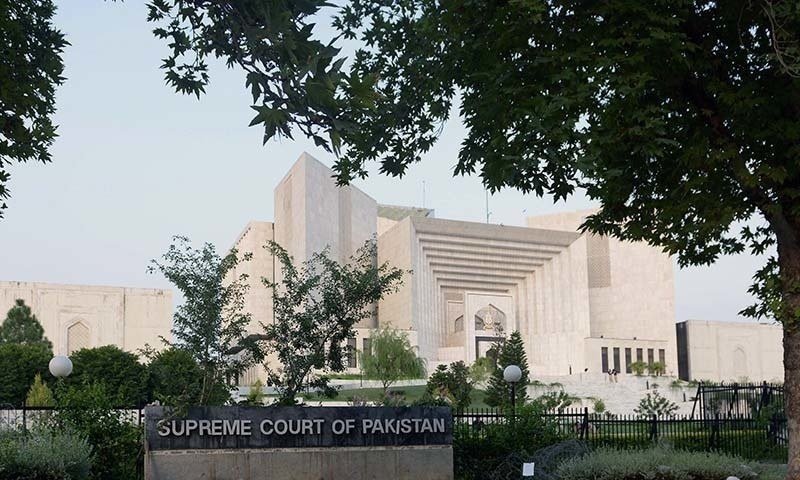
The Supreme court (SC) will take up the presidential reference seeking opinion on Article 63-A of the Constitution – which deals with the disqualification of parliamentarians over defection – at 1pm on Thursday, reports Dawn.
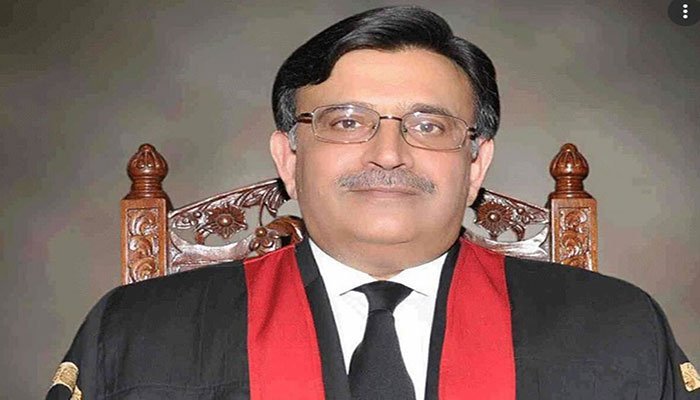
A five-member bench of the SC comprising Chief Justice of Pakistan (CJP) Umar Ata Bandial will head the bench, which also includes Justice Ijazul Ahsan, Justice Mazhar Alam Khan Miankhel, Justice Munib Akhtar, and Justice Jamal Khan Mandokhail.
Earlier, on Monday, a two-member bench of the apex court comprising CJP Bandial and Justice Akhtar took up the presidential reference and declared that a larger bench would hear the case.
Justice Faez Isa “perplexed” over CJP Bandial’s decision to hear the presidential reference
The senior-most judge of SC Justice Faez Isa has said that he is “perplexed” over CJP Bandial’s decision to hear the presidential reference for the interpretation of Article 63-A together with the SCBA petition over the no-confidence motion.
In a three-page letter to the top judge, dated March 22, Justice Isa has questioned multiple legal aspects along with the formation of a larger bench “without the inclusion of senior-most judges”.
“On 19 March 2022, a two-member bench headed by yourself and an hon’ble judge 8 in seniority, heard CP No. 2/2022 in Court on a Saturday, despite the filing of the petition on Thursday. On the said date it was ordered that CP No. 2/2022 be heard ‘along with a Reference, if any, that is filed under Article 186 of the Constitution and the petition and the proposed reference were ordered to be fixed together for hearing. I am perplexed as to how a matter which had not been filed was ordered to be fixed for hearing,” the letter said.
Justice Isa further stated that the apex court rules demand that the constitution of a bench is done fairly and as per the law, referring to Article IV of the Code of Conduct, which says:
“[…] a judge must avoid all possibility of his opinion or action, in any case, being swayed by any consideration of personal advantage, either direct or indirect.”
“The Constitution specifically recognises the most senior Judge of the Supreme Court (including in Article 175A(3) and Article 180), and with seniority comes responsibility, which must not be shirked. The most senior Judge also ensures the continuity of the Supreme Court as an institution,” Justice Isa wrote.
Better if the assembly’s fight is fought inside the assembly: CJP Bandial
Justice Bandial on Monday heard a plea filed by the Supreme Court Bar Association (SCBA) about the lawful proceeding of the no-confidence motion in the National Assembly (NA).
During the hearing, which was attended by three bigwigs of the Opposition — PML-N President Shehbaz Sharif, Pakistan People’s Party (PPP) Chairman Bilawal Bhutto-Zardari, and Jamiat-e-Ulema-Islam-Fazl (JUI-F) chief Maulana Fazlur Rehman, SCBA counsel argued that NA Speaker Asad Qaiser summoned the session 17 days after the submission of the no-confidence motion. However, according to Article 95, the session has to be called within 14 days.
He further argued that the no-confidence motion could not be adjourned before voting. To this, CJ observed that it is an “internal matter” and it would be “better if the assembly’s fight is fought inside the assembly”.
According to Justice Munib, a member’s individual vote has no “status”. Justice Munib Akhtar said after joining a political party, a member’s vote is considered a “collective” right.
SCBA writes a reply to the apex court
On Thursday, the SCBA submitted a written reply to the apex court ahead of today’s hearing in accordance with the court’s directives.
In its reply, the SCBA said that the votes of MNAs “cannot possibly be construed as a collective right of a political party”, citing Article 95 of the Constitution, which deals with the procedure to bring in a no-confidence motion against the prime minister.
Fawad Chaudhry responds to SCBA’s reply to the apex court
Information Minister Fawad Chaudhry took to Twitter and reacted to SCBA’s response.
Fawad said, “Reading SCBA’s answer, it seems that Supreme Court bar body is a subsidiary of Noon League,” says Fawad Chaudhry, adding, “Ordinary lawyers are dissatisfied with the role of lawyers’ organisations and the defeat of this group in the Lahore Bar elections is the result of the lawyers’ reaction.”
Attorney General of Pakistan (AGP) Khalid Jawed Khan had submitted the reference seeking the SC’s opinion on Article 63-A of the Constitution on March 21.