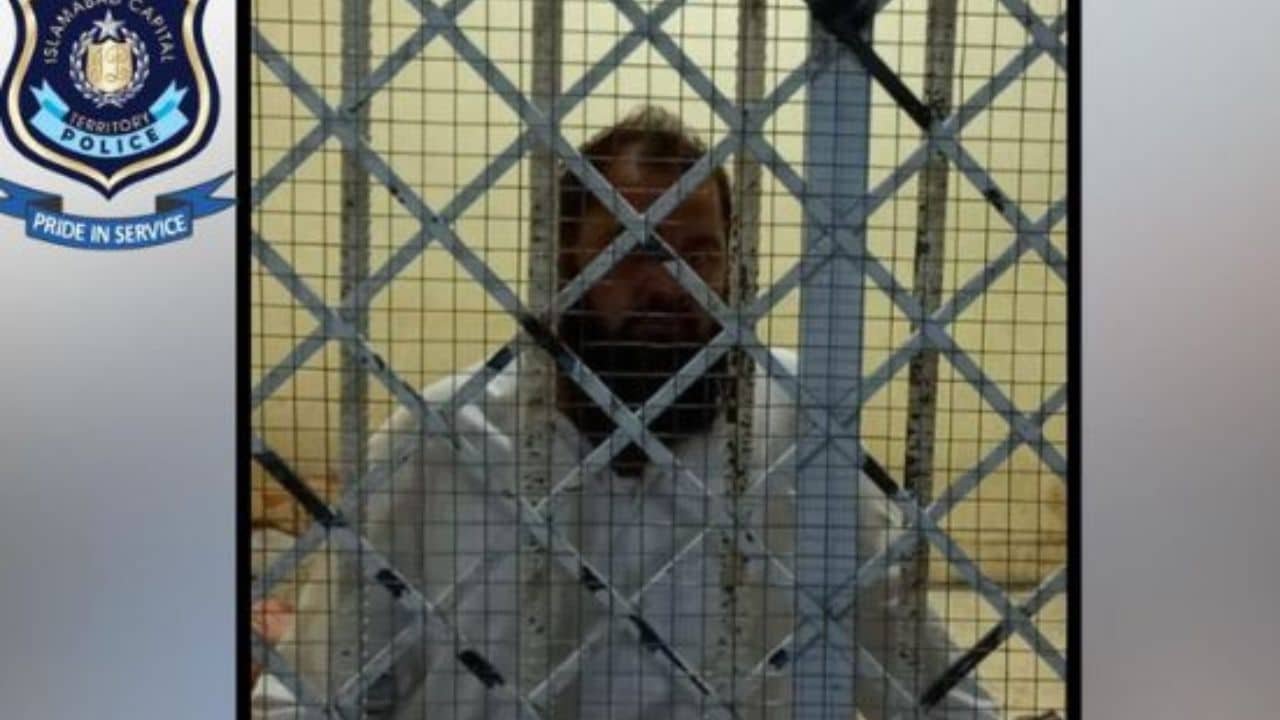
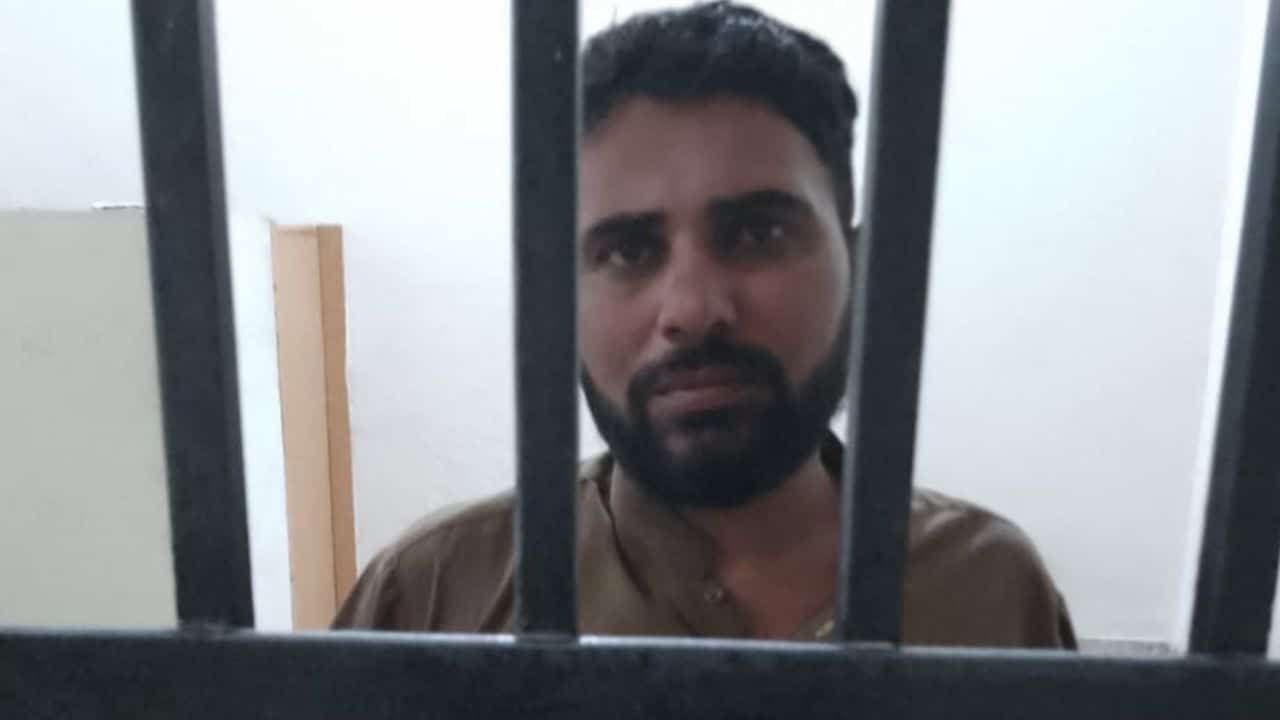
A new United Nations report highlights an increase in the terrorism threat in Pakistan.
According to the report, Pakistan faces threats from Fitnah-ul-Khawarij (TTP) and other militants who have sought refuge in Afghanistan, with Fitnah-ul-Khawarij (TTP) intensifying its attacks in Pakistan.
The UN report also raises concerns about Fitnah Al-Khawarij (TTP) potentially increasing cooperation with Taliban and Al-Qaeda.
In 2024, Pakistan has witnessed an increase in terrorism. The South Asia Terrorism Portal reveals 300 terrorism-related deaths so far this year.
During the first six months of this year alone, dozens of Pakistani security personnel have been killed in militant attacks and counterterrorism operations.
The World Health Organization’s top decision-making body voted Friday to grant Palestinians additional rights, echoing a similar decision in May by the United Nations General Assembly.
Countries gathered for this week’s World Health Assembly, the annual gathering in Geneva of the WHO’s 194 member states, overwhelmingly approved a draft resolution on “aligning the participation of Palestine” in the WHO with its participation in the United Nations.
A full 101 of the 177 countries with voting rights backed the text, with five opposed.
The resolution, presented by a group of mainly Arab and Muslim countries along with China, Nicaragua and Venezuela, called for the Palestinians, which already have observer status at the WHO, to be granted virtually all the same rights as full members.
The vote came after UN members voted in New York in May to grant Palestinians more rights in the global body, after their drive for full membership was blocked by the United States.
At the WHA in Geneva, Palestinian officials and their backers did not attempt to ask for full membership.
Several diplomatic sources suggested that was due to concern that a vote for Palestinian membership would trigger an automatic suspension of US funding to the WHO.
The text approved Friday instead handed the Palestinians, among other things, “the right to be seated among member states… the right to submit proposals and amendments… (and) to be elected as officers in the plenary and the main committees of the Health Assembly”.
But it noted that “Palestine, in its capacity as an observer state, does not have the right to vote in the Health Assembly or to put forward its candidature to WHO’s organs”.
Israeli genocide against Palestinians has killed at least 36,224 people in Gaza, mostly civilians, according to the territory’s health ministry.
Pakistan is projected to experience a real GDP growth rate of 2 per cent in 2024, with a slight increase to 2.3 per cent expected in 2025, according to a United Nations economic survey.
The survey, titled ‘Economic and Social Survey of Asia and the Pacific 2024: Boosting Affordable and Longer-term Financing for Governments,’ released on Thursday, also forecasts a decrease in the inflation rate from 26 per cent to 12.2 per cent in the same period.
The report highlights the challenges faced by Pakistan’s economy in 2023, citing political unrest and a significant flood that disrupted agricultural production.
To address fiscal pressures, Pakistan, along with Sri Lanka, sought external assistance from the International Monetary Fund (IMF), with additional support from bilateral partners such as China, Saudi Arabia, and the United Arab Emirates.
Both countries are implementing fiscal adjustments, including debt restructuring in Sri Lanka and subsidy removal in Pakistan’s power sector.
Despite moderate tax gaps in Bangladesh, Pakistan, and Sri Lanka, the report suggests that improving tax policies and administration alone may not suffice to bridge development financing gaps, emphasising the need for broader improvements in socioeconomic development and public governance.
The macroeconomic conditions in the developing Asia-Pacific region remain challenging, with a disparity in economic growth among different economies.
While some larger economies experienced a rebound in economic growth, others saw only moderate growth in 2023. Pakistan’s GDP growth rate for the second quarter of fiscal year 2023–24 stood at a modest 1 per cent, below earlier projections ranging from 2–3 per cent.
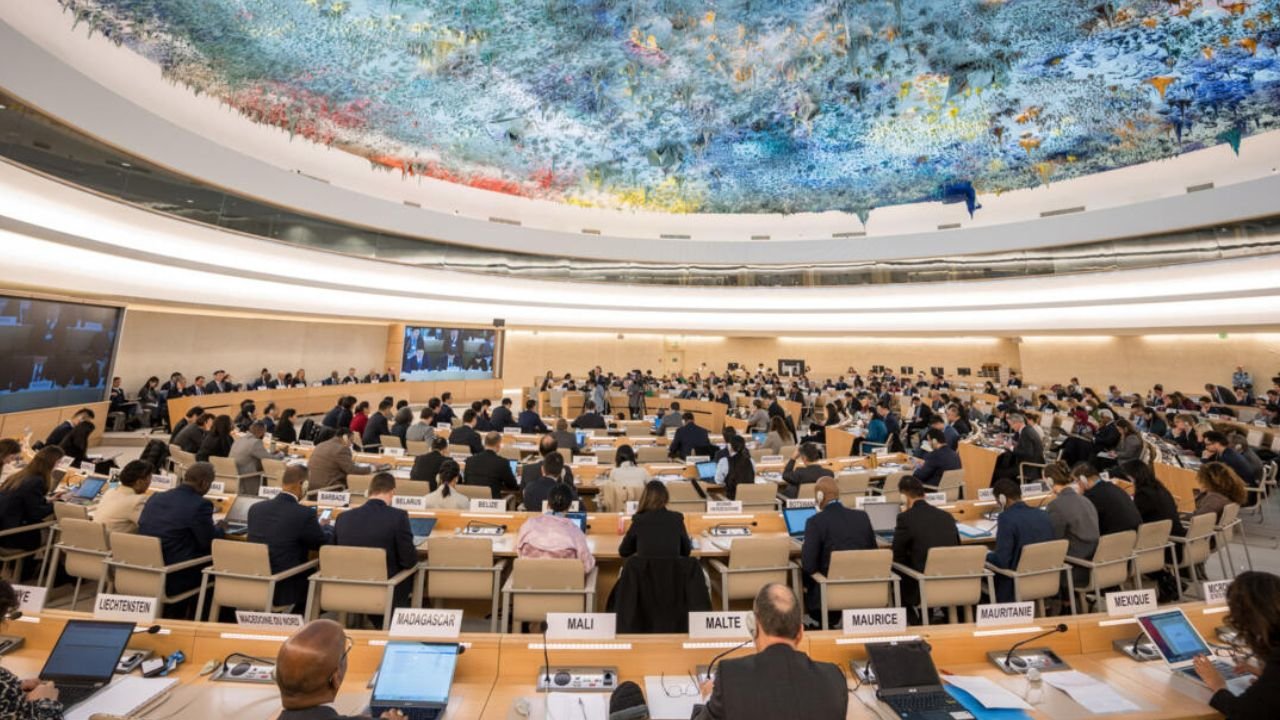
The UN Human Rights Council was on Friday debating whether to demand a halt in arms sales to Israel, whose genocide in Gaza has killed more than 33,000 people.
If the text is adopted, it would mark the first time that the United Nations’ top rights body has taken a position on the bloodiest-ever genocide to beset the besieged Palestinian territory.
The draft text calls on countries to “cease the sale, transfer and diversion of arms, munitions and other military equipment to Israel”.
This, it said, is needed among other things “to prevent further violations of international humanitarian law and violations and abuses of human rights”.
It stresses that the International Court of Justice ruled in January “that there is a plausible risk of genocide” in Gaza.
Friday’s draft resolution, which was brought forward by Pakistan on behalf of all Organisation of Islamic Cooperation (OIC) member states except Albania, calls for “an immediate ceasefire” and “for immediate emergency humanitarian access and assistance”.
It comes after the UN Security Council in New York last week also finally passed a resolution calling for a ceasefire — thanks to an abstention from Washington, Israel’s closest ally and largest arms supplier.
However, the ceasefire demand has had no impact on the ground.
Palestinian militants also took more than 250 hostages on October 7, and 130 remain in Gaza, including 34 who the army says are dead.
Israel’s retaliatory campaign has killed at least 33,037 people, mostly women and children, according to the health ministry in Gaza.
The rights council draft resolution does not name Hamas but it does condemn the firing of rockets at Israeli civilian areas and demands “the immediate release of all remaining hostages”.
The strongly worded text repeatedly names Israel, stressing it is “the occupying Power”.
It demands that Israel end its occupation of all Palestinian territories and “immediately lift its blockade on the Gaza Strip and all other forms of collective punishment”.
The text, which was revised late on Thursday removing several references to genocide, continues to express “grave concern at statements by Israeli officials amounting to incitement to genocide”.
And it urges countries to “prevent the continued forcible transfer of Palestinians within and from Gaza”.
It warns in particular “against any large-scale military operations in the city of Rafah” in the south of the densely populated Gaza Strip, where well over one million civilians are sheltering, warning of “devastating humanitarian consequences”.
The draft resolution also condemns “the use of starvation of civilians as a method of warfare in Gaza”, where the UN has warned that famine is looming.
And it slammed “the unlawful denial of humanitarian access, wilful impediment to relief supplies and deprivation of objects indispensable to the survival of civilians, including food, water, electricity, fuel and telecommunications, by Israel”.
The text also condemns Israel’s “use of explosive weapons with wide area effects by Israel in populated areas in Gaza”.
Friday’s draft resolution deplores the fact that Israel has persistently refused to cooperate with numerous investigations ordered by the UN rights council.
And it insists on the “imperative of credible, timely and comprehensive accountability for all violations of international law” in Gaza.
It calls on the Commission of Inquiry on the rights situation in the occupied Palestinian territories — the highest-level UN investigation launched prior to October 7 — to probe all “direct and indirect transfer or sale of arms, munitions, parts, components and dual use items to Israel, the occupying Power”.
The team, it said, should identify the weapons used since October 7 and “analyse the legal consequences of these transfers”.
The investigators should present their findings to the council at its 59th session, which will be held in mid-2025, it said.
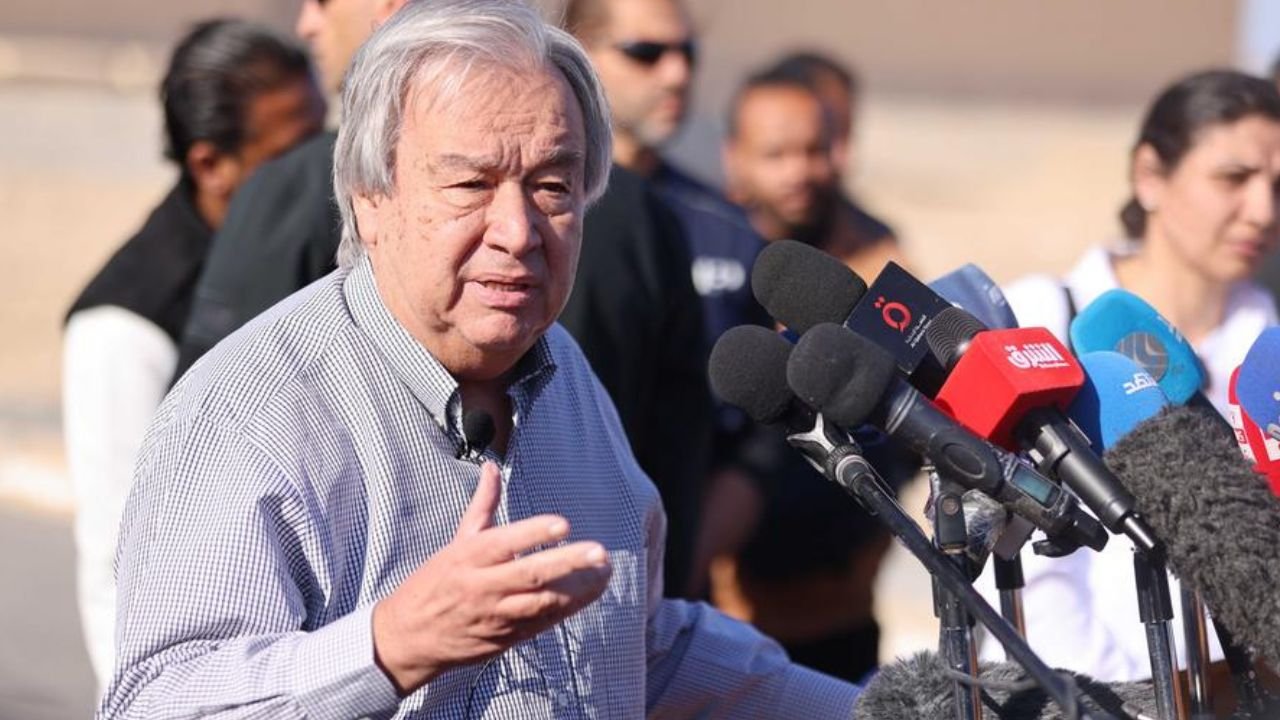
UN chief Antonio Guterres, on a visit to the doorstep of Gaza, on Saturday said the world has seen enough of the war’s horrors and appealed for a ceasefire to allow in more aid.
‘Palestinians in Gaza—children, women, men—remain stuck in a non-stop nightmare,’ he said on the Egyptian side of the Rafah crossing where truckloads of aid trickle into Gaza but the population is stalked by ‘hunger and starvation’.
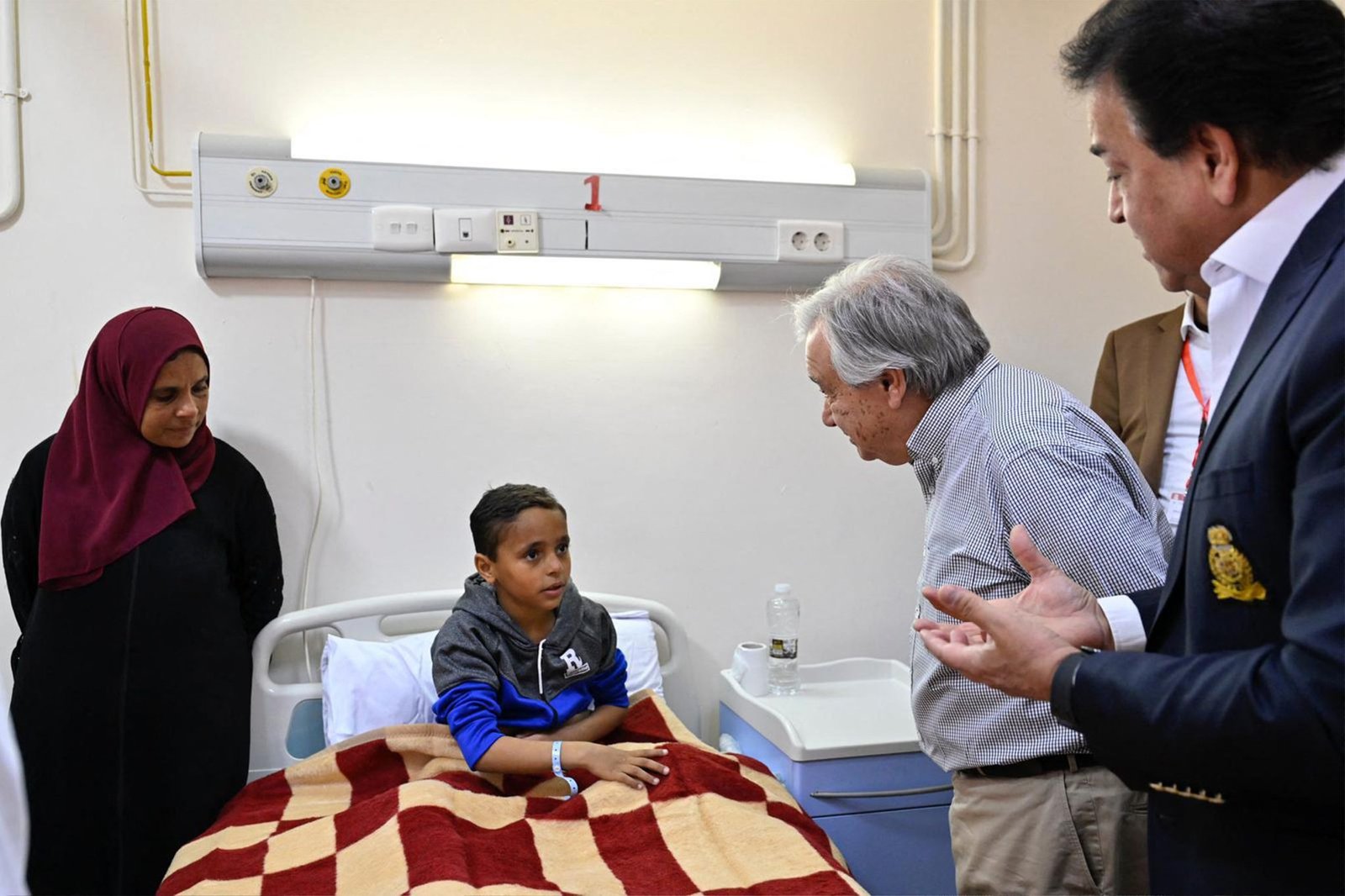
This handout pictured released by the United Nations press office shows UN Secretary-General Antonio Guterres meeting with a Palestinian child evacuated from the Gaza Strip receiving treatment at the general hospital in El-Arish in Egypt’s northeastern North Sinai province on March 23, 2024, amid the ongoing conflict in the Palestinian territory between Israel and the militant group Hamas. (Photo by Mark GARTEN / UNITED NATIONS / AFP) / RESTRICTED TO EDITORIAL USE – MANDATORY CREDIT “AFP PHOTO / UNITED NATIONS – MARK GARTEN” – NO MARKETING NO ADVERTISING CAMPAIGNS – DISTRIBUTED AS A SERVICE TO CLIENTS – RESTRICTED TO EDITORIAL USE – MANDATORY CREDIT “AFP PHOTO / UNITED NATIONS – Mark Garten” – NO MARKETING NO ADVERTISING CAMPAIGNS – DISTRIBUTED AS A SERVICE TO CLIENTS /
‘I carry the voices of the vast majority of the world who have seen enough,’ Guterres said, deploring ‘communities obliterated, homes demolished, entire families and generations wiped out’.
He reiterated that ‘nothing justifies the horrific attacks by Hamas’ against Israel, triggering the war on October 7.
‘And nothing justifies the collective punishment of the Palestinian people,’ the United Nations secretary-general said.
Guterres, speaking at a lectern in front of the imposing gates to the Gaza side of Rafah, through which aid trucks pass, said the ‘heartbreak and heartlessness of it all’ were clear.
‘A long line of blocked relief trucks on one side of the gates. The long shadow of starvation on the other,’ which he called ‘a moral outrage.’
Guterres emphasised ‘it is more than time for an immediate humanitarian ceasefire’ and appealed to Israel for ‘total, unfettered access for humanitarian goods throughout Gaza.’
The UN chief, who makes an annual ‘solidarity mission’ to distressed Muslim communities during their holy fasting month, said that ‘in the Ramadan spirit of compassion, it is also time for the immediate release of all hostages’ captured in the October attacks and still held by militants in Gaza.
Response from Israel
Israel’s foreign minister said Saturday the United Nations had become an ‘anti-Israeli body’ under Antonio Guterres, after the UN chief called for a ceasefire on a visit to Gaza’s border.
International outrage over the heavy civilian toll and humanitarian crisis in Gaza has further worsened the long strained ties between Israel and the world body.
‘Under his (Guterres’s) leadership, the UN has become an anti-Semitic and anti-Israeli body that shelters and emboldens terror,’ Foreign Minister Israel Katz said on social media platform X.
The top Israeli diplomat criticised Guterres, who Katz said ‘stood today on the Egyptian side of the Rafah crossing and blamed Israel for the humanitarian situation in Gaza’, claiming instead that Hamas militants ‘plunder’ aid.
Katz, whose government has accused staff at the UN agency for Palestinian refugees of involvement in Hamas’s October 7 attack that triggered the war, also said Guterres spoke ‘without calling for the immediate, unconditional release of all Israeli hostages’.
Vote at Security Council
Meanwhile, a vote at the UN Security Council on a new text calling for an ‘immediate’ ceasefire in the Israel-Hamas war was postponed to Monday, diplomatic sources told AFP, after a separate, US-lead draft resolution was vetoed.
The United States, Israel’s main ally and military backer, had put forward a resolution mentioning ‘the imperative of an immediate and sustained ceasefire’ and condemning the October 7 attack by Hamas.
Russia and China on Friday vetoed that resolution, which was also opposed by Arab states for stopping short of explicitly demanding Israel immediately end its campaign in Gaza.
The new ceasefire text was meant to go to a vote on Saturday, but was pushed back to allow further discussions, the diplomatic sources said.
The new, tougher draft resolution, seen by AFP, ‘demands an immediate ceasefire’ for the ongoing Muslim holy month of Ramadan that leads ‘to a permanent sustainable ceasefire’ respected by all sides.
Eight of the council’s 10 non-permanent members have been working on the draft, which also calls for the ‘immediate and unconditional’ release of hostages seized by Hamas and the lifting of ‘all barriers’ to humanitarian aid flowing into the besieged Gaza Strip.
‘We as (the) Arab Group unanimously endorse and support the draft resolution,’ said Palestinian ambassador to the UN Riyad Mansour, who had denounced the US-led text as biased.
But US Ambassador Linda Thomas-Greenfield indicated opposition, saying the resolution would jeopardize ongoing diplomatic efforts to secure the release of hostages—the same reason the United States gave before vetoing previous ceasefire resolutions.
‘In its current form, that text fails to support sensitive diplomacy in the region. Worse, it could actually give Hamas an excuse to walk away from the deal on the table,’ she said.
Friday’s text did not explicitly use the word ‘call,’ but simply stated that a ceasefire was imperative, and linked to ongoing talks, led by Qatar with support from the United States and Egypt, to halt fighting in return for Hamas releasing hostages.
‘If the US is serious about a ceasefire, then please vote in favor of the other draft resolution, clearly calling for a ceasefire,’ China’s representative, Zhang Jun, said.
The United Nations has said that heavy fighting has “encircled” two hospitals in Khan Younis – Nasser and Al-Amal – leaving thousands of “terrified staff, patients and displaced people trapped inside”.
The World Health Organization (WHO) has said that seven out of 24 hospitals are “partially functioning” in northern Gaza and suffering a shortage of personnel and supplies.
Journalist Bisan shared a recent post detailing an attack on the Khan Yones camp by the Israeli occupation forces. Consequently, the last functioning hospital in Gaza- Al Nasser Medical Hospital- was under attack as well. Videos of gunfire surfaced on various social media platforms as well.
According to the WHO, only 15 of Gaza’s 36 hospitals are partially functional – nine in the south and six in the north. The hospitals in the south are operating at three times their capacity while facing critical shortages of basic supplies and fuel.
The facilities are “without enough specialized medical staff to manage the volume and range of injuries, nor sufficient medicines and medical supplies, fuel, clean water, or food for patients or staff”, the WHO said in a statement.
The Ministry of Health in Gaza says occupancy rates are reaching 206 percent in inpatient departments and 250 percent in intensive care units.
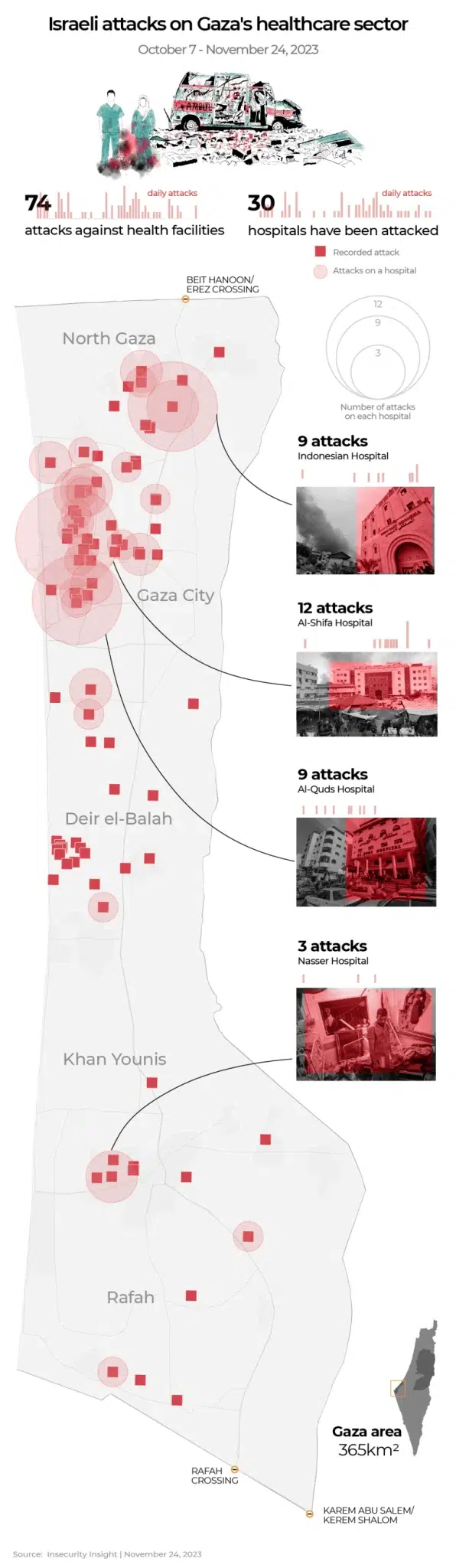
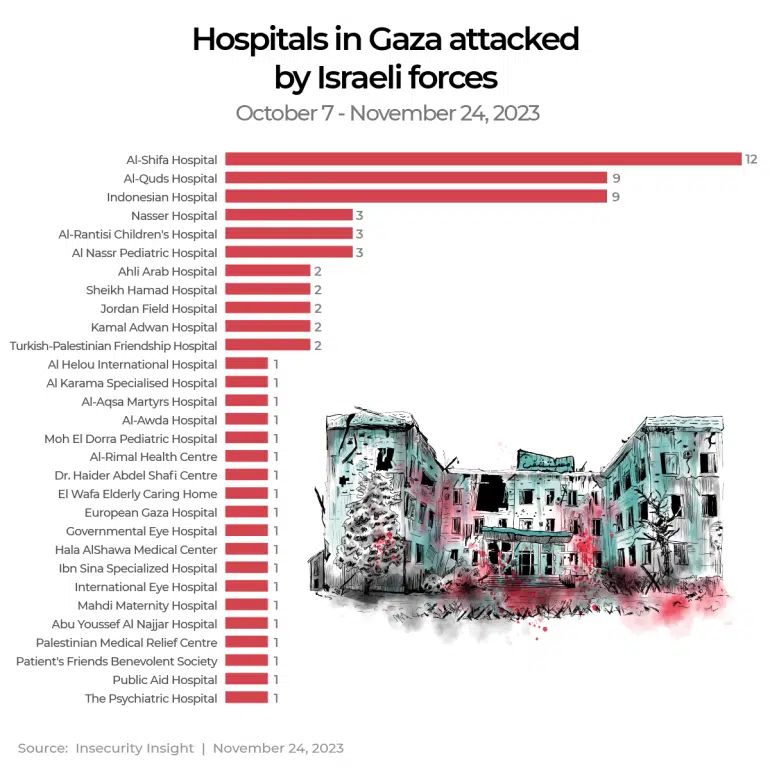
From October 7 to November 24, there were 74 Israeli assaults on health facilities with 30 hospitals attacked in Gaza, according to Insecurity Insight, a humanitarian association that collates data on threats facing people in dangerous environments. It delivered 19,000 litres (5,000 gallons) of fuel to al-Shifa Hospital on Tuesday after facing delays at a checkpoint and on damaged roads.
The hospitals that have been attacked most often include:
1. al-Shifa Hospital – attacked 12 times 2. al-Quds Hospital – attacked nine times 3. Indonesian Hospital – attacked nine times 4. Nasser Hospital – attacked three times
Insecurity Insight documented at least 26 other hospitals from across the Gaza Strip that were attacked by Israeli forces over the same period.
How Gaza’s healthcare system has been destroyed?
Mohamed S Ziara, a Palestinian doctor, talked to Al Jazeera and explained in a tone that is soft and unaffected by the rumbling explosions and pop of gunfire that can be heard in the background.
He is a plastic surgeon working 12- to 14-hour shifts, six days a week at the European Gaza Hospital (EGH) in Khan Younis, where he treats up to 15 cases a day. Ziara describes the healthcare situation as “catastrophic”.
“It doesn’t match anything I’ve seen before, even with previous escalations and war,” says Ziara, who has worked during Israel’s assaults on Gaza since 2014.
He has been posting about Israeli attacks near the EGH and the conditions inside on his Instagram account.
“No doctor wakes up in the morning and says: ‘I’m going to amputate a child’s leg without anesthesia.’”
“You don’t want to watch children suffer,” Dr Amber Alayyan with Doctors Without Borders, known by its French initials MSF, told Al Jazeera.
Chronically ill patients
In addition to immediate injuries from Israeli air strikes and artillery, patients with prior and long-term illnesses and vulnerable health conditions are faced with not being treated. According to WHO, they include:
1,100 patients in need of kidney dialysis
71,000 patients living with diabetes
225,000 patients with high blood pressure requiring medication
485,000 people with mental health disorders
cancer patients, 2,000 of whom are diagnosed each year, including 122 children
On January 7, exactly three months into the war on Gaza, WHO Director-General Tedros Adhanom Ghebreyesus said: “It is inconceivable that this most essential need – the protection of healthcare – is not assured.”
The United Nations migration agency launched its first global annual appeal on Monday, requesting nearly $8 billion for this year alone to manage the growing scale of population displacement.
The International Organization for Migration said it was seeking a total of $7.9 billion in 2024 to “save lives and protect people on the move, drive solutions to displacement, and facilitate safe pathways for regular migration”.
“Irregular and forced migration have reached unprecedented levels and the challenges we face are increasingly complex,” IOM chief Amy Pope said in a statement.
“The evidence is overwhelming that migration, when well-managed, is a major contributor to global prosperity and progress,” said Pope, who last October became the first woman to lead the organisation.
“We are at a critical moment in time, and we have designed this appeal to help deliver on that promise,” she said.
“We can and must do better.”
IOM was founded more than 70 years ago, but only became a UN agency in 2016 as a smaller, parallel operation to the UNHCR, which focuses on refugees.
It works in emergency situations, advocates for migrants’ rights, and sees humane and orderly migration as a benefit to people on the move and the societies they settle in.
The agency said Monday that full funding of its appeal would allow it to serve almost 140 million people, including internally displaced people and the local communities that host them.
It would also help IOM to expand its development work, aimed at helping prevent further displacement, it said.
Breaking down the appeal, it said a full $3.4 billion of the requested funds would go towards saving lives and protecting those on the move.
Another $2.7 would be used to work on solutions to displacement, including reducing the risks and impacts of climate change.
The remainder would help facilitate regular pathways to migration and to help make IOM’s service delivery more effective.
“This funding will address the large and widening gap between what we have, and what we need in order to do the job right,” Pope said.
IOM said that its Missing Migrants Project showed that more than 60,000 people had died or disappeared during perilous migration journeys over the past nine years.
“The consequences of underfunded, piecemeal assistance come at a greater cost, not just in terms of money but in greater danger to migrants through irregular migration, trafficking and smuggling,” it warned.
Like a number of other UN agencies, IOM is calling for funds to be able to take a more longterm, preventative approach, instead of being forced to always respond in crisis mode.
The agency said that properly funding its operations would help it streamline and optimise its response, and would effectively reduce the cost of crisis management.
It also urged countries to recognise the benefits of migration.
“Migration is a cornerstone of global development and prosperity,” it said, adding that “the 281 million international migrants generate 9.4 percent of global GDP”.
“Well-managed migration has the potential to advance development outcomes, contribute to climate change adaptation, and promote a safer and more peaceful, sustainable, prosperous and equitable future.”
Geneva, Switzerland – The United Nations said Monday that it needed $46.4 billion next year to bring life-saving help to around 180 million people in desperate circumstances around the world.
The UN said the global humanitarian outlook for 2024 was “bleak”, with conflicts, climate emergencies and collapsing economies “wreaking havoc” on the most vulnerable.
While global attention focuses on the conflict raging in the Gaza Strip, the UN said the wider Middle East, Sudan and Afghanistan were among the hotspots that also needed major international aid operations.
But the size of the annual appeal and the number of people it aims to reach were scaled back compared to 2023, following a decrease in donations.
“Humanitarians are saving lives, fighting hunger, protecting children, pushing back epidemics, and providing shelter and sanitation in many of the world’s most inhumane contexts,” UN aid chief Martin Griffiths said in a statement.
“But the necessary support from the international community is not keeping pace with the needs,” he said.
The 2023 appeal was for $56.7 billion but received just 35 percent of that amount, one of the worst funding shortfall in years. It allowed UN agencies to deliver assistance and protection to 128 million people.
With a few weeks left to go, 2023 is likely to be the first year since 2010 when humanitarian donations declined compared to the previous year.
The UN therefore scaled down its appeal to $46.4 billion this time around, and will focus on those in the gravest need.
72 countries
Launching the 2024 Global Humanitarian Overview, Griffiths said the sum was nonetheless a “massive ask” and would be tough to raise, with many donor countries facing their own cost of living crises.
“Without adequate funding, we cannot provide life-saving assistance. And if we cannot provide that assistance, people will pay with their lives,” he said.
The appeal covers aid for 72 countries: 26 states in crisis and 46 neighbouring nations dealing with the knock-on effects, such as an influx of refugees.
The five largest single-country appeals are for Syria ($4.4 billion), Ukraine ($3.1 billion), Afghanistan ($3 billion), Ethiopia ($2.9 billion) and Yemen ($2.8 billion).
Griffiths said there would be 300 million people in need around the world next year — a figure down from 363 million last year.
But the UN aims to reach only 180.5 million of those, with NGOs and aid agencies targeting the remainder — not to mention front-line countries and communities themselves who provide the first help.
Climate impact
The Middle East and North Africa require $13.9 billion, the largest total for any region in 2024.
Beyond Syria, the Palestinian territories and Yemen, Griffiths also pointed to Sudan and its neighbours, and to Ukraine, Afghanistan, Venezuela and Myanmar as hotspots that needed sustained global attention.
Ukraine is going through a “desperate winter” with the prospect of more warfare on the other side, he said.
With the Gaza war between Israel and Hamas, plus Russia’s war in Ukraine, Griffiths said it was hard for the Sudan crisis to get the attention it deserved in foreign capitals.
More broadly, Griffiths said climate change would increasingly impact the work of humanitarian aid workers, who would have to learn how to better use climate data to focus aid resources.
“There is no doubt about the climate confronting and competing with conflict as the driver of need,” he said.
“Climate displaces more children now than conflict. It was never thus before,” he said.
The UN Secretary-General Antonio Guterres has invoked Article 99 of the UN Charter, calling on the Security Council to declare a ceasefire to put a stop to Israeli atrocities committed in Gaza.
Invoking Article 99 is one of the few powers that the Charter gives the UN Secretary-General.
In a letter written to the council’s president, Guterres cites the responsibility of the 15-member Security Council that has the obligation to maintain international peace and security, stating that the situation in Gaza and Israel “may aggravate existing threats to the maintenance of international peace and security.”
He added that the humanitarian crisis in Gaza can have “potentially irreversible implications for Palestinians as a whole and for peace and security in the region.”
I’ve just invoked Art.99 of the UN Charter – for the 1st time in my tenure as Secretary-General.
Facing a severe risk of collapse of the humanitarian system in Gaza, I urge the Council to help avert a humanitarian catastrophe & appeal for a humanitarian ceasefire to be declared. pic.twitter.com/pA0eRXZnFJ
UN Spokesperson Stéphane Dujarric explained that the move has been taken “given the scale of the loss of human life in Gaza and Israel, in such a short amount of time.”
He described the use of Article 99 as a “dramatic constitutional move” made by Guterres in the hope that it would put more pressure on the Council – and the international community at large – to demand a ceasefire between the warring parties.
“I think it’s arguably the most important invocation”, Dujarric told reporters at UN Headquarters, “in my opinion, the most powerful tool that he [the Secretary-General] has.”
Singer The Weeknd has made international headlines after his XO Humanitarian Fund is sending $2.5 million to Gaza to provide four million meals for civilians. Israel is again bombing the vulnerable population where already more than 15,000 civilians have died. Currently, the death toll after the ending of truce is 160 Palestinians.
The artist, whose real name is Abel Tesfaya, stepped into the role of the Goodwill Ambassador in 2021 in October 2021, and set up the XO Humanitarian Fund with the United Nations World Food Program.
“WFP is working round the clock to provide aid in Gaza but a major scale up is needed to address the desperate level of hunger we are seeing,” said UN WFP’s director for the Middle East, North Africa and Eastern European Region, Corinne Fleischer. “Our teams need safe and sustained humanitarian access, and continued support from donors to reach as many people as we can. We thank Abel for this valuable contribution towards the people of Palestine. We hope others will follow Abel’s example and support our efforts.”
On November 23, Tunasian Egyptian actress Hend Sabri announced on her Instagram account that she was resigning from her role as Goodwill Ambassador from the UN World Food Program because of the organisation’s inability to condemn the ongoing genocide of Gaza.
“Over the past weeks, I have witnessed and shared the experiences of my dedicated WFP colleagues. Their frustration at being unable to do what they do best towards children, mothers, fathers and grandparents in Gaza. They could only do so much in the face of a grinding war machine that would not stop and would not spare civilians the agony and anguish as war encircles them.”
“I had faith,” the actress wrote to her 3.3 million followers, “that WFP – which was named Nobel Peace Prize Laureate only three years ago after championing UN resolution 2417, against using hunger and starvation as a weapon of war – would use its voice forcefully as it had done in multiple emergencies and human crises. However, hunger and starvation have been used as weapons of war for over the past 46 days against more than 2 million civilians in Gaza.”