Tag: United Nations

  • ‘Go where Muslims are in minority if you want more kids,’ Abdul Qadir Patel on population control

    ‘Go where Muslims are in minority if you want more kids,’ Abdul Qadir Patel on population control

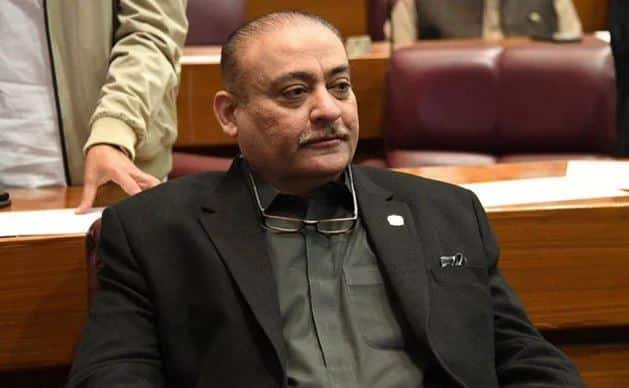
    Federal Minister for Health Abdul Qadir Patel on Monday presented a unique suggestion to control the population of Pakistan. The health minister said that if couples want to have more children, then they should go to another country where Muslims are in a minority so that the Muslim population can also increase around the world.

    Patel said that by 2030, Pakistan’s population is expected to cross 285 million. He said it is an “alarming situation”.

    “We do not want to decrease the Muslim population. We want Muslims to be better, more educated and provide them with better healthcare facilities.”

    Qadir Patel said that he has suggested to people to go have children in countries where the Muslim population is in a minority. “We are a lot in numbers here masha’Allah.”

    The federal minister emphasised that in order to control the growing population, there needs to be more awareness about family planning.

    Qadir Patel made the remarks while addressing a seminar in Islamabad.

    The world’s population could grow to around 8.5 billion in 2030 and 9.7 billion in 2050. According to a United Nations (UN) report, Pakistan is among eight countries where the projected increase of population is expected to be concentrated in 2050.

  • India to become the most populous country in 2023

    India to become the most populous country in 2023

    India will become the world’s most populous country next year i.e 2023, beating China, according to a United Nations (UN) report. Currently, India’s population stands at 1.412 billion, compared to China’s 1.426 billion.

    The findings were released by the UN on July 11 to mark World Population Day.

    The latest projections also suggest the world population is expected to reach eight billion by mid-November 2022, 8.5 billion in 2030 and 9.7 billion in 2050, 10.4 billion people during the 2080s and to remain at that level until 2100.

    India is also among eight countries where the population is expected to be concentrated in 2050. The other seven countries are Congo, Egypt, Ethiopia, India, Nigeria, Pakistan, the Philippines and Tanzania.

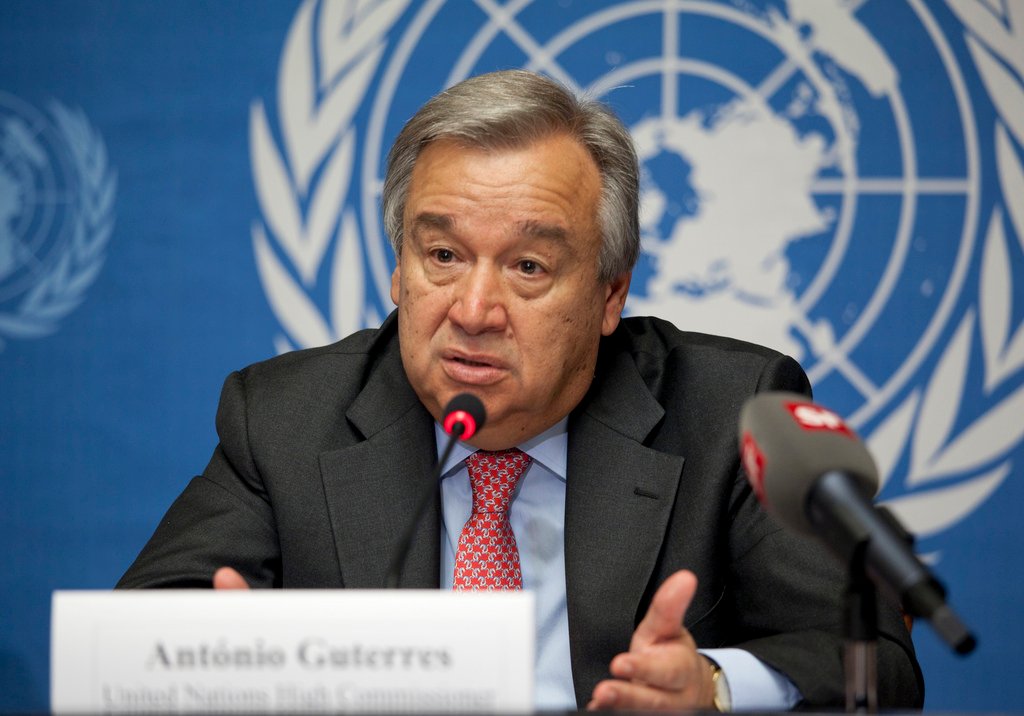
    UN Secretary-General António Guterres said, “This year’s World Population Day (July 11) falls during a milestone year when we anticipate the birth of the Earth’s eight billionth inhabitant. This is an occasion to celebrate our diversity, recognise our common humanity, and marvel at advancements in health that have extended lifespans and dramatically reduced maternal and child mortality rates.”

    In a tweet, he added, “On ensuring our world can support our needs and those of future generations. On protecting human rights and the ability of all individuals to make informed choices about whether and when to have children.”

  • Bilawal urges UN to create task force to tackle disinformation

    Bilawal urges UN to create task force to tackle disinformation

    Bilawal urges UN to create task force to tackle disinformation

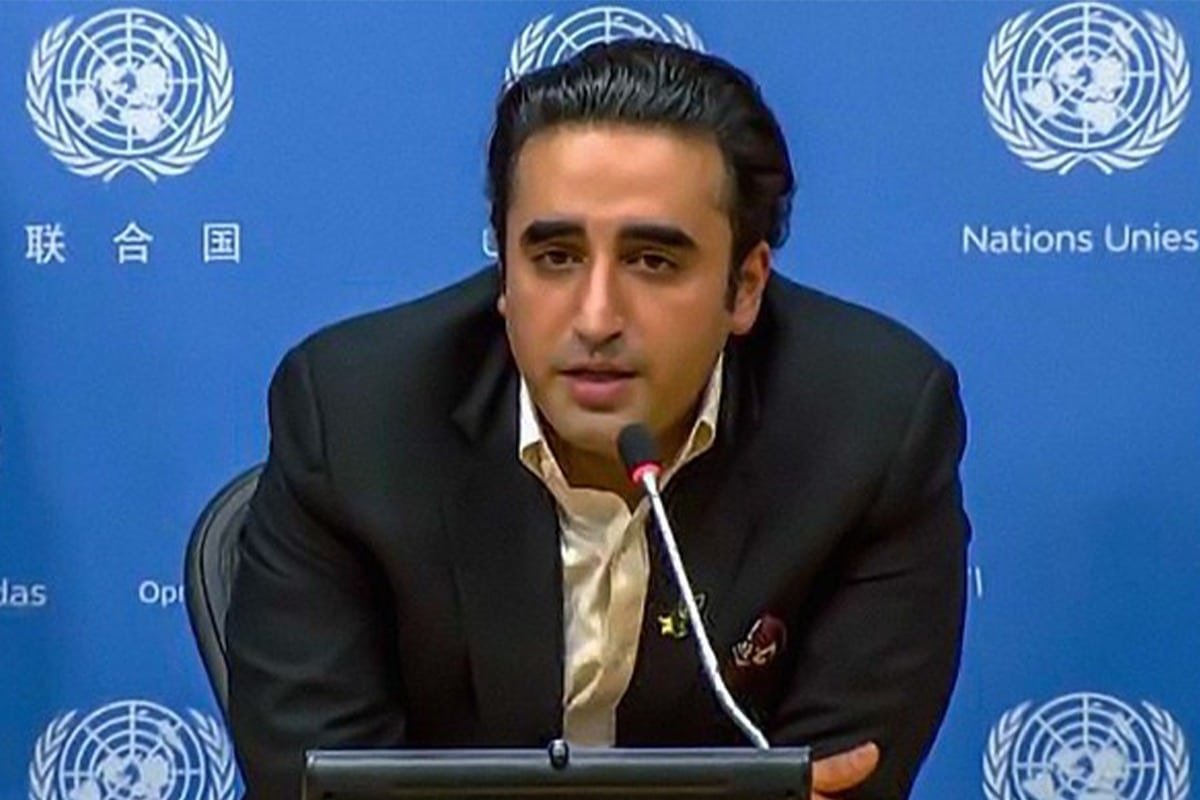
    Foreign Minister (FM) Bilawal Bhutto-Zardari in his virtual address to the Group of Friends on Countering Disinformation urged that a United Nations (UN) backed task force be set up to counter disinformation.

    “We should agree on an international plan to counter disinformation online and offline, in the public and private domain,” said Bilawal.

    He urged that the UN department of information set an international standard of guidelines that countries can follow to tackle disinformation.

    FM Bhutto put forth some of his own suggestions on how disinformation can be dealt with ranging from creating public awareness campaigns about disinformation to increasing the capacity of governments to filter and limit hate speech.

    “Misinformation is the biggest problem of this era,” Bilawal said. “An effective strategy has to be formulated to tackle the issue of disinformation.”

  • ‘Govt backed by establishment took repressive measures against us’: Shireen Mazari writes letter to the UN

    ‘Govt backed by establishment took repressive measures against us’: Shireen Mazari writes letter to the UN

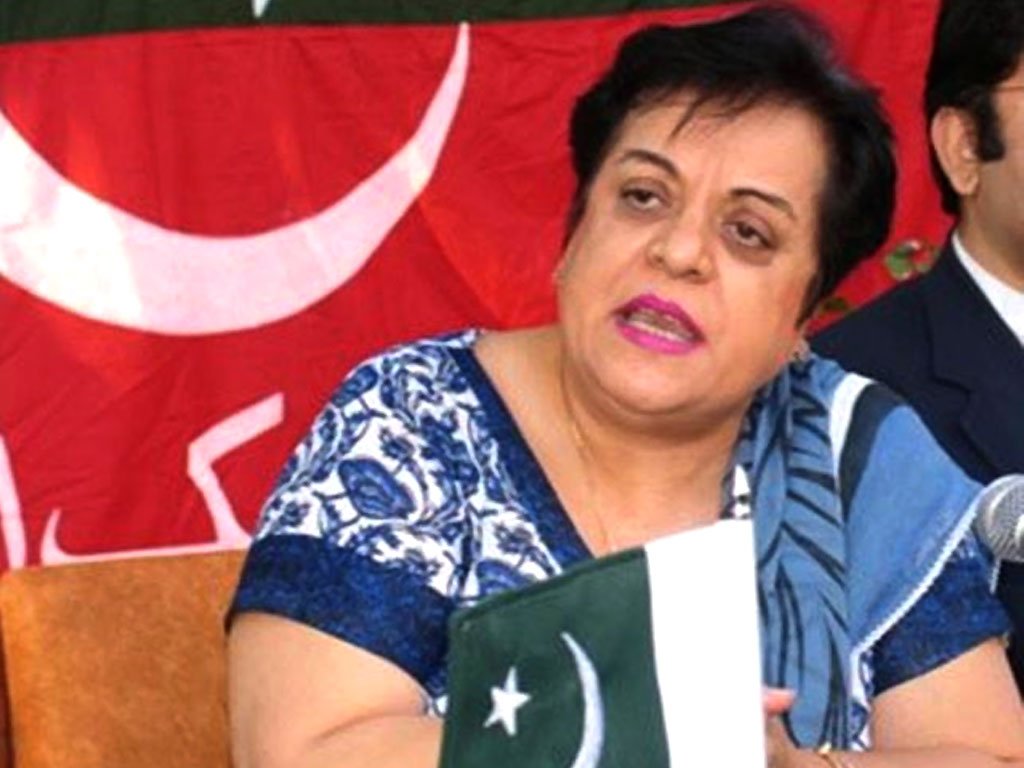
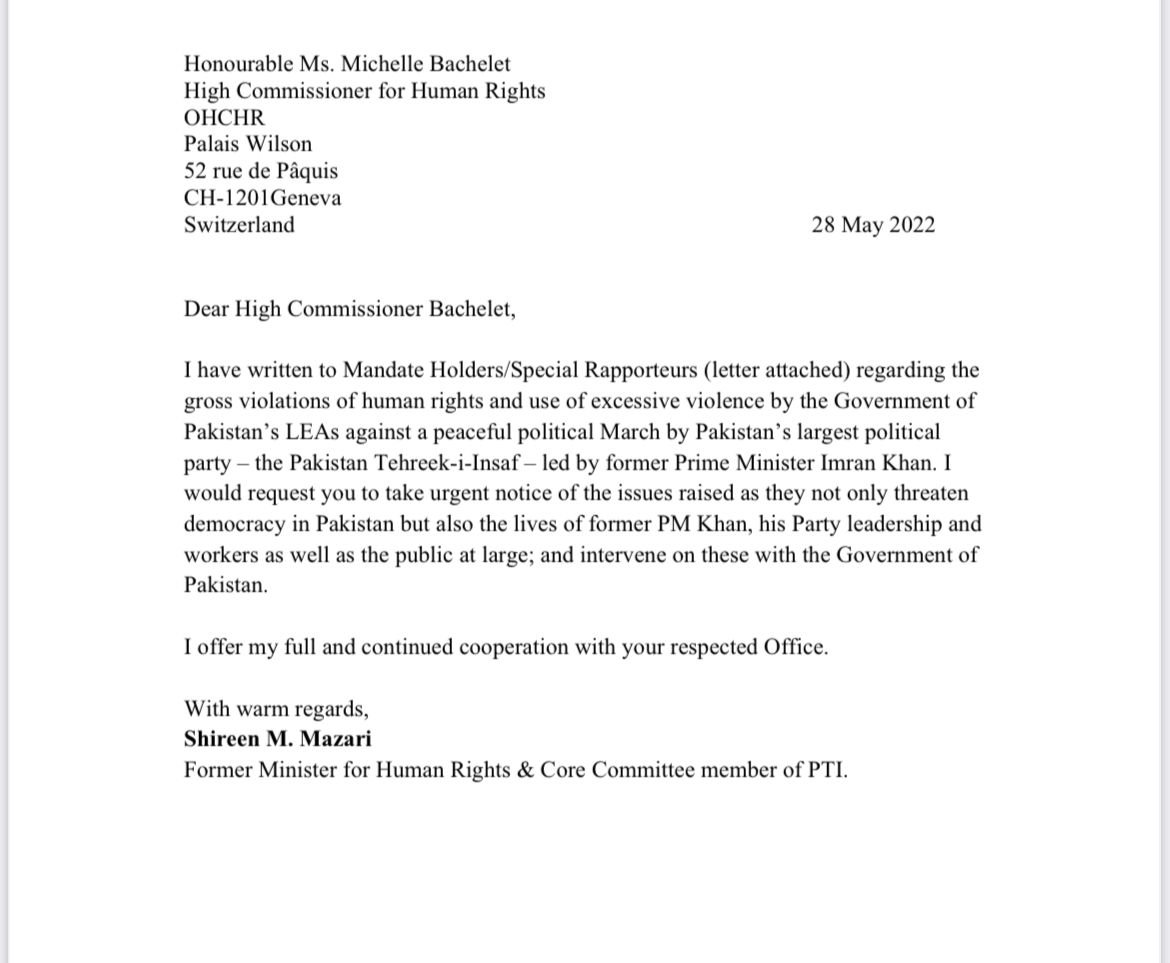
    Former Human Rights Minister Shireen Mazari has written a letter to the United Nations (UN) to hold an “independent and impartial investigation” into the “state excesses and human rights violations” during Pakistan Tehreek-e-Insaf’s (PTI) Azadi March, held on May 25.

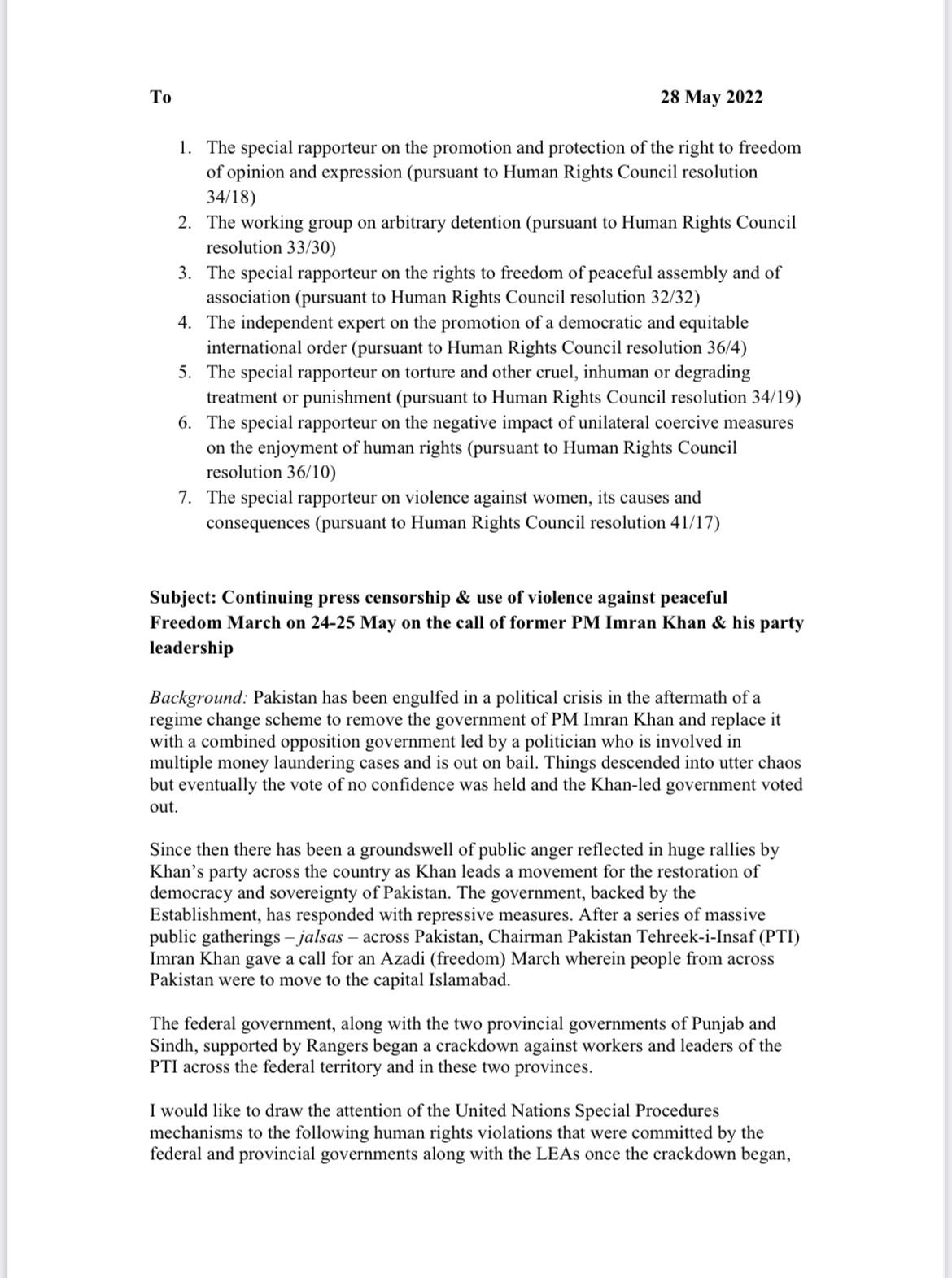
    In the letter, Mazari told the UN officials that Pakistan has been engulfed in a “political crisis” since former Prime Minister (PM) Imran Khan was ousted.

    The letter stated that the government “backed by the establishment” had taken “repressive measures” against the “Azadi March”.

    Mazari has requested the UN officials to “take urgent notice of the issues raised as they not only threatened democracy in Pakistan but also the lives of former Prime Minister Imran Khan, his party leadership…and intervene on these with the government of Pakistan”.

    Demands of PTI in letter

    The PTI in its letter also put forward five demands to the UN:

    Demand an independent and impartial investigation into these state excesses and human rights violations.

    Demand that the government immediately cease harassment of PTI workers and leaders.

    Demand the release of all political workers and cease lodging politically-motivated FIRs against workers and leaders of the PTI.

    Stop media censorship, which is in violation of basic democratic norms and of the ICCPR to which Pakistan is a party.

    Stop denying the right to peaceful protest through repressive measures and blocking access to protest sites.

  • UN lists Pakistan among 23 drought-hit countries

    UN lists Pakistan among 23 drought-hit countries

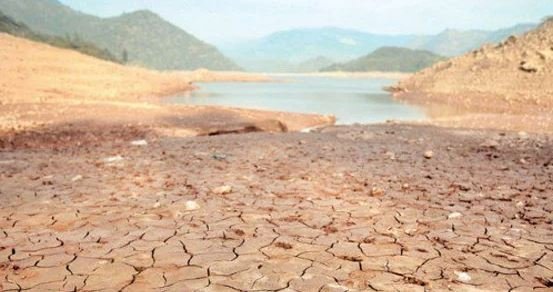
    According to the United Nations ‘Global Land Outlook’ report, Pakistan is one of 23 nations that have experienced drought in the last two years (2020-2022).

    The report, released by the United Nations Convention to Combat Desertification (UNCCD) ahead of World Drought Day (June 17), lists the highest total number of people affected by drought over the last century.

    The 23 countries listed by the report include Afghanis­tan, Angola, Brazil, Burkina Faso, Chile, Ethiopia, Iran, Iraq, Kazakhstan, Kenya, Lesotho, Mali, Mauritania, Madagascar, Malawi, Moza­m­bique, Niger, Somalia, Sou­th Sudan, Syria, Pakistan, the United States and Zambia.

    The report warns that humanity has never confronted such a diverse range of known and unknown risks and hazards while interacting in a hyper-connected and fast-changing environment.

    By 2050, an additional 4 million square kilometres of natural areas, equivalent to the size of India and Pakistan, would require drought restoration measures, the report said.

    The report warned that up to 40 per cent of the planet’s land is degraded, which affects half of humanity and threatens roughly 50 per cent of the global GDP worth USD 44 trillion.

  • UN chief arrives in Ukraine

    UN chief arrives in Ukraine

    Following talks with Russian President Vladimir Putin in Moscow, UN Secretary-General Antonio Guterres announced his arrival in Kyiv on Wednesday. “I have arrived in Ukraine after visiting Moscow,” he wrote on his official Twitter account as he landed ahead of talks with Ukraine’s President Volodymyr Zelensky.

    “We will continue our work to expand humanitarian support and secure the evacuation of civilians from the conflict zones. The sooner this war ends, the better — for the sake of Ukraine, Russia, and the world – it will be ,” Guterres tweeted.

    During talks in Moscow on Tuesday, Guterres repeated calls for both Russia and Ukraine to work together to set up “safe and effective” humanitarian corridors in war-torn Ukraine.

    “Despite the fact that the military operation is ongoing, we still hope that we will be able to reach agreements on the diplomatic track,” the Russian leader said in televised remarks.

  • World treats crises affecting blacks, whites unequally, regrets WHO chief

    The WHO chief said on Wednesday that the world was treating humanitarian crises affecting black and white lives unequally, with only a “fraction” of the attention on Ukraine given elsewhere.

    According to the AFP, World Health Organisation’s director-general Tedros Adhanom Ghebreyesus said the emergencies happening in other parts of the world were not being taken as seriously and hoped the international community “comes back to its senses”.

    “I don’t know if the world really gives equal attention to black and white lives,” Tedros told a news conference. “The whole attention to Ukraine is very important of course, because it impacts the whole world.

    “But even a fraction of it is not being given to Tigray, Yemen, Afghanistan and Syria and the rest. A fraction.

    “I need to be blunt and honest that the world is not treating the human race the same way. Some are more equal than others. And when I say this, it pains me. Because I see it. Very difficult to accept but it’s happening.”

    Tedros, who is himself from Tigray, said the United Nations had determined that 100 trucks per day of life-saving humanitarian supplies needed to be going into the besieged northern region of Ethiopia.

    The country’s former health and foreign minister said that since a truce was declared, at least 2,000 trucks should have gone in, but only 20 have done so thus far.

    Tedros said he was worried that the 20 trucks going in could be just a “diplomatic manoeuvre” on the part of the government in Addis Ababa.

    “In effect, the siege by the Ethiopian and Eritrean forces continues,” he said.

    “To avert the humanitarian calamity and hundreds of thousands more people from dying, we need unfettered humanitarian access from those reinforcing the siege.” But Tedros said global attention was simply not being placed on such humanitarian crises.

    “I hope the world comes back to its senses and treats all human life equally,” he said.

    “What is happening in Ethiopia is a tragic situation. People are being burned alive… because of their ethnicity…. Without any crime. “So we need to balance. We need to take every life seriously because every life is precious.”

    The UN says hundreds of thousands of people are at risk of starvation in Tigray, where people have for months also faced fuel shortages and a lack of basic services such as electricity, telecommunications, internet and banking.

    Across northern Ethiopia, the 17-month conflict has driven more than two million people from their homes, according to the UN, and left more than nine million people in need of food aid.

  • UN Security Council condemns ‘heinous and cowardly’ terrorist attack in Peshawar

    The United Nations Security Council (UNSC) condemned the “heinous and cowardly” terrorist attack in Peshawar at a mosque on Friday (March 4). The attack was claimed by the Islamic State-Khurasan (IS-K).

    The statement on Sunday said that the UNSC members expressed their deepest sympathy and condolences to the victims and the Pakistani government.

    “I condemn the horrific attack on a mosque in Pesh­awar during Friday prayers. My condolences to those who lost loved ones, and my solidarity with the people of Pakistan,” UN Secretary Gene­ral António Guterres tweeted on Friday.

  • ‘I know India much more than rest of my own countrymen’: PM Khan

    ‘I know India much more than rest of my own countrymen’: PM Khan

    Prime Minister (PM) Imran Khan on Sunday said that no one in Pakistan knows India better than him. PM Khan was talking to CNN’s Fareed Zakaria about Pakistan’s relations with India.

    “I understand and know India much more than the rest of my own countrymen or probably all over the world,” said PM Imran Khan, adding that he has many friends in India.

    Racist RSS ideology has taken over India: PM Imran Khan

    “The moment my government came into power, the first thing I did was reach out to India. I told them [PM Narendra Modi] if he took one step forward, I would take two. Our only issue is Kashmir, and we should solve it like good neighbours on the dialogue table,” said PM Khan.

    “Unfortunately Fareed, there is a tragedy unfolding in India. The Rashtriya Swayamsevak Sangh (RSS) ideology has taken over India. We are in this day of information technology. All we have to do is Google who are the founding fathers of RSS,” said the premier.

    “It’s a racist ideology which has taken over India. It’s an ideology that assassinated the great Gandhi. It’s very difficult to come to terms with the ideology,” said the prime minister.

    “We have made no headways. But my worry is Fareed that what is going on in India is much more damaging for India than for Pakistan,” added PM Khan.

    The only option the world has right now is to engage with the Taliban for things to move forward: PM Khan

     The premier further talked about Pakistan’s diplomatic relations with the new Taliban government in Afghanistan and the current state of the war on terror.

    PM Khan said that sooner or later, the Taliban will have to be recognised by the world as it is about the well-being and future of about 40 million Afghans.

    “Forty million people in Afghanistan are in dire straits because of the ongoing situation in the country,” the premier said, adding that the people of the United States (US) should understand that disliking the Taliban government is one thing but thinking about the welfare of the Afghans is another as they are facing “extreme difficulties”.

    “Afghanistan is on the verge of experiencing the worst humanitarian crisis,” PM Imran Khan said. “Considering the circumstances, is there any other alternative to the Taliban in Afghanistan? No, there isn’t.”

    “Therefore, the only alternative we have is to work with the Taliban government [for the sake of the Afghans] because turning the Taliban away would only lead to chaos in the country,” PM Imran Khan reiterated. 

    He went on to say that the US’ War on Terror (WoT) backfired and increased the number of terrorists worldwide, adding that because of the war, there had been extensive casualties in Pakistan as more than 80,000 Pakistani citizens lost their lives during the war.

    “Pakistan had to bear the brunt of the war in Afghanistan by witnessing numerous suicide attacks,” he said. “The US must reconsider its policy on carrying out drone attacks.”

    The situation in Xinjiang is not what the western media portrays: Premier

    When asked about China’s treatment of Uyghur Muslims, PM Khan said that Pakistan’s ambassador to China Moin ul Haq had visited Xinjiang and said that the situation over there is “not what the western media portrays”.

    The premier said that a comparison of Pakistan’s condemnation of India committing genocide of innocent people in occupied Kashmir and the issue of Xinjiang is not fair.

    “Occupied Kashmir is a disputed territory between Pakistan and India and India is ruled by an RSS ideology,” the premier said. “Until the Kashmir issue is resolved, the fear of war between the two nuclear powers will remain intact.”
  • Shah Mehmood refuses to directly answer question about Biden not calling Khan, says it’s irrelevant

    Shah Mehmood refuses to directly answer question about Biden not calling Khan, says it’s irrelevant

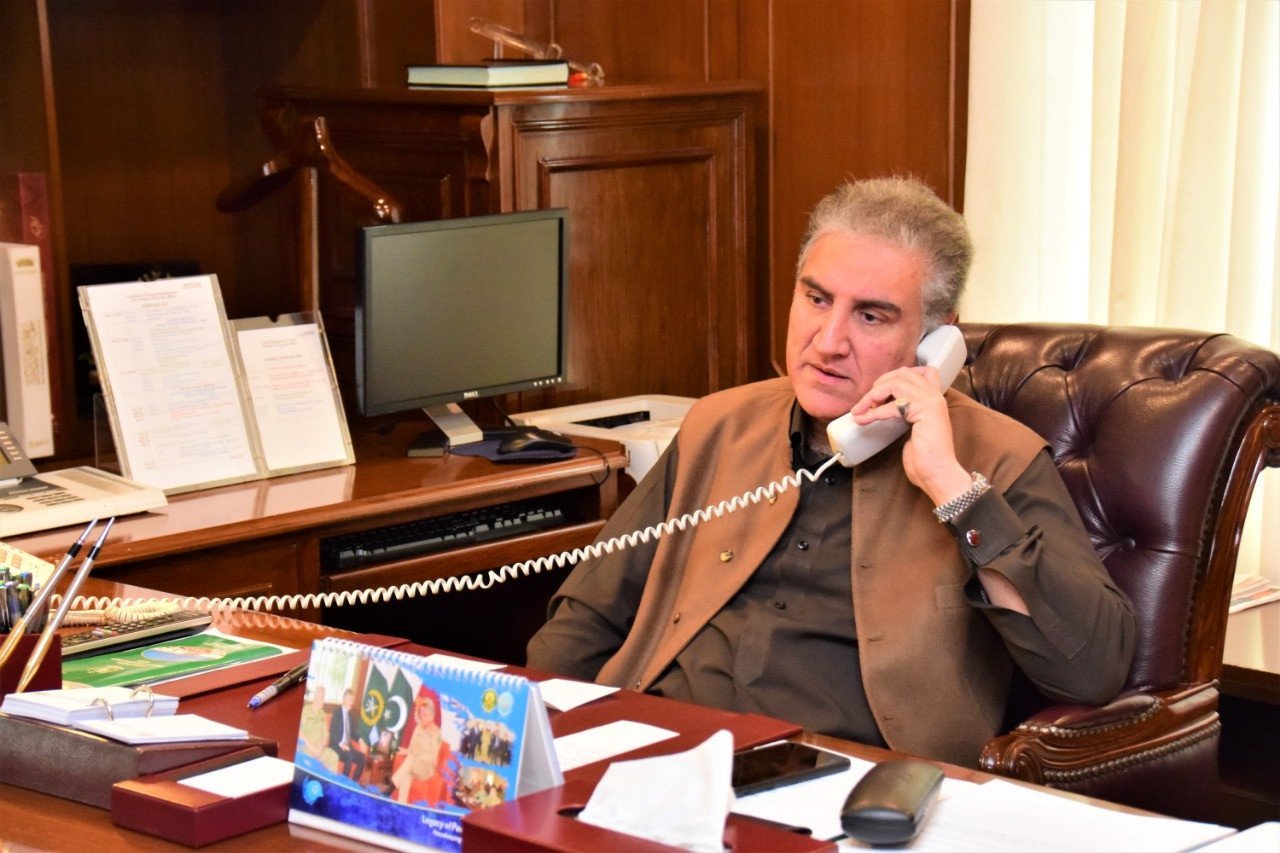
    Foreign Minister (FM) Shah Mahmood Qureshi, while speaking on Samaa News programme, revealed that talks of Pakistan with the President of United States (US) Joe Biden are now irrelevant.

    Speaking on ‘Nadeem Malik Live’, Qureshi said, “These talks with America have no weight, they are irrelevant.”

    Nadeem interjected and said that Pakistan does not want to talk to America, to which Qureshi said, “We will talk to them, whenever required we will talk to them [America]. When they need to talk to us, they do so.”

    “When we require we engage with them. When I was in New York I met US Secretary of State Antony Blinken, we had a great meeting,” said Qureshi.

    Nadeem questioned Qureshi if the relationship between America and Pakistan had scaled down? Qureshi negating the question said, “No, the relationship has scaled up now.”

    “Why can’t you talk to Biden?” questioned Nadeem. “Biden as a personality has many institutions and has many channels of communication. Those channels of communications are open to us and we use them,” responded Qureshi.

    Later when Nadeem reminded him that there was a time when foreign office used to actively work to get a call for the sidelines of the United Nations (UN) assembly, now Qureshi was stating that the Biden call is irrelevant.

    Negating his previous statement, Qureshi said, “There is no harm in meeting Biden. But if he [Biden] thinks that he is busy with things and he might have is own preferences, so we have no hurry as well.”

    “Why has Biden kept us away from him as a policy, and has disengaged with us,” questioned Nadeem?

    “[Biden] can give the answer to this,” said Qureshi.