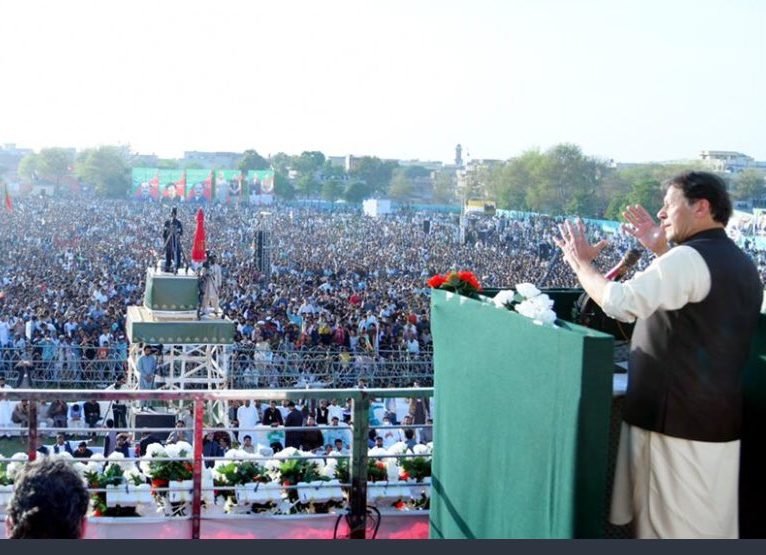
Prime Minister (PM) Imran Khan on Sunday said that he did not join politics to know the prices of aaloo and tamatar (potatoes and tomatoes) but decided to become a politician for the sake of the country’s youth.
Addressing a rally in Hafizabad, the premier promised the people of Punjab that his government will work on the development of the province, something which he claimed would be “unprecedented” in the history of the country.
I joined politics for the sake of the country’s youth: Khan
“I didn’t join politics to know the prices of potatoes and tomatoes. I joined it for the sake of the country’s youth,” the premier said. “If we want to become a great nation, we will have to support the truth, and this is what I have been preaching for the last 25 years.”
The prime minister reiterated that Pakistan wanted equal ties with all the countries. “But as a prime minister of a country with a 220 million population, it is my first and foremost duty to protect people’s rights and interests of the country. I will not allow any policy that harms our motherland. I will not compromise on the national interests just for seeking the pleasure of any country,” he stressed.
Past PMs of Pakistan used to “shiver with fear” whenever they met a United States president
Taking a dig at the Opposition and how leaders of different parties criticised him for issuing statements against the European Union (EU) envoys, the premier said that in the past, prime ministers of Pakistan used to “shiver with fear” whenever they met a United States president and used Pakistan People’s Party (PPP) Chairperson Bilawal’s slip of the tongue “kaanpein taang rahi hoti thein” as an example.
The premier went on to say that when he rebuked the envoys of European countries for asking Pakistan to explicitly condemn Russia for attacking Ukraine, Shehbaz Sharif, Maulana Fazlur Rehman, and Bilawal Bhutto-Zardari were “trembling”.
“My criticism of EU was justified,” the premier said, adding that Opposition leaders, including Maulana Fazlur Rehman, Shehbaz Sharif, and Bilawal Bhutto-Zardari thought it was “grave injustice” to chide EU envoys.
The prime minister said that whenever a foreign diplomat came to meet Shehbaz Sharif, he would quickly change into a suit and a tie.
“Since I know the West better than everyone else, I can assure that they do not respect people who polish their boots,” he said. “They respect nations who stand up for themselves.”
On the ‘terrorist’ living in London
PM Imran Khan also spoke about the US War on Terror and the ensuing drone attacks in Pakistan, calling it a “violation of human rights”. He also talked about a “terrorist” living in London for the last 30 years, saying that this terrorist was responsible for the killing of more people than those killed by US drones.
He said he once told a group of European representatives whether they would allow the use of drones against a terrorist and criminal sitting in London who had killed scores of people in Karachi. The premier was apparently referring to Muttahida Qaumi Movement (MQM) founder Altaf Hussain.
PM Imran further said the United States carried out 400 drone strikes inside Pakistan from 2008 to 2013 but governments led by PPP and Pakistan Muslim League-Nawaz (PML-N) never opposed them.
“We want cordial relations with all countries but will not compromise on national interest… I would not bow down to anyone nor would I allow the nation to give in before anyone.”
On the contrary, the prime minister said, he had always opposed those attacks, staged sit-ins, and gave statements in the United States and the United Kingdom, calling these attacks a grave violation of basic human rights and global principles.
‘One-million-strong’ power show at D-Chowk
The premier then talked about transforming Pakistan into an exemplary welfare society, based on the model of the State of Madinah.
“I formed Rehmatul-Lil-Alameen Authority in the country so that every Pakistani child becomes aware of the life and teaching of the Holy Prophet (PBUH) and stay on the path of the truth.”
As part of the PTI-led government’s strategy to thwart the Opposition’s no-trust bid, it was decided during the meeting that a one-million strong rally would be staged at Islamabad’s D-Chowk ahead of the no-confidence motion in the lower house of parliament.