Tag: United States

  • WWIII in the offing? All you need to know about escalating US-Iran tensions

    WWIII in the offing? All you need to know about escalating US-Iran tensions

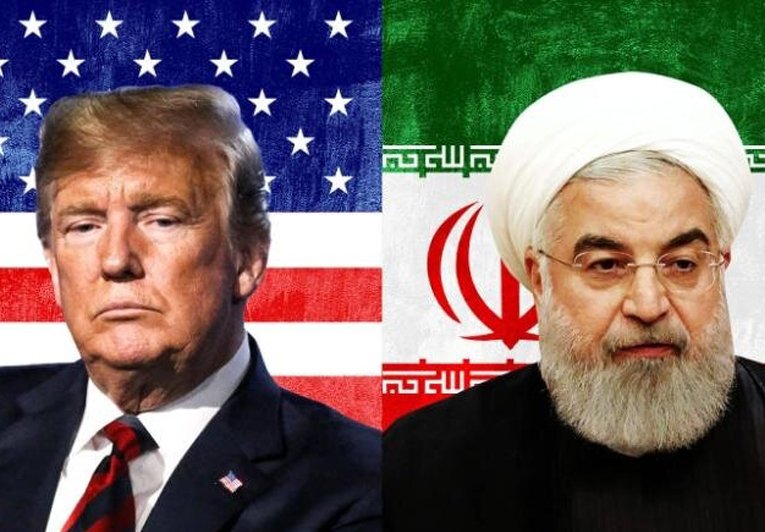
    Tensions between the United States (US) and Iran have escalated to an all-time high after top Iranian commander Qassem Soleimani was killed on Friday in a US strike on Baghdad’s international airport.

    The development has been confirmed by both Tehran and Washington, and the Pentagon has said that President Donald Trump “ordered Soleimani’s killing”, after a pro-Iran mob this week laid siege to the US embassy.

    Following Soleimani’s death, Trump tweeted an image of the US flag without any further explanation.

    The pre-dawn developments mark the most major escalation yet in a feared proxy war between Iran and the US on Iraqi soil.

    Here’s everything you need to know about the dramatic escalation:

     WHO WAS QASSEM SOLEIMANI?

    Head of Iran’s Islamic Revolutionary Guard Corps’ (IRGC) Quds Force Soleimani acquired celebrity status at home and abroad as leader of the foreign arm of the Revolutionary Guards and for his key role in fighting in Syria and Iraq.

    He was instrumental in the spread of Iranian influence in the Middle East, which the US and Tehran’s regional foes Saudi Arabia and Israel have struggled to keep in check, Al Jazeera reported.
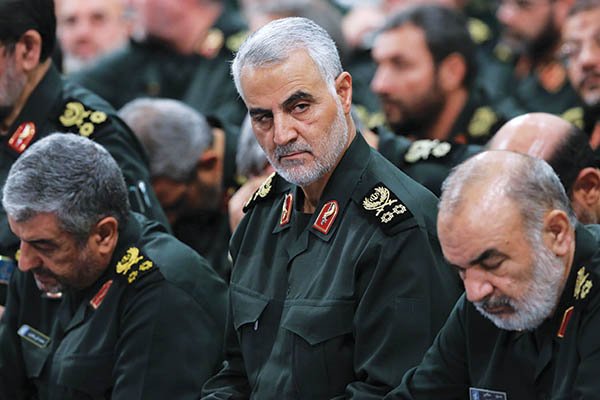
    Soleimani survived several assassination attempts against him by Western, Israeli and Arab agencies over the past 20 years.

    Under Soleimani’s leadership, the IRGC vastly expanded its capabilities, becoming a significant influence in intelligence, financial, and political spheres beyond Iran’s borders.

    WHY WAS HE KILLED?

    It all started on Sunday with US military airstrikes in Iraq and Syria that killed 25 fighters and left militias vowing revenge.

    SUNDAY (DEC 29)

    According to a report, the US military carried out airstrikes on five sites in Iraq and Syria against the Iranian-backed Kataeb Hezbollah militia, calling it retaliation for last week’s killing of an American contractor in a rocket attack on an Iraqi military base that it blamed on the group.
    At least 25 fighters were killed and dozens wounded. The targeted group, which is a separate force from the Lebanese militant group Hezbollah, operates under the umbrella of the state-sanctioned militias known collectively as the Popular Mobilization Forces, or PMF. Abu Mahdi al-Muhandis, the deputy commander of the PMF and a founder of Kataeb Hezbollah, was also killed in the strikes Thursday that killed Soleimani in Baghdad.

    The two were scheduled to meet and were leaving Soleimani’s plane at the airport when Friday’s attack occurred.

    MONDAY (DEC 30)

    The Iranian-backed Iraqi militia vowed to retaliate while a spokesperson for Kataeb Hezbollah denied the group was behind last week’s rocket attacks, including the one that killed the American contractor, saying Washington was using them as a pretext to attack his group.

    “These forces must leave,” he said of American troops in Iraq, calling Sunday’s attack a “crime” and a “massacre”.
    The Iraqi government said it would reconsider its relationship with the US-led coalition — the first time it has said it will do so since an agreement was struck to keep some US troops in the country. It called the attack a “flagrant violation’’ of its sovereignty.

    TUESDAY (DEC 31)

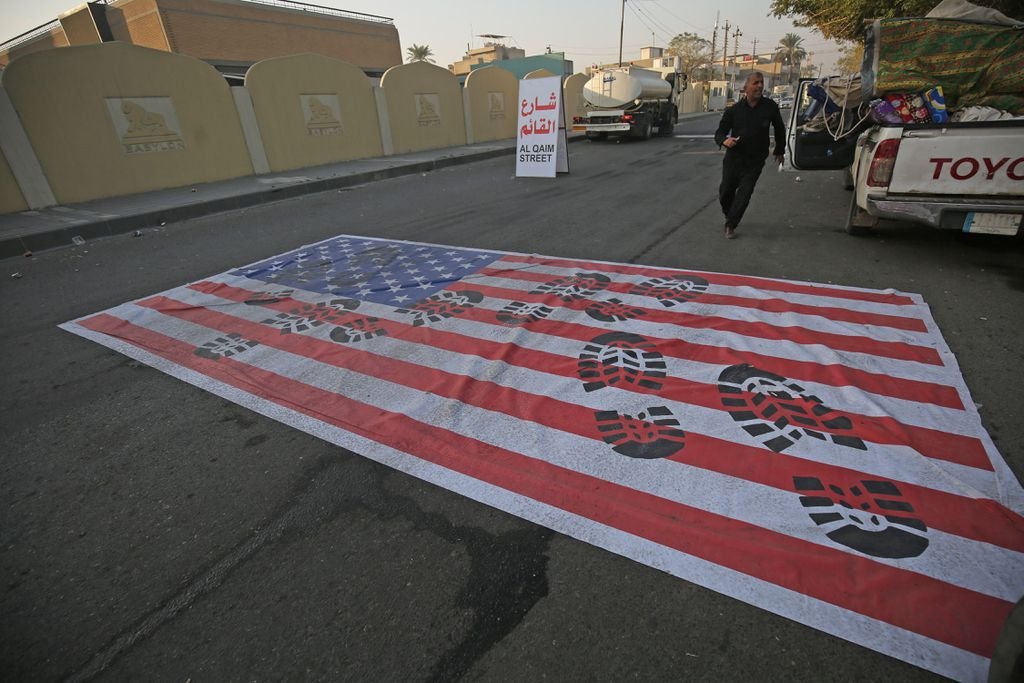
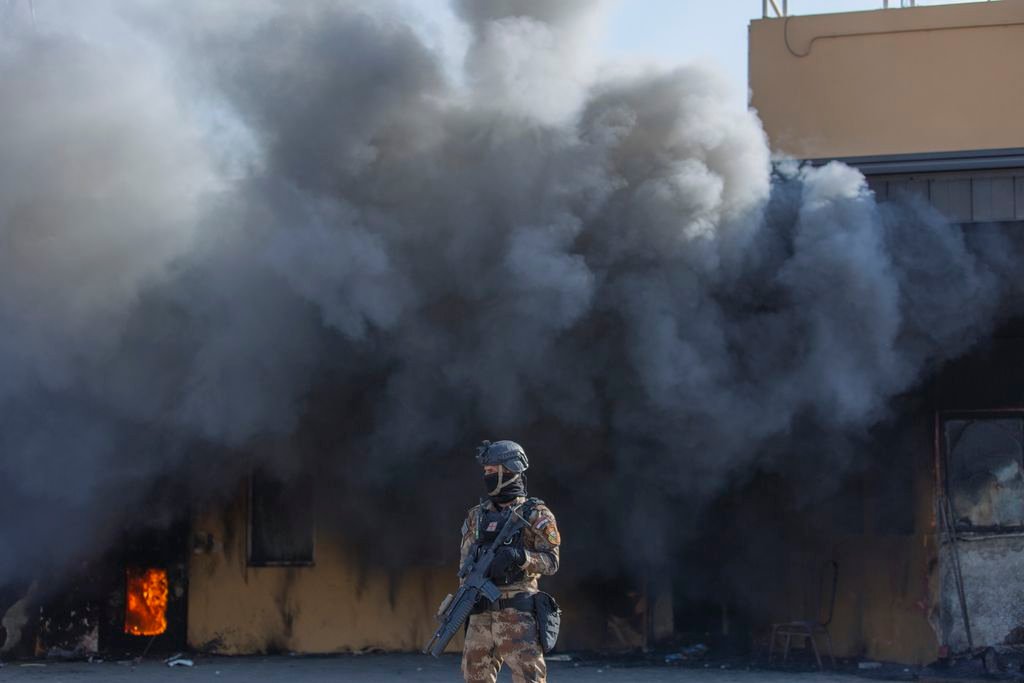
    Hundreds of Iraqi militiamen and their supporters broke into the American Embassy compound in Baghdad, smashing a main door and setting fire to a reception area.

    The marchers, many of them in militia uniforms, shouted “Death to America” and “Death to Israel” outside the compound, hurling water and stones over its walls. The group set up a tent camp overnight in front of the embassy and sprayed graffiti on its walls.

    Some commanders of militia factions loyal to Iran joined the protesters outside the embassy in a strikingly bold move. Among them was Qais al-Khizali, the head of one of the most powerful Iranian-backed group in Iraq, who is on a US terror list, and Hadi al-Amiri, the head of the PMF, the umbrella group for the Iran-backed militias.

    President Trump blamed Iran for the breach of the embassy compound in Baghdad and called on Iraq to protect the embassy.

    There were no reports of casualties. The State Department said all American personnel were safe and that there were no plans to evacuate the embassy. Following the storming of the compound, Defence Secretary Mark Esper ordered roughly 750 additional American troops to deploy to the region, with another 3,000 placed on standby.

    The political influence of the PMF has risen in recent years, and their allies dominate the parliament and the government. That has made them the target of the anti-government protesters, who set up a sprawling protest camp in central Baghdad, and who for weeks have been trying to enter the Green Zone. Iraqi security forces have beaten them back with tear gas and live ammunition, killing hundreds.

    The militiamen and their supporters, however, were able to quickly enter the Green Zone on Tuesday and mass in front of the embassy, with little if any resistance from authorities. Iraqi security forces made no effort to stop the protesters as they marched to the heavily fortified Green Zone after a funeral for those killed in the airstrikes.

    WEDNESDAY (JAN 1)

    The Iran-backed militiamen withdrew from the American Embassy compound after two days of clashes with American security forces.

    US Marines had fired tear gas in response to stones thrown by protesters but no one was reported killed and the tent camp dispersed after the PMF called on its supporters to depart, suggesting their message had “been received.”
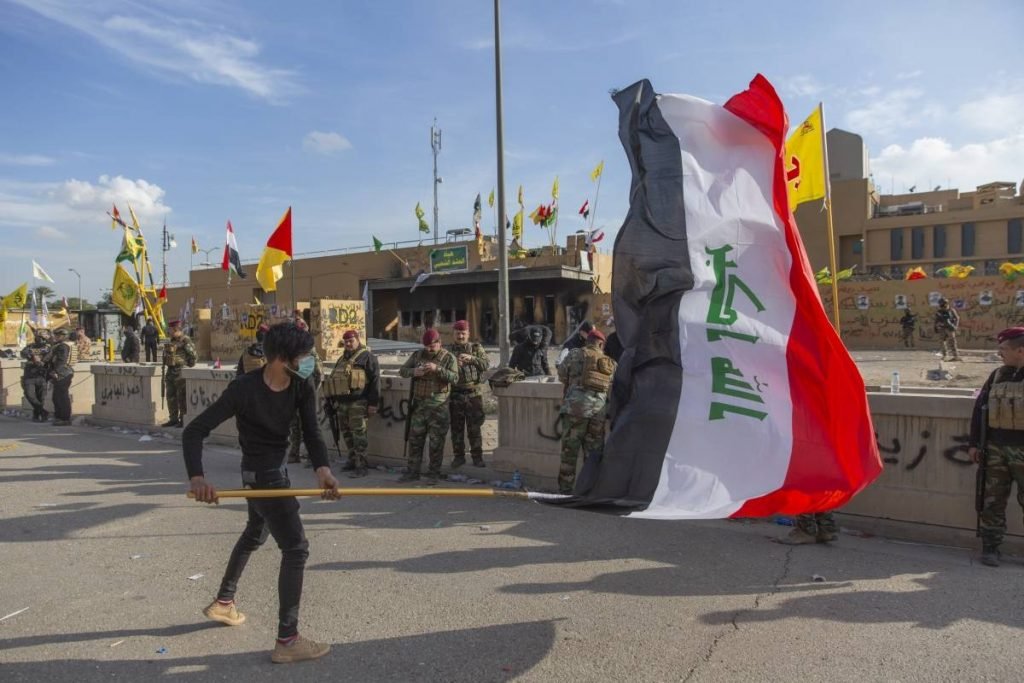
    “We rubbed America’s nose in the dirt,” said Fadhil al-Gezzi, a militia supporter.

    Embassy workers and diplomats were ultimately holed up for more than 24 hours during the situation at the embassy. Ambassador Matt Tueller, the American ambassador to Iraq, was traveling at the time of the attack but State Department officials told The Hill that he would return to the embassy amid the tensions.

    FRIDAY (JAN 3)

    General Qassem Soleimani, Abu Mahdi al-Muhandis, and five others were killed in the early-morning airstrike at Baghdad International Airport, Iraqi officials said.
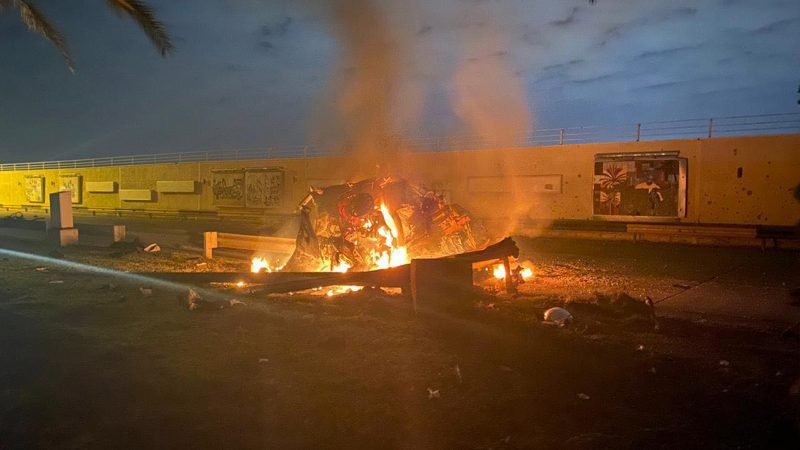
    A senior Iraqi security official said the airstrike, conducted by an American drone, took place on an access road near the cargo area of the airport after Soleimani left his plane to be greeted by al-Muhandis and others. The official said the plane had arrived from either Lebanon or Syria.
  • What’s next for Trump and who can replace him?

    What’s next for Trump and who can replace him?

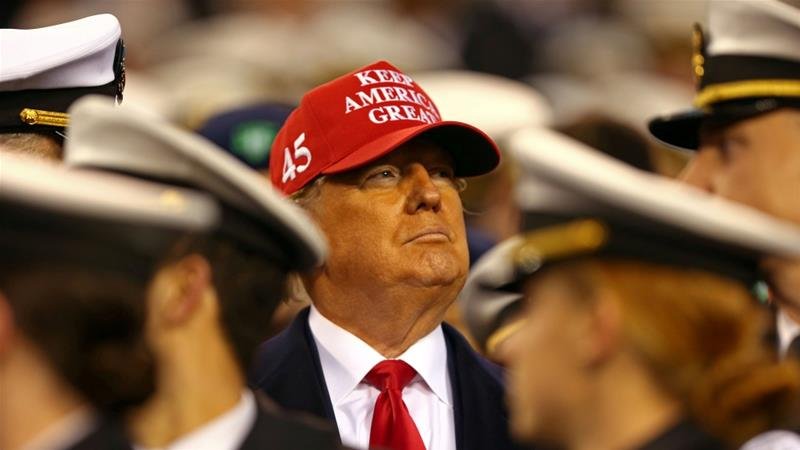
    United States (US) President Donald Trump has been impeached for abuse of power in a historic vote in the House of Representatives, setting up a Senate trial on removing him from office after three turbulent years.

    By a 230 to 197 vote in the Democratic-majority House, the 45th US president on Wednesday became the third occupant of the White House in American history to be impeached.

    But what happens next and who can replace Trump if the Senate convicts him?

    According to AFP, the stage is set for the US president’s trial where the party of defendant Trump gets to set the rules and some senator, who will be jurors, are already delivering their verdicts.

    Trump is expected to stand trial in the Republican-led Senate beginning in early January, and if convicted, he will be removed from office. While it would be an unprecedented outcome, it looks like a highly unlikely conclusion.

    THE TRIAL:

    If the procedures used in the 1868 and 1999 Senate trials of Andrew Johnson and Bill Clinton are repeated, Democratic prosecutors will enter the Senate to read out the charges against Trump.

    “All persons are commanded to keep silence, on pain of imprisonment,” the Senate sergeant at arms will admonish. This is the official who notifies the White House by summons that the president has been charged.

    After that the 100 senators — 53 Republicans and 47 Democrats — will sit in judgement on one of the world’s most powerful men.

    To remove him from office, 67 of them have to find him guilty — highly unlikely, given the Republicans’ numerical strength.

    Their numbers also mean they get to decide if witnesses can be called, and which ones, how long prosecutors can take to present their case and how long the trial will last. If the Senate doesn’t want to try Trump at all, it can simply dismiss the case, by a simple majority vote.

    And given Trump’s political hold over his party, the rules can be dictated by the White House itself.

    WHO CAN SUCCEED TRUMP?

    In the unlikely event that the Senate convicts and removes Trump from office, Vice President Mike Pence would become president and complete Trump’s term, which ends on January 20, 2021.

    The 48th vice president of the US has previously also served as the 50th governor of Indiana from 2013 to 2017 and a member of the US House of Representatives from 2001 to 2013.

    He is the younger brother of U.S. representative Greg Pence.

  • US officials regret treating Pakistan as a friend; say Islamabad ‘played double game’

    US officials regret treating Pakistan as a friend; say Islamabad ‘played double game’

    United States (US) officials in the Bush and Obama administrations believe the “treatment of Pakistan as a friend” in Washington’s trillion-dollar Afghanistan war was a “critical error” as Islamabad “played a double game”, The Washington Post has revealed in its “secret history” of the 18-year-long conflict.

    The American newspaper on Monday published US government papers in an extensive report, ‘The Afghanistan Papers’. It contains confidential government papers containing around 2,000 pages of previously unpublished notes of interviews with US generals and diplomats who were key decision makers along with aid workers and Afghan officials playing a direct role in the conflict.

    As per the report, US officials admit that despite receiving advanced weapons and billions of dollars in aid, “Pakistan never supported America and was playing a double game in the conflict as early as 2002”.

    The Print quoted the report as claiming that Pakistan had joined the US in the war against terror, “but it also supported the Taliban and the al-Qaeda leadership in finding safe havens and logistics support on its soil and in Afghanistan”.

    The documents obtained by the Post also revealed that senior US officials failed to tell the truth about the Afghan war throughout the 18-year campaign and they “kept making rosy pronouncements they knew to be false while hiding unmistakable evidence that the war had become unwinnable”.

    Over the past 18 years, over 775,000 American troops have served in Afghanistan, many repeatedly. Over 2,300 US troops died in the conflict while 20,589 returned home wounded, according to the US Defense Department figures. At present, over 13,000 American troops are serving in Afghanistan whereas several thousand veterans suffer from Post Traumatic Stress Disorder (PTSD).

    The George W Bush administration had invaded the country in 2001 to hunt down 9/11 perpetrator, al-Qaeda chief Osama Bin Laden, and destroy his terror organisation.

    However, the war, continued by Presidents Barack Obama and Donald Trump, eventually became a prolonged conflict, with the US objectives changing over the years to include fighting the ultraconservative religious faction Taliban and installing a democratic Afghan government.

    In the ‘Lessons Learned’ interviews, other US officials said the Bush administration compounded its first mistake by “treating Pakistan as a friend”.

    This was because of former military ruler General (r) Pervez Musharraf, who had allowed the Pentagon to use Pakistani airspace and US intelligence agency CIA to track al-Qaeda leaders in Pakistani territory.

    “As a result, the Bush White House was slow to recognise that Pakistan was simultaneously giving covert support to the Taliban, according to the interviews,” the Post said in its report.

  • Rao Anwar blacklisted by the US

    Rao Anwar blacklisted by the US

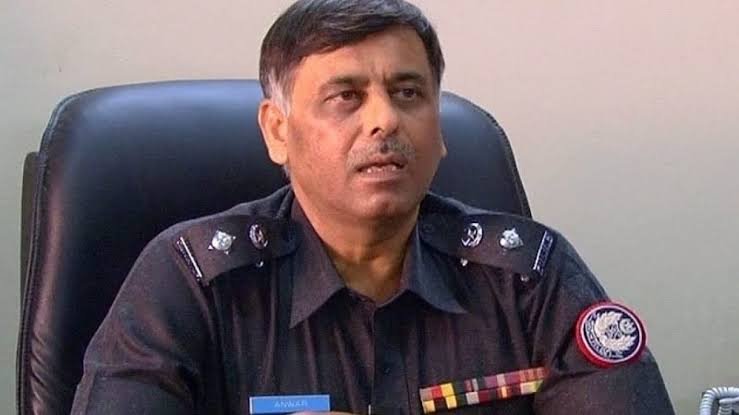
    On International Human Rights’ Day, former Malir SSP Rao Anwar was blacklisted by the United States. Rao Anwar was blacklisted on Tuesday for engaging in “serious human rights abuse” by carrying out alleged fake police ‘encounters’ in which scores of individuals including Naqeebullah Mehsud were killed.

    Rao Anwar is among 18 individuals from six countries that the Trump administration has imposed economic sanctions on for suspected human rights violations.

    “During his tenure as the Senior Superintendent of Police in District Malir, Pakistan, Rao Anwar Khan (Anwar) was reportedly responsible for staging numerous fake police encounters in which individuals were killed by police, and was involved in over 190 police encounters that resulted in the deaths of over 400 people, including the murder of Naqeebullah Mehsood,” the US Treasury said in a statement.

    It said Rao Anwar “helped to lead a network of police and criminal thugs that were allegedly responsible for extortion, land grabbing, narcotics, and murder”.

    According to the press release, Rao Anwar has been designated “for being responsible for or complicit in, or having directly or indirectly engaged in, serious human rights abuse.”

  • Pakistan warns ‘US military aircraft’ against entering territory; jet then changes course

    The Civil Aviation Authority (CAA) has denied reports that any United States (US) military aircraft entered Pakistani airspace.

    “Relevant departments have informed me that no aircraft entered Pakistan’s limits. In our record, no airplane has crossed our airspace,” said CAA spokesperson Ismail Khoso, Daily Times reported.

    On Wednesday, ARY had reported that an aircraft from Muscat was heading towards Karachi. The pilot was asked about the permission and the code to which he didn’t answer. The air traffic controller warned the aircraft after which it moved out of its territory.

    Aviation Division Senior Joint Secretary and spokesperson Abdul Sattar Khokhar said Muscat authorities informed Pakistan on November 18 at 9:15 am that an aircraft was flying towards Pakistani airspace.

    “However, the plane did not enter our airspace and remained in international airspace. The authorities contacted the airplane for identification, but it did not respond either,” he added.

    Khosa said there are air spaces of other countries besides Pakistan about which the CAA could not say anything. “We must have noticed any aircraft if it had entered Pakistan’s limits.”

    “The aircraft was of US origin. However, I cannot confirm if it was a military plane, a fighter or a bomber or a transport plane,” Khokhar added.