Tag: US Dollar Exchange Rate

  • Pakistani rupee ends 2023 with marginal gain versus US dollar

    Pakistani rupee ends 2023 with marginal gain versus US dollar

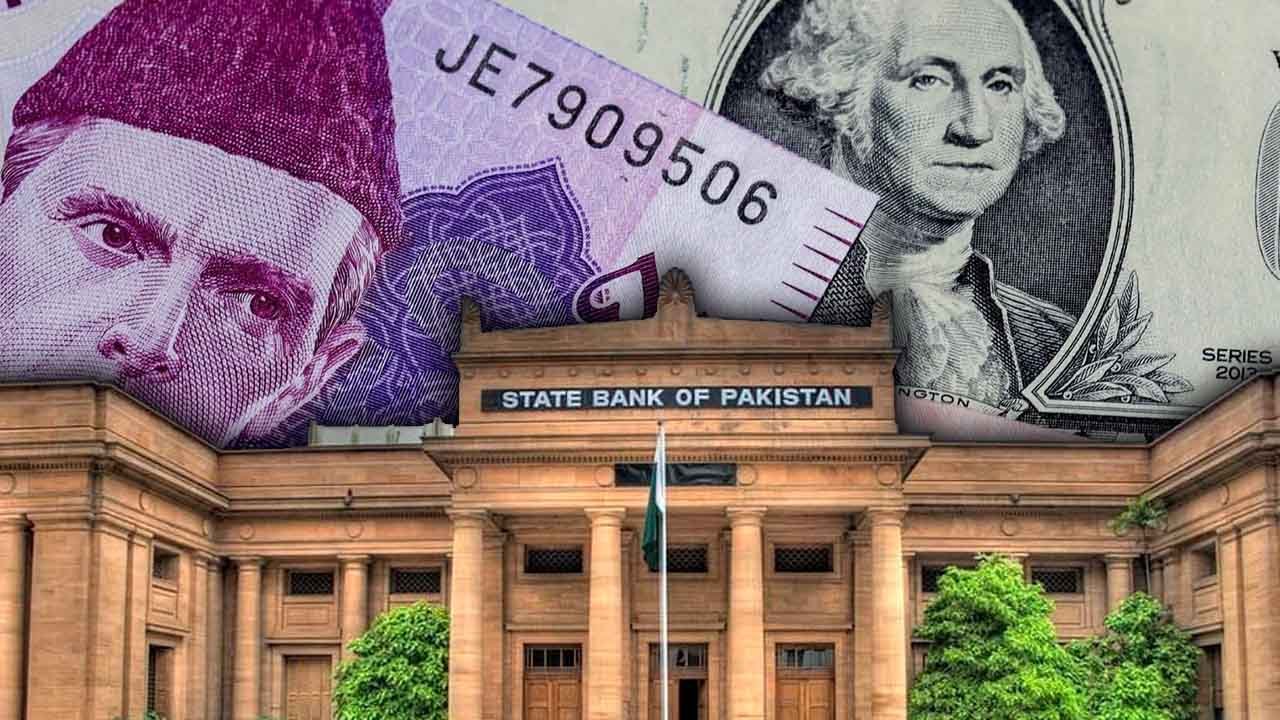
    Pakistani rupee demonstrated a slight appreciation against the US dollar for the 13th consecutive session, marking a gain of 0.02 per cent in the inter-bank market on Friday.

    According to the State Bank of Pakistan (SBP), the day concluded with the rupee settling at Rs281.86, reflecting an increase of Rs0.07.

    Remarkably, this signifies a closure of 2023 with the rupee undergoing a depreciation of 19.7 per cent, originating from its starting point at Rs226.43 against the US dollar in the inter-bank market at the beginning of the year. 

    Notably, on the preceding Thursday, the rupee experienced a marginal upturn, settling at Rs281.93 against the US dollar.

    A significant development unfolded as the foreign exchange reserves held by the State Bank of Pakistan observed a substantial weekly upswing, surging by $852 million to reach $7.75 billion as of December 22, according to data released on Thursday. 

    The overall liquid foreign reserves for the country tallied at $12.85 billion, with commercial banks holding net foreign reserves amounting to $5.1 billion. The SBP attributed this surge in reserves to official government inflows.

    On the global stage, the US dollar appeared poised to conclude 2023 with a loss, reversing a two-year trend of gains. This shift was influenced by market expectations that the US Federal Reserve might initiate rate easing as early as March of the following year. 

    The greenback remained generally subdued on the last trading day of the year, hovering near a five-month low against a basket of currencies, falling 0.02 per cent to 101.18, following a recent dip to 100.61. 

    This trend underscored the impact of the Federal Reserve’s aggressive rate-hike cycle initiated in early 2022 on the dollar’s trajectory over the past two years.
  • Pakistani rupee extends winning streak against US dollar for 12th straight session

    Pakistani rupee extends winning streak against US dollar for 12th straight session

    The Pakistani rupee continued its upward trend against the US dollar for the 12th consecutive session, appreciating by 0.1 per cent in the inter-bank market on Thursday. 

    The State Bank of Pakistan reported that the rupee settled at Rs281.93, marking an increase of Re0.27. A day earlier, the rupee had experienced a slight gain, closing at Rs282.20 against the US dollar.

    In a related development, the Ministry of Finance acknowledged the persistent challenge of higher markup payments. The ministry stressed the importance of both revenue enhancement and prudent expenditure control.

    Internationally, the US dollar faced substantial losses on Thursday, poised for a yearly decline after two years of robust gains. 

    Anticipation of interest rate cuts from the Federal Reserve in the coming year influenced market sentiments. As the year concludes, limited market activity is expected until the New Year due to thin liquidity.

    The dollar index, measuring the US currency against six rivals, reached a five-month low of 100.81. It declined by 0.5 per cent on Wednesday and is on track for a 2.6 per cent decrease this year, breaking a two-year trend of strong gains. I

    Investors are closely monitoring the timing of potential interest rate cuts from the Fed, with markets indicating an 89 per cent chance of a cut in March 2024, according to the CME FedWatch tool. Futures suggest up to 158 basis points of Fed easing in the coming year.

    Oil prices, a significant indicator of currency parity, stabilised on Thursday following a previous sharp decline. 

    Concerns about shipping disruptions along the Red Sea route eased, despite escalating tensions in the Middle East. 

    Brent crude futures rose by 2 cents to $79.75 a barrel, while US WTI crude futures traded 3 cents lower at $74.08 a barrel, rebounding from a nearly 2 per cent drop on Wednesday as major shipping firms resumed operations in the Red Sea.

  • Pakistani rupee gains ground against US dollar for 11th consecutive session

    Pakistani rupee gains ground against US dollar for 11th consecutive session

    The Pakistani rupee sustained its upward trajectory against the US dollar for the 11th consecutive session, exhibiting a 0.06 per cent appreciation in the interbank market on Wednesday. 

    According to the State Bank of Pakistan (SBP), the rupee concluded at Rs282.20, reflecting an increment of Re0.17.

    In the preceding session on Tuesday, the rupee had achieved a marginal gain, settling at Rs282.37 in relation to the US dollar. 

    Concurrently, there has been a notable surge of 200 per cent in the cumulative borrowing by the federal and provincial governments for budgetary support from the domestic banking system in the current fiscal year (FY24).

    Internationally, the US dollar encountered continued pressure on Wednesday, while the euro flirted with a four-month pinnacle. 

    This trend emerged as market expectations of an imminent interest rate cut by the Federal Reserve gained traction. The restrained week, marked by global holiday absences until the New Year, is anticipated to witness subdued trading volumes.

    The dollar index, gauging the US currency against six counterparts, stood at 101.54, just below the five-month low of 101.42 recorded last week. 

    The index is poised for a 1.9 per cent decline in 2023, following two consecutive years of robust gains driven by the Fed’s rate hikes to combat inflation. 

    The recent weakening of the dollar is attributed to market anticipation of forthcoming rate cuts by the Fed in the coming year, diminishing the allure of the greenback.

  • Here are the latest prices of all Honda cars in Pakistan after reduction

    Here are the latest prices of all Honda cars in Pakistan after reduction

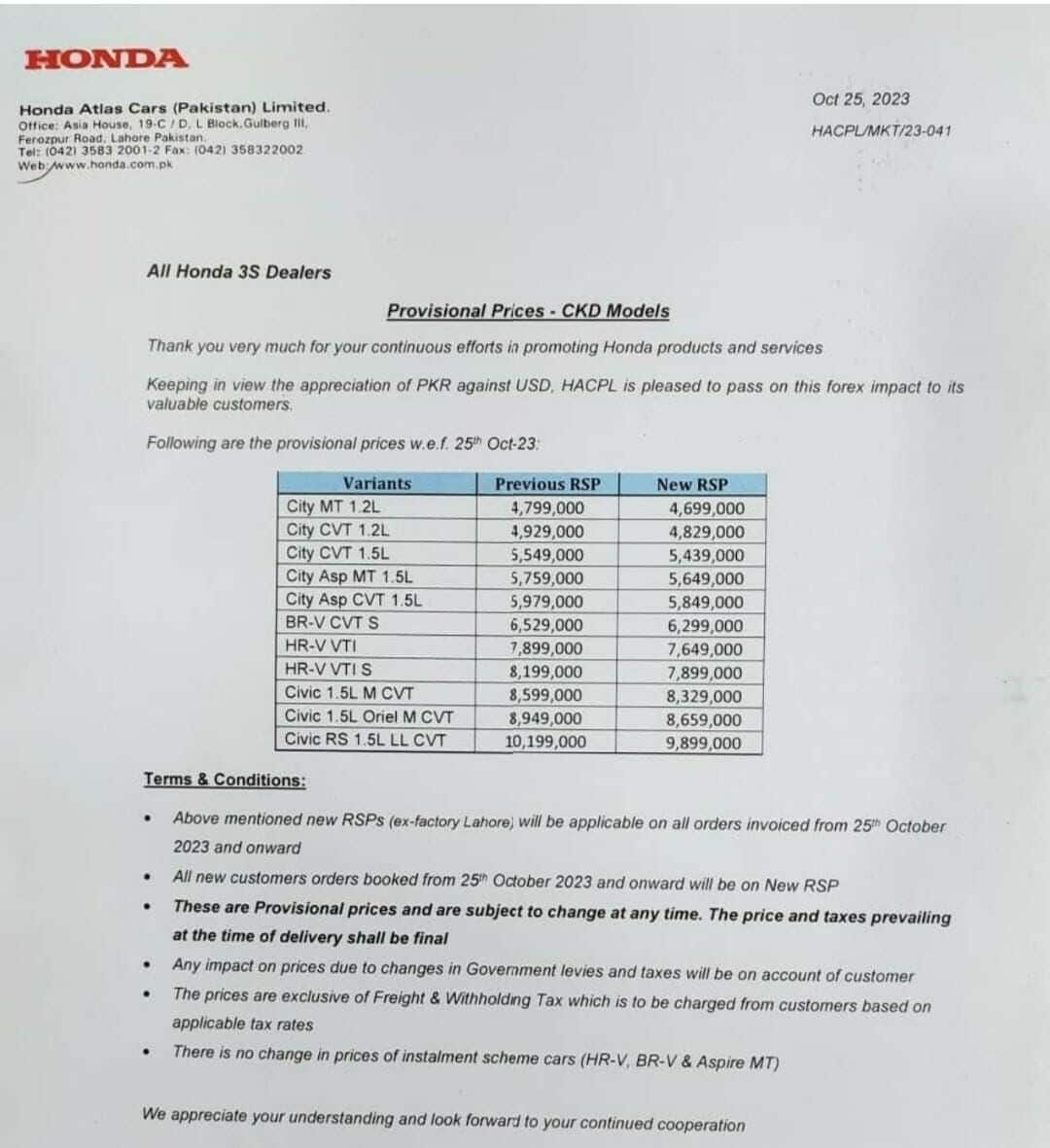
    In a move similar to what Toyota did earlier, Honda Atlas Cars (Pakistan) Limited announced on Wednesday that it is reducing the prices of its vehicles, especially the popular Honda City lineup.

    This decision was made due to the significant strengthening of the Pakistani rupee (PKR) against the US dollar.

    Through an official circular, Honda Pakistan disclosed the updated ex-factory prices for all its car models, reflecting reductions of up to PKR 300,000.

    This substantial price drop is expected to make Honda vehicles more affordable for a broader consumer base.

    After these adjustments, the price of the most budget-friendly Honda car in Pakistan, the City MT 1.2L, now stands at Rs4.699 million following a reduction of Rs100,000.

    Moreover, the top variant, the Aspire CVT 1.5L, is now available for Rs5.849 million after a cut of Rs130,000.

    The most significant price changes have been applied to the popular Honda City lineup, generating excitement among potential buyers.

    Here are the new prices for all Honda cars:

  • Pakistan Stock Exchange surpasses 50,500 points after more than six years

    Pakistan Stock Exchange surpasses 50,500 points after more than six years

    On Friday, the KSE-100 benchmark index of the Pakistan Stock Exchange surpassed the 50,500-point mark, a level last witnessed in May 2017 when it reached 50,592 points. 

    The Karachi Stock Exchange (KSE-100) index has advanced by 207 points and is presently at 50,572 points.

    Yesterday marked a significant milestone for the Pakistan Stock Exchange as its benchmark KSE-100 index crossed the 50,000-point threshold, an achievement that experts have noted took six years to accomplish. 

    During intraday trading, the benchmark Karachi Stock Exchange (KSE) 100 Index surged by 600 points, settling at 50,025 points, a level not seen since June 7, 2017.

    Concurrently, the Pakistani rupee exhibited a recovery against the US dollar in the interbank market on Thursday. After experiencing a Rs1 gain against the PKR in interbank trading on Wednesday, the US dollar depreciated by Rs1.96 in early Thursday afternoon trading. 

    As of the latest data, the Pakistani rupee has gained Rs1.96 against the US dollar, now trading at Rs278.30 in the interbank market, according to forex dealers. 

    In the open market, banks are selling the greenback to importers at Rs278.80, while the US currency has also experienced a Rs1 loss against the local currency.

  • Afghani emerges as top-performing currency against US dollar 

    Afghani emerges as top-performing currency against US dollar 

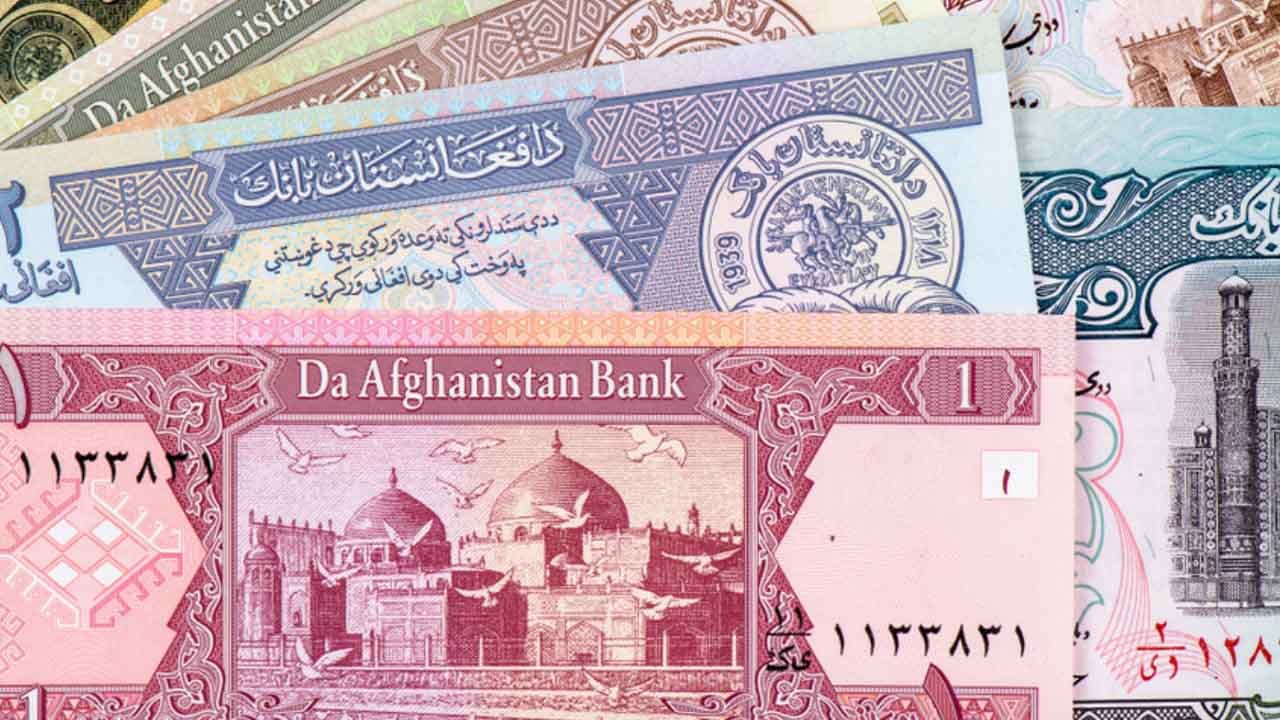
    In the third quarter of 2023, the Afghani, the official currency of Afghanistan, has exhibited exceptional performance, marking itself as the standout currency in the global financial landscape. Its remarkable ascent against the US dollar, with a substantial 9 per cent surge since the commencement of July, stands as a testament to its resilience and strength. 

    This impressive trajectory positions the Afghani as the third-strongest performer among global currencies in 2023, trailing only behind the Colombian peso and the Sri Lankan rupee. This distinction underscores the Afghani’s resilience amid challenging economic circumstances. 

    In Afghanistan, the pivotal role of facilitating foreign currency transactions falls upon the numerous money exchange establishments known as “sarrafs.” These sarrafs are ubiquitous, dotting the landscapes of both urban centres and rural villages alike, serving as the lifeblood of currency exchange activities. 

    Among these financial hubs, the Sarai Shahzada market in Kabul takes centre stage as Afghanistan’s premier financial epicenter. It serves as a bustling hub where substantial sums of currency are traded daily, exemplifying the nation’s financial vitality. Remarkably, the central bank places no restrictions on these exchange transactions. 

    Due to stringent financial sanctions, a significant portion of funds flowing into Afghanistan from foreign nations now traverse through the age-old money transfer system known as Hawala. This venerable system plays a pivotal role in the operations of sarrafs, further cementing their significance in Afghanistan’s financial ecosystem. 

    It is noteworthy that the United Nations (UN) has identified Afghanistan’s dire need for approximately $3.2 billion in aid for the current year, with roughly $1.1 billion already disbursed. This underscores the critical importance of international assistance in alleviating the nation’s pressing humanitarian challenges. 

    A sombre backdrop to these financial dynamics is the fact that, just last year, the UN disbursed nearly $4 billion in aid as Afghanistan grappled with a dire famine that affected half of its 41 million citizens. This staggering statistic underscores the profound challenges faced by the Afghan population. 

    Since the Taliban’s resurgence in Kabul in August 2021, stringent currency controls have been imposed, disallowing the use of the US dollar and Pakistani rupee by locals and restricting online trading activities. While these measures have seemingly contributed to Afghanistan’s stability, the broader Afghan economy has suffered, with soaring unemployment rates exacerbating the nation’s humanitarian crisis. 

    Regrettably, a staggering 79 per cent of the population now languishes in poverty, with a distressing 44 per cent of the people unable to secure adequate nourishment. The plight of Afghanistan’s populace remains a pressing global concern, necessitating concerted efforts to address both immediate humanitarian needs and long-term economic stability.