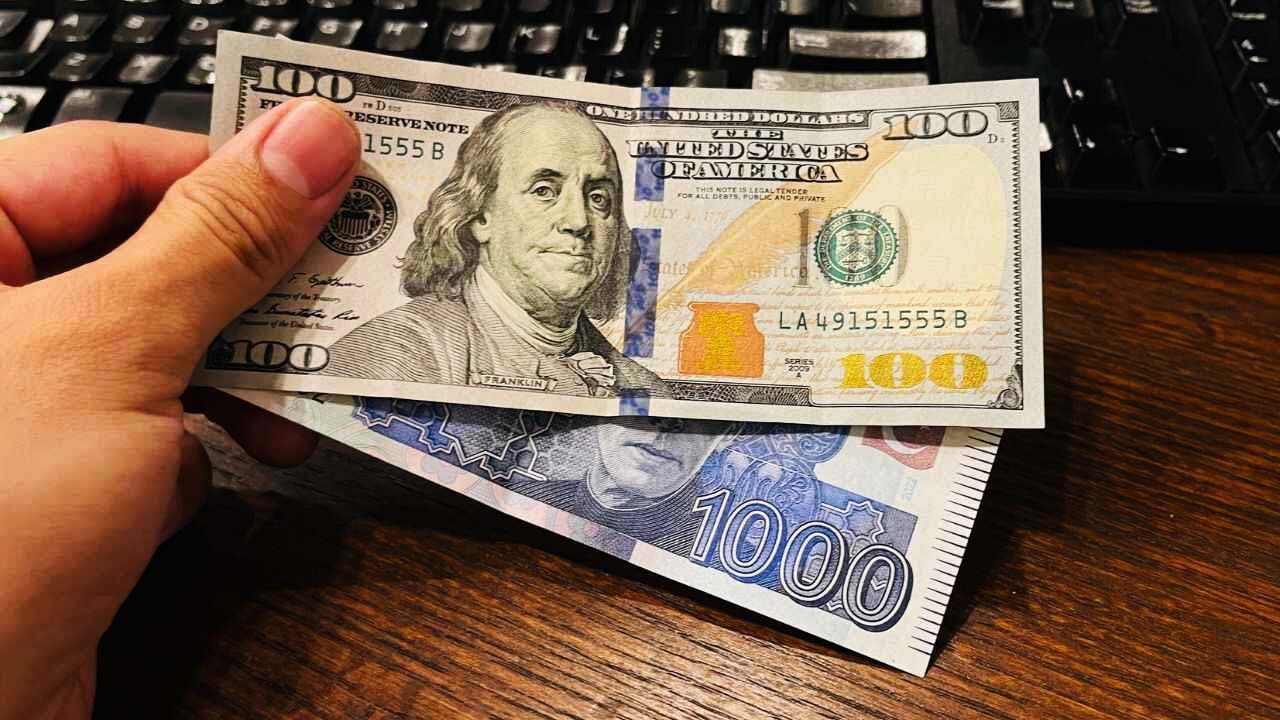
Tag: USD

  • Exchange rates: Rupee closes at Rs277.68 against US dollar

    Exchange rates: Rupee closes at Rs277.68 against US dollar

    The Pakistani rupee (PKR) recorded a marginal decline against the US dollar, depreciating 0.01 per cent in the interbank market on Monday.

    According to the State Bank of Pakistan (SBP), PKR wrapped up first trading day of the week at Rs277.68 after experiencing a loss of four paisa versus the greenback.
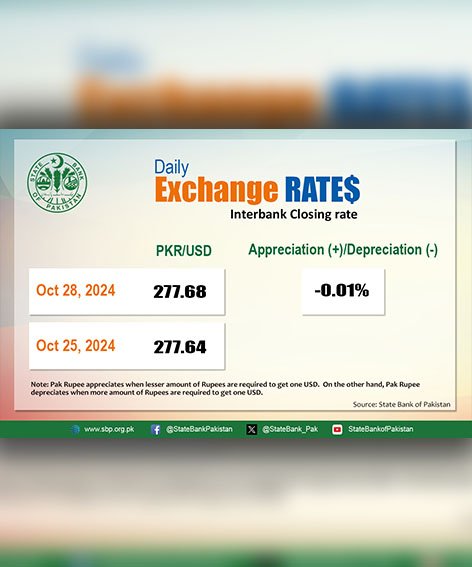
    SBP exchange rate: USD to PKR

    During the current fiscal year, Pakistani currency has gone up by 66 paisa or 0.24 per cent against the dollar. While it has appreciated more than Rs4 or 1.51 per cent so far this calendar year.

    During the previous week, PKR weakened marginally as it depreciated three paisa or 0.01 per cent against the US dollar.

    The dollar index has climbed 3.6 per cent to 104.49 during October, its sharpest monthly rise in more than two years.

    In the open market, local money exchangers quoted the American currency at Rs278.62 for selling and Rs276.75 for buying.

    As compared to other foreign currencies, the home unit remained largely stable despite minor fluctuations.

    Currency Change (Paisa) Change (%) Today’s rate (PKR) Last close (PKR)
    Euro 62.43 0.21 per cent 299.97 300.59
    Japanese Yen 1.64 0.90 per cent 1.8105 1.8269
    British Pound 14.39 0.04 per cent 360.06 360.20
    Chinese Yuan 2.85 0.07 per cent 38.95 38.98
    Saudi Riyal 1.82 0.02 per cent 73.94 73.96
    UAE Dirham 1.07 0.01 per cent 75.60 75.61
    Swiss Franc 36.12 0.11 per cent 320.00 320.36
    Exchange rates

    Against the Pound, PKR appreciated 14.39 paisa or 0.04 per cent and closed at Rs360.06.

    PKR increased 62.43 paisa or 0.21 per cent against the Euro, closing at Rs299.97.

    The local unit was reported 36.12 paisa or 0.11 per cent up against Swiss franc to end the session at Rs320.

    Pakistani currency fell by 1.07 paisa or 0.01 per cent against the UAE Dirham to close at Rs75.60.

    PKR’s value against the Japanese Yen rose 1.64 paisa or 0.90 per cent to close the day at Rs1.8105.

    The local unit increased 2.85 paisa or 0.07 per cent against Chinese Yuan to close at Rs38.95.

    The local currency shed 1.82 paisa or 0.02 per cent against Saudi Riyal to Rs73.94.
  • Pakistani rupee closes week strong at Rs282.53 against US dollar

    Pakistani rupee closes week strong at Rs282.53 against US dollar

    In a trend marking its ninth consecutive session, the Pakistani rupee (PKR) demonstrated resilience against the US dollar (USD) by registering a 0.09 per cent appreciation in the inter-bank market on Friday.

    Closing the week at Rs282.53, the currency saw an increase of Rs0.26, according to the State Bank of Pakistan (SBP).

    This positive momentum follows a marginal gain on Thursday, settling at Rs282.79 against the US dollar.

    Simultaneously, the foreign exchange reserves held by the State Bank of Pakistan experienced a decline, falling below the $7 billion mark.

    A notable decrease of $136 million, attributed to debt repayments during the week ending December 15, 2023, brought the reserves to $6.904 billion.

    On the international front, the US dollar found itself near a more than four-month low on Friday, anticipating a key US inflation gauge reading scheduled for later in the day.

    This data is expected to provide clarity on the Federal Reserve’s room to manoeuvre in terms of interest rate cuts in the coming year.

    Early Asia trade witnessed the greenback hitting a five-month trough against the New Zealand dollar and a three-week low against the euro.

    This decline resumed after a sudden risk-aversion episode in New York hours on Wednesday triggered a sell-off in US stocks, leading to a rise in the dollar.

    Against a basket of currencies, the greenback hovered around 101.76, remaining close to the previous session’s more than four-month low of 101.72.

     The dollar index seemed poised for a weekly loss of about 0.8 per cent, extending the previous week’s 1.3 per cent decline.

    The Federal Reserve’s decision to leave the door open to potential rate cuts in the next year, as indicated in its last policy meeting for 2023, contributed to the ongoing downward pressure on the US dollar.

    This market movement has implications for various currency pairs, including the Pakistani rupee to US dollar exchange rate, which continues to be of interest to investors tracking global economic trends.

  • Pakistan’s cotton production surge offers hope for forex reserves 

    Pakistan’s cotton production surge offers hope for forex reserves 

    Cotton production this year is proving to be a silver lining for Pakistan’s foreign exchange reserves, with an impressive 83 per cent increase in production for the 2023-24 season, totalling 6.79 million bales. 

    According to an estimate by the Pakistan Cotton Ginners’ Forum, cumulative production in the current season may reach around 9 to 9.5 million bales, a significant improvement from the previous year’s production of 5 million bales. This can be attributed to favourable weather conditions. 

    However, it’s worth noting that the production is still below the government’s target of 11.5 million bales. 

    According to Express Tribune, the recent 193 per cent increase in gas prices has exacerbated challenges faced by textile manufacturers and exporters, reducing the country’s competitiveness among regional textile exporters. 

    Another discouraging factor is for the farmers, as the market is offering them Rs7,000 per 40 kilogrammes, falling short of the government’s announced support price of Rs8,500 per 40 kilogrammes.

    The government has yet to fulfil its promise of purchasing cotton to stabilise market prices.  

    The Caretaker Prime Minister has urged the activation of the Trading Corporation of Pakistan, but this action is contingent on approval from the Economic Coordination Committee of the Cabinet, which has not yet occurred. 

    Ginners has mentioned that the increase in cotton production will save the country approximately $1 billion in import costs. 

  • Gold price surges by Rs4,900 in a single day, reaches Rs202,000 per tola 

    Gold price surges by Rs4,900 in a single day, reaches Rs202,000 per tola 

    The price of gold in Pakistan has experienced a significant surge following an increase in the global market.  

    According to the All-Pakistan Sarafa Gems and Jewellers Association (APSGJA), the cost of 24-carat gold has risen by Rs4,900, reaching Rs202,000 per tola.  

    Meanwhile, the price of 10-gramme gold has also seen a substantial increase, going up by Rs4,201 to settle at Rs173,182. 

    In the international market, the price of gold saw a notable uptick, with a $46 increase, bringing it to $1,938 per ounce.  

    Concurrently, the US dollar (USD) weakened by Rs5.07 against the Pakistani rupee in the interbank market over the course of this week’s trading. In interbank trading, the USD declined from Rs282.69 to Rs277.62 this week. 

    Furthermore, the American currency witnessed a decrease of Rs4.50 in the open market at the end of the week, closing at Rs277, down from Rs281.50. 

  • Second consecutive decline: Gold price drops by more than Rs6,000 per tola

    Second consecutive decline: Gold price drops by more than Rs6,000 per tola

    The price of gold in Pakistan fell for the second consecutive day on Tuesday, as the rupee depreciated against the US dollar. The price of 24 karat gold decreased by Rs6,300 per tola (11.66 grammes) and Rs5,402 per 10 grammes, to settle at Rs232,800 and Rs199,588, respectively.

    The decline in gold prices was in line with the fall in the international market, where the price of gold fell by $9 to settle at $1,931 per ounce. The gold rate has been volatile in Pakistan recently due to political and economic uncertainty, and high inflation.

    The price of silver also fell by Rs100 per tola and Rs85.74 per 10 grammes, to settle at Rs2,800 and Rs2400.5, respectively.

    The depreciation of the rupee against the dollar is the main reason for the decline in gold prices in Pakistan. When the rupee weakens, gold becomes more expensive for buyers in Pakistan, who have to pay more rupees to buy the same amount of gold.

    The political and economic uncertainty in Pakistan is also a factor that is contributing to the volatility of gold prices. Investors are unsure about the future of the country, and they are looking to gold as a safe haven investment. This demand for gold is pushing up prices.

    The high inflation in Pakistan is also making gold more expensive. When inflation rises, the value of the rupee decreases, which makes gold more expensive for buyers in Pakistan.

    Overall, the gold rate in Pakistan is expected to remain volatile in the near future due to the factors mentioned above.

  • Pakistani rupee sets new record, falls to Rs307.10 per US dollar 

    Pakistani rupee sets new record, falls to Rs307.10 per US dollar 

    In the interbank market on Tuesday, the Pakistani rupee (PKR) continued to weaken against the US dollar, losing PKR 1.4569 (0.48 per cent) on a day-over-day basis and ending the session at PKR 307.0996 per US dollar.

    On Monday, the Pakistani rupee experienced a slight decline against the US dollar, settling at Rs305.64 in the interbank market.

    The government has not yet finalised relief measures for the surging electricity bills of consumers, primarily due to disagreement between the federal government and the International Monetary Fund (IMF) regarding the provided data.

    On the international front, the US dollar remained strong on Tuesday, while the Australian dollar faced some pressure. Traders were closely monitoring the Reserve Bank of Australia’s upcoming interest rate decision, speculating that interest rates may have reached their peak.

  • Petrol price increased to historic high of Rs305.36 per litre

    Petrol price increased to historic high of Rs305.36 per litre

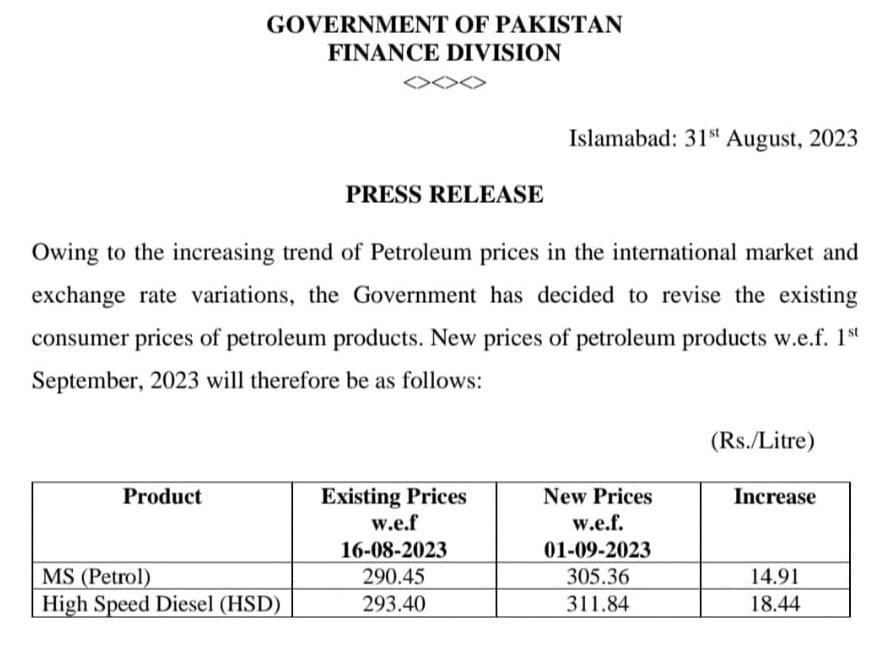
    For the first time in Pakistan’s history, the price of petrol has crossed the Rs300 mark due to a recent hike of Rs14.91. This brings the new petrol price to Rs305.36 per litre. The diesel price has also increased by Rs18.44, now at Rs311.84 per litre.

    The government has attributed these revisions to the upward trajectory of global petroleum prices and the consequential fluctuations in exchange rates.

    A statement issued by the finance ministry highlights that due to the escalating trend of petroleum prices in the international market and the subsequent shifts in exchange rates, the Government has opted to recalibrate the prevailing consumer prices of petroleum products.

    In the days ahead, the effects of these significantly heightened petrol and diesel prices will become evident. These price fluctuations are poised to have a substantial impact on individuals who rely on personal vehicles, such as bikes and cars, as well as those who depend on public transportation services.

  • SBP likely to hike key policy rate by up to 300 basis points next month

    SBP likely to hike key policy rate by up to 300 basis points next month

    The Monetary Policy Committee (MPC) of the State Bank of Pakistan (SBP) will likely meet at its upcoming meeting to decide on the key policy rate, and the market anticipates a possible rate increase of up to 300 basis points.

    According to the analysts contacted by the Brecorder, the SBP is likely to increase the rate from its current historic high of 22 per cent. As per the advance calendar issued in July, the SBP is currently slated to hold its MPC meeting on September 14.

    Notably, the central bank has previously taken the initiative to declare changes in its key policy rate through ’emergency’ meetings, similar to what occurred in June.

    Market speculation hints that the central bank might adopt a more patient approach this time, making an emergency meeting less probable.

     Tahir Abbas, the Head of Research at Arif Habib Limited (AHL), foresees a rate hike ranging between 100 and 150 basis points.

    He emphasised, the inflation rate is projected to remain elevated not only in August but also in the upcoming months. Furthermore, the persistent depreciation of the currency might compel the SBP to push interest rates upwards.

    Abbas added, “We expect a policy rate hike of around 100-150 bps.”

    In a previous report, AHL stated that headline inflation is expected to climb higher in August, surpassing the 28.3 per cent figure recorded in July 2023.