Tag: USD Exchange Rate

  • Govt expected to increase petrol price by Rs3.5 for first half of March

    Govt expected to increase petrol price by Rs3.5 for first half of March

    In a possible move that could impact consumers, the government is considering a hike in petrol prices by Rs3.5 per litre for the initial half of March 2024.

    As of the latest estimates until February 27, 2024, the ex-refinery price of petroleum has seen a noticeable rise, reaching Rs195.75 per litre. This reflects an increase of approximately Rs3.58 compared to the preceding fortnight’s price of Rs192.17 per litre.

    Contrary to petrol, there might be no significant adjustment in the price of high-speed diesel (HSD), with the government likely to maintain the current rate due to marginal changes in its pricing structure.

    The national currency has experienced a modest appreciation against the USD since the previous fortnight’s decision, settling at a weighted average rate of approximately PKR 279.37 per USD.

    It is crucial to highlight that, with two more sessions pending before the next pricing update, the final prices will be subject to global market fluctuations and exchange rate variations.

    The official announcement revealing the new prices is scheduled for midnight on February 29, 2024. If approved, these adjustments will remain effective for the first half of March. 
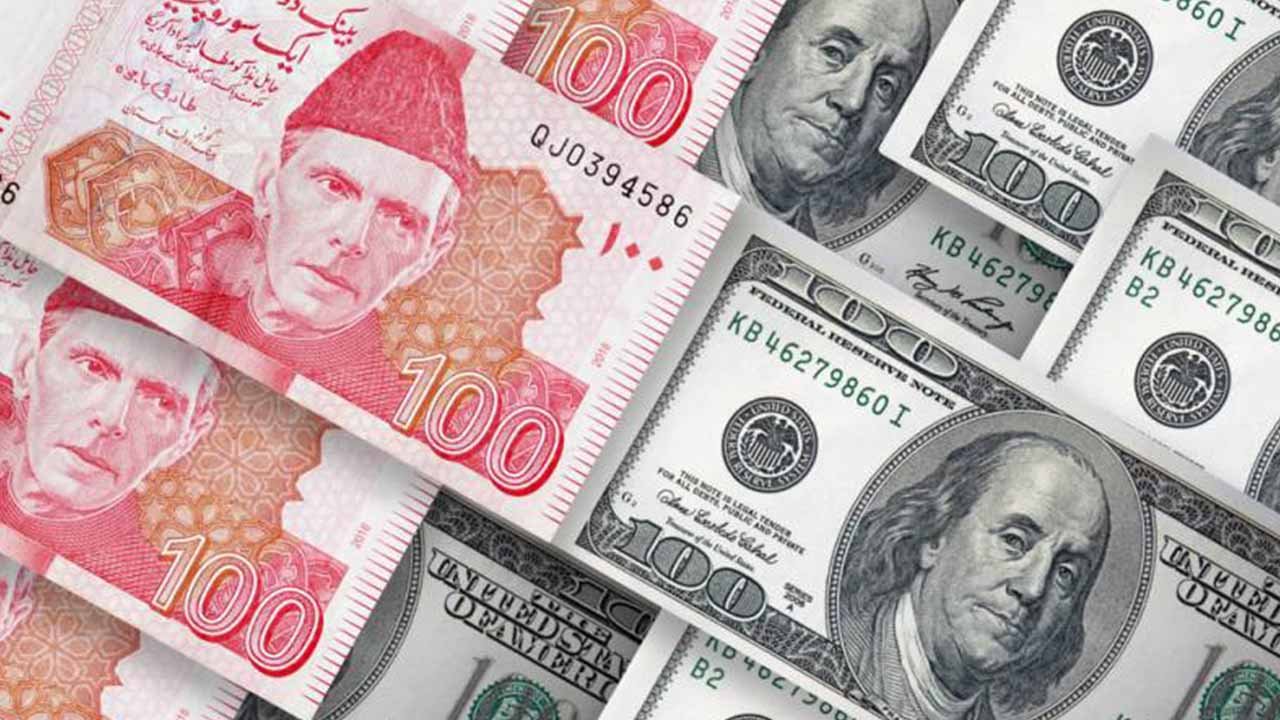
  • 7th consecutive gain: Pakistani rupee closes at Rs282.9 against US dollar

    7th consecutive gain: Pakistani rupee closes at Rs282.9 against US dollar

    In a persistent surge, the Pakistani rupee (PKR) continued its upward trend against the US dollar (USD) for the seventh consecutive session, appreciating by 0.04 per cent in the inter-bank market on Wednesday.

    According to the State Bank of Pakistan (SBP), the PKR concluded at Rs282.9, marking an increase of Rs0.11.

    In the open market scenario, the PKR experienced a decline of 25 paisa for both buying and selling against the USD, settling at Rs281.50 and Rs284.50, respectively.

    Conversely, against the Euro, the PKR maintained stability for both buying and selling, closing at Rs307.00 and Rs310.00, respectively.

    Against the UAE dirham, the PKR held steady for both buying and selling, concluding at Rs77.30 and Rs78.00, respectively.

    In comparison, against the Saudi Riyal, the PKR saw a gain of 10 paisa for both buying and selling, closing at Rs75.20 and Rs75.90, respectively.

    This positive trend follows Tuesday’s marginal gain, where the rupee settled at Rs283.01 against the US dollar.

    The dollar index, which experienced a slight dip on Tuesday, maintaining a mostly flat position at 102.20, had previously reached a four-month low of 101.76 last week.

    In the backdrop of global trade concerns and heightened geopolitical tensions in the Middle East, with Yemen’s Iran-aligned Houthi forces conducting attacks on ships in the Red Sea, oil prices surged past $80 a barrel on Wednesday.

    Brent crude futures observed an 89-cent increase, or 1.1 per cent, reaching $80.12 a barrel by 1101 GMT, while US West Texas Intermediate crude climbed 93 cents, or 1.3 per cent, to $74.87 a barrel.

  • PKR gains ground against US dollar, closes at Rs283.26

    PKR gains ground against US dollar, closes at Rs283.26

    The Pakistani rupee (PKR) continued its positive trajectory against the US dollar (USD) for the fourth consecutive session, appreciating by 0.09 per cent in the inter-bank market on Friday.

    According to the State Bank of Pakistan (SBP), the rupee concluded at Rs283.26, reflecting an increase of Re0.25.

    Thursday witnessed a marginal gain in the rupee, settling at Rs283.51 against the US dollar.

    The ongoing optimism is buoyed by the recently released trade figures for November, revealing a noteworthy 13.16 per cent month-over-month (MoM) and a substantial 31.72 per cent year-over-year (YoY) reduction in the trade deficit, amounting to $1.89 billion.

    Export figures exhibited a robust 7.66 per cent YoY surge, reaching $2.57 billion, while imports saw a YoY decline of 14.47 per cent, totaling $4.46 billion.

    On the global front, the US dollar remained near four-month lows on Friday, influenced by the increasing likelihood of US interest rate cuts in the coming year.

    Conversely, the euro and pound found support as their respective central banks reiterated the necessity for sustained higher interest rates.

    Amid an eventful week for central banks, clarity emerged regarding the potential timing of interest rate cuts following Federal Reserve Chair Jerome Powell’s statement during Wednesday’s meeting.

    Powell suggested that the tightening of monetary policy is likely concluding, with discussions about cuts coming “into view.”

    The Fed’s projections imply a 75-basis-point cut next year from the current level, leading to a broad decline of the greenback against its counterparts.

    The dollar index stands at 102.05, not far from the four-month low of 101.76 observed on Thursday, marking a 1.9 per cent decrease and its most significant weekly decline since July.

    Oil prices, a pivotal indicator of currency dynamics, saw an increase on Friday, set to achieve their first weekly rise in two months.

    This positive shift is attributed to a bullish forecast from the International Energy Agency (IEA) regarding oil demand for the upcoming year, coupled with a weaker dollar.

    Brent futures rose by 21 cents to $76.82 a barrel at 0918 GMT, while US West Texas Intermediate (WTI) crude also experienced a 21-cent climb, reaching $71.79.

  • Gold price increases to Rs213,100 per tola

    Gold price increases to Rs213,100 per tola

    The gold price in Pakistan witnessed an increase on Friday, with the cost of 24-karat gold rising by Rs1,300 per tola, settling at Rs213,100 in today’s session.

    The Karachi Sarafa Association reported that the closing price for 10 grammes of 24-karat gold was Rs 182,698, indicating a loss of Rs1,114.
    Meanwhile, 10 grammes of 22-karat gold saw an increase, reaching Rs166,452, up by Rs1,022.

    In contrast, the silver prices remained unchanged in the domestic market, with 24-karat silver and 10 grammes of 24-karat silver closing at Rs2,580 and Rs2,211.93, respectively.

    It is noteworthy that domestic gold prices are influenced by fluctuations in international prices and changes in the local currency’s interbank exchange rate.

    Despite intraday gains, the Pakistani rupee (PKR) is facing its fourteenth consecutive loss against the USD.

    The depreciation of PKR against the USD leads to an increase in the value of PKR-denominated gold since gold is denominated in US dollars.

    On the global front, international gold prices experienced a decline, marking the second consecutive week of losses. International spot gold is currently trading at $1,954.29, down by 0.20 per cent for the day.

  • Pakistani rupee settles at Rs290.86 against US dollar, marking 14th consecutive gain

    Pakistani rupee settles at Rs290.86 against US dollar, marking 14th consecutive gain

    In continuation of its recent positive streak, the Pakistani rupee extended its upward trajectory against the US dollar for the 14th consecutive session, marking a gain of 0.31 per cent in the interbank market on Monday.

    According to data released by the State Bank of Pakistan (SBP), the rupee closed at Rs290.86, representing a noteworthy increase of Re0.9 in the inter-bank market. This sustained appreciation trend has seen the rupee make significant gains, amounting to 5.28 per cenr, or Rs16.24, since its record low of Rs307.1 against the US dollar on September 5 in the inter-bank market.

    In the previous week, the rupee experienced a further appreciation of 1.74 per cent, concluding positively for all five trading sessions and settling at Rs291.76 against the US dollar in the inter-bank market by the end of the week. Additionally, the rupee’s performance in the open market has strengthened, reducing the ‘premium’ to negligible levels and aligning with the benchmarks established by the International Monetary Fund (IMF).

    While several experts attribute the rupee’s recent gains to administrative and enforcement measures, some argue that these increases reflect the currency’s intrinsic value when speculative influences and negative sentiment are excluded.