Tag: vacancies

  • How to apply for government jobs in Pakistan

    How to apply for government jobs in Pakistan

    Many Pakistanis prefer working for the government over the private sector since a government job not only offers job stability but also other incentives that encourage people to work for the government.

    People from middle-class households typically favour working in the government. We have addressed the benefits that favour government jobs for career advancement because there are some benefits that the private sector does not provide.

    Here are some advantages of government jobs:

    Working hours

    The benefit of choosing government employment over the private sector is the flexible work schedule. In contrast to positions in the private sector, when employees are occasionally required to work a little bit extra, occupations in the public sector have set working hours. However, in some government agencies, working overtime is required without compensation.

    Job security

    The biggest benefit of working for the government is job stability. And there is no job security in the private sector. In contrast, there is very little chance that any government official will lose his or her job.

    Employees in the private sector are displaced like houseflies because this perk is only available to those working in government sectors.

    Promotions

    Another crucial element in the public sector is the promotional benefit. Promotion in government positions is always contingent on how well and how long you work. However, this can occasionally be both a benefit and a drawback because someone who is above average may not be able to develop as quickly as his typical counterparts.

    Benefits and perks

    Next in the government sector are the perks and rewards. As a result, the government sector offers a wide range of benefits, including pension plans, retirement benefits, health care, housing loans, and childcare, among others. However, several significant private sector enterprises do provide such advantages.

    In the government sector, however, retirement becomes crucial since it guarantees the longevity of a person’s career.

    Read more: Here’s how to use a SIM in a non-PTA approved phone

    Lesser stress

    The government sector, as we’ve seen above, has set working hours. Therefore, these hours will result in reduced work-related stress. The best time frame to finish the work on time and in the best way is offered by government jobs, which is not available in the private sector.

    Respect

    Along with all these advantages, working for the government increases respect. Everyone will treat you with respect if you work for the government because of your authority and position.

    Salary increments

    The other best perk of working for the government is, of course, wage increases. As a result, your compensation will rise without regard to how well you perform. So this is fantastic if you are an average performer.

    These multiple advantages provided by government employment may provide you a competitive advantage over the private sector. A government career is the ideal option, though, if you are considering doing something exceptional in the future and need job fulfilment.

    Where to apply?

    There are currently hundreds of job vacancies on the websites below:

    National Job Portal

    Punjab Jobs Online

    These websites allow interested applicants to submit applications for several Pakistani government job positions. Numerous openings, from entry-level to senior-level ones, are listed on these websites.

    Applying for posts in the following categories is possible: BPS-01, BPS-04, BPS-05, BPS-09, BPS-11, BPS-14, BPS-15, EVP/SEVP, G-1, G-2, G-3, G-4, Grade-10, Grade-11, Grade-12, MP-I, MS-VIII, PPS-10 and PPS-12.

    People who live in Punjab can apply for the most recent positions that the Punjab Government has posted, including those in the departments of planning and development, energy, and health care, by visiting Punjab Jobs Online.
  • Here are the latest income tax rates and slabs for salaried class

    Here are the latest income tax rates and slabs for salaried class

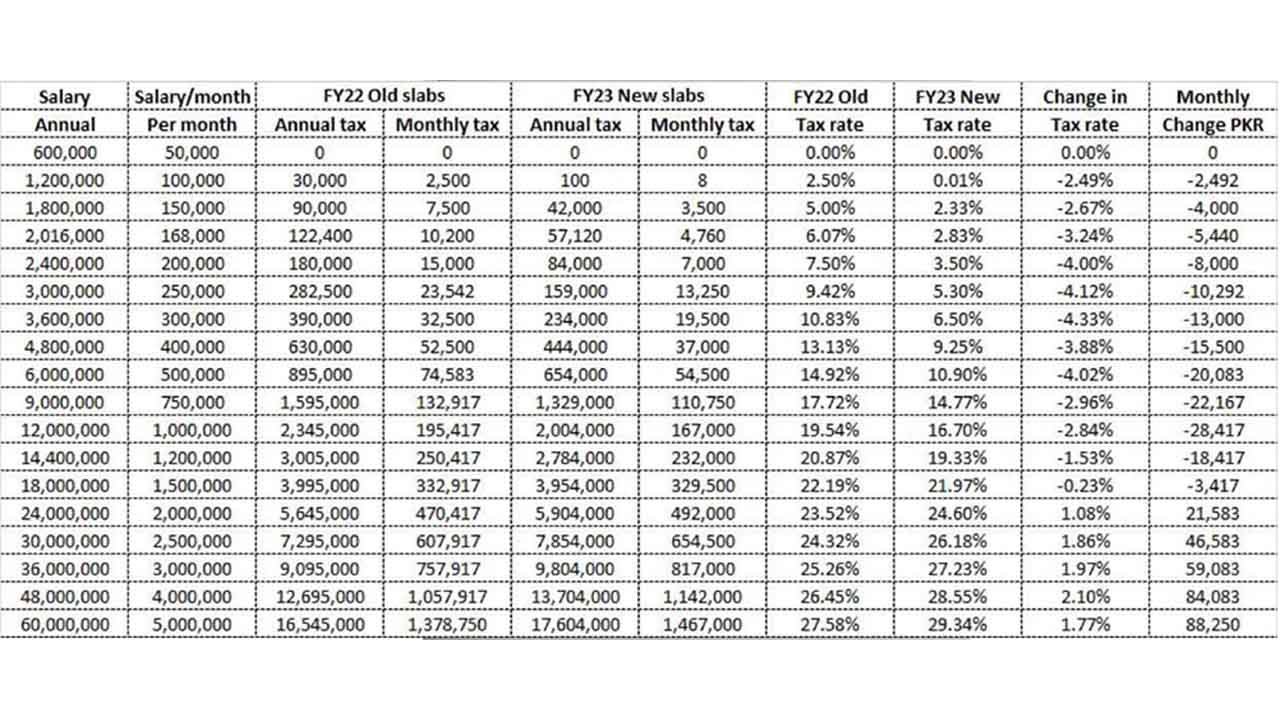
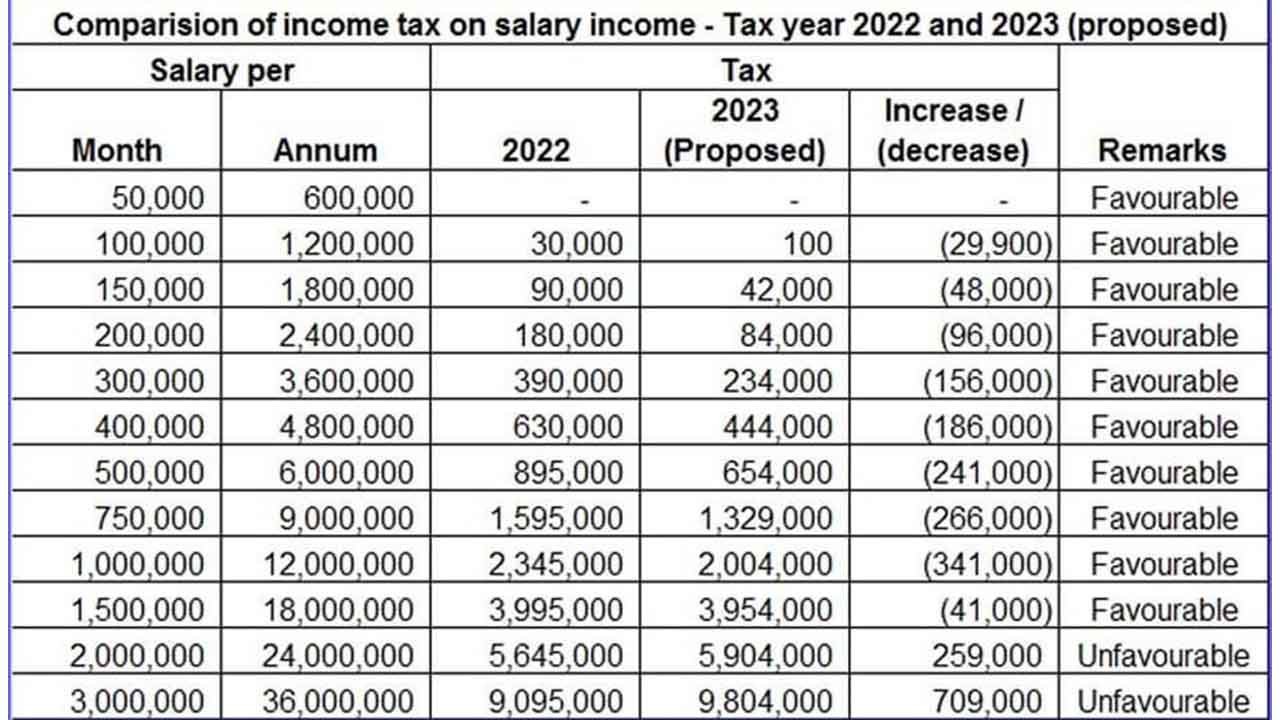
    In the budget for fiscal year 2022-23, the government has exempted those earning up to Rs100,000 per month from paying income tax, up from Rs50,000 last year.

    For the salaried income group, the latest budget is a mishmash as the government reduced tax rates and the number of slabs while eliminating available credit through the omission of deductible allowance for profit on debt and tax credit for investment in shares, health insurance, and pension funds.

    Moreover, the government has released a revamped list of income tax brackets for salaried employees. There were previously 12 slabs, which have now been shrunk to seven.

    Here are the new slabs:

    1. For annual incomes less than Rs600,000 (below Rs50,000 per month)
    2. For a yearly income of Rs600,000-Rs1.2 million (Rs50,000 to Rs100,00 per month).
    3. For annual earnings of Rs1.2m-2.4m (Rs100,000 to Rs200,000 per month)
    4. For annual earnings of Rs2.4m-3.6m (Rs200,000 to Rs300,000 per month)
    5. For earnings of Rs3.6m-6m (Rs300,000 to Rs500,000 per month)
    6. For annual earnings of Rs6m-12m (Rs500,000 to Rs10,00,000 per month)

    For annual earnings of more than $12 million (more than $100,000 per month), income tax is not to be levied on people earning between 0 and Rs600,000 per year (where income from salary exceeds 75 per cent of taxable income). A nominal amount of Rs100 will be subtracted per year from those earning between Rs600,000 and Rs1.2 million.

    Employees getting paid more than Rs1.2 million but less than Rs2.4 million per year will be levied 7 per cent of the amount that exceeds Rs1,200,000 in the third slab.

    An employee getting paid Rs1,400,000 per year will be levied 7 per cent of Rs200,000 (Rs1,400,000 minus Rs1,200,000 since that is the amount exceeding Rs1,200,000).

    As per the latest budget resolution, the government recommended an income tax rate of 20 per cent on small business earnings, 42 per cent on banking, and 29 per cent on related companies.

  • Pakistan’s textile sector witnesses a significant downturn in growth

    Pakistan’s textile sector witnesses a significant downturn in growth

    Pakistan’s Economic Survey 2021-22 reveals that the textile industry expanded by 3.2 per cent during July-March in fiscal year 2021-22, compared to 8 per cent in the same period last year, demonstrating a considerable setback in progress.

    The poundage of the textile sector has declined from 20.9 to 18.16 per cent in QIM 2015-16, but it remains the highest among all LSM sectors, according to Brecorder.

    Woolen segment production grew the most, with a 38.9 per cent increase in blankets, a 27.9 per cent increase in woollen and carpet yarn, and a 19.1 per cent increase in woollen worsted cloth. Yarn and cloth production increased by 0.7 per cent and 0.3 per cent, respectively.

    Congruent production units, invariant capacity and elevated cotton prices owing to demand and supply gap disruptions have moderated the growth momentum of the cotton sector, stated the Economic Survey 2021-22 document, unveiled by Finance Minister Miftah Ismail.

    “Depreciation of PKR restrained the production of jute, as most of the raw material is imported from Bangladesh. However, surge in imports of textile machinery, rising demand for concessionary financing from textile firms and high exports of this sector showing a sizable improvement in the textile sector,” it added.

    With a weight of 6.08 in the LSM, wearing garments has been detached from the textile sector. It grew by 34 per cent compared to 35.6 per cent compression.

    The sector has been growing traction both locally and internationally, with garment production increasing by 34 per cent during the time frame. Garment exports have also increased by 33.9 per cent in aspects of volume.

    Textile is Pakistan’s most valuable manufacturing sector, with the widest production chain and intrinsic value addition ability at each point of the process, from cotton to ginning, spinning, fabric, dyeing and printing, made-ups and garments.

    This sector accounts for well almost one-fourth of industrial value addition and employs approximately 40 per cent of the industrial workforce. Textile products have maintained an average share of about 61.24 per cent in national exports, excluding seasonal volatility.

    In the meantime, knitwear exports decreased by 4.8 per cent in quantity while increasing by 34.1 per cent in value during the period under review. Towel exports totaled $819.6 million, up from $692.1 million, representing an increase of 18.4 per cent in value and 5.1 per cent in quantity.

    The ready-made garment industry has surfaced as a crucial small-scale industry in Pakistan, and it is a good source of providing employment opportunities to many people with a very low capital investment. Exports increased by 33.9 per cent in quantity and 26.2 per cent in value from 27.8 million dozen to 37.3 million dozen worth $2.8 billion, up from $2.27 billion in the same period last year.

    Meanwhile, Pakistan exported synthetic textile fabrics worth $343.59 million in comparison to $269.20 million in the same period last year, representing a 27.6 per cent increase. In terms of volume, synthetic textile exports fell by 33.6 per cent.

    The ceremony was also attended by Ahsan Iqbal, Minister of Planning, Development, and Special Initiatives, Khurram Dastgir, Federal Minister of Power, and Aisha Ghaus Pasha, Minister of State for Finance and Revenue.

    Furthermore, the survey underscored the key features of the government’s policies aimed at restoring macroeconomic stability and putting the economy on a growth path. Addressing the launch event, Miftah Ismail stated that the government has avoided a default due to the difficult decisions made by the current administration. He said that the country is now on the path of stability.

  • Plan under consideration to increase govt officials’ salaries by 5 to 15 per cent

    Plan under consideration to increase govt officials’ salaries by 5 to 15 per cent

    In an attempt to lessen the impact of inflation, the government is considering raising salaries by 5 to 15 per cent in the upcoming fiscal year’s budget, according to The News, following the Pay and Pension Commission’s inability to submit a report ahead of the next budget, which led to the prime minister’s decision to grant another extension.

    The deadline for submitting the Commission’s recommendation is being extended to June 30, 2022, as per a statement released by the Finance Division.

    According to top official sources, the former PTI-led government gave a 15 per cent allowance to officials in grades 1 to 19, effective March 1, 2022.

    The new Shehbaz Sharif-led administration, on the other hand, pledged a 10 per cent rise in the pension and a 25,000-per-month minimum wage.

    A Finance Ministry official stated that in the future budget, pay for grades 1 to 19 may be boosted by another 5-10 per cent as an adhoc allowance. Employees in grades 20 to 22 could see a pay raise of 10 per cent to 15 per cent.

    In addition, due to increased inflationary pressures, the government may boost pensions by 5-10 per cent. The Regulation Wing of the Ministry of Finance has completed its internal work in this regard. It was also resolved to form a Pay and Pension Commission, which would make recommendations.

    The commission was established by the PTI-led government in April 2020, and its chairman was former Secretary of Finance Abdul Wajid Rana. He resigned, however, and former bureaucrat Nargis Sethi was named Chairperson of the Pay and Pension Commission. She later quit as well.

    The Pay and Pension Commission was then chaired by Zafar Ahmed Khan, who was chosen by the government. So far, the commission has requested two extensions but has yet to present its recommendations.

    The text box was included in the Pay and Pension Commission’s terms of reference, which included studying the adequacy of the existing basic pay scale system and evaluating the current salaries of government employees.

    Read more: Petrol quota for ministers, govt officials in Sindh lowered by 40 per cent

    It also includes making recommendations for streamlining existing classification from BPS 1-22, studying the separation of existing basic pay scales for dedicated departments, occupations/cadres, reviewing special scales such as management grades, management position scales (MP Scales), special professional pay scales (SPPS); project pay scales, and proposing measures for uniformity and improvement, reviewing admissible regular allowances, special incentives, and all other supplementary pay scales.

    The panel was tasked with identifying current shortcomings in the Pension Scheme and making recommendations for a corrective revision along with ensuring the current model’s long-term viability and recommending a system with clear timelines that is more efficient and sustainable given the available resources.