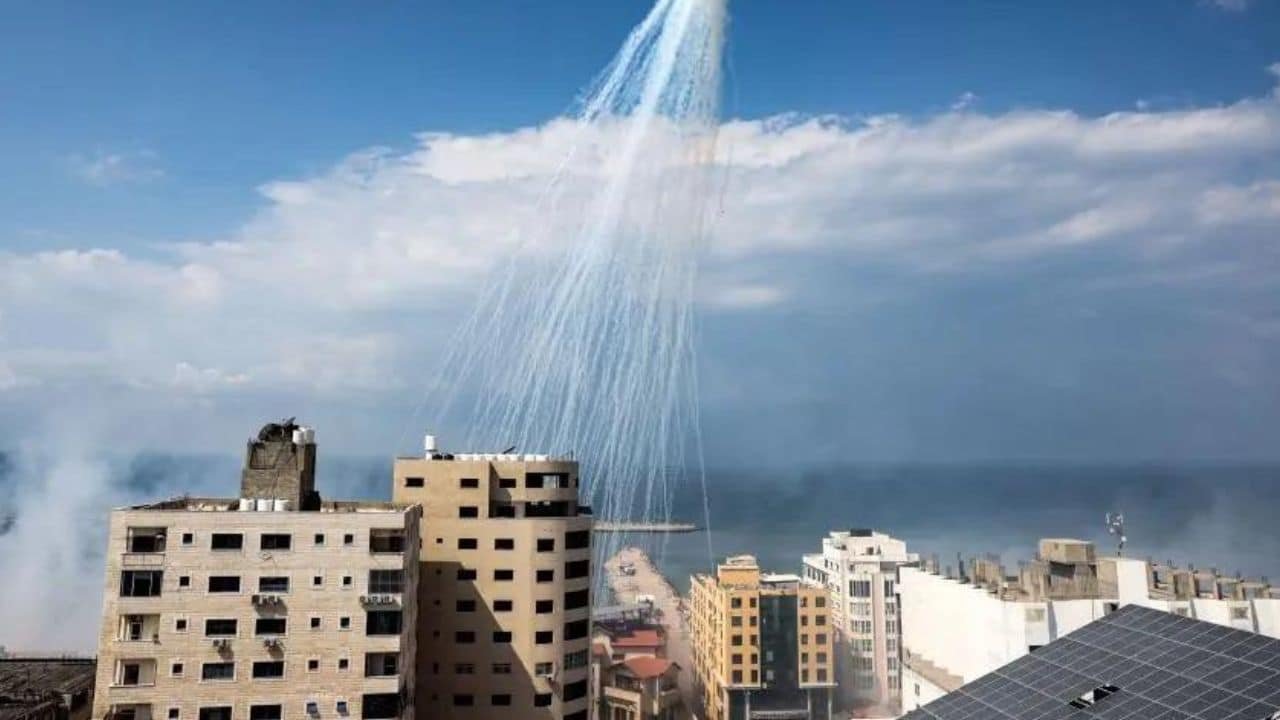
As Israel’s onslaught on Gaza enters the seventh day, multiple sources claimed that Israeli forces were using white phosphorus to attack Gaza and Lebanon.
Israeli warplanes and artillery use internationally #prohibited_white_phosphorus, destroying #Al_Karama neighborhood in the northwest of Gaza City with a continuous series of airstrikes. There are casualties and wounded, while ambulances and civil defense vehicles are unable to… pic.twitter.com/ym7zfKqIBH
— State of Palestine – MFA (@pmofa) October 10, 2023
The Palestinians claimed the news to be true but many news platforms did not verify the reports.
LATEST: Shocking! Israel air force drops white Phosphorus bombs on Gaza#Israel #Gaza #IsraelPalestineWar #Hamas #طوفان_الأقصى | #IsraelAtWar | #طوفان_القدس #GazaUnderAttack pic.twitter.com/mlHxjpnr2z
— Shehzadiii~ (@KHAAAN2743) October 11, 2023
The use of white phosphorus has now been confirmed by Human Rights Watch.
BREAKING: Israel has used white phosphorus in military operations in Gaza and Lebanon, putting civilians at risk of serious and long-term injuries.
White phosphorus causes excruciating burns and can set homes afire. Its use in populated areas is unlawful.https://t.co/TbCVA5Qynp pic.twitter.com/4UKANHTwI2
— Human Rights Watch (@hrw) October 12, 2023
“Human Rights Watch verified videos taken in Lebanon and Gaza on October 10 and 11, 2023, respectively, showing multiple airbursts of artillery-fired white phosphorus over the Gaza City port and two rural locations along the Israel-Lebanon border, and interviewed two people who described an attack in Gaza,” they have stated.
Additionally, Lama Fakih, Middle East and North Africa director at Human Rights Watch explains that “Any time that white phosphorus is used in crowded civilian areas, it poses a high risk of excruciating burns and lifelong suffering,
“White phosphorous is unlawfully indiscriminate when airburst in populated urban areas, where it can burn down houses and cause egregious harm to civilians.”
The United Nations has banned the use of incendiary weapons in 1972.
“Incendiary weapons are weapons or munitions designed to set fire to objects or cause burn or respiratory injury to people through the action of flame, heat, or combination thereof, resulting from a chemical reaction of a flammable substance such as napalm or white phosphorus,” the UN says.
Nonetheless, it is not the first time that Israel has used white phosphorus against Palestinians. One of the first recorded incidents of its use is from 2009.