Tag: war on terror

  • Didn’t join politics to know prices of ‘aaloo, tamatar’ but for country’s youth: PM Khan

    Didn’t join politics to know prices of ‘aaloo, tamatar’ but for country’s youth: PM Khan

    Prime Minister (PM) Imran Khan on Sunday said that he did not join politics to know the prices of aaloo and tamatar (potatoes and tomatoes) but decided to become a politician for the sake of the country’s youth. 

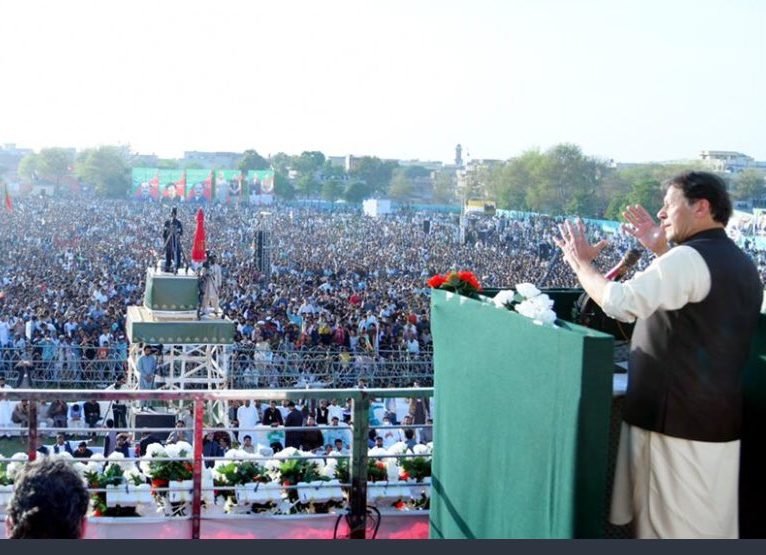
    Addressing a rally in Hafizabad, the premier promised the people of Punjab that his government will work on the development of the province, something which he claimed would be “unprecedented” in the history of the country.

    I joined politics for the sake of the country’s youth: Khan

    “I didn’t join politics to know the prices of potatoes and tomatoes. I joined it for the sake of the country’s youth,” the premier said. “If we want to become a great nation, we will have to support the truth, and this is what I have been preaching for the last 25 years.”

    The prime minister reiterated that Pakistan wanted equal ties with all the countries. “But as a prime minister of a country with a 220 million population, it is my first and foremost duty to protect people’s rights and interests of the country. I will not allow any policy that harms our motherland. I will not compromise on the national interests just for seeking the pleasure of any country,” he stressed.

    Past PMs of Pakistan used to “shiver with fear” whenever they met a United States president

    Taking a dig at the Opposition and how leaders of different parties criticised him for issuing statements against the European Union (EU) envoys, the premier said that in the past, prime ministers of Pakistan used to “shiver with fear” whenever they met a United States president and used Pakistan People’s Party (PPP) Chairperson Bilawal’s slip of the tongue “kaanpein taang rahi hoti thein” as an example. 

    The premier went on to say that when he rebuked the envoys of European countries for asking Pakistan to explicitly condemn Russia for attacking Ukraine, Shehbaz Sharif, Maulana Fazlur Rehman, and Bilawal Bhutto-Zardari were “trembling”.

    “My criticism of EU was justified,” the premier said, adding that Opposition leaders, including Maulana Fazlur Rehman, Shehbaz Sharif, and Bilawal Bhutto-Zardari thought it was “grave injustice” to chide EU envoys.

    The prime minister said that whenever a foreign diplomat came to meet Shehbaz Sharif, he would quickly change into a suit and a tie.

    “Since I know the West better than everyone else, I can assure that they do not respect people who polish their boots,” he said. “They respect nations who stand up for themselves.” 

    On the ‘terrorist’ living in London

    PM Imran Khan also spoke about the US War on Terror and the ensuing drone attacks in Pakistan, calling it a “violation of human rights”. He also talked about a “terrorist” living in London for the last 30 years, saying that this terrorist was responsible for the killing of more people than those killed by US drones. 

    He said he once told a group of European representatives whether they would allow the use of drones against a terrorist and criminal sitting in London who had killed scores of people in Karachi. The premier was apparently referring to Muttahida Qaumi Movement (MQM) founder Altaf Hussain.

    PM Imran further said the United States carried out 400 drone strikes inside Pakistan from 2008 to 2013 but governments led by PPP and Pakistan Muslim League-Nawaz (PML-N) never opposed them.

    “We want cordial relations with all countries but will not compromise on national interest… I would not bow down to anyone nor would I allow the nation to give in before anyone.”

    On the contrary, the prime minister said, he had always opposed those attacks, staged sit-ins, and gave statements in the United States and the United Kingdom, calling these attacks a grave violation of basic human rights and global principles.

    ‘One-million-strong’ power show at D-Chowk

    The premier then talked about transforming Pakistan into an exemplary welfare society, based on the model of the State of Madinah.

    “I formed Rehmatul-Lil-Alameen Authority in the country so that every Pakistani child becomes aware of the life and teaching of the Holy Prophet (PBUH) and stay on the path of the truth.”

    As part of the PTI-led government’s strategy to thwart the Opposition’s no-trust bid, it was decided during the meeting that a one-million strong rally would be staged at Islamabad’s D-Chowk ahead of the no-confidence motion in the lower house of parliament.

  • ‘Extremely unfair to allege Pakistan supported Taliban’: PM Khan

    ‘Extremely unfair to allege Pakistan supported Taliban’: PM Khan

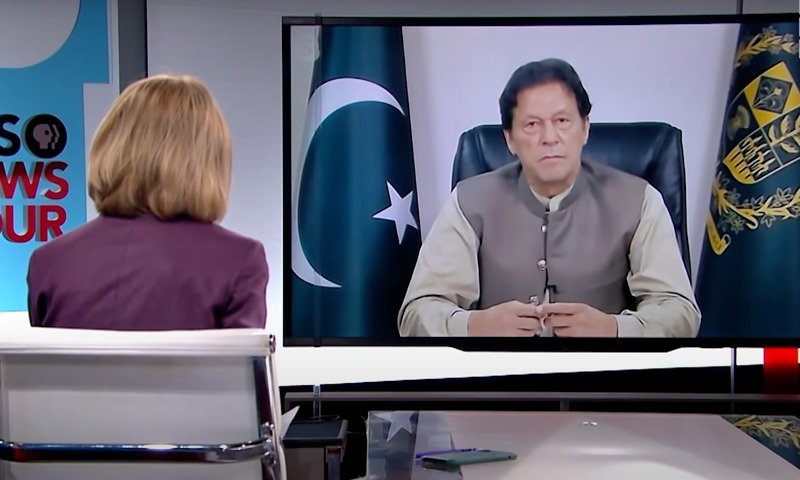
    In an interview with PBS Newshour, Judy Woodruff asked Prime Minister Imran Khan about Pakistan’s alleged military, intelligence, and financial support to Afghanistan.

    PM Khan replied, “I find this extremely unfair.”

    The premier added that when the Pakistani government decided to join the United States (US) war on terror, “we were devastated by that”. PM said that 70,000 Pakistanis died because of the US war in Afghanistan, even when “Pakistan had nothing to do with what happened” [in New York on September 11, 2001].

    Al Qaeda was based in Afghanistan at the time, and “there were no militant Taliban in Pakistan,” he said, maintaining that Pakistan was not involved in the 9/11 attacks.

    “We had nothing to do with it,” he repeated, regretting that the war in Afghanistan had resulted in a loss of $150 billion to Pakistan’s economy.

    PM further added that the US “really messed it up in Afghanistan”.

    Judy Woodruff asked PM Imran about claims of Taliban sanctuaries being present in Pakistan and a report about 10,000 fighters crossing the border to help the group in Afghanistan.

    “Judy, for a start, this 10,000 Taliban — or as the Afghan government says, Jihadi fighters — have crossed over, is absolute nonsense. Why don’t they give us evidence of this?” asked PM Imran.

    To a question about safe-havens, the premier questioned where the sanctuaries are located in Pakistan.

    “Taliban are not some military outfit. They are normal civilians. If there are some civilians in these camps, how is Pakistan supposed to hunt these people down? How can you call them sanctuaries?” asked PM Imran.

    “First of all, they tried to look for a military solution in Afghanistan when there was never one. And people like me, who know the history of Afghanistan and kept saying there isn’t a military solution, were called anti-American. I was called Taliban Khan,” said PM Imran.

    The prime minister further added, “I don’t know what the objective was in Afghanistan, whether there was to have some nation-building, democracy or liberate the women. Whatever the cause was, the way they went about it was never going to be the solution.”

    “When they finally decided there is no military solution, unfortunately, the bargaining power of the American or North Atlantic Treaty Organisation (NATO) forces had gone,” said the premier.

    “Once they had reduced the troops to barely 10,000 and when they gave the exit date, Taliban thought they had won,” said PM Imran. He added that it is difficult right now to ask the group to compromise or “force them” to take a political solution.

    “It’s very difficult to force them into a political solution because they [Taliban] think that they won,” said PM Imran.

    PM Khan further said, “Pakistan is hosting over three million Afghan refugees. And what we fear is that a protracted civil war would [bring] more refugees. And our economic situation is not such that we can have another influx.”

    “Secondly, the worry is that the civil war will flow into Pakistan because Taliban are ethnic Pashtuns. Now there are more Pashtuns on our side of the border than Afghanistan. And so the worry is if this goes on, the Pashtuns on our side will be drawn into it and that is also the last thing we want,” said PM Imran.

  • ‘To blame Pakistan is extremely unfair’: PM Khan tells Ashraf Ghani

    ‘To blame Pakistan is extremely unfair’: PM Khan tells Ashraf Ghani

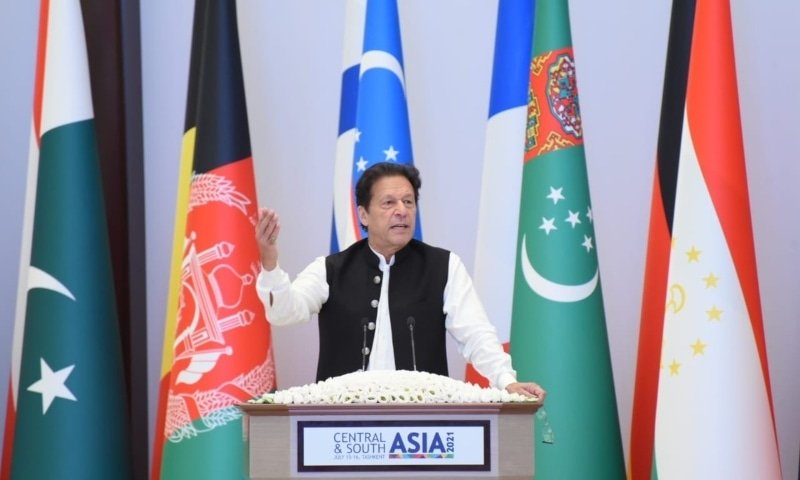
    Prime Minister Imran Khan on Friday countered Afghan President Ashraf Ghani’s claims about Pakistan’s “negative role” in the Afghan peace process and said, “To blame Pakistan for what is going on in Afghanistan I feel is extremely unfair.” PM Khan was addressing the international conference on “Central and South Asia Regional Connectivity: Challenges and Opportunities” during his two-day visit to Uzbekistan.

    “President Ghani, let me just say that the country that will be most affected by turmoil in Afghanistan is Pakistan. Pakistan suffered 70,000 casualties in the last 15 years. The last thing Pakistan wants is more conflict,” the premier said

    “To blame Pakistan for what is going on in Afghanistan, I feel, is extremely unfair,” said PM Khan.

    “Why would I come to Kabul if I was not interested in peace? The whole idea was that Afghanistan should have looked at Pakistan as a partner in peace. I feel really disappointed that we have been blamed for what is going on in Afghanistan.”

    “I repeat, the last thing we want is turbulence in Afghanistan,” said PM Khan.

    PM Khan added, “What is happening in Afghanistan is over two decades of conflict, deep divisions, and unfortunately the United States (US) seeking a military solution when there was no one. When there were 150,000 Nato troops in Afghanistan, the greatest military machine, that was the time to ask the Taliban to come on the table. Why were the Taliban to compromise when their existing date was given and with only a few thousand American troops left? Why would they [Taliban] listen to us, when they are sensing victory?”

    He said that he had a conversation with Uzbekistan President Shavkat Mirziyoyev about how all the neighbours in the region can help the Afghan peace process. 

    “All neighbours are interested in a peace settlement in Afghanistan. There are already three million Afghan refugees in Pakistan. We are petrified that will be another flow of refugees coming in. We do not have the capacity or the economic strength to bear another flow of refugees. So I can assure you again, if any country is trying its best of all the countries in the world, it’s Pakistan today.”

     Director-General Inter-Services Intelligence (ISI) Lt Gen Faiz Hameed Friday rejected the allegations of infiltration levelled by Afghan President Ashraf Ghani.

     Afghan president had levelled unsubstantiated accusations against Pakistan, saying that 10,000 fighters had crossed over into Afghanistan from Pakistan.

    “If talks fail, we will fight the Taliban,” said Ghani. “This is the last chance for peace,” he had said.

    DG ISI explicitly stated that these accusations against Pakistan are not true. In fact, infiltration is being done from Afghanistan, he added.

    “We want peace in the neighbouring country as a peaceful and stable Afghanistan is in the interest of Pakistan and other countries,” DG ISI said.

    He said that Pakistan is not supporting any group in Afghanistan. “We are interested in a negotiated settlement among all the Afghan groups,” added DG ISI.

  • ‘Pakistan can be partners in peace with US but never in conflict’: PM Imran Khan

    ‘Pakistan can be partners in peace with US but never in conflict’: PM Imran Khan

    Speaking at the budget session of the National Assembly (NA), Prime Minister Imran Khan once again reiterated, “Pakistan could be partners with the United States in peace but never in conflict.”

    PM gave his speech the day after the government smoothly passed Finance Bill 2021-22.

    The premier further added, “When we gave so many services, did they (US) praise us or acknowledge our sacrifices? Instead, they called us a hypocrite and blamed us. Instead of appreciating us, Pakistan was bad-mouthed.”

    “I have never felt more insulted than when Pakistan decided to join the US war on terror. We decided to become a frontline state for the American war on terror. I questioned repeatedly: what did we have to do with the war?”

    “Does any country get involved in another’s [war] and lose 70,000 lives?” he asked. “What they (US) said, we kept doing. Musharraf said in his book that he took the money [from the US] and sent people to Guantanamo.”

    The premier termed it as the “darkest period of our history” when Pakistan did not know which was a friendly country and which was not. “Have you heard of a friendly country carrying out attacks and drone strikes in your country?”

    In an apparent reference to Muttahida Qaumi Movement (MQM) founder Altaf Hussain, PM asked: “A terrorist is sitting in London for 30 years. Will they give us permission to attack him? If they will not give permission then why did we? Are we subhuman or half-human or do our lives not have enough value?”

    The prime minister said that in a meeting of the US Senate, an American commander had claimed that the Pakistan government did “not tell the truth” to its citizens. “We disrespected ourselves, the world did not disrespect us.”

    He said that overseas Pakistanis had to hide their faces after the raid by US Navy Seals in Abbottabad in which Osama Bin Laden was killed because “our ally did not trust us enough to carry out the attack”.

    The premier warned that a “very tough time” was coming for Pakistan in view of the situation in Afghanistan. He said he was thankful that the US had recognised there was no military solution to the conflict in the neighbouring country but it should have done so earlier.

    “Afghanistan has never accepted interference from outside. If we were proactive and a self-respecting government, stood up and said [the US] is wrong, then we would have protected them (Afghans).”

    The premier clarified that Pakistan did not want to have favourites or choose sides, insisting “whoever Afghan people choose, we are with them”.

    PM Khan invited the Opposition to work with the government on election reforms. “After 1970, all elections have been controversial,” he said.

    PM Khan said the recently held by-polls and Senate elections were made controversial as well.

    He said the government had been considering ways to make the elections acceptable to all the parties, and reminded the Opposition that election reforms would benefit democracy.

    “The time has come to make the country’s elections acceptable to everyone,” he said.

    He recalled that when he wanted to give a speech in parliament after being elected prime minister, the Opposition refused to allow him to speak claiming that the election had been rigged. “When Trump claimed the same, the media asked him to give proof.”

    “We did the same in 2013. We had asked the then government to hold recounting in four constituencies. We had to approach the court and as a result in all four constituencies, rigging was proved.”

    “After trying our best, we came to the conclusion that EVMs (electronic voting machines) are the only solution,” he said.

    The premier said his government was “ready to listen” if the Opposition had any other “advice” regarding the electoral reforms.

    The premier said if the country steps back from this aim, then there would be “no justification for Pakistan’s existence”.

    PM Imran Khan said that the budget reflected the PTI’s three core principles — justice, humanity, and self-sufficiency and praised his financial team for ensuring the budget embodies all three.

    He said that when the PTI government came to power, the country’s biggest problem was the current account deficit. “[Pakistan] had the biggest deficit in history, which means our currency was in danger. Our team was new and we had no experience … We took many difficult steps to stabilise our economy which were painful.”

    The premier thanked countries like the UAE, Saudia Arabia, and China for “protecting us from defaulting”.

    The premier lauded National Command and Operations Centre (NCOC) chief Asad Umar and Special Assistant to Prime Minister on Health Dr Faisal Sultan, the Pakistan Army, and others involved in curbing the spread of coronavirus.

    “The Opposition attacked us, we were criticised for two months for no lockdowns,” he recalled.

    PM Imran Khan said Pakistan’s coronavirus situation was better as compared to countries in the region and it was “due to Allah’s blessings and the poor people’s prayers”.

    He cited the government’s “protection” of agriculture as well as record crop production for the 3.9 per cent economic growth rate in fiscal year (FY)22.

    “We incentivised export industry and it grew 17 per cent in one year. Our exports in June were $2.7 billion, which is an all-time record for the month in Pakistan,” added PM Khan.

    “We held negotiations with the construction industry and tried to give them incentives because when [that industry] starts running, then 30 related industries also start running,” he added.

    Pakistan was moving towards becoming an Islamic welfare state for the first time, said PM Khan.

    “By next month, we will have data on all income levels of families and according to that, the lowest 40-50pc families will be brought under the [government’s social welfare] programme. We have dedicated Rs500bn for them,” he said, disclosing that it would include interest-free loans, health cards, technical education, low-cost housing, and scholarships.

    A day earlier, the National Assembly had passed the budget for the fiscal year 2021-2022, with a majority vote amid a dismal showing by the Opposition.

    PM gave his speech the day after the government smoothly passed Finance Bill 2021-22.

    The premier further added, “When we gave so many services, did they (US) praise us or acknowledge our sacrifices? Instead, they called us a hypocrite and blamed us. Instead of appreciating us, Pakistan was bad-mouthed.”

    “I have never felt more insulted than when Pakistan decided to join the United States war on terror. “We decided to become a front line state for the American war on terror. I questioned repeatedly, what did we have to do with the war?” said PM Khan.

    “Does any country get involved in another’s [war] and lose 70,000 lives?” he asked. “What they (US) said, we kept doing. [Former president Pervez] Musharraf said in his book that he took money and sent people to Guantanamo [Bay jail].

    The premier termed it as the “darkest period of our history” when Pakistan did not know which was a friendly country and which was not. “Have you heard a friendly country doing attacks and drone strikes in your country?” he asked.

    “A terrorist is sitting in London since 30 years. Will they give us permission to attack him?” he questioned in an apparent reference to Muttahida Qaumi Movement (MQM) founder Altaf Hussain.

    “If they will not give permission then why did we? Are we subhuman or half human or do our lives not have enough value?” he said angrily.

    The prime minister said that in a meeting of the US Senate, an American commander had claimed that the Pakistan government did “not tell the truth” to its citizens. “We disrespected ourselves, the world did not disrespect us.”

    He said that overseas Pakistanis hid their faces after the raid by US Navy Seals in Abbottabad in which Osama Bin Laden was killed because “our ally did not trust us enough to carry out the attack.”

    The premier warned that a “very tough time” was coming for Pakistan in view of the situation in Afghanistan. He said he was thankful that the US had recognised there was no military solution to the conflict in the neighbouring country but it should have done so earlier.

    “Afghanistan has never accepted interference from outside. If we were proactive and a self-respecting government stood up and said [the US] is wrong, then we would have protected them (Afghans).”

    The premier clarified that Pakistan did not want to have favourites or choose sides, insisting “whoever Afghan people choose, we are with them.”

    PM Khan invited the Opposition to work with the government on election reforms. “After 1970, all elections have been controversial,” he said.

    PM Khan said the recently held by-polls and Senate elections were made controversial as well.

    He said the government had been considering ways to make the elections acceptable to all the parties, and reminded the Opposition that election reforms would benefit democracy.

    “The time has come to make the country’s elections acceptable to everyone,” he said.

    He recalled that when he wanted to give a speech in parliament after being elected prime minister, the opposition refused to allow him to speak claiming that the election had been rigged, adding, “When [former United States president Donald] Trump claimed the same, the media asked him to give proof.”

    “We did the same in 2013. We had asked the then government to hold recounting in four constituencies,we had to approach the court and as a result in all four, rigging was proved.

    “After trying our best, we came to the conclusion that EVMs (electronic voting machines) are the only solution,” he said.

    The premier said his government was “ready to listen” if the opposition had any other “advice” regarding the reforms.

    The premier said if the country steps back from this aim, then there would be “no justification for Pakistan’s existence”.

    PM Imran Khan said that the budget reflected the PTI’s three core principles — justice, humanity, and self-sufficiency and praised his financial team for ensuring the budget embodies all three.

    He said that when the PTI government came to power, the country’s biggest problem was the current account deficit. “[Pakistan] had the biggest deficit in history which means our currency was in danger. Our team was new and we had no experience … We took many difficult steps to stabilise our economy which were painful.”

    The premier thanked countries like UAE, Saudia Arabia and China for “protecting us from defaulting”.

     The premier lauded National Command and Operations Centre (NCOC) chief Asad Umar and Special Assistant to Prime Minister on Health Dr Faisal Sultan, the Pakistan Army, and others involved in curbing the spread of coronavirus.

    “The opposition attacked us, we were criticised for two months for no lock downs,” he recalled.

    PM Imran Khan said Pakistan’s coronavirus situation was better as compared to countries in the region and it was “due to Allah’s blessings and the poor people’s prayers”.

    He cited the government’s “protection” of agriculture as well as record crop production for the 3.9 per cent economic growth rate in fiscal year (FY)22.

    “We incentivised export industry and it grew 17 per cent in one year. Our exports in June were $2.7 billion which is an all time record for the month in Pakistan,” added PM Khan.

    “We held negotiations with the construction industry and tried to give them incentives because when [that industry] starts running, then 30 related industries also start,” he added.

    Pakistan was moving towards becoming an Islamic welfare state for the first time, said PM Khan.

    “By next month, we will have data on all income levels of families and according to that, the lowest 40-50pc families will be brought under the [government’s social welfare] programme. We have dedicated Rs500bn for them,” he said, disclosing that it would include interest-free loans, health cards, technical education, low-cost housing and scholarships.

    A day earlier, the National Assembly had passed the budget for the fiscal year 2021-2022, with majority vote amid a dismal showing by the Opposition.
  • ‘PM calling OBL a martyr was a slip of the tongue’: Fawad Chaudhry

    Prime Minister Imran Khan referring to slain Al-Qaeda leader Osama bin Laden as a “martyr” last year was a “slip of the tongue”, Information Minister Fawad Chaudhry clarified in Geo News programme, ‘Jirga’.

    “Pakistan has voted in the UN on the war on terror [against militants], we are a voter on a [UN] list that declared Osama bin Laden and Al-Qaeda terrorists,” said Fawad Chaudhry.

    “Pakistan has sacrificed the most in the war against terrorism,” Chaudhry added.

    In an interview with Afghanistan’s Tolo News, Foreign Minister Shah Mahmood Qureshi skipped a question when asked if Osama bin Laden was a martyr. Qureshi paused for a few seconds and then said, “I will let that pass.”

    Senior Afghan journalist Lotfullah Najafizada had originally asked Qureshi about PM Khan calling Osama bin Laden a martyr. The foreign minister responded that the PM was quoted out of context. “Out of context. He was quoted out of context. And, a particular section of the media played it up.

    When asked to comment on why the foreign minister hesitated in answering a question on the premier’s statement on bin Laden, Fawad Chaudhry said Shah Mahmood Qureshi wanted to put the issue behind him and move forward.

    Addressing the National Assembly in June last year, PM Khan recalled how the Americans had conducted an operation in Abbottabad and “killed Osama Bin Laden — martyred him”.

  • ‘Pakistan wants a civilised relationship with the US’: PM Khan

    Prime Minister Imran Khan recently gave an interview to The New York Times about Pakistan’s planned future strategy once the United States (US) leaves Afghanistan and said that in the past, the US kept expecting more from Pakistan, while previous governments “tried to deliver what they were not capable of”.

    The interview was published on June 25, when US President Joe Biden had his first face-to-face meeting with his Afghan counterpart, Ashraf Ghani, at the White House.

    Replying to a question related to Pakistan’s future relationship with the US after the withdrawal of American troops from Afghanistan, PM Khan said that Pakistan has always had a closer relationship with the United States than neighbouring India.

    “After 9/11, Pakistan again opted to join the US war on terror. Now, after the US leaves Afghanistan, basically Pakistan would want a civilised relationship, which you have between nations, and we would like to improve our trading relationship with the US,” he said.

    Mr Khan recalled that Pakistan has had a closer relationship with the United States than other nations in the region, such as India, and was a US partner in the war against terrorism, an argument used by previous Pakistani rulers as well without much success.

    “Now, after the US leaves Afghanistan, basically Pakistan would want a civilised relationship, which you have between nations, and we would like to improve our trading relationship with the US,” the prime minister replied.

    “Unfortunately, the relationship during the war on terror was a bit lopsided,” he said, adding, “It was a lopsided relationship because [the] US felt that they were giving aid to Pakistan, they felt that Pakistan then had to do US’s bidding. And what Pakistan did in terms of trying to do the US bidding cost Pakistan a lot … 70,000 Pakistanis died, and over $150 billion were lost to the economy because there were suicide bombings and bombs going on all over the country.”

    Asked if Pakistan was still using its leverage with the Taliban to move the peace talks towards a deal, Mr Khan said: “Pakistan has used the maximum leverage it could on the Taliban.”

    The prime minister said Pakistan has been emphasising to the Taliban that they should not go for a military victory because it would only lead to a protracted civil war. And since the Taliban are primarily a Pashtun movement, this will have two effects: Another influx of refugees into Pakistan and upset Pakistan’s efforts to lift its economy through trade, he explained.

    ‘We have signed very good trade deals with the Central Asian republics, but we can only go there through Afghanistan. If there is a civil war, all that goes down the drain,’ he said.

    “Let me assure you, we will do everything except use military action against the Taliban. I mean, we will do everything up to that,” Mr Khan said, adding: “All sections of our society have decided that Pakistan will take no military action.”

    The premier was also questioned whether Indo-Pakistan relations would improve if the Modi government leaves power. In response, he said that he “knows India better than any other Pakistani”.

    He said that he has had “love and respect from India [more] than anyone because cricket is a big sport”.

    “And the best way would be if India and Pakistan had a normal, civilised trading relationship. It would benefit both countries,” the PM said he told Modi.

    “So we tried. Didn’t get anywhere. I think that it is a particular ideology of the (Hindu nationalist group) Rashtriya Swayamsevak Sangh (RSS), which Narendra Modi belongs to, which just came up against a brick wall. And therefore the answer to your question is yes. Had there been another Indian leadership, I think we would have had a good relationship with them. And yes, we would have resolved all our differences through dialogue.”

    When asked if Pakistan would consider it an Indian win if Kashmir’s status quo remains the same, PM Imran Khan said that it would be a “disaster for India.”

    “[That is because] it will just mean that this conflict festers on and on. And so as long as it festers, it’s going to stop there being any relationship — normal relationship — between Pakistan and India.”

    The premier was questioned about Pakistan’s relationship with China and how it affects both the US and India. In response, he said that he finds it “very odd” that China and the US would become great rivals. 

  • Australian special forces killed Afghan prisoner to make room on plane: US marine

    Australian special forces killed Afghan prisoner to make room on plane: US marine

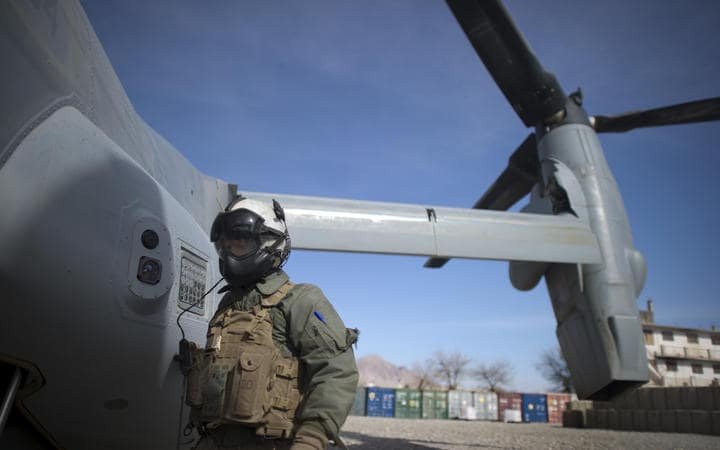
    A United States Marine Corps (USMC) helicopter crew chief accused Australian special forces of killing a hog-tied Afghan prisoner after being told he would not fit on the US aircraft coming to pick them up.

    The marine told ABC Investigations he was a door gunner providing aerial covering fire for the Australian soldiers of the 2nd Commando Regiment during a night raid in mid-2012. The operation took place north of the HMLA-469 base at Camp Bastion in Afghanistan’s Helmand Province.

    It was part of a wider joint Australian special forces-US Drug Enforcement Administration (DEA) campaign targeting illicit drug operations that were financing the Taliban insurgency. “We had done the drug raid, the Aussies actually did a pretty impressive job, wrangling all the prisoners up,” Josh said.

    “We just watched them tackle and hogtie these guys and we knew their hands were tied behind their backs.”

    He says the commandos then called up the US aircraft to pick them and about seven prisoners up. He says the Americans only had room on the aircraft for six. “And the pilot said, ‘That’s too many people, we can’t carry that many passengers.’ And you just heard this silence and then we heard a pop. And then they said, ‘OK, we have six prisoners’.

    “So it was pretty apparent to everybody involved in that mission that they had just killed a prisoner that we had just watched them catch and hogtie,” he said.

    Josh says neither he nor any of his crew spoke about what had just happened.

    “We were all being recorded on our comms,” he said.

    “All of us were pretty aware of what we just witnessed, and kind of didn’t want to be involved in whatever came next.”

    Josh says he later discussed the incident with his crewmates after returning to Camp Bastion.

    “This was the first time we saw something we couldn’t morally justify, because we knew somebody was already cuffed up, ready to go, taken prisoner and we just witnessed them kill a prisoner,” he said.

    “This isn’t like a heat of the moment call where you’re trying to make a decision. It was a very deliberate decision to break the rules of war.

    “I think that was the first thing that happened that didn’t quite sit right with us, where we were like, ‘OK, there’s no excuse, there’s no ambiguity, there’s no going around this one’.”

  • US officials regret treating Pakistan as a friend; say Islamabad ‘played double game’

    US officials regret treating Pakistan as a friend; say Islamabad ‘played double game’

    United States (US) officials in the Bush and Obama administrations believe the “treatment of Pakistan as a friend” in Washington’s trillion-dollar Afghanistan war was a “critical error” as Islamabad “played a double game”, The Washington Post has revealed in its “secret history” of the 18-year-long conflict.

    The American newspaper on Monday published US government papers in an extensive report, ‘The Afghanistan Papers’. It contains confidential government papers containing around 2,000 pages of previously unpublished notes of interviews with US generals and diplomats who were key decision makers along with aid workers and Afghan officials playing a direct role in the conflict.

    As per the report, US officials admit that despite receiving advanced weapons and billions of dollars in aid, “Pakistan never supported America and was playing a double game in the conflict as early as 2002”.

    The Print quoted the report as claiming that Pakistan had joined the US in the war against terror, “but it also supported the Taliban and the al-Qaeda leadership in finding safe havens and logistics support on its soil and in Afghanistan”.

    The documents obtained by the Post also revealed that senior US officials failed to tell the truth about the Afghan war throughout the 18-year campaign and they “kept making rosy pronouncements they knew to be false while hiding unmistakable evidence that the war had become unwinnable”.

    Over the past 18 years, over 775,000 American troops have served in Afghanistan, many repeatedly. Over 2,300 US troops died in the conflict while 20,589 returned home wounded, according to the US Defense Department figures. At present, over 13,000 American troops are serving in Afghanistan whereas several thousand veterans suffer from Post Traumatic Stress Disorder (PTSD).

    The George W Bush administration had invaded the country in 2001 to hunt down 9/11 perpetrator, al-Qaeda chief Osama Bin Laden, and destroy his terror organisation.

    However, the war, continued by Presidents Barack Obama and Donald Trump, eventually became a prolonged conflict, with the US objectives changing over the years to include fighting the ultraconservative religious faction Taliban and installing a democratic Afghan government.

    In the ‘Lessons Learned’ interviews, other US officials said the Bush administration compounded its first mistake by “treating Pakistan as a friend”.

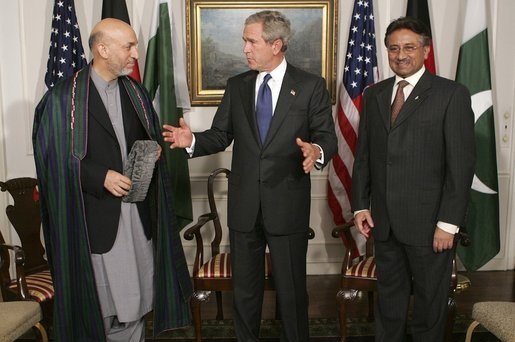
    This was because of former military ruler General (r) Pervez Musharraf, who had allowed the Pentagon to use Pakistani airspace and US intelligence agency CIA to track al-Qaeda leaders in Pakistani territory.

    “As a result, the Bush White House was slow to recognise that Pakistan was simultaneously giving covert support to the Taliban, according to the interviews,” the Post said in its report.