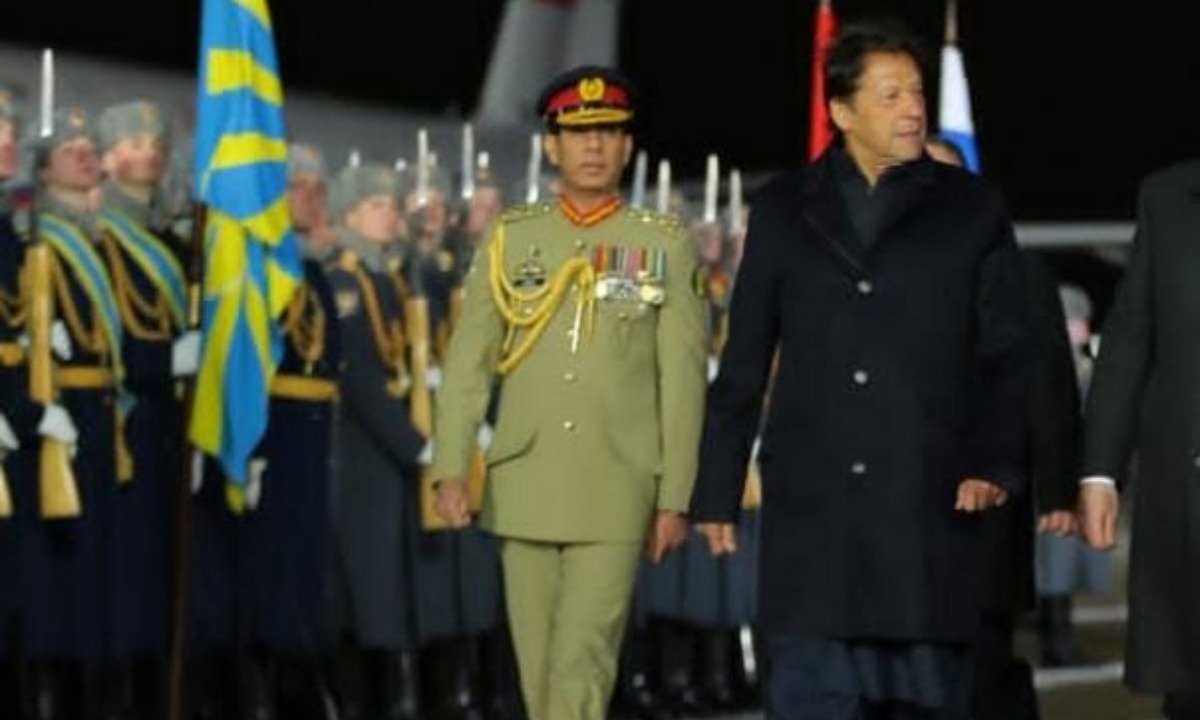
Prime Minister (PM) Imran Khan landed in Moscow for a two-day visit — from February 23-24 — to push for the construction of a long-delayed, multi-billion-dollar gas pipeline to be built in collaboration with Russian companies.
Deputy Foreign Minister of Russia Igor Morgulov welcomed the Prime Minister.
While walking on the red carpet, PM Khan said, “What a time I have come, so much excitement.”
“Let me tell you, we are so excited to come to Moscow,” said PM Khan.
PM Khan will see Russian President Vladimir Putin in a one-on-one three-hour-long meeting today at 3pm Pakistan time, amid the Ukraine-Russia crisis.
The meeting has been extended from one hour to three. Earlier the meeting was to be held for one hour.
Russian President Vladimir Putin announced a military operation in Ukraine on Thursday with explosions heard soon after in the capital and other parts of the country.
In an interview ahead of his trip, PM Imran Khan had expressed concern about the situation in Ukraine and the possibility of new sanctions and their effect on Islamabad’s budding cooperation with Moscow.
A right-wing television presenter, Glenn Beck has thanked Prime Minister Imran Khan in a series of tweets for his support in getting Afghans out from the war-torn country.
Beck, who has a charity organisation called Mercury One, has been assisting with evacuations from Afghanistan since the Taliban’s takeover, revealed that Pakistan’s leadership helped with the release and departure of three flights.
8. Because of his tireless leadership and support from the military and civilian resource of Pakistan, three planes were released by the Taliban, who have been businesslike in their responses to adhere to their agreement to let civilian allies of the NATO forces leave the country
In a tweet, he stated that, “We reached out and asked numerous leaders in political and civil society around the world for help. The silence was shocking as was the outpouring of help on a humanitarian basis. We received an immediate response to our requests from PM Imran Khan of Pakistan who then acted on his willingness to assist.”
3. we received an immediate response to our requests from Prime Minister Imran Khan of Pakistan who then acted on his willingness to assist.Collectively, we transcended religious differences, political divides, national boundaries and local dynamics – it was about a humanitarian
“Pakistan has once again proven to be a valued partner in all seasons for the United States, despite recent criticisms from some sections of US media,” he added.
10. Each of their lives are worth the time, energy, money, passion and love spent by so many people, organizations and the PM of Pakistan. Other media outlets may have their own agenda for criticizing him over the last few days, don’t
While stressing that the US should recognize Pakistan’s assistance at this point, he tweeted, “We will not forget this support that has enabled America and its allies to make good on their promises to those who helped them without pause or reflection.”
12. collectively recognise Pakistan’s assistance at this juncture. We will not allow anyone to forget this moment that enabled America and its allies to make good on their promises to those that helped them without pause or reflection. More tomorrow
“Let no one fool you, the International Federation of Association Football (FIFA) female athletes are out because of you and Imran Khan”, he concluded in his last tweet.
Earlier, there were reports that six chartered planes by Beck’s charity were seeking to evacuate at least 1,000 people, including more than 100 Americans. During his efforts, his supporters praised him for doing “more for Americans than all of Biden’s supporters combined.”
According to the statement made by Pakistan Foreign Office in early September, 12,000 people had been evacuated from Afghanistan with the help of Pakistan.
Beck is one of the most controversial media figures in the US and quite well-known among conservative circles.
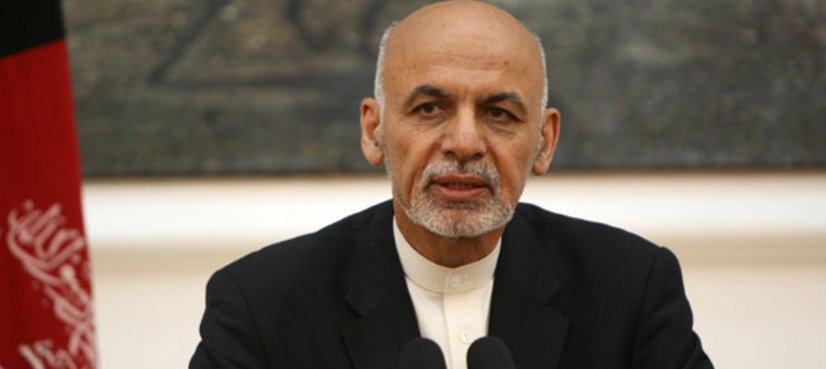
Afghan President Ashraf Ghani said Saturday the remobilisation of Afghanistan’s armed forces was a “top priority”.
In a televised speech, Ashraf Ghani said, “As a historic mission, I will not let the imposed war on people cause more deaths.”
“In the current situation, the remobilisation of our security and defence forces is our top priority, and serious steps are being taken in this regard,” he said.
د هیواد د روان وضعیت په اړه د جمهوررئیس محمد اشرف غني پیغام — پیام رئیس جمهور محمد اشرف غنی در خصوص وضعیت جاری در کشور pic.twitter.com/Pi7qRaU9OI
With the country’s second and third-largest cities having fallen into Taliban hands, Kabul has effectively become a besieged last stand for government forces who have offered little or no resistance elsewhere.
“Therefore, I have started extensive consultations inside the government with the elders, political leaders, representatives of people, and international partners on achieving a reasonable and certain political solution in which the peace and stability of the people of Afghanistan are envisaged.”
But Ghani praised the forces “that have defended the nation courageously and showed strong determination”.
Nadeem Baig has revealed that Yasir Hussain wanted the uninvited guest question to be asked himself on Vasay Chaudhry’s Ghabrana Mana hai.
The Meray Paas Tum Ho’s director appeared on Nida Yasir’s Eid Special Morning Show and almost two months after the comments landed Yasir in hot water and sparked a heated war between him and Shah, the talk show’s director Baig revealed what had led to that contentious question.
Hussain had unleashed havoc after he stated that fellow actor Nausheen Shah demanded an invitation to his and Iqra Aziz’s wedding in 2019.
The Jhooti actor, 37, was asked on Vasay Chaudhry’s talk show Ghabrana Mana Hai about whether any one of the attendees at his wedding had showed up without getting invited, to which he said he hadn’t invited Shah but she still came.
Baig shared that his associate had gone up to Hussain prior to the show and asked him if there were any funny anecdotes he would like to be questioned about.
The director said: “While he was getting his makeup done, he said, ‘Just ask me who showed up uninvited to my wedding.’”
Nida had asked Baig about the controversies related to his show. He also said that everyone criticised Vasay for asking this question but actually he told us to ask this question.
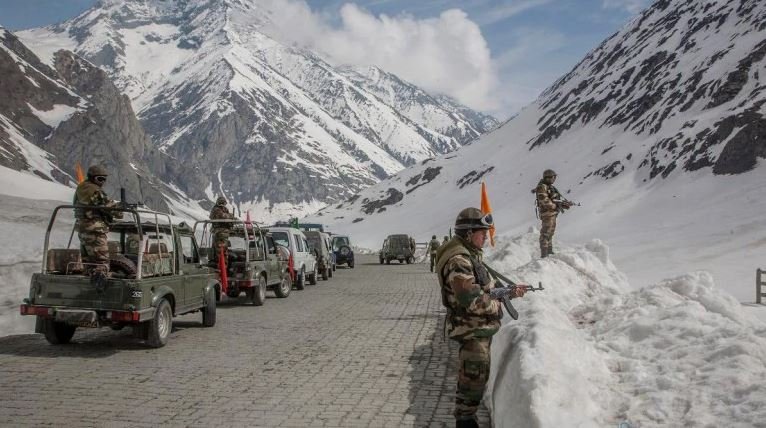
India has accused Chinese troops of meticulously preparing an attack on its soldiers on the treacherous Himalayan border, claiming they erected a tent on the Indian side, dammed a river, brought in machinery and then lay in wait with stones and batons wrapped in barbed wire, The Guardian reported.
The incident on Monday night, in which 20 Indian soldiers died and 76 were injured, was the worst violence between India and China in 45 years. China has not said whether it sustained any casualties.
Ten Indian soldiers who were reportedly captured by Chinese troops during the attack were back in India on Thursday night. China said it had not seized any Indian personnel.
Both sides continue to blame the other for the clash. China is now claiming sovereignty over the Galwan valley in Ladakh, where the attack happened, and has accused Indian troops of three times crossing into its territory. “The responsibility entirely lies with Indian side,” said Zhao Lijian, a spokesman for the Chinese ministry of foreign affairs.
India accused China of carrying out a “premeditated and planned action” on its side of the border. Satellite images of the Galwan Valley taken by Planet Labs, an imaging company, in the days before the clash appear to show increased activity on the Chinese side, including the damming of a river and the movement of troops and machinery close to the disputed and poorly defined border.
The Australian Strategic Policy Institute said its analysis of satellite images found there was “evidence that strongly suggests People’s Liberation Army forces have been regularly crossing into Indian territory temporarily on routine patrol routes”.
Indian officials said commanders from the Indian and Chinese sides had met on 13 June and agreed to each retreat back two kilometres in the Galwan valley and Pangong Lake area.
But rather than retreating, the officials said, Chinese troops erected a tent in disputed territory close to what is known as Patrolling Point 14. They said India’s 16 Bihar Regiment, led by Col Santosh Babu, dismantled the structure in an attempt to push back the PLA troops.
According to accounts given to the Hindu newspaper, when Babu and his troops later approached the Chinese side to challenge the refusal to retreat, they were ambushed by PLA forces on the steep mountain precipice. The Chinese allegedly unblocked the dammed river, releasing a rush of water to destabilise Indian soldiers, and they attacked with stones and makeshift spiked weapons.
Indian troops retaliated, it was reported, and reinforcements were summoned on both sides until there were upwards of 600 soldiers in hand-to-hand combat in the dark and icy conditions. No shots were fired.
There were reports that the Indian soldiers were unarmed, but India’s external affairs minister, Subrahmanyam Jaishankar, said: “Let us get the facts straight. All troops on border duty always carry arms, especially when leaving post. Those at Galwan on 15 June did so.”
Due to the treacherous conditions, many of the bodies of the Indian soldiers could not be retrieved until the next morning, by helicopters working with troops and border police. The injured were taken to hospitals in the Ladakh city of Leh.
India and China have agreed to continue the process of disengagement that was first agreed on 6 June, and discussions are ongoing through political and diplomatic channels. Army generals from both sides have also had three days of talks at Patrolling Point 14. However, the Indian army and air force in Ladakh remain on high alert.
Azad Jammu & Kashmir (AJK) President Sardar Masood Khan has dared Indian chief of army staff (COAS) to attack the region, adding that the armed forces of the country were ready to avert any and all attacks against its soil.
Army chief General Manoj Mukund Naravane, in his maiden press briefing as the top Indian military commander, had on January 11 said that the forces were ready to take appropriate action to gain control over Pakistan-administered Kashmir.
The statement had come five months after Indian Foreign Minister (FM) Subrahmanyan Jaishankar had said that he expected India to gain physical control over AJK one day.
“Don’t forget what has happened in the past. The armed forces of Pakistan are always ready to give a befetting response to India,” Khan reportedly said on Saturday.
Khan further said that if the United States (US) wanted to act as a mediator in resolving the Kashmir dispute, it would have to take action against the brutalities of Indian forces in held Kashmir first. “The troubled valley is a living hell. Youngsters are being imprisoned, people are being electrocuted and even kids are being labelled as enemies.”
He also thanked China for playing its role in highlighting the issue in the United Nations (UN).
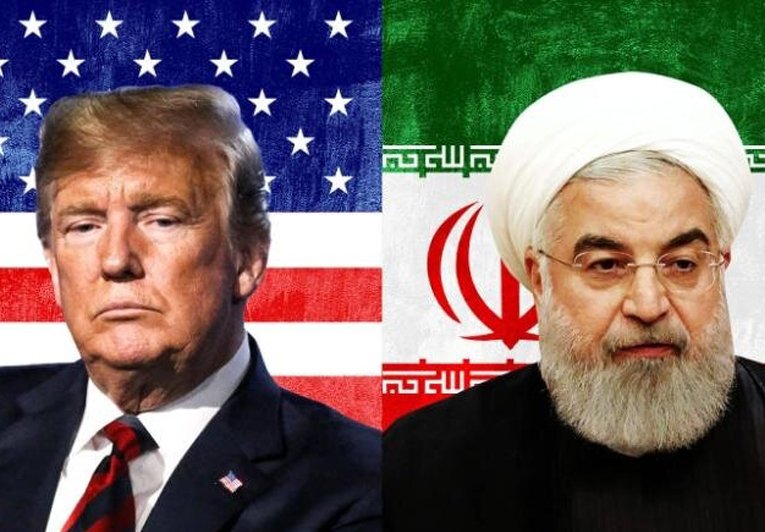
Tensions between the United States (US) and Iran have escalated to an all-time high after top Iranian commander Qassem Soleimani was killed on Friday in a US strike on Baghdad’s international airport.
The development has been confirmed by both Tehran and Washington, and the Pentagon has said that President Donald Trump “ordered Soleimani’s killing”, after a pro-Iran mob this week laid siege to the US embassy.
Following Soleimani’s death, Trump tweeted an image of the US flag without any further explanation.
The pre-dawn developments mark the most major escalation yet in a feared proxy war between Iran and the US on Iraqi soil.
Here’s everything you need to know about the dramatic escalation:
WHO WAS QASSEM SOLEIMANI?
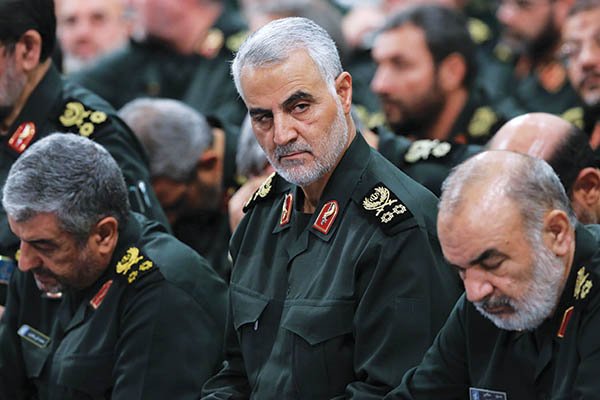
Head of Iran’s Islamic Revolutionary Guard Corps’ (IRGC) Quds Force Soleimani acquired celebrity status at home and abroad as leader of the foreign arm of the Revolutionary Guards and for his key role in fighting in Syria and Iraq.
He was instrumental in the spread of Iranian influence in the Middle East, which the US and Tehran’s regional foes Saudi Arabia and Israel have struggled to keep in check, Al Jazeera reported.
Soleimani survived several assassination attempts against him by Western, Israeli and Arab agencies over the past 20 years.
Under Soleimani’s leadership, the IRGC vastly expanded its capabilities, becoming a significant influence in intelligence, financial, and political spheres beyond Iran’s borders.
WHY WAS HE KILLED?
It all started on Sunday with US military airstrikes in Iraq and Syria that killed 25 fighters and left militias vowing revenge.
SUNDAY (DEC 29)
According to a report, the US military carried out airstrikes on five sites in Iraq and Syria against the Iranian-backed Kataeb Hezbollah militia, calling it retaliation for last week’s killing of an American contractor in a rocket attack on an Iraqi military base that it blamed on the group.
At least 25 fighters were killed and dozens wounded. The targeted group, which is a separate force from the Lebanese militant group Hezbollah, operates under the umbrella of the state-sanctioned militias known collectively as the Popular Mobilization Forces, or PMF. Abu Mahdi al-Muhandis, the deputy commander of the PMF and a founder of Kataeb Hezbollah, was also killed in the strikes Thursday that killed Soleimani in Baghdad.
The two were scheduled to meet and were leaving Soleimani’s plane at the airport when Friday’s attack occurred.
MONDAY (DEC 30)
The Iranian-backed Iraqi militia vowed to retaliate while a spokesperson for Kataeb Hezbollah denied the group was behind last week’s rocket attacks, including the one that killed the American contractor, saying Washington was using them as a pretext to attack his group.
“These forces must leave,” he said of American troops in Iraq, calling Sunday’s attack a “crime” and a “massacre”.
The Iraqi government said it would reconsider its relationship with the US-led coalition — the first time it has said it will do so since an agreement was struck to keep some US troops in the country. It called the attack a “flagrant violation’’ of its sovereignty.
TUESDAY (DEC 31)
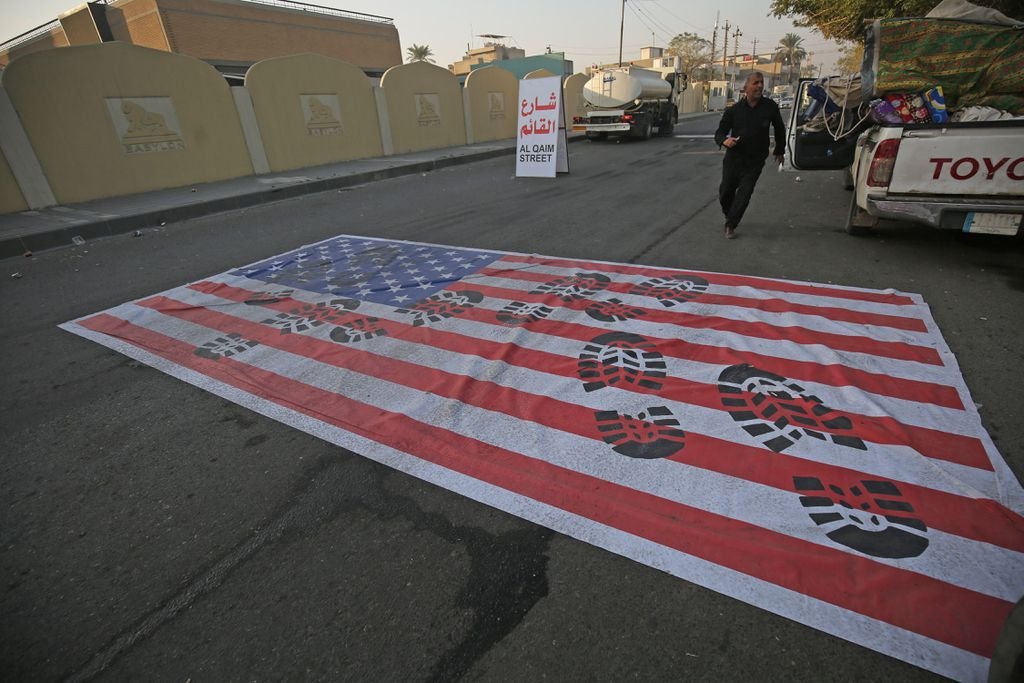
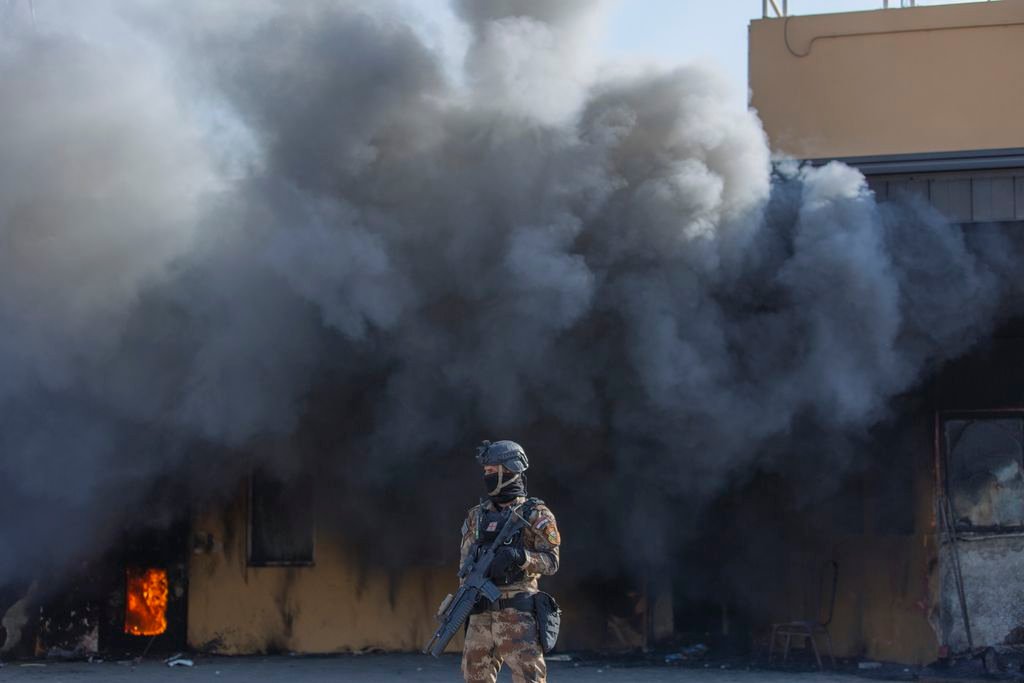
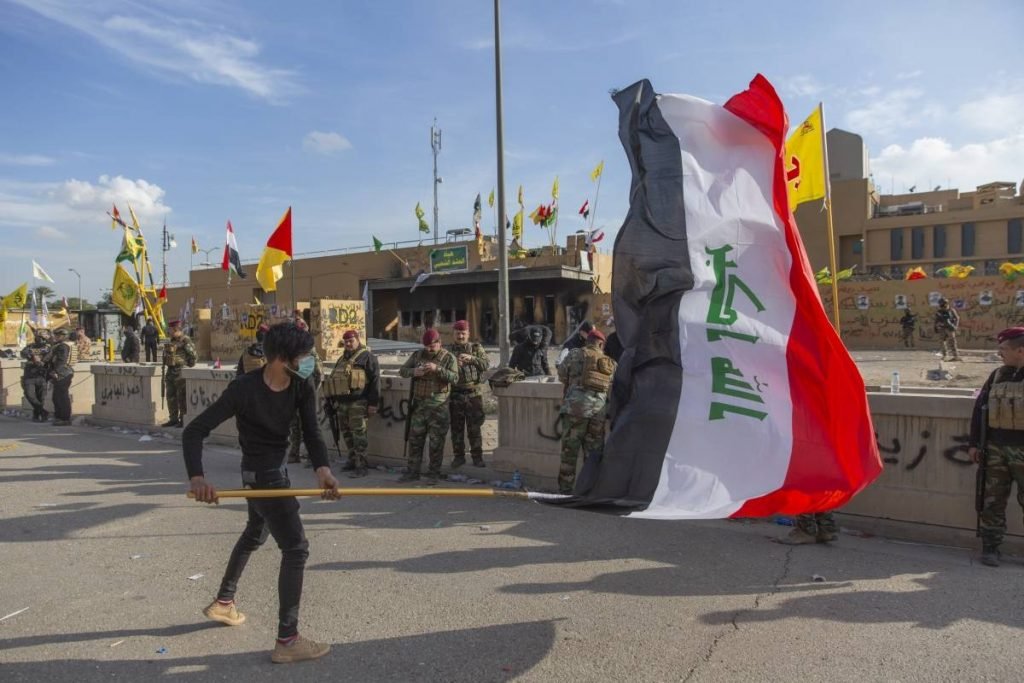
Hundreds of Iraqi militiamen and their supporters broke into the American Embassy compound in Baghdad, smashing a main door and setting fire to a reception area.
The marchers, many of them in militia uniforms, shouted “Death to America” and “Death to Israel” outside the compound, hurling water and stones over its walls. The group set up a tent camp overnight in front of the embassy and sprayed graffiti on its walls.
Some commanders of militia factions loyal to Iran joined the protesters outside the embassy in a strikingly bold move. Among them was Qais al-Khizali, the head of one of the most powerful Iranian-backed group in Iraq, who is on a US terror list, and Hadi al-Amiri, the head of the PMF, the umbrella group for the Iran-backed militias.
President Trump blamed Iran for the breach of the embassy compound in Baghdad and called on Iraq to protect the embassy.
Iran killed an American contractor, wounding many. We strongly responded, and always will. Now Iran is orchestrating an attack on the U.S. Embassy in Iraq. They will be held fully responsible. In addition, we expect Iraq to use its forces to protect the Embassy, and so notified!
There were no reports of casualties. The State Department said all American personnel were safe and that there were no plans to evacuate the embassy. Following the storming of the compound, Defence Secretary Mark Esper ordered roughly 750 additional American troops to deploy to the region, with another 3,000 placed on standby.
The political influence of the PMF has risen in recent years, and their allies dominate the parliament and the government. That has made them the target of the anti-government protesters, who set up a sprawling protest camp in central Baghdad, and who for weeks have been trying to enter the Green Zone. Iraqi security forces have beaten them back with tear gas and live ammunition, killing hundreds.
The militiamen and their supporters, however, were able to quickly enter the Green Zone on Tuesday and mass in front of the embassy, with little if any resistance from authorities. Iraqi security forces made no effort to stop the protesters as they marched to the heavily fortified Green Zone after a funeral for those killed in the airstrikes.
WEDNESDAY (JAN 1)
The Iran-backed militiamen withdrew from the American Embassy compound after two days of clashes with American security forces.
US Marines had fired tear gas in response to stones thrown by protesters but no one was reported killed and the tent camp dispersed after the PMF called on its supporters to depart, suggesting their message had “been received.”
“We rubbed America’s nose in the dirt,” said Fadhil al-Gezzi, a militia supporter.
Embassy workers and diplomats were ultimately holed up for more than 24 hours during the situation at the embassy. Ambassador Matt Tueller, the American ambassador to Iraq, was traveling at the time of the attack but State Department officials told The Hill that he would return to the embassy amid the tensions.
FRIDAY (JAN 3)
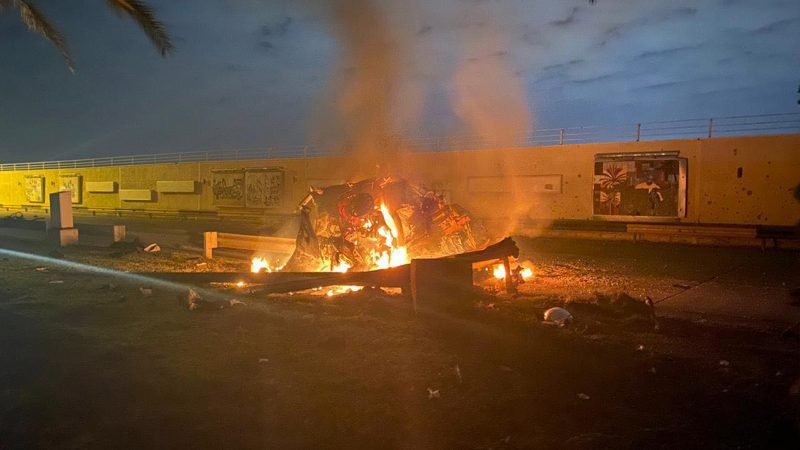
General Qassem Soleimani, Abu Mahdi al-Muhandis, and five others were killed in the early-morning airstrike at Baghdad International Airport, Iraqi officials said.
A senior Iraqi security official said the airstrike, conducted by an American drone, took place on an access road near the cargo area of the airport after Soleimani left his plane to be greeted by al-Muhandis and others. The official said the plane had arrived from either Lebanon or Syria.
A transnational non-profit organisation, International Crisis Group, has warned that any militant attack on Indian forces in held Kashmir could set off an escalation between Pakistan and India, saying that pro-freedom militants were lying low in the troubled vallet, but they were still active.
“India’s heavy-handed military operations in Kashmir over the past few years have inspired a new homegrown generation, whose ranks are likely to swell further after the latest repression,” read its report titled “10 conflicts to watch in 2020”.
Indian fighter planes had violated Pakistani airspace after a pro-freedom militant attack that killed at least 40 paramilitary soldiers in Pulwama on February 19, 2019. In retaliation, Pakistan had shot down two Indian jets over Kashmir on Feb 27, and captured an Indian pilot as well. He, however, was released by Prime Minister (PM) Imran Khan’s government as a “gesture of peace”.
The Crisis Group, which describes itself as “working to prevent wars and shape policies that will build a more peaceful world” , has warned that any Pulwama-like attack on Indian forces in Kashmir would precipitate Indian action against Pakistan.
“In a worst-case scenario, the two nuclear-armed neighbours could stumble into war,” the report said.
The Crisis Group asked New Delhi to lift the communication blackout and release political prisoners in the occupied valley, and asked Pakistan to take action against militants allegedly operating from its soil.
It further urged the international community to push Pakistan and India for talks “before it is too late”.