Tag: whatsapp

  • WhatsApp will stop working on selected iPhones, Android devices from 2021

    WhatsApp will stop working on selected iPhones, Android devices from 2021

    Facebook-owned messaging app WhatsApp has announced that it will end support on some old Android and iOS smartphones from 2021.

    As per reports, WhatsApp is ending support for Android phones and iPhones that run on a dated operating system. The app will stop working on smartphones that are not running on at least iOS 9 or Android 4.0.3 operating systems.

    The iPhone models include all iPhone 4 and earlier models. However, if you have iPhone 4S, iPhone 5, iPhone 5S, iPhone 5C, iPhone 6, and iPhone 6S, you will have to update your phone to iOS 9 or later if you want to continue using WhatsApp.

    The iPhone 6S, 6 Plus, and iPhone SE first generation can be updated to iOS 14.

    Similary, Android phones that do not have Android 4.0.3 will lose access to WhatsApp. This includes models like HTC Desire, LG Optimus Black, Motorola Droid Razr, the Samsung Galaxy S2 and some other Android phones.

    Some users may still continue to access WhatsApp on their older smartphones as their operating systems may have received a patch with an update

    How to check the operating system running on your phone?

    In order to find out what operating system your phone is running on, iPhone users can go to Settings > General > Information, where you will find information about the software version on your iPhone. 

    On the other hand, Android users can go to Settings > About Phone to see which Android version their smartphone is running on.

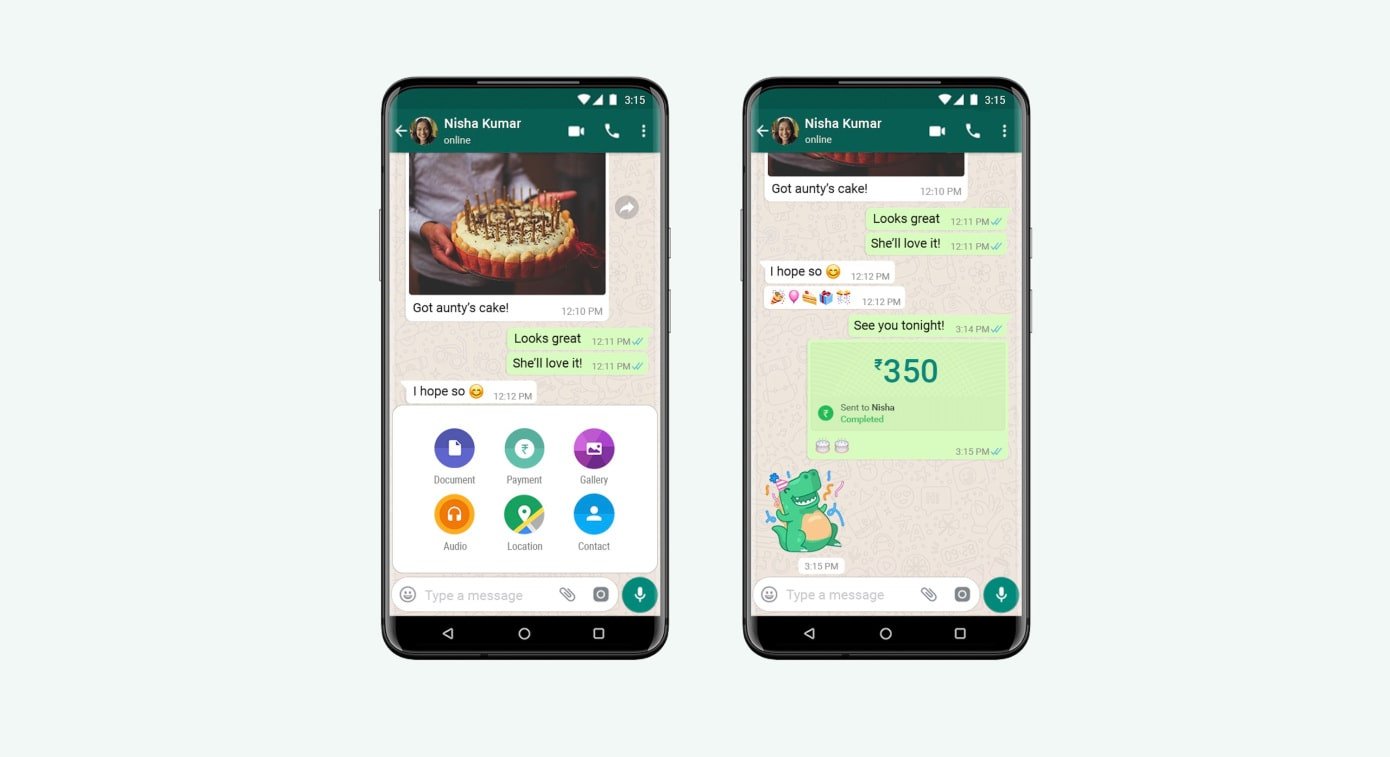
  • WhatsApp rolls out payment services in India

    WhatsApp rolls out payment services in India

    WhatsApp began testing its payment services in India with one million users in 2018, and now they are rapidly expanding the feature to capture the world’s second-largest economy.

    The Facebook-owned company said on Friday that it is rolling out payments in ten regional languages in the latest stable version of WhatsApp on Android and iOS.

    The company made the announcement when National Payments Corporation of India (NPCI), the body that runs the Unified Payment Interface (UPI) system, approved to roll out the feature in the Indian market.

    Like Google, Samsung and several other firms, WhatsApp has built its payments service in collaboration with large banks in India.

    NPCI said WhatsApp, which has accumulated over 400 million users in India, can expand payments to its users in a “graded-manner”, and to start with, it can only roll out the payments service to 20 million users and has to work with multiple banking partners.

    WhatsApp said that they are already working with leading banks like ICICI, HDFC, Axis, Jio Payment, and the State Bank of India.

    Google and Walmart are currently dominating the mobile payments market in India; together they have almost 80% of the UPI market share.

    UPI’s popularity has diminished the relevance of several firms in India, including SoftBank and Alibaba-backed Paytm that spent years building mobile wallets. Unlike UPI apps, mobile wallets are not interoperable with other mobile wallets and levy a small fee to consumers.

    “With UPI, India has created something truly special and is opening up a world of opportunities for micro and small businesses that are the backbone of the Indian economy. India is the first country to do anything like this. I’m glad we were able to support this effort and work together to help achieve a more digital India. I want to thank all our partners who’ve made this possible. When people can access financial tools, they’re more empowered to support themselves and others or start a business. Long term, we need more innovation that gives people control over their money, and making payments easier is a small step that can help,” said Mark Zuckerberg, Chief Executive Officer (CEO) of Facebook, in a video posted on Friday.

    Facebook itself has made a big push in e-commerce in the past year. And if WhatsApp gains traction with payments, it could open more avenues for its parent firm.

  • WhatsApp to charge business customers for ‘some services’

    WhatsApp has decided to charge its business account users for some of the services it provides to help it “build a business of its own”.

    According to a statement issued by the WhatsApp, it will charge “business customers for some of the services we offer, which will help WhatsApp continue building a business of our own while we provide and expand free end-to-end encrypted text, video and voice calling for more than two billion people”.

    “The global pandemic has made clear that businesses need fast and efficient ways to service their customers and make sales,” the messaging platform said in a press release. “Our research shows people prefer to message a business to get help and they’re more likely to make a purchase when they can do so.”

    “We’ve provided the WhatsApp Business app and WhatsApp Business API to help businesses of all sizes manage their chats. We’ve listened to feedback on what’s worked and believe WhatsApp can help make messaging the best way for consumers and businesses to connect,” read the statement.

    “The global pandemic has made clear that businesses need fast and efficient ways to service their customers and make sales. WhatsApp has become a simple and convenient resource in this time. More than 175 million people every day message a WhatsApp Business account. Our research shows people prefer to message a business to get help and they’re more likely to make a purchase when they can do so.”

  • WhatsApp launches new feature to tackle ‘fake information’ on its platform

    WhatsApp has recently announced a new feature ‘search the web’ that would allow the user to gather information on the internet about all the sent links and images.

    Not only WhatsApp but most of the social media platforms have turned into a hub of fake videos and news, since the beginning of COVID-19 pandemic.

    In a statement, the spokesperson of WhatsApp said: “Today, we’re piloting a simple way to double-check these messages by tapping a magnifying glass button in the chat. Providing a simple way to search messages that have been forwarded many times may help people find news results or other sources of information about the content they have received.”

    WhatsApp has also included double arrows to let users know that messages have not originated from their close contact. The update also informed about the authenticity of the chain messages.

    Search the web is being rolled out in Brazil, Italy, Ireland, Mexico, Spain, the United Kingdom (UK), and the United States (US) for those on the latest versions of WhatsApp for Android, iOS and WhatsApp Web.

  • Indian man travels 1200 kilometres to meet girlfriend in Pakistan

    Indian man travels 1200 kilometres to meet girlfriend in Pakistan

    An Indian man hailing from Maharashtra, Siddiqui Mohammad Zishan, travelled nearly 1200 kilometres to meet a girl from Shah Faisal town in Karachi, Pakistan. According to details, Zishan, who is an engineering student, befriended the girl on Facebook and had been communicating with her over social media including Facebook and Whatsapp. Zishan wanted to cross the border and come to Pakistan using Google Maps.

    However, the 20-year-old’s plans were cut short when the Indian Border Security Force (BSF) caught him in Gujarat’s Rann of Kutch while he was trying to cross over to the other side of the border on foot. The young man revealed that he had travelled nearly 1200-odd kilometres to meet his friend.

    According to reports, he was found by BSF personnel in a dehydrated condition and had fainted.  An ATM card and other documents like Aadhaar card helped security officials identify him.

    During the search operation, the BSF also found a bike that the youth had abandoned when he reached close to the border. He had used the bike to travel from his hometown in Maharashtra. The young man was caught about 1.5 kilometres away from the Indo-Pakistan international border based on information shared by the Crime Branch of Maharashtra Police. The police added that Zishan had started walking towards Pakistan after his motorcycle got stuck in the sand.

    The Maharashtra Police had informed the Gujarat Police about a missing complaint that had been filed by the parents of the man. The Gujarat Police with the help of the Border Security Force personnel traced the young man by tracking his mobile phone.

    The BSF has handed over the young man to the police for further investigation and so that his story can be verified.

  • Indian anchors fall for fake WhatsApp forward, claim 30 Chinese soldiers dead in clash

    Indian anchors fall for fake WhatsApp forward, claim 30 Chinese soldiers dead in clash

    At least 20 Indian soldiers were killed in an armed clash with China in Galwan Valley of Ladakh earlier this week.

    While the number of Chinese casualties is still unclear, anchors of an Indian news channel have claimed that 30 were killed, reading out their names from a fake Whatsapp forward message.

    While the message was falsely credited to Chinese daily tabloid newspaper Global Times, there’s no evidence to support its validity.

    However, later in its bulletin, the news channel probably noticed the faux pas and mentioned that the information could be a “fake forward”.

    Following this, several Indian news outlets fact-checked this and found that no such information had been shared by Global Times. A search on the organisation’s website also led to no results while the news organisation has not shared any such information on its Twitter account as well.

    Meanwhile, Hu Xijin, editor-in-chief of Global Times, tweeted that the Chinese government had not released the official number of casualties.

    “My understanding is the Chinese side doesn’t want people of the two countries to compare the casualties number so [as] to avoid stoking public mood. This is goodwill from Beijing,” Xijin wrote.

  • VIDEO: Fawad Ch removes successor Firdous Ashiq Awan from Imran cabinet’s WhatsApp group

    VIDEO: Fawad Ch removes successor Firdous Ashiq Awan from Imran cabinet’s WhatsApp group

    Incumbent Federal Minister for Science & Technology and former information minister Fawad Chaudhry has removed his successor Dr Firdous Ashiq Awan from the WhatsApp group of Prime Minister (PM) Imran Khan’s cabinet after Awan, who had been handed the reins of the Information Ministry last year, was removed as the special assistant to the PM on information and broadcasting.

    Ever since Fawad was replaced by non-elected Awan in 2019, reports had hinted at a possible rift among the ranks of Pakistan Tehreek-e-Insaf (PTI). The now science & tech minister had also discussed with a media outlet the cold war that was going on within the ruling party, saying that “non-elected people had the power to change portfolios of ministers” and “important decisions were made without many team members knowing about them”.

    Among several other reported spats between Fawad and Awan, with the ex-SAPM even complaining of some lawmakers’ behaviour to PM Imran, Fawad’s statements of a battle going on between elected and non-elected members was followed by Awan “admiring Fawad’s ‘struggle to always stay in headlines“.

    Amid rumours that the two weren’t best of friends ever since Fawad’s removal and Awan’s subsequent appointment, the federal minister had earlier this year even called out PM Imran’s former aide on “illiterate” remarks regarding Punjab Chief Minister (CM) Sardar Usman Buzdar.

    With Awan being replaced by former military bigwig Lt Gen (r) Asim Bajwa on Monday and PTI Senator Shibli Faraz being handed the reins of the Information Ministry, senior journalist and analyst Arshad Sharif asked if Fawad, being an admin of the WhatsApp group of PM Imran’s cabinet, had added Faraz and removed his successor, cracking the minister up.

    WATCH VIDEO:

    “That is how it is. If they go, they have to be removed,” a smiling Fawad told the journalist, adding that he was shocked to know that Sharif knew about the group, its admins and whatever happened in it.

  • Whatsapp imposes new limits on the forwarding of viral messages

    Whatsapp imposes new limits on the forwarding of viral messages

    We are all being bombarded with Whatsapp forwards about coronavirus cures or other related issues in our family/friends or other Whatsapp groups. Many times, these messages turn out to be fake.

    With heightened scrutiny on the potential of private message apps to spread misinformation related to the coronavirus pandemic, WhatsApp on Tuesday said it would place new limits on the forwarding of messages. Messages that have been identified as “highly forwarded” — sent through a chain of five or more people — can only be forwarded to a single person. The move is designed to reduce the speed with which information moves through WhatsApp, putting truth and fiction on a more even footing.

    “We know many users forward helpful information, as well as funny videos, memes, and reflections or prayers they find meaningful. In recent weeks, people have also used WhatsApp to organize public moments of support for frontline health workers,” the company, which is part of Facebook, said in a blog post. “However, we’ve seen a significant increase in the amount of forwarding which users have told us can feel overwhelming and can contribute to the spread of misinformation. We believe it’s important to slow the spread of these messages down to keep WhatsApp a place for personal conversation.”

    For much of WhatsApp’s existence, it was easy for users to forward a single message to as many as 256 people with just a few taps. Initially, these messages were not labelled as forwards, and the end-to-end encryption in WhatsApp could make it almost impossible for authorities to determine who might be using the app to spread hate speech or calls to violence. This triggered a crisis in India, where WhatsApp was linked to mob violence.

    In 2018, WhatsApp began experimenting with limits on the number of times a message could be forwarded. It also began labeling forwarded messages for the first time, and adding two arrows to show that a message has been repeatedly forwarded. Last year, the company began limiting the number of people you can forward a single message to to five.

    It’s a soft limit: nothing prevents you from forwarding the same message over and over again to different people. But introducing more friction helped to slow the rate of forwarding overall — in the past year, WhatsApp says, forwards are down 25 percent around the world.

    But amid a huge surge in use related to the pandemic, WhatsApp has come under the spotlight for the way it can be used to spread misinformation. Last month, CNN and other news organisations found that the app had been used to share a variety of false information about “cures” for COVID-19 and hoaxes about military activity related to the disease. The prime minister of Ireland, Leo Varadkar, urged people to “please stop sharing unverified info on Whatsapp groups.”

    In response, WhatsApp promoted a bot made by the World Health Organisation (WHO) that provides information about the disease that has been vetted by healthcare professionals. The app has been used by more than 10 million people. WhatsApp also donated $1 million to the International Fact-Checking Network.

  • Coronavirus myths flooding your WhatsApp? Here’s what is actually true

    Coronavirus myths flooding your WhatsApp? Here’s what is actually true

    The WhatsApp inbox of almost every Pakistani user has been flooding with myths regarding the new coronavirus — COVID-19 — since first two cases of the disease in the country were confirmed by the government last night.

    While the World Health Organization (WHO) has already declared an emergency following the global outbreak of the novel virus that has so far claimed over 2,700 lives and left around 81,000 others infected, here are some myth busters you need to know while maybe ignoring all those forwarded messages on WhatsApp.

    Does the new coronavirus affect older people, or are younger people also at risk?

    According to the WHO, people of all ages can be infected by the new coronavirus (2019-nCoV). Older people and people with pre-existing medical conditions (such as asthma, diabetes, heart disease) appear to be more vulnerable to becoming severely ill with the virus. 

    WHO advises people of all ages to take steps to protect themselves from the virus, for example by following good hand hygiene and good respiratory hygiene.

    Are antibiotics effective in preventing and treating the new coronavirus?

    No, antibiotics do not work against viruses, only bacteria.

    The new coronavirus is a virus and, therefore, antibiotics should not be used as a means of prevention or treatment. However, if you are hospitalised for the COVID-19, you may receive antibiotics because bacterial co-infection is possible.

    Can eating garlic or putting on sesame oil help prevent coronavirus?

    Garlic is a healthy food that may have some antimicrobial properties. However, there is no evidence from the current outbreak that eating garlic has protected people from the new coronavirus.

    As for sesame oil, it does not kill the new coronavirus. There are some chemical disinfectants that can kill the 2019-nCoV on surfaces. These include bleach/chlorine-based disinfectants, either solvents, 75% ethanol, peracetic acid and chloroform.

    However, they have little or no impact on the virus if you put them on the skin or under your nose. It can even be dangerous to put these chemicals on your skin.

    Are there any specific medicines to prevent or treat the new coronavirus?

    To date, there is no specific medicine recommended to prevent or treat the new coronavirus, however, chloroquine phosphate — used for the treatment of malaria — has so far proven to be the most effective drug against the virus.

    Those infected with the virus should receive appropriate care to relieve and treat symptoms, and those with severe illness should receive optimised supportive care. Some specific treatments are under investigation, and will be tested through clinical trials. WHO is helping to accelerate research and development efforts with a range or partners.

    Can pets at home spread the coronavirus?

    At present, there is no evidence that companion animals/pets such as dogs or cats can be infected with the new coronavirus. However, it is always a good idea to wash your hands with soap and water after contact with pets. This protects you against various common bacteria such as E.coli and Salmonella that can pass between pets and humans.

  • Govt offices: Punjab bans WhatsApp

    Punjab government has banned any action leading to or resulting in the sharing of official documents through WhatsApp by government offices over the risk of confidential information being potentially leaked to irrelevant persons.

    According to a notification issued on February 14, the order of banning WhatsApp use has been issued by the Services and General Administration Department (S&GAD) in light of a decision taken in a meeting of the Cabinet Division on January 31.

    With regard to the orders, the Punjab commissioner of Overseas Pakistanis Commission, the Punjab Government Servants Housing Foundation MD, the Anti-Corruption DG and Punjab Procurement Regularity Authority MD have been sent a letter. Moreover, all section officers, law officers and state officers have also been informed about the orders, according to which, the ban will be implemented immediately.

    The provincial authorities had earlier received complaints that authorities in government departments were using WhatsApp to execute day-to-day matters pertaining to office work as documents were being exchanged on the messaging service. WhatsApp groups had been formed for this purpose and documents were reportedly being leaked.

    According to The Express Tribune, as per the new SOPs, official files will be delivered to the department concerned following the customary practice. Keeping in view the situation, an old procedure will be followed in government offices and SOPs will be followed accordingly.