Tag: women empowerment

  • Boss Ladies of South Asia: Women entrepreneurs are taking over social media and how!

    Boss Ladies of South Asia: Women entrepreneurs are taking over social media and how!

    By Anum Hanif, Lubna Jerar Naqvi, Shreya Pareek, Zeba Warsi

    Sara Zafar Mir, a social media entrepreneur from Karachi, Pakistan, is busy making her own money. She specializes in premium baby products and Facebook is her social media platform of choice. Every day, she reaches more than 150,000 followers who are all potential buyers, bringing to them customized baby clothes and postpartum care packages at the click of a button. She leads this while also raising two young pre-teens.

    Mir said: “I am blessed to have a supportive husband and in-laws, who go out of their way to help me in my work. Both my kids help me in my business. It is great to be able to lean on family when needed.”
    Nearly 500 miles away, in Jaipur, India, thirty-one-year-old Kriti Gupta has a busy morning ahead. She needs to get her daughter ready for school while her toddler demands her attention. Amid this hustle, Gupta’s phone chimes. It’s an Instagram notification. One of her clients has left a thank-you message for the timely delivery and premium quality of soap she sold on the social networking app. Like Mir, Gupta is also a social media entrepreneur who has built a credible brand of customized soaps and toiletries. 
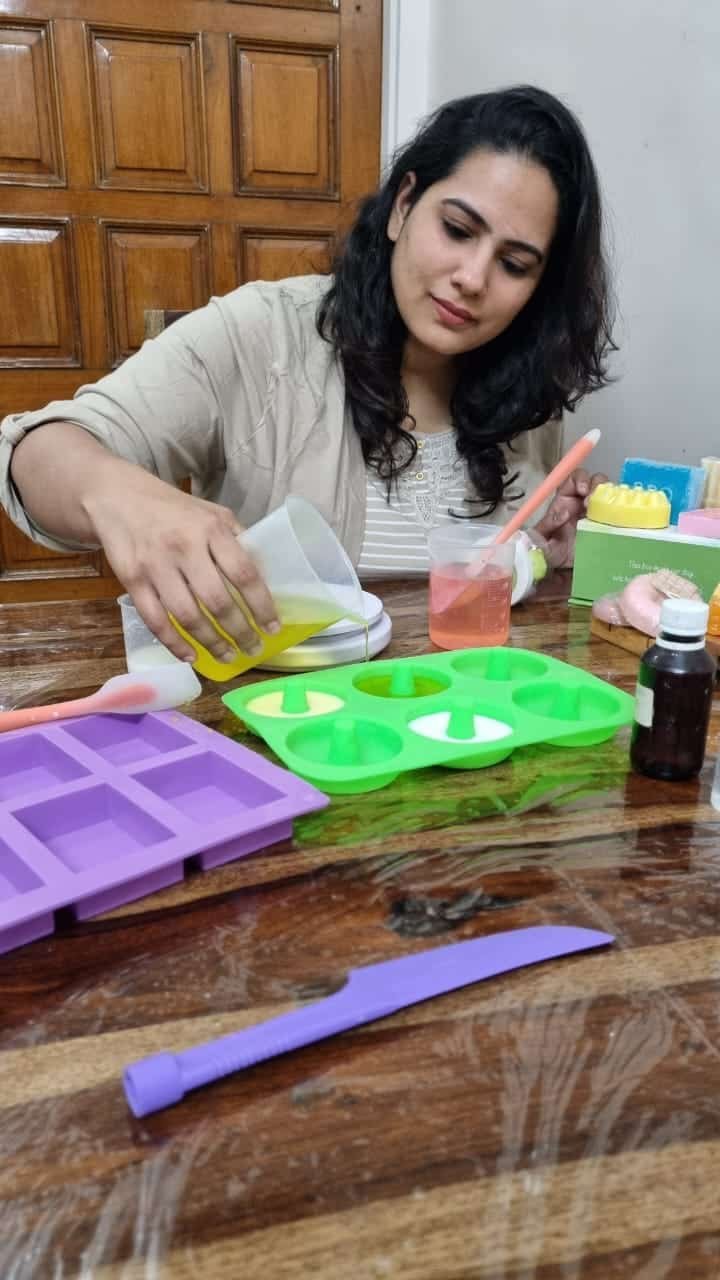
    Both Mir and Gupta may be separated by the India-Pakistan border, but their similarities far outweigh their differences. They both belong to a new generation of South Asian boss ladies who are taking social media by storm. They’re creating unique online businesses. They use Instagram, WhatsApp, and Facebook, not just to post selfies, or share pictures of their baby showers and family dinners but to earn a livelihood, chase their dreams, and be financially independent.

    Over 4.26 billion people use social media worldwide, a number projected to increase to almost six billion in 2027. That’s where a new, dynamic market is emerging, and South Asian women entrepreneurs are here to reach that whole new world of consumers. They are breaking stereotypes and patriarchal norms which had long been dominant in South Asian communities.

    Mir, a Kashmiri, was married off at a very young age, moving to Karachi with her new husband. As a young mother in Karachi in 2013, Mir found herself searching for premium baby products and felt that there was a void to be filled. That led her to start Mummy and MiniMe, which is almost like her third baby.

    Mir was a teacher before she got married. She left her job when she moved to Karachi. After her son was born, she was ready to start something but didn’t quite know what and how.

    “At the time my son was young, so I would always be looking for baby clothes, shoes and products,” Mir said, “so I had some experiences (laughs). I realized that Karachi has some very good quality products which you don’t find in other cities.”

    She explored the internet and found that there were not a lot of people in Pakistan who offered quality products at affordable prices. “We began with PKR 25,000 at the time, which is not a lot of investment,” she added. And so, Mother and MiniMe was born on Facebook and then expanded to Instagram. After the launch of her business, Mir was joined by her sister-in-law Nauwarah, who was studying at the time. Mummy and MiniMe currently has 157,673 people following on Facebook and 4,782 followers on Instagram.

    “My goal as a young mother was to provide affordability and uniqueness. When I used to shop for my son, I realized there were so many options and I thought to help mothers to get quality stuff in one place,” Sara said. Apart from baby products she also began curating wooden toys. With time, the online space started becoming saturated. Many new businesses popped up online and the online market became competitive. 

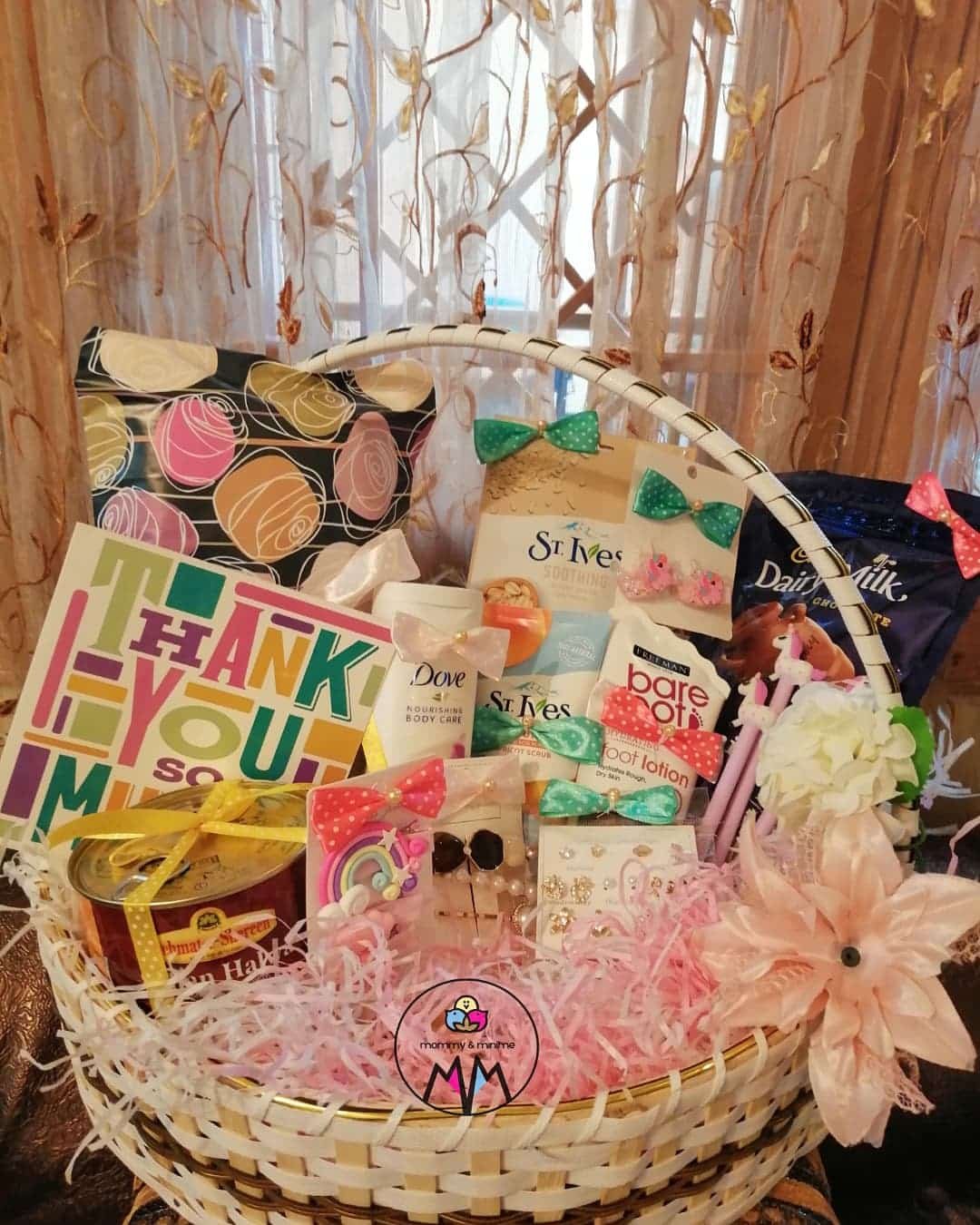
    “In 2017, I realized that we need a new strategy. So, we began offering baby gift baskets for new-borns. This is now a favorite among our customers. Mostly grandmothers, aunts, and friends are ordering these.” Mir then started collaborating with bloggers on social media to promote her products. 

    “I sent a basket with panjeeri (nutritious mixture) to this blogger who had lost her mother and had just had a baby. When I sent her a PR basket, she called me crying saying that my mother used to send her this,” Mir said.

    On the other side of the border, Gupta is running her own little online empire with the support of her family.

    Gupta said: “My Insta-shop never shuts down. It is open 24×7. Living in a joint family I have realized that everything is manageable if you have a good mother-in-law. And I am blessed in that department,” Gupta said. Living in a three-storey home in Jaipur in northwestern India, she cradles her toddler in one arm, while updating her Instagram business account with the other. The festive season is upon her, she has an order of more than 50 exclusive bath hampers in the pipeline. But she knows she can make it with the support of her family. 

    Born and brought up in Bangkok, Gupta was 21 years old when she moved to India to get married. Initially, it was a culture shock to settle down in a rich but conservative Marwari (an Indian ethnic group from Rajasthan) family. She dropped out of journalism school to have her dream wedding. Soon, she had her first child, and her career took a back seat. It was on her daughter’s fifth birthday in 2020 that she kickstarted her entrepreneurial journey by starting Bath and Bubble Co, a brand that sells handmade, natural, artisan soaps and bath products.

    The business model

    In Pakistan, Mir’s business has now reached a stage where she earns a decent living since she first began in 2013. The revenue spikes during Eid but even otherwise her business is consistent and is doing good. She receives around 10-15 queries a week. And a good 80 percent of those convert to sales. 

    Since it takes time to build trust among customers online, many first-time buyers pay through cash on delivery but the majority of her customers make online payments. Due to her regular and direct engagement with customers online, Mir’s business rarely sees any returns or exchanges. 

    “It is hard work. You have to be consistent and patient. With time, we can get an idea who is going to continue ordering products and who is there just to window shop, just like a regular retail shop,” Mir said. 

    There are thousands of such women who use social media exclusively as their main marketplace, especially in South Asian countries.

    In India, Gupta exclusively uses Instagram to sell her products. Despite her humble 760 followers on Instagram, she has already found some dedicated and returning customers. Gupta offers over 25 varieties of exclusive, natural soaps. Currently shipping across India, Gupta’s products are favorite among children due to their quirky and colorful designs. Her personalized hampers are a huge hit and are often ordered in bulk through Instagram and WhatsApp for special occasions. Since creating a website or an offline store would require a huge investment of money and time, she decided to stick to Instagram in the beginning.

    Gupta manages to get four-to-five queries each day through Instagram. A majority of her buyers use Instagram DMs and WhatsApp to place orders and use online modes of payments like Google Pay or PayTm. Gupta also mentioned how using the right hashtags and trending reels has helped her reach her target audience. The visual format on Instagram has helped business owners like Gupta to connect with her customers in a better way. She claims it is easier to track her customers on a real-time basis on social media and immediately find out what is working for them. Instagram trends also help in boosting the sales. 

    “You never know what clicks. You have to constantly keep thinking of new ideas. I am currently manufacturing the soaps myself at home after I send my daughter off to school. I soon plan to set up a separate space for my business. The first person I plan to hire is someone who can handle our social media,” she said.

    The rise and rise of social media

    Economies worldwide have been disrupted by the pandemic, but it has also created new opportunities to do business through social media. Women-owned businesses have received a big boost in recent years. And with a second income coming in, the standard of living of most families has improved. This means the women are not only being empowered financially, but are also getting family support and acceptance for their role as working women.

    Nighat Dad from Lahore, Pakistan, a lawyer, internet activist and founder and executive director of Digital Rights Foundation has closely tracked the trend of women using social media for their growing businesses in recent years. “I have so many examples of women who started online businesses and they have grown over the years. They started to have an online presence. A couple of years back, women were really not confident about using these platforms (social media) for their businesses not only in terms of what to do and how to use these platforms but also not having knowledge of financial gains and opportunities,” Dad said. 
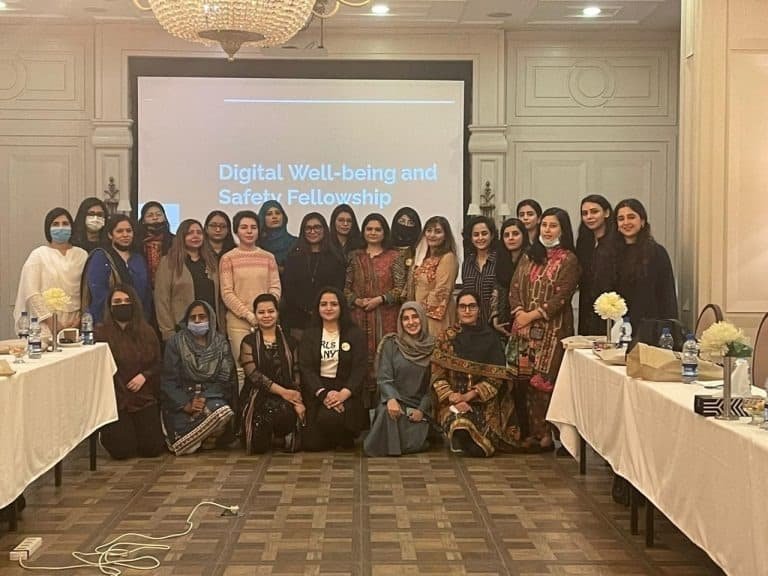
    In Pakistan, Instagram has gradually become the preferred choice to run businesses replacing Facebook as the most popular platform. In 2019, Facebook signed a Memorandum of Understanding of its #SheMeansBusiness with Lahore Chamber of Commerce and industry to provide support in hands on training, skills enhancement and resources to women. This was a major step towards empowering women to become entrepreneurs. It is estimated that women’s earnings in Pakistan have increased by four percent compared to previous year. One of the reasons is start-ups owned by women, and social media has played a pivotal role in helping them grow their businesses.

    In India, Sairee Chahal, founder of “Sheroes”, India’s first women-only social media network, has also looked into the changing trends of how women are using social media.

    Chahal said: “When I started Sheroes, there were maybe 10 million women online in India. Today, there are 350 million women who are online, who have tasted the internet at least once and there’s an increasing number of women who are using this to their advantage.”

    Chahal, who started her first company in 1999 as a first-generation entrepreneur shares her insights on how digital platforms have helped many women entrepreneurs grow: “The mobile phone in a very patriarchal society is a personal device, it has your name on it. And once you have it, there’s no looking back.” 

    For women in a patriarchal setup, running a business requires much more than entrepreneurial skills. There are many family dynamics that women are expected to navigate and balance. 

    “Women are invisible in their societal setups, whether it’s families or the work that they do both at home and outside. It’s this recognition that is driving women online. Look on the internet, everybody’s somebody you know. You’re the handler, you are handling your content. So, this recognition more than other things is what makes a difference,” Chahal said. She also said that only 9 percent of women are in the formal workforce. That means that most women are left to fend for themselves.

    Thanks to social media, women are now getting a fair chance to establish their businesses and sustain a balanced personal and professional life.

    Not all’s well in the digital universe

    Although social media has played a pivotal role in helping women become financially independent, it also has its share of challenges. The major issue that entrepreneurs like Gupta and Mir face is developing a sense of trust among customers since it is difficult to showcase the quality of products through just pictures and videos. Another concern shared by various women was the easy imitation of handcrafted products at lower prices. This makes it difficult for micro-entrepreneurs to compete in the vast market. 

    The digital world can also be intimidating for some entrepreneurs who belong to a different generation. So, while it is a blessing for some women who have grown up with technology, it might not work for others who are still trying to get used to it.

    “Social media can be very demanding and takes a toll on one’s life. We have to constantly think of the next reel, next trend, and next viral post,” Gupta said. At the same time, there is a serious threat to cyber security. Several entrepreneurs have found their accounts to be hacked causing them not just financial but also immense emotional loss.

    “Sometimes I feel it is easier to make soaps as compared to making an Instagram reel,” Gupta said. 

    Dad from Pakistan believes there are serious challenges and risks associated with online entrepreneurship.

    “All kinds of challenges these women face in terms of harassment, finances, and stumbling upon bad actors online and trusting them. In offline spaces, sometimes they are earning but sometimes they don’t own what they are earning due to having a patriarchal society. Even if you are earning, you really don’t have ownership of your income,” she added. 

    She also emphasized how women who work online should be aware of their rights. “How safe their devices are, how safe their platforms are, how much women know about digital security, and how strong are their passwords,” she added. Dad’s foundation has a toll-free number on its website to help women entrepreneurs in need.

    While Dad is providing much-needed help to the women entrepreneurs of Pakistan, Chahal is filling this gap in India. She uses her platform ‘Sheroes not only provide livelihood and financial support to women but also the offer crucial mental support to them. Over three million women have benefited from Sheroes’ counseling services. During the pandemic, Sheroes launched a digital bank called Mahila Money. The platform exclusively serves women who are not served by microfinance. Sheroes also acts as a marketplace for women where they can sell a range of items online. 

    Is this the beginning of a new revolution?

    This rise of women entrepreneurs on social media is not just restricted to South Asia. It is a global phenomenon attracting millions of dollars of investment. 

    In 2020 Facebook COO Sheryl Sandberg announced that the social media giant is investing $100 million to help 30,000 small businesses in over 30 countries. According to the latest statistics, there are 252 million female business owners in the world. 

    In 2021, Instamojo saw a 14.83 per cent spike in new female users in comparison to a five per cent drop in male new users. This shows that women are more eager to start their own businesses now and want to go online. Social media has enabled women to connect across boundaries, cultures, genders and has shown a positive trend where many women are comfortable establishing their businesses in a male-dominated society. 

    “I never got a chance to look back and see how far I have come. I can’t believe that something which was just an idea or a dream is now a fully functional business. It has not just made me financially independent but has also given my life a new purpose,” Gupta said.

    Mir, who started her business with a small investment of 25000 Pakistani rupees, is always looking for innovative ideas to continually grow her business.
  • Male doctors can’t treat female patients, Taliban announce ban

    Male doctors can’t treat female patients, Taliban announce ban

    The Directorate of Public Affairs and Hearing of Taliban Complaints in the Balkh province, Afghanistan, has announced that male doctors are no longer allowed to treat female patients.

    According to Afghan newspaper Hasht-e-Subah, the Taliban also announced that working rooms for male and female healthcare workers should be seperated, and female patients should reach out to female health workers instead of male ones for their problems.

    It further banned men from walking into the rooms of female patients.

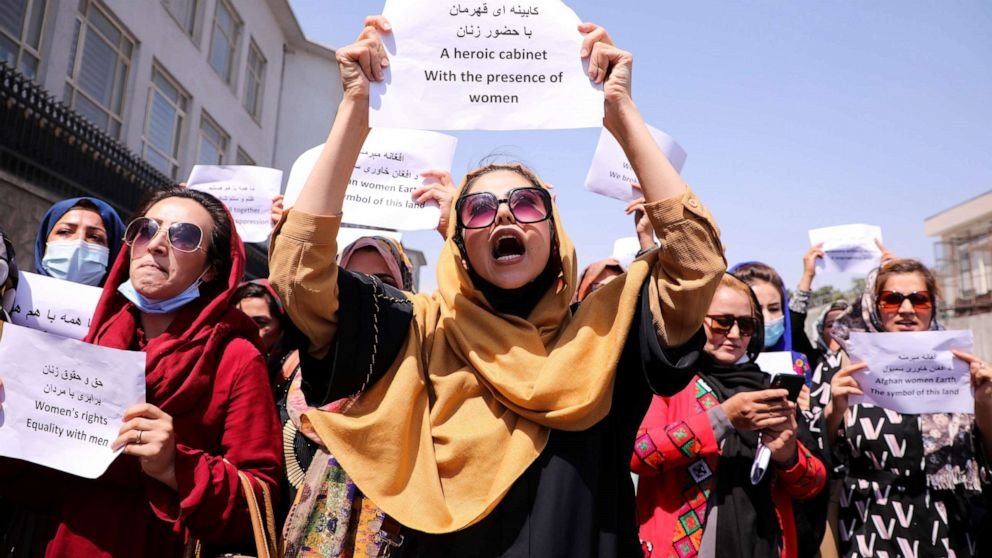
    The Taliban have placed a number of restrictions on women including a ban on education, barring them from attending high school or university in December of last year. In November, 2022, the Taliban had banned women from entering Kabul’s parks or funfairs.

  • President Alvi stresses on women empowerment in sparsely attended session

    President Alvi stresses on women empowerment in sparsely attended session

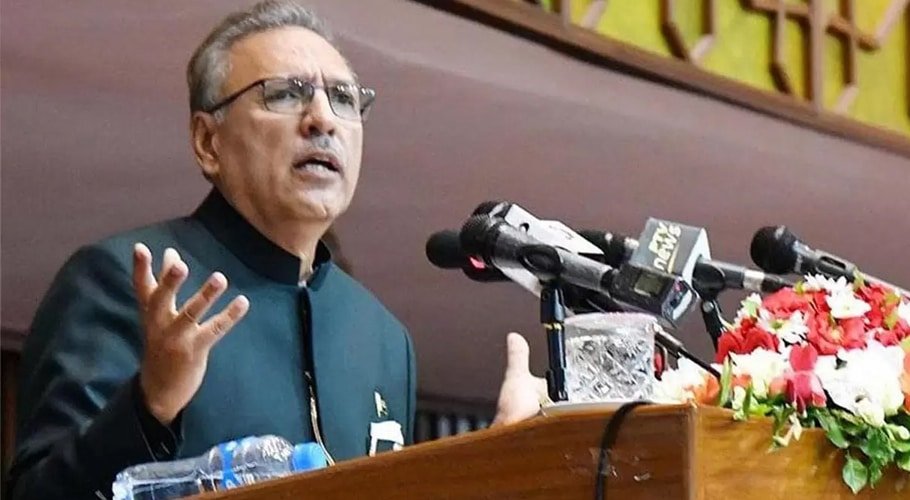
    Addressing a joint session of the parliament on Thursday, President Dr Arif Alvi stressed on empowerment of women in Pakistan, saying that opportunities should be made for them.

    Addressing a sparsely attended session, the President said that women should feel safe in public spaces and men in society can contribute to that. He pointed out that women in Pakistan can contribute a greatly to society.

    Moreover, the president said that women should be given chances to work in public offices and urged lawmakers to work on eliminating harassment.

    His remarks were addressed to a mostly empty hall, with legislators from both treasury and Opposition benches choosing to skip the session.

    Dr Alvi warned against neglecting youth as he called for the inclusion of children who were out of school and urged lawmakers to focus on it.

    “I have spoken to ulema that mosques should have sessions to provide school education. If you can’t provide education to children, give them skills,” he highlighted.

    Talking about the flood situation in Pakistan, the president, “I want to felicitate the Pakistan Army for helping victims while sacrificing their lives. The federal and provincial governments, PDMA (Provincial Disaster Management Authority), and NDMA (National Disaster Management Authority) all worked hard on the ground. I thank all of them.”

    He said that the recent floods had, once again, raised the demand for building dams. Furthermore, he pointed out that if the relief work is not done on time, human and economic losses from the floods would be higher.

    “The Netherlands is 19 times smaller than Pakistan but it has progressed in agriculture, and my country should have progressed more in this field. If we adopt a scientific approach, Pakistan can beat the world,” he stated.

    Talking about foreign affairs in his speech today, the president lauded the government for improving ties with the United States (US). On China, the president said, “I believe the Pakistan-China friendship is a real one and CPEC (China-Pakistan Economic Corridor) is an example of it.”

    At one point during his address, the president also called for the continuation of the work on Electronic Voting Machines (EVMs), saying “We shouldn’t delay this”.

    President Alvi was set to address the joint session on August 14, but due to the apprehensions of the coalition government, the address was postponed.

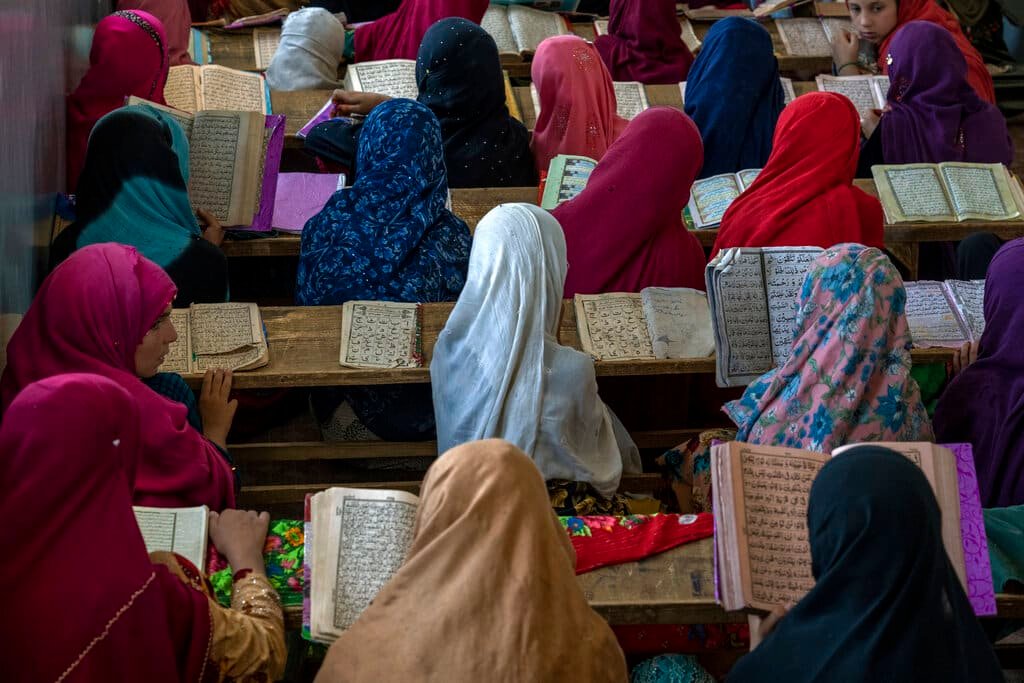
  • Today marks one year since Afghan girls were banned from attending school

    Today marks one year since Afghan girls were banned from attending school

    United Nations (UN) Secretary-General Antonio Guterres took to Twitter to urge Taliban authorities in Afghanistan to revoke the ban on girls’ education that was implemented a year ago.

    He said, “Sunday marks one year since girls were banned from attending high school in Afghanistan. A year of lost knowledge and opportunity that they will never get back. Girls belong in school. The Taliban must let them back in.”

    “It is profoundly damaging to a generation of girls and to the future of Afghanistan itself”, said Markus Potzel, the acting head of the United Nations Assistance Mission in Afghanistan (UNAMA). The UN has called the ban ‘tragic and shameful.

    According to UNAMA, more than a million teenage girls have been deprived of education across the county.

    Earlier this month, dozens of girls protested in an eastern Afghan city due to the closure of schools for girls.

    When the Taliban seized power in August last year, they did reopen high schools for boys on September 18 but banned secondary school girls from attending classes.

    Education Minister Noorullah Munir termed this act a “cultural issue”. He said that many rural people do not want their teenage daughters to attend school.

    Earlier this year, the Taliban said that schools for girls would be opened after March 21 with the caveat that girls and boys must be completely segregated in schools

    However, schools were opened for a small period of time and again were shut down

    At the time, the Ministry of Education said that the schools would be closed until a plan was drawn up in accordance with Islamic law and Afghan culture.

    Despite the fact that the international community has on multiple occasions made the education of girls a key demand for any future recognition of the Taliban administration, the group has barred Afghan girls and women with certain restrictions including covering themselves from head to toe and not to travelling alone.

  • Miss Universe will allow married women, mothers to compete

    Miss Universe will allow married women, mothers to compete

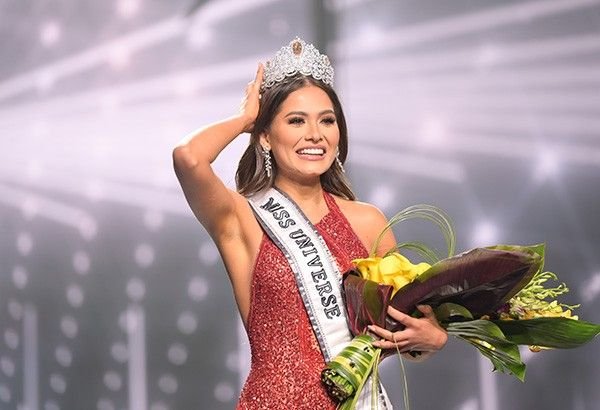
    The Miss Universe Organisation (MUO) recently announced that it has decided to allow married women, women who are pregnant or those who have children to compete in the global beauty pageant.

    The Miss Universe pageant has updated its 70-year-old eligibility rule. Currently, the rule states that only single women aged 18 and 28, who have never been married or had children are allowed to apply.

    The new rules will take effect for the 72nd Miss Universe pageant in 2023.

    “We all believe that women should have agency over their lives and that a human’s personal decisions should not be a barrier to their success,” said an internal memo from within the Miss Universe organisation, which is available with The National.

    Andrea Meza, who represented Mexico in the pageant and was crowned Miss Universe 2020, shared a message for those criticising this new rule. 

    “A few people are against these changes because they always wanted to see a single beautiful woman who is available for a relationship,” she said. “They always wanted to see a woman that from the outside looks so perfect that she’s almost unreachable. The former is sexist and the latter is unrealistic.”

    “Just like in any other industry, women are capable of having demanding leadership positions without or with a family, it is no different in this case,” she said. 

  • ‘More power to her’: Inspiring story of female rider delivering food

    ‘More power to her’: Inspiring story of female rider delivering food

    A LinkedIn user named Fizza Ijaz recently posted about receiving her order from a female KFC rider, Meerab.

    Meerab belongs to Lahore and is currently pursuing a degree in fashion designing.

    “Today I ordered KFC in Lahore and received a call from a female saying: ‘Hello, I am your rider speaking’,” the post read.

    “I got so excited that I stood outside the gate to receive her and we (my friends and I) spoke to her for a good 10 minutes about many things including her pursuits, passion and bike riding skills. Meet Meerab from Youhanabad, Lahore.”

    “She is pursuing an undergraduate degree in Fashion Designing and does her night duty as a KFC rider to cover her fees. She intends to remain a rider for another 3 years until she graduates post which she plans to launch her own Fashion Brand!”

    The post has received over 50,000 likes and over 1,500 comments.

    Meerab’s university fees are paid by the KFC Female Higher Education Scholarship Programme.

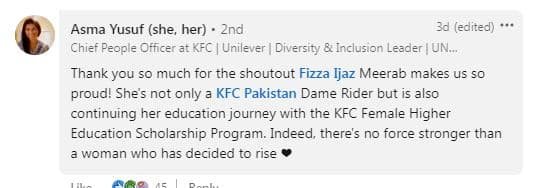
    Asma Yusuf, KFC Pakistan’s Cheif People Officer (CPO), commented, “Thank you so much for the shoutout Fizza Ijaz Meerab makes us so proud! She’s not only a KFC Pakistan Dame Rider but is also continuing her education journey with the KFC Female Higher Education Scholarship Program. Indeed, there’s no force stronger than a woman who has decided to rise.”

  • Pakistani women don’t get their rights as traditions adopted from India: PM Khan

    Pakistani women don’t get their rights as traditions adopted from India: PM Khan

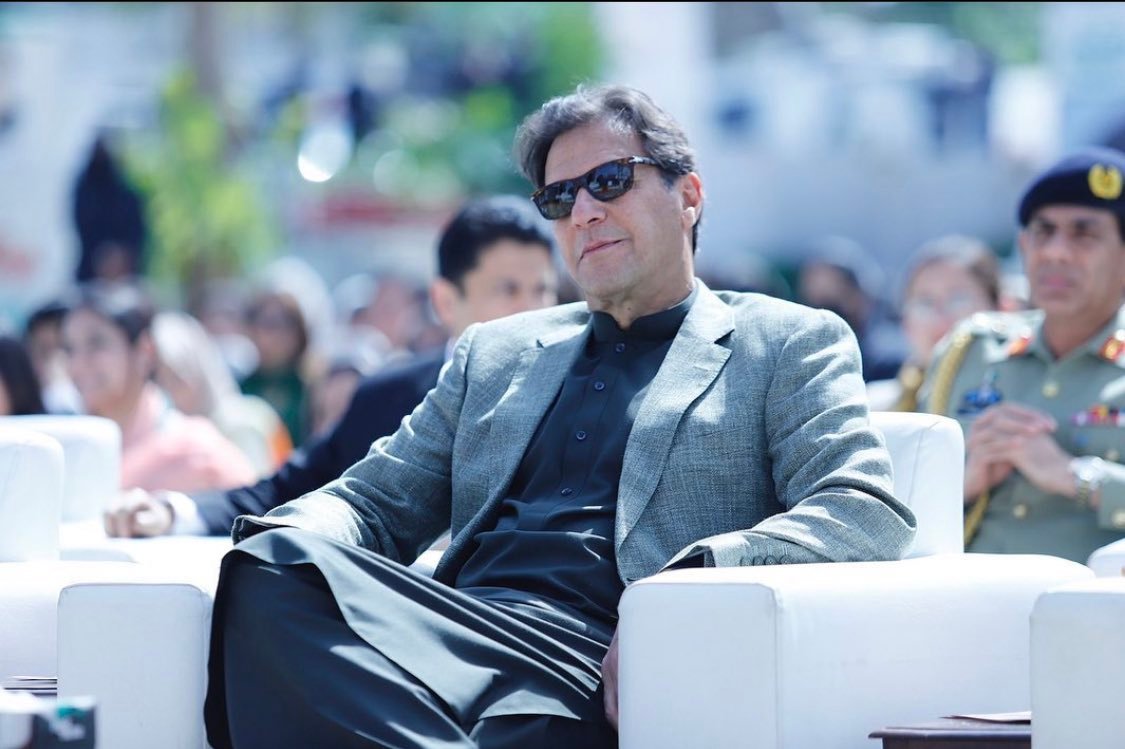
    Prime Minister (PM) Imran Khan, at a ceremony in Rawalpindi’s Fatima Jinnah University to celebrate International Women’s Day, said that when the history of Pakistan Tehreek-e-Insaf (PTI) will be written, the only party that shall be known to have empowered women will be PTI.

    PM Khan said that most Pakistani women don’t get their rights and that is because the country has adopted traditions from India, where women were considered men’s property.

    “Indian women used to be burned alive (Satti) with the body of her husband if he died,” said PM Khan, adding that Islam gives more rights to women.

    Praising his mother, PM Khan said, “I am what I am today because of my mother.”

    “My mother was educated, if she had not made me sit and do my homework, I would have never studied in the first place,” said the prime minister.

    “Education is also important along with the protection of their rights,” said PM Khan.

    The premier further said that rule of law is the biggest issue in Pakistan.

    PM Khan, criticising the former leader of Pakistan, said, “The powerful desires NRO and threaten to topple the government if they don’t get it but I will not give them that as long as I am alive.”

    “No matter what these robbers do, try as much as they can or plan any strategy, I am ready,” he said in reference to the Joint Opposition’s efforts to table a no-trust motion against the incumbent government.

  • Whether a woman chooses a burqa or a bikini, she has the right to decide for herself: Malala

    Whether a woman chooses a burqa or a bikini, she has the right to decide for herself: Malala

    Nobel Laureate and Women’s Education Rights Activist Malala Yousafzai, in a recent essay, Please stop telling us how to dress, has talked about the criticism and pressure women have to face on the choice of their dressing.

    Malala, sharing some text from her essay on her Instagram, wrote: “Years ago I spoke against the Taliban forcing women in my community to wear burqas – and last month I spoke against Indian authorities forcing girls to remove their hijabs at school. These aren’t contradictions – both cases involve objectifying women. If someone forces me to cover my head, I will protest. If someone forces me to remove my scarf, I will protest.”

    “Whether a woman chooses a burqa or a bikini, she has the right to decide for herself. Come and talk to us about individual freedom and autonomy, about preventing harm and violence, about education and emancipation. Do not come with your wardrobe notes,” she added.

    “Someday I might make changes to my wardrobe. I also might not. But exploring and understanding clothing will remain part of my life, as will defending every woman’s right to determine what she wears. I love my patterned, floral shalwar kameez. I love my jeans too. And I am proud of my scarves,” she wrote while concluding her essay.

  • What Must Pakistan Do to Achieve SDG4 Targets By The Year 2030?

    What Must Pakistan Do to Achieve SDG4 Targets By The Year 2030?

    “Pakistan has the second largest population of out-of-school children in the world”. This population makes up of 22.8 million children being out-of-schools in Pakistan who are between the ages of 5 and 16. This also means that 44% of the population of Pakistan in this age group is out-of-schools.

    The on-going pandemic of Covid-19 has further escalated the challenges in education in the country and it is said that an additional 1 million school going children will have dropped out of schools when the pandemic ends. The government of Pakistan alongside other stakeholders managed to enroll around 2.2 million children in schools in the last decade and these efforts seem to going at a loss owing to the pandemic.

    The parliament of Pakistan adopted the UN Sustainable Development Goals (SDGs) as the country’s national development goals in February of 2016. With the current government coming in to power in 2018, all the provinces were given a free hand in development and practicing their own priority frameworks.

    The provinces were able to conclude drafting their policy framework and SDG 4 (quality education for all) turned up to be a common goal for the provinces.

    Economist and public finance expert Asim Bashir Khan recently authored a white-paper “Public Investment in Education: An Appraisal of SDG 4 in Pakistan” which was published by Pakistan Youth Change Advocates (PYCA) and The Education Champion Network. This white-paper takes stock of Pakistan’s progress towards SDG4 and highlights several glaring gaps that negate the high priority accorded to education on paper.

    On paper, the provinces have key policies to achieve the SDG 4 targets including:

    • Access to Education
    • Quality of Education
    • Gender Parity in Education
    • Adult Literacy
    • Educational Infrastructure
    • Teacher’s Training

    Despite a limited number of targets and poor baseline figures, the progress towards achieving the target of quality education for all has been dauntingly slow. With the current pace of progress, it seems that Pakistan will not be able to meet the targets of Agenda2030.

    This white-paper presents the findings towards the SDG4 progress and also provides a concrete set of recommendations for Pakistani to meet the international commitments of SDG4. With 8 years still remaining, the federal and provincial governments must work collectively and effectively to ensure that Pakistan is able to live up to the international commitments.  

    A summary of the key recommendations in the White-Paper include:

    Eliminating Political Inertia:

    Despite the passage of more than five years since ratifying the 2030 Sustainable Development Agenda, Pakistan is yet to begin making the preliminary but significant adjustments identified in its National Framework.

    The federal and the provincial governments of Pakistan must be synced and work collectively on one agenda. The progress can’t bring any fruits if there is a different agenda on the federal level and a different on provincial level. This will ensure swift progress in the implementation and realization of the necessary steps.

    Classification of Education Budgets:

    It is equally important that budgets for education-related interventions, even if they are undertaken by other departments, should be classified under the education budget. The current approach under which at times large education development projects are classified under “social welfare,” “population development,” or other departments only serves to scatter the effort, making it unnecessarily tedious to monitor progress.

    Alignment of education budget heads with relevant SDG 4 indicators:

    First of all, there is a need to set up an SDG Committee for Equitable Quality Education-related policy scrutiny and parliamentary control. Budget must be adjusted to reflect on SDG4 targets and indicators while drafting budget proposals. SDG 4 budget tagging needs to be introduced and integrated into the Financial Management Information System (FIMS).

    Enrollment in Schools:

    To encourage more students to enroll in schools, the government must increase education stipend programs and introduce new ones that focus on girls and children with impairments.

    Elimination of Gender Disparities:

    In order to curb education inequality across Pakistan, the government should adopt gender-responsive budgeting. Solutions to track and trace out-of-school children by gender and location can greatly help identify the deserving children in need of education. There is also a dire need for a new infrastructure that focuses on facilitating continued learning for girls beyond the primary level.

    Qualified Teachers and Training Programs:

    To provide quality education, the federal and provincial governments must increase the number of qualified teachers with an emphasis on recruiting subject specialists in Math and Science. Investing in the recruitment of female teachers at a secondary and higher level to encourage parents to send their daughters to schools can also be a positive step towards progress.

    This article is part of Pakistan Youth Change Advocates’ #InvestInEducationStrengthenPakistan campaign. For more information follow their Facebook, Twitter, Instagram, and YouTube channels.

  • Twitter welcomes first female Supreme Court Judge of Pakistan

    Twitter welcomes first female Supreme Court Judge of Pakistan

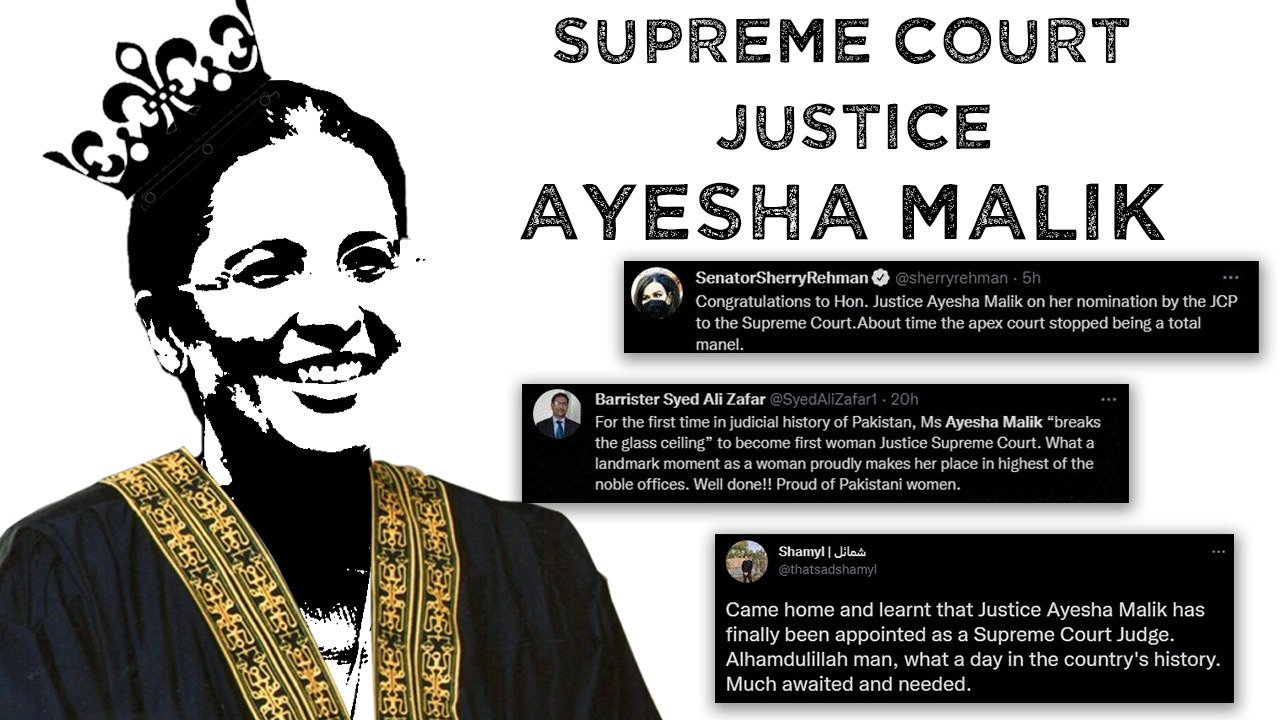
    History has been made as a divided Judicial Commission of Pakistan (JCP) approved the nomination of the first woman judge to join the Supreme Court (SC).

    Lahore High Court Justice Ayesha A. Malik’s nomination was secured by a majority of five to four during a heated JCP session that lasted nearly three-and-a-half hours, reports Dawn.

    She may even have a chance to become the first woman to be Chief Justice (CJ) of Pakistan. If she is elevated following approval from an eight-member bipartisan parliamentary committee, Justice Malik will remain a judge of the SC until 2031.

    The justice gave her landmark judgment back in June, when she had declared virginity tests for examination of sexual assault survivors “illegal and against the Constitution of Pakistan”. She was called upon as an expert witness in family law cases conducted in England and Australia involving issues of child custody, divorce, women’s rights, and constitutional protection for women in Pakistan.

    Following the news, congratulations are in order and people have shared their happiness on Twitter.