A 17 year old schoolgirl in Islamabad was gang-raped by four boys who kidnapped her while she was on her way to school in Sector E-9. The police have arrested three of the four suspects: Atish, Junaid Ansar and Afad Malik while Hassan Shakeel is still at large.
According to The News, the child’s mother told the police that the girl left for school at 8 o’ clock in the morning when she met a friend of her brother, Atish, waiting for her near the school. Atish kidnapped her by lying to her about an emergency. The boy then took her to village Matiari where three of his friends- Junaid Ansar, Afad Malik and Hassan Shakeel- tortured her. Then, they put a gun to her head, threatening to kill her if she cried or screamed while she was being raped.
The police has registered a First information report (FIR) under Section 375-A and said that they are hunting down Hassan Shakeel, promising to trace him within 24 hours.
Yashma Gill was a guest on the Nadir Ali podcast, a clip of which has gone viral, where she passionately spoke out against the misogynist stereotype that women are gold-diggers.
Ali said that in our society today, a man’s ugliness is considered his empty pocket:
“Regardless of whether he is good-looking or not, he looks awful without having money. He is told to go and earn money.”
Gill corrected this statement by pointing out that that many women in successful, happy marriages are earning more than their husbands so this stereotype that women are only in love with money isn’t true:
“I will not give any names, but around us there are a lot of examples where a woman is more successful than her husband, and they had love marriages…Regardless of these people belonging to my field or not..I don’t like the stigma attached to women that we are gold diggers.”
Ali brought up a sexist stereotype about women gaining financial independence and abandoning men:
“When a man earns, he hands over everything he has to the woman. Whereas when a woman begins earning she decides to abandon her man.”
Gill counteracted this statement by pointing out that financial independence only helps women become more confident within themselves, and doesn’t translate into not wanting a companion anymore.
“People are confusing this with when a woman becomes financially independent, she is no longer helpless,” stressed the ‘Pyaar Kay Sadqay’ actor. “She can stand up for herself. She can remind her parents that she is no longer a burden on them so doesn’t need to be married off. She can even provide for her children…So I think that independence for women and girls can give them strength and power, not the fact that they don’t need a man. Everyone needs companionship.”
Gill then gave the example of Hazrat Adam (S.A.W) and Hazrat Havva (S.A.W), to prove that every human being was meant to have a companion:
“Take the example of Hazrat Adam (S.A.W) and Hazrat Havva (S.A.W), this is a natural thing that evcryone needs companionship. But there must be compatibility, respect and a lot of other things.”
Listen to her complete interview here:
Gill shared the viral clip on her Instagram stories to address the misunderstanding that might rise in case audience is assuming that Ali was being sexist, to which the actor had written that the host was respectful and well mannered:
“So just to clear the air, the respectable host only meant to ask my opinion on what is a common misconception in society. Nowhere did he agree with it himself or said that it is something that he believes in. It was just one of the many things that he discussed with me – “discussed” not imposed, argued or debated. Therefore let’s not get him wrong and frame him in ways he doesn’t deserve because he was nothing but extremely kind and respectful towards me that I was honestly in awe of his nature. A true gentleman.”
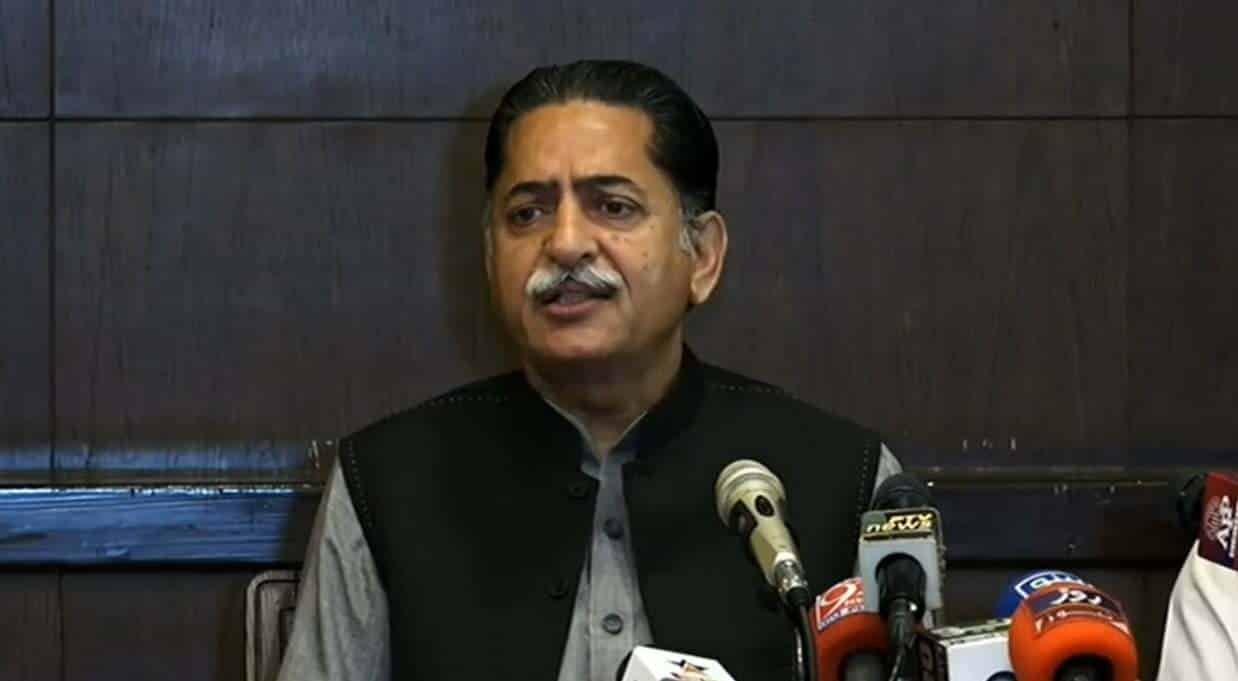
Considered a “senior leader” of Pakistan Muslim League-Nawaz (PML-N), Javed Latif has passed sexist comments against former First Lady and Pakistan Tehreek-e-Insaf (PTI) Chairman Imran Khan’s wife Bushra Bibi.
In an apparent reference to Khan and his wife, he said, “The 72-year-old boy is saying that my 75-year-old wife was alone in the house in Zaman Park. The chaadar and the sanctity of the four walls have been violated.” He continued, “If she was alone in the presence of 200 terrorists, Should she be surrounded by 4000 or 5000 armed people for him to her consider safe?”
His comments came under fire on Twitter where a lot of social media users not only condemned the politician’s statement but also called him out in harsh words.
72 سالہ لڑکا کہہ رہا ہے کہ میری 75 سالہ بیوی زمان پارک گھر میں اکیلی تھیں چادر اور چار دیواری کا تقدس پامال کیا گیا ہے.اگر 200 تربیت یافتہ دہشتگردوں کے حصار میں بھی اس کی بیوی اکیلی تھی تو کیا اس کے ارد گرد 4,5 ہزار مسلح لوگ ہوں تو یہ اسے محفوظ سمجھے گا؟ وفاقی وزیر میاں جاویدلطیف pic.twitter.com/o3MfUfSUVa
Aurat March Karachi issued a statement, quote tweeting the clip. “We strongly condemn such sexist remarks against Bushra Bibi by a government representative,” stated the feminist group. “It is disgusting that political parties have normalised sexist attacks on women from opponent groups.”
“That this statement is coming from the party of Maryam Nawaz, who herself remains a victim of sexist slurs is all the more concerning,” continued the official statement.
“We demand the government and all political parties stop this misogynist tradition which targets women due to their gender. Such practice should lead to strict punitive action by [the] government as well as Election Commission.”
We strongly condemn such sexist remarks against Bushra Bibi by a government representative. It is disgusting that political parties have normalised sexist attacks on women from opponent groups. That this statement is coming from the party of Maryam Nawaz, who herself remains a.. https://t.co/nAdByipieg
— Aurat March – عورت مارچ (@AuratMarchKHI) March 20, 2023
This is not the first time that a politician sitting in a media gathering has used this kind of language for a woman.
The Current strongly condemns the PML-N leader’s remarks. This should stop NOW!
A teenage orphaned girl has been murdered by her aunt for refusing to marry her son, Sher Ali in Alpuri district, Muzzafargarh.
According to the FIR registered on Sunday, Muslimah, 16, was living with her maternal aunt after her father went missing from a coal mine years ago, and her mother re-married a man from the Mingora area of Swat.
The complaint, Muslimah’s uncle Wazir Khan, said that his niece was being pressurized by her aunt to marry her 22-years-old son. However, she had refused because she wasn’t ready to take such a decision. She was poisoned to death by her aunt.
According to Dawn, police officials said that the girl had been buried and the aunt’s family had hidden the truth by declaring Muslimah’s death a natural one. But her father’s relatives had refused to accept the explanation and demanded an autopsy of the body.
In the FIR filed at the Alpuri police station, Sher Ali and his father Hamil Kareem have also been named as culprits in the murder.
Actor Amna Ilyas was a guest on “The Talk Talk Show’ where she opened up about being a feminist, and clarified the misinformation around the Aurat March slogan ‘Mera Jism Meri Marzi’.
When the placcard was raised at the 2018 Aurat March, it caused outrage after many right-wing critics said that the chant supports promiscuity and challenges family values in Pakistan. Many religious clerics had used the placard as justification to call ‘Aurat March’ un-Islamic and accused it of promoting a Western agenda in Pakistan.
Many feminist activists have defended the slogan for protecting women’s bodily autonomy, and now Ilyas has also done the same, as she explained that the slogan ‘Mera Jism Meri Marzi’ was more than about clothes, it’s about protecting the rights of women:
“It’s about having body autonomy rights and consent. It’s about harassment, domestic violence, and concepts like, ‘No one has the right to touch me without my consent, even if I’m married to you’.”
Ilyas went on to debunk the stereotype associated with feminism that women who support this ideology are promoting vulgarity, when in reality the ideology supports the rights of women to have the same opportunities as men:
“Whenever I talk about feminism, people always object by saying ‘Oh, Amna is bold, of course, she will spread vulgarity as she’s from the industry, she wants all our daughters to be like her’. No, I don’t want that, I only do what I want to for myself.”
“When we speak of equal rights, it’s about having the same opportunities to thrive in my career as the man beside me. If you’re a father of four children who excel in your profession, why can’t I do the same? Honestly, it’s not about whether you’re getting permission to wear jeans or not. What we truly need, is the space to work in a cerebral capacity,” she explained.
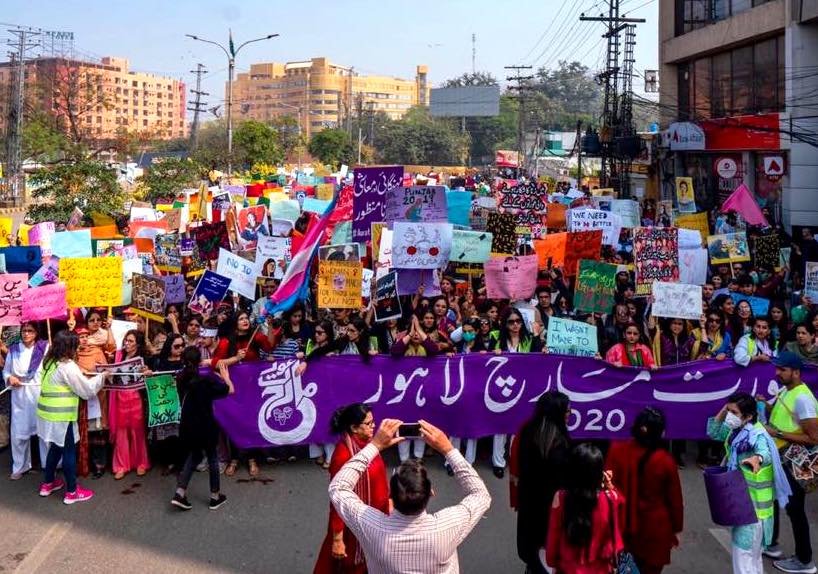
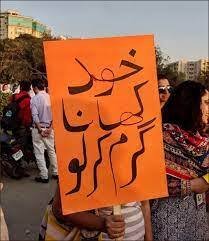
Aurat March, scheduled to take place on March 8 to protest injustices against women and minorities has been denied permission to hold a public rally by Deputy Commissioner (DC) Rafia Haider.
While talking exclusively to The Current, activist and one of the volunteers of Aurat March, Leena Ghani, said that they had applied for a Non-Objection Certificate (NOC) on February 13 for the march to be held on the decided date. However, the administration backed out at the last moment.
“At the time, in a meeting with deputy commissioner Rafia, she assured us. However, later she sent a rejection letter,” Ghani revealed.
She said that in the letter, the administration has also banned them from gathering at Lahore Press Club, from where the march typically starts every year.
About the meeting they had with Deputy Inspector General of Police (DIG) Operations on Friday, she mentioned that they kept on insisting on changing Aurat March venue. “It seems like they have promised Nasir Bagh to Haya March organisers for a gathering, that’s why they want us to pressurise now.”
She also added that police have said that security won’t be provided if they don’t change the venue. However, the organisers remained adamant that security should be provided regardless of the fact that where they want to protest.
Moreover, she mentioned that NOC is just a formality, and in the past, a verbal agreement used to take place.
“NOC is not needed in order to exercise your constitutional right to march,” said Ghani.
Now, she said that they are going to move Lahore High Court (LHC) to challenge the decision.
Sabahat Rizvi challenges denial of NOC to Aurat March
Earlier, the Lahore High Court Bar Association (LHCBA) Secretary Sabahat Rizvi challenged the decision of DC Haider.
The development took place after DC’s decision was condemned and criticised by organisations including the Human Rights Commission of Pakistan (HRCP).
Many people have argued that it is an attempt to suppress women’s voices and prevent them from exercising their constitutional rights.
‘We will march’: Aurat March determined despite NOC denial
NOC was denied on the grounds of “security concerns, controversial banners and posters, strong reservations by the general public and religious organisations and the likelihood of clashes with members of Jamaat-i-Islami’s Haya March.”
Reacting to the denial of the NOC, organisers have remained adamant that they will march on the decided date as they don’t require a NOC to exercise their constitutional rights.
The denial of NOC cites the ‘Haya March’ by the JI as the reason for denial. The DC herself acknowledges that the Jamaat has “announced a program against the Aurat March”, yet it is the March that is being denied its constitutional right, not the group inciting violence.
“Women, khawaja sara community, transgender persons, gender non-conforming people, and allies of the Aurat March have the right to assembly under Article 16 of the Constitution of Pakistan,” they said.
They highlighted that “large crowds are allowed to gather for PSL, but a peaceful gathering of women and gender minorities is being silenced and denied their constitutional right to assembly.”
They added the administration has forgotten that the courts have already upheld their right to hold Aurat March in 2020.
It is not the first time that the city’s authorities have imposed such a restriction. Last year, the organisers in Lahore had been urged to cancel the rally over safety concerns. The march was also arbitrarily cut short by the district administration despite being given permission.
A Pakistani-American family living in the United States of America (USA) has been sentenced on Monday to serve between five to twelve years in jail for physical violence and forced labor inflicted upon a Pakistani woman. Federal authorities have described this case as the ‘modern-day equivalence of slavery’. As reported by US newspaper Richmond Times, the three defendants, matriarch Zahida Aman along with her two sons, Mohammad Rehan Chaudhri (49) and Mohammad Nauman Chaudhri (55), had used physical labor, verbal abuse and coercion against the survivor, Maria Butt, to get her to serve thousands of hours of domestic labor ‘for 12 long years’, said federal authorities in a statement. “Indeed, during the course of their illegal agreement and in furtherance of their criminal conspiracy, each defendant assaulted, verbally attacked and abused [the victim’s] children to carefully construct a climate of fear that continuously compelled her labor,” Assistant U.S. Attorneys Stephen Miller and Shea Gibbons revealed in a court statement. Butt was married to Salman Chaudhri, the eldest son of Aman in January 2002 when she was living in Pakistan. She claimed that she had not met her husband before their marriage. After moving to the United States, Butt recalled her husband telling her that if she wanted to keep him happy, then she must fulfil the obligations of his family. Shortly after moving to the US, Butt was called in a family meeting by Aman where the victim was asked to surrender her legal documents, including the jewlery gifted by her family, as well as a notebook listing the contact numbers of her family members back home. Prosecutors note that due to this act, the survivor “had no legal documentation, assets of value or contact information for her family and friends within months of arriving in the United States. She was becoming completely dependent on the defendants for basic necessities and emotional support.” After her arrival, the survivor was forced to perform an endless amount of housework which included cleaning bedrooms, wiping down the kitchen and, as prosecuters pointed out, had ‘become a robot of the house’ who basically had to respond to all of the requests of the family members. Soon, the survivor was made to perform incredibly difficult tasks like moving the lawn with a push mover, hand-washing and line-drying area rugs, including painting the inside and outside of the family’s two-storey house. When she would refuse, the survivor was slapped or subjected to cruel punishments like in one instance, she was tied with rope and pushed down the stairs infrount of her children for simply using a family member’s phone to call her husband. “As the type of work the defendants required [the victim] to perform intensified, so too did the coercive scheme they employed to compel her labor,” prosecutors said in the trial brief. “The defendants used a combination of coercive means, including physical assaults, verbal abuse, isolation, starvation and threats of deportation to create a climate of fear that compelled [the victim’s] labor,” prosecutors said. The survivor’s husband, Salman Chaudhri, was not dtsying regularly in the family’s home, and had moved to Pennsylvania for his medical education and then to California to set up his practice. He got engaged to another woman in 2013. The survivor revealed that the husband did not take her, or their four children with him to California. Prosecuters also revealed that the family also tried to separate the survivor from her children. They revealed that the children were encouraged to spit on their mother, and had been convinced that she was dangerous. The children were also belittled and punished if they would ever show any kindness to their mother. In May 2016, the survivor managed to escape with her brother from Pakistan and had filed a police case with Chesterfield County Police detective Laura Kay, after which the family members were placed under arrest. “After two months of rebuilding her relationships with her family and gaining emotional courage, [the victim] contacted [her brother], who helped her leave the home,” prosecutors wrote. The survivor “subsequently gained full custody of her children, despite a contested custody battle with the defendants.”
Thousands of people participated in a march on Monday in Strasbourg, France, to show support for the Iranian opposition movement in favour of women’s rights.
The famous Eiffel Tower became part of the demonstration as well as the landmark was illuminated with pro-Iranian demonstrators and pro-women activists’ messages.
“Woman. Life. Freedom” and “StopExecutionsInIran,” were displayed on the tower.
The protests in Iran were triggered after Mahsa Amini, died on September 16, 2022, while being held by the morality police for allegedly breaking a rigorously adhered-to Islamic clothing code. This incident served as the impetus for the protests in Iran. Despite widespread criticism, Iran has arrested many people for crimes connected to the uprising started by Mahsa Amini’s killing..
The devasting floods have killed at least 1,191 people in the country. Balochistan and Sindh are the most affected provinces of the country. Hundreds of thousands of people who were displaced by the floods since June are currently residing in camps or with host families.
As per an estimate, 8.2 million women in flood-affected areas are of reproductive age. Menstruating women in disaster-hit areas require access to safe and clean menstruation hygine products.
Many organisations are donating sanitary pads for women. However, a debate has been going around for days that whether sanitary pads should be donated or not. Some give the arguments that rural women do not use and do not know how to use sanitary pads, and donating them sanitary pads is a waste of already limited resources. While others give an argument that disposing of sanitary pads pollutes the environment.
“One study has suggested that there may be an increased risk of urogenital infections, such as yeast infection, vaginosis or urinary tract infections, when women and girls are not able to bathe and/or change or clean their menstrual supplies regularly,” a report published by the United Nations Population Fund reads.
Here is the United Nations Children’s Fund (UNICEF) Guide to Menstrual Hygiene Materials:
Pads are arguably the most widely used period product the sanitary pad/napkin has been commercially available for more than a century. They are worn inside the user’s underwear and absorb menstrual blood through layers of absorbent material, often rayon, cotton, and plastic. Pad design has changed over the decades to become considerably more absorbent and pleasant, with a wide selection available to suit different flows.
Talking about the arguments going around regarding the negative consequences of using disposable pads environment Lawyer Ahmad Rafay Alam while talking to The Current about the issues said, “Women are as entitled to their dignity as men. Screaming plastic pollution at a time like this is disingenuous at best. We can work out plastic pollution issues soon. Let’s first deal with the millions of women who menstruate.”
Dr Alia Haider, who is working for the relief of flood victims in Khyber Pakhtunkhwa (KP), while talking to The Current said that women in flood-affected areas do not have access to sanitary pads or the clothes they would normally use, as all of their belongings were completely destroyed.
Talking about the need of donating sanitary pads in flood-affected areas Haider said, “It would be very unfair to give women medicines but not sanitary pads,” adding that sanitary pads are not a luxury but a basic human need.
However, she said that donating sanitary pads is not enough, a tutorial about how to use them should be sent along or people distributing them should go and teach the flood-affected women.
“When I was working in medical camps in those areas, women came to me and said they don’t need it because they don’t know how to use them, then I used to take a group of 10 to 15 women in a room and used to teach them how to use sanitary pads. I made sure that they know that these are disposable.
She continued by adding, “We can also find and coordinate with women from those communities and backgrounds who know how to use sanitary pads and they can teach their fellow community members” So we need to connect with them on a community level.”
“When I was in Rajanpur, Taunsa, a woman did not know how to use sanitary pads so a guy came to me and said do get it to them. I asked the guy if he knows someone who knows how to use sanitary pads, to which the boy replied that his wife knows how to use them. Then I asked him to bring his wife, she knew how to use it and she offered that she would teach women in that community how to use sanitary pads.”
“We can’t sit idle and say oh my God that this is not the need of the time. Not maintaining menstrual hygiene can lead to many issues including Urinary tract infection (UTI), fungal infection, and prolonged use of clothing cause menorrhagia (excessive bleeding). During my visit to flood-affected areas, almost 60 to 70 per cent of women were suffering from Menorrhagia and other infections.”
She said that she does not think there is any other option than sanitary pads because even if they are provided with clothes, they will not have the resources to wash them or reuse them. Sanitary pads are accessible and disposable so they are the best option available according to Dr Alia’s assessment.
Where can you donate?
Bushra Mahnoor, who is leading a campaign called “Mahwari Justice” along with her friend Anum, while talking to The Current said that they started the campaign when the floods hit Pakistan at the end of June.
Mahwari is an Urdu word for Menstruation and Mahwari Justice means justice for women who menstruate and who are in dire need of menstrual assistance.
Talking about why she felt compelled to start the campaign, Bushra said,” I was a kid when the 2010 foods hit Pakistan. A lot of areas near my hometown Attock were flooded. My parents would collect goods and would take them to relief camps.”
Once when she went along with her parents to a relief camp, she saw a girl who was a year or two older than her. The girl’s shirt and shalwar (trousers) were spotted with large blood stains.
“My mother approached the girl and gave her a shawl to cover herself and a piece of clothing to use [as a pad]. The young girl explained to my mother that her periods started in the relief camp and she had nothing to use as a sanitary cloth. The girl was using her dupatta to manage periods but it was barely doing the job.”
“When floods hit Pakistan this year, the image of that little girl flashed into my mind and I knew I had to do something,” said Mahnoor. She then contacted Anum and they both decided that they had to do something for the women in flood-affected areas.
“Women and their needs get neglected not only by the state but by relief campaigners as well.”
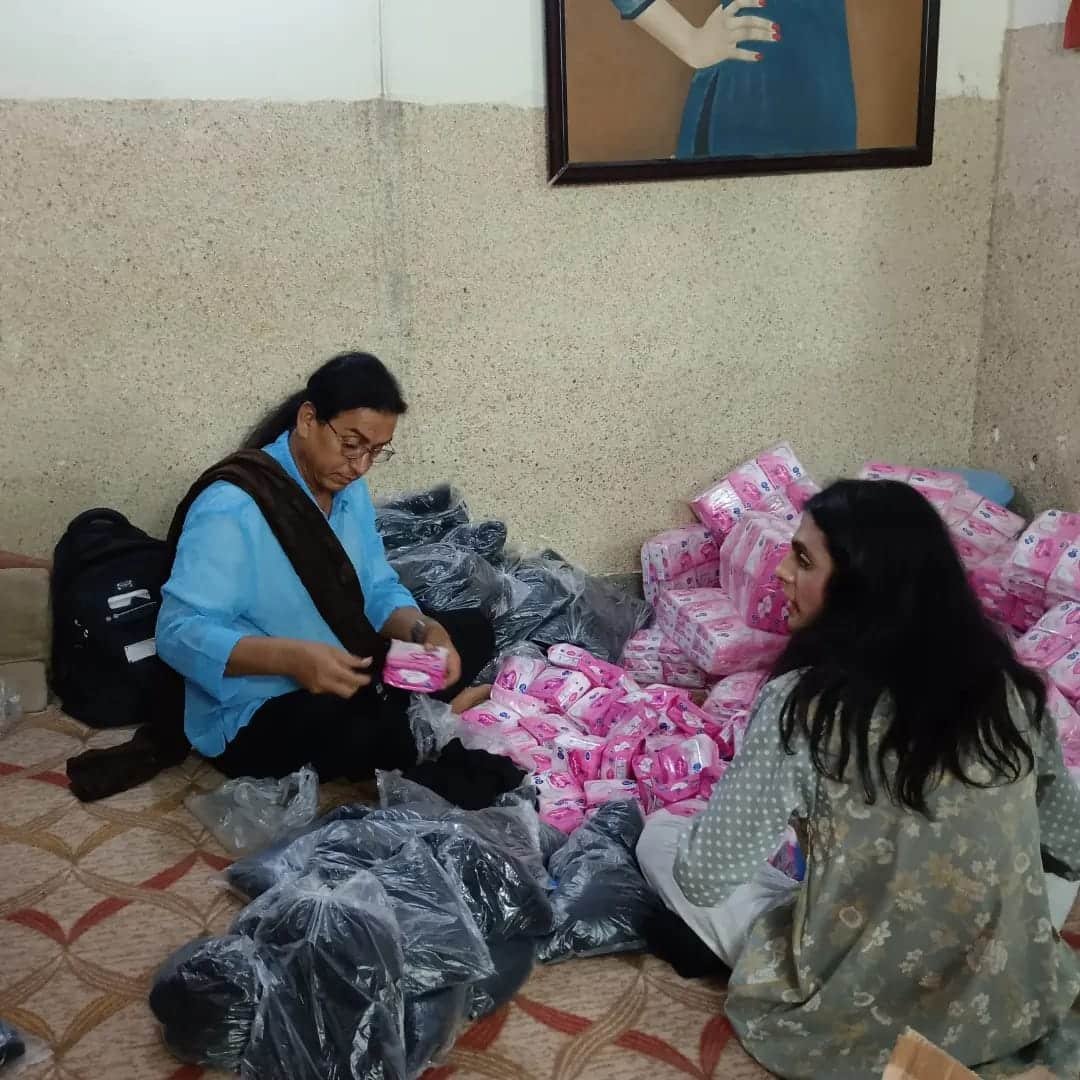
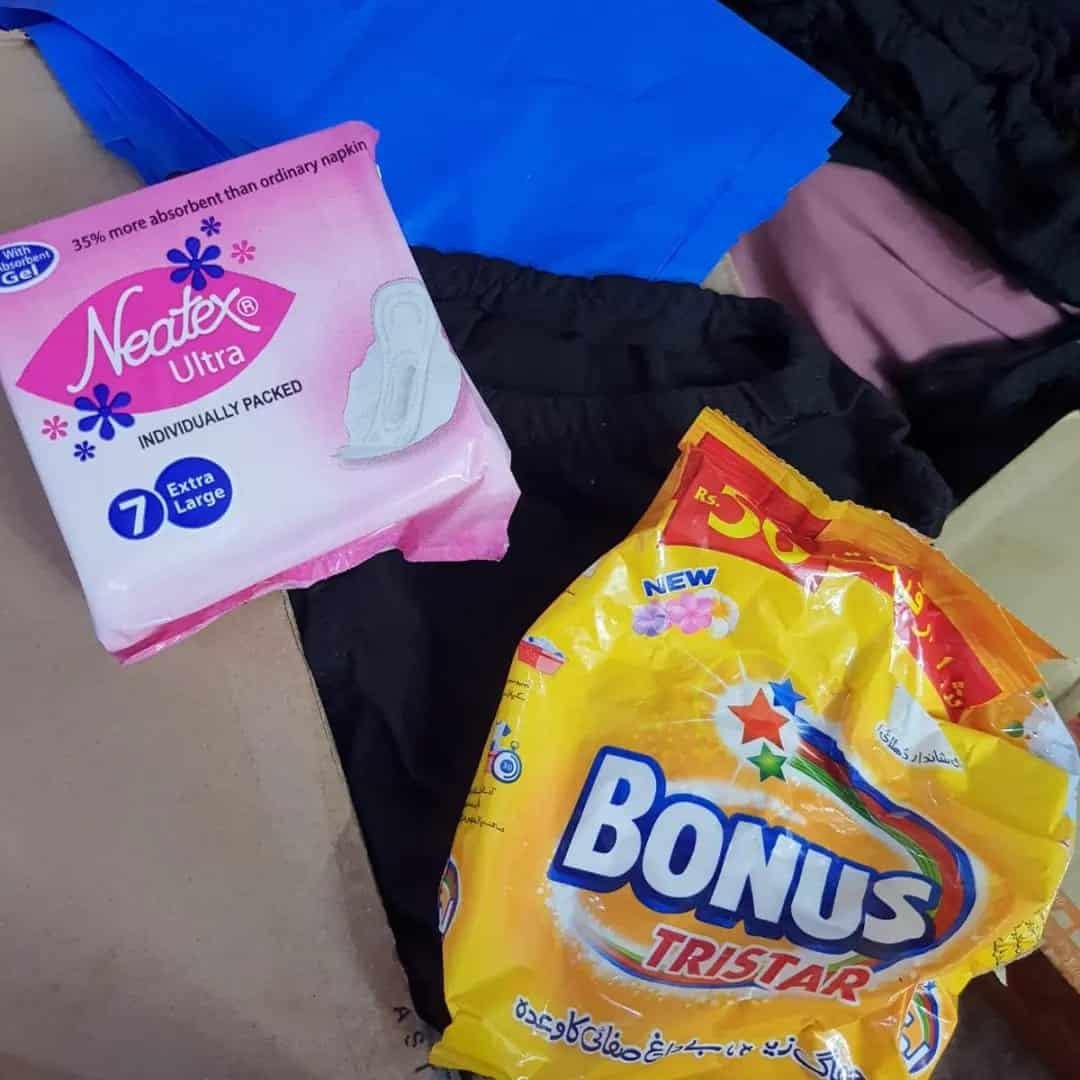
Mahnoor told The Current that Mahwari Justice is collecting sanitary napkins, cloth pads, cotton pads, underwear and sheets which they then donate to women in disaster-hit areas.
“There are many people who are saying that women in rural areas do not use sanitary pads. Why don’t they use sanitary pads? Because they do not have access to them and the critique is mostly coming from those who maybe have never used a cloth pad in their lives,” she stated.
Bushra comes from a lower-income background and for most of her life, she used a cloth pad. “Do you even realise, how uncomfortable and how unhygienic and how itchy the cloth pads are?” she wondered, adding: “I had to use cloth pads because we did not have the resources to buy sanitary napkins. It was difficult to afford sanitary napkins for six people every month.”
Mahoor further said that she agrees that sanitary pads have many problems too, but she does not understand why people think it is okay to preach about climate impact when an urgent crisis has hit the country.
“Pakistan is only contributing one per cent to the global carbon emission and women in rural areas do not make even a fraction of that one per cent.” She said she doesn’t understand why people are so worried about the waste that will be generated.
Anum Khalid, who started this campaign with Mahnoor while talking to The Current said, “If a flood victim is thirsty and you are giving them water in a plastic bottle, does that not harm the environment?”.
She continued by saying, “Bushra and I started this campaign to provide immediate relief to women or other menstruators from the issues they face from continuous bleeding.”
United Nations (UN)’s report on Guide to Menstrual Hygiene products suggests that consultation should be done on what products women are comfortable using because different materials and products are utilised for this purpose.
Anam said that they now send information about how to use sanitary pads along with their sanitary kits. They are also providing cloth pads for women in the areas where women ask for them because of their cultural preferences.
She continued by adding that our volunteers are teaching women in rural areas in their own language how to correctly use sanitary napkins.
She concluded by saying that the debate about whether something is a luxury or a basic need in times of crisis was tragic. “Our justice campaign, I believe, is helping to change the belief that sanitary pads are luxury,” she stressed.
Appeal for donations
Help us reach more flood-affected women and girls!
‘Woman of bad character’ is one of the phrases we often hear when the word ‘abortion’ is mentioned in our country. Abortion means the deliberate termination of a human pregnancy, most often performed during the first 28 weeks of pregnancy. Abortion sparked a debate after the United States (US) Supreme Court overturned Roe v Wade, a landmark ruling that granted the right to abortion. The court determined that there is no constitutional right to an abortion, leaving it up to the states to decide whether or not to allow abortions.
According to a 2020 article in ‘Soch writing’, Pakistan has an annual abortion rate of 50 per 1,000 women as per a 2012 survey, the highest in South Asia and one of the highest in the world. (A previous study estimated a rate of 27 per 1,000 women in 2002).
So at present, we understand the meaning of abortion but what we don’t understand is why is it required. A woman conceives a child, but somehow her circumstances lead her to the “choice” of not having the child anymore, and “she ends up deciding of quitting the will to bring a child into this world”. What happens next? She decides to “abort” the baby. Will she be “allowed” to do so? What if the woman was raped and conceived the child as a result of sexual assault? What if she is in an abusive marriage and doesn’t want to risk another life at the hands of her partner? What if the child conceived is a serious threat to the mother’s health? What if both parents are drug addicts? What if they don’t have the financial means to nurture a child? What if both parents carry childhood traumas that they haven’t fully recovered from? What if they are simply not ready? The situations are plenty but they all lead to one word, “choice”. A choice that a woman and her partner must have. A choice to decide when to bring another life into this world and their lives.
Women in Pakistan are no different. They are clearly seeking abortions, and medical practitioners often refuse to perform them or do so only in secret, which are very risky and at times, very expensive —in general, both seekers and providers of abortions tend to believe the procedure is against religion or Pakistani law, or both. So where does it lead us? Education on abortion must be taken up as a priority by the health practitioners and by the individuals involved. Yes, abortion is a big step and comes with its own weight and worries but one’s mind and body should be allowed to make a choice. A choice that doesn’t lead to a judgement about a woman’s character but will only be considered a choice which she freely made for herself. Her body, her choice.