Tag: women rights

  • Prime Minister Imran Khan breaks silence on Aurat March

    Days after it was held, Prime Minister (PM) Imran Khan has broken silence on Aurat March 2020, saying that a “culture clash” was developing in the country due to different education systems and it was most visible in the mixed reactions drawn by women marching on International Women’s Day to demand basic rights.

    “We will, hopefully by next year, introduce a core syllabus for all schools that will be mandatory for students apart from the additional subjects each institution chooses to teach,” the premier said in a speech marking the groundbreaking ceremony of housing projects for low-income people.

    “This is how you create a nation. This is how you end rival cultures from developing,” he said. “The Aurat March that just happened… a different culture was visible in it… this is a cultural issue and this comes from the schooling system,” he added.

    WATCH VIDEO:

    https://twitter.com/mmnewsdottv/status/1237783284723179522

    PM Imran said that by adopting a uniform education system, Pakistan could bring an end to the societal divide that is perpetuated by different educational standards.

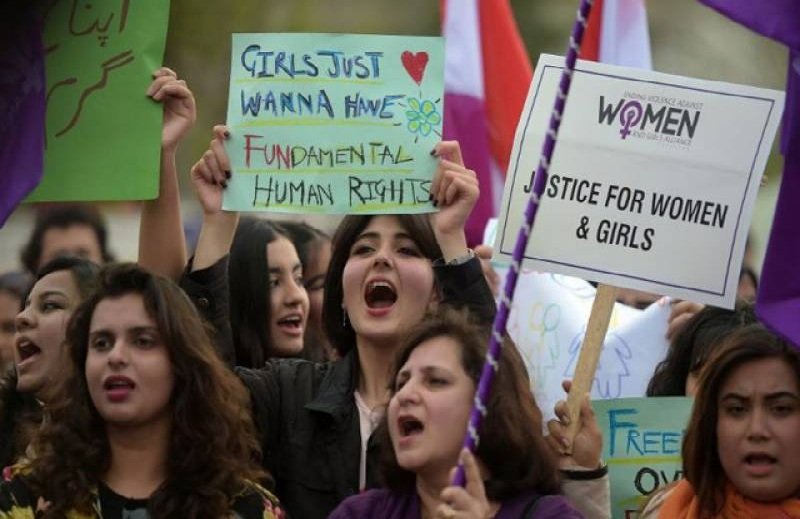
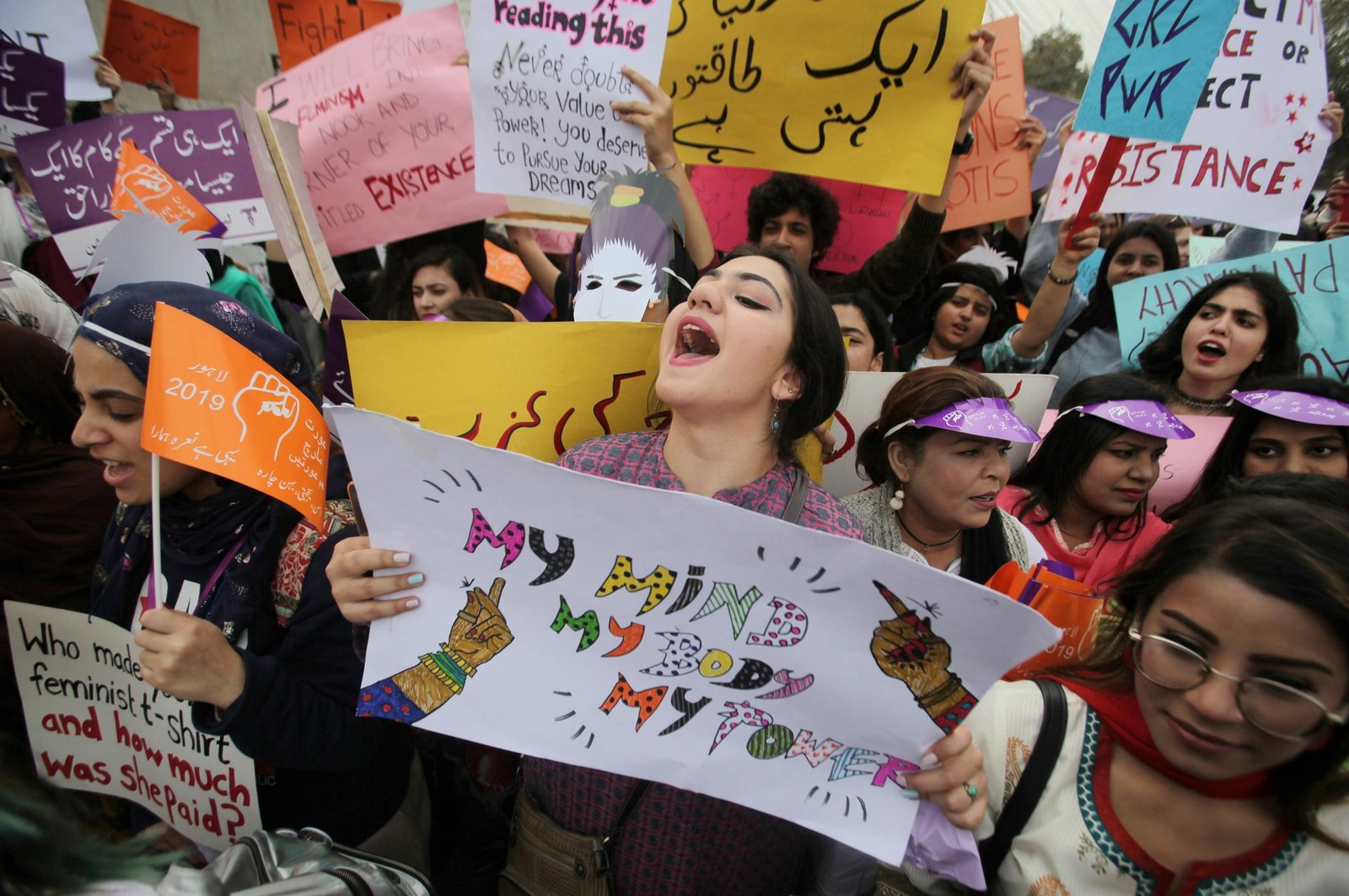
    In various cities across Pakistan, the Aurat March was held on Sunday to mark International Women’s Day. The marches were attended by women, children, men, transgender people and others.

    The first Aurat March was held in 2018 in Karachi. Last year, it was extended to more cities, including Lahore, Multan, Faisalabad, Larkana and Hyderabad. The Aurat March, as it has come to be known since its first iteration, was organised by Hum Aurtain — a feminist collective.

    It has a manifesto demanding basic rights for women in each field of life.

    Many people object to placards and demands of women marchers, saying that they are “un-Islamic” and “unconstitutional”.

  • Why we march

    International Women’s Day is celebrated across the globe on March 8. Pakistan, too, marks the day as women from all walks of life take out rallies and marches across the country to ask for equal rights.

    Aurat March, a rally organised by women, is being held across several cities of Pakistan today. 

    Despite threats from the Jamiat Ulema-e-Islam-Fazl (JUI-F), Lal Masjid affiliates and other right-wing elements, women have not backed down and will continue marching, bearing the flag of equality.

    As for why we march; we march for those 1,000 women killed in the name of “honour” every year. We march because domestic violence has been normalised in our society. We march because more than a thousand Christian and Hindu girls are forcefully converted and then married off to Muslim men against their will. We march because only 5-10 per cent of women have land in their own name. We march because 70,000 young girls die during childbirth as a result of underage marriages. We march because acid attack victims are shunned by society. We march because rape survivors are shamed into silence. We march so that victims of sexual harassment do not fear speaking out. We march because freedom should win over fear. We march because misogynists like Khalilur Rehman Qamar are glorified by our media while strong women like Marvi Sirmed are asked to tone down their behaviour. 

    Women were told to change or tone down the slogans of Aurat March. They are being threatened that if this is how they ask for their rights, they will not be given anything. Well, enough! We will ourselves decide how to speak, how to walk, how to sit, what to wear, where to go, what to do. When a woman says no, it means NO! 

    When we say ‘Mera Jism, Meri Marzi’, we speak for those nameless rape survivors, for those who are victims of domestic violence, for those who are victims of sexual violence, for those whose reproductive health rights have been snatched away, for those women who continue to suffer silently because society does not give them a chance or a way out. 

    We will march and continue to fight patriarchy every step of the way. Without equality, there is no going forward. It is not an easy task but our women have never let us down. From Fatima Jinnah to Benazir Bhutto, from Asma Jahangir to Malala Yousafzai, our women have continued to make us proud. We are proud of each and every one of our women. More power to you. Happy Women’s Day!

  • Vanity projects and double standards

    Women in public life are judged on what they wear rather than what they do.”

    The runup to International Women’s Day in Pakistan has been marked by a heated national debate: not about the sorry state of women’s status in the country, but about the witty and audacious slogans raised in connection with Sunday’s Aurat March.

    The absurdity of the debate about Aurat March is characterised by the terrible misogyny it reveals in terms of women’s choices, particularly in relation to their bodies and their appearance. And here it is pertinent to take a step back and recognise just how deeply ingrained preconceptions about women’s appearance and sartorial choices are in Pakistan — and how, to some extent, all of us are guilty of this.

    For me, the most telling thing is the different way in which male and female politicians are regarded and judged and the very different standards to which they are held.

    Most young people will not remember this, but not so long ago, the Sharif brothers sported gleaming pates. Then over a decade ago, they had whatever work is required done and then they sprouted hair on the top of their heads. Nobody really commented on this even though it was essentially a vanity undertaking.

    I wrote about this on my blog on BBC Urdu, pointing out the complete double standards at play: Benazir Bhutto’s appearance had been routinely criticised and her clothes, shoes, gait, hairdo and makeup were something that nearly everybody in Pakistan — men or women — would hold forth upon. My blog which was titled Naye Baal, Nayee Zindagi pointed this out but much of the feedback it generated had an outraged tone telling me how dare I “criticise” these wonderful men — even though all I was doing was pointing out the double standards.

    “Nearly every woman politician in Pakistan is careful to cover her head in public and to look modest, yet the Vawdas and Khans in the political arena will wear tight jeans and designer garb or any other less-than-occasion-appropriate attire yet arouse no comment and suffer no public backlash at all.”

    Bhutto was the first woman elected Muslim prime minister in the world and she achieved this at the very young age of 35. Yet, most of the public discourse around her was less about her policies or her politics and more about her clothes or her looks. People discussed, ad infinitum, the possibility that she might have had plastic surgery as if it was a matter of grave national importance. There was endless holding forth upon this by armchair experts who insisted, authoritatively, that her face looked different than in her early photos. Implicit in all of this commentary was the idea that Bhutto was somehow a terrible, vain and wealthy person if she had had any “work” done.

    Yet, when the Sharifs got new hair, nobody even batted an eyelid.

    Now fast forward to the present day where botox and hair regrowth procedures are becoming more and more common in Pakistan. Notice how little comment there is when a male politician or TV personality appears with a suddenly creaseless forehead or with jet black hair. No surprise, no comment, no embarrassment.

    The prime minister, Imran Khan, had a small bald patch about 14 years ago, but now he periodically appears with slightly thicker hair and nobody seems to comment on it or on any small changes to his face. I’m not saying that we need to comment on people’s appearance or their choices about that appearance, I’m just pointing out that the prevalent view is that men can do what they want but women’s appearance or clothes are considered something that everybody simply MUST criticise.

    These attitudes are, of course, linked up with a primitive social view that “honour” reposes in the body of the woman and she is a possession that might be “stolen” or “lost”. As a possession, she must be controlled by a man because there is a perception that if she is “free”, society will collapse and “immorality” or “fahashi” will prevail.

    Nearly every woman politician in Pakistan is careful to cover her head in public and to look modest, yet the Vawdas and Khans in the political arena will wear tight jeans and designer garb or any other less-than-occasion-appropriate attire yet arouse no comment and suffer no public backlash at all. Educational institutions will have a very strict dress code and rules for females, but be lenient with the males. It is always the women who have to be conscious of what they wear, how they walk or who they speak to.

    Times are changing, but there still is a long way to go because the people who are guilty of this sort of double standards are not just the chauvinists or the religious right — it is nearly everyone. These attitudes are now normalised and are so ingrained in our society that even educated, reasonable people — both men and women – are guilty of such behaviour. But the more aware of these double standards we can become, the more we will be able to overcome them.
  • ‘Why I march’: 90 per cent people hold bias against women, study reveals

    ‘Why I march’: 90 per cent people hold bias against women, study reveals

    Almost 90% of the global population irrespective of gender holds some prejudice against women, indicated a United Nations (UN) study released ahead of International Women’s Day.

    The UN Development Programme studied 75 countries representing 80% of the world’s population and found that nine in 10 people — including women — hold such beliefs.

    The prejudiced views include: that men are better politicians and business leaders than women; that going to university is more important for men than women; and that men should get preferential treatment in competitive job markets.

    The percentage of those holding at least one sexist bias was largest in Pakistan — where 99.81% of people held similar prejudices — followed by Qatar and Nigeria, both at 99.73%.

    Countries with the lowest population of those with sexist beliefs were Andorra, at 27.01%, Sweden with 30.01%, and the Netherlands, 39.75%.

    France, Britain, and the United States each came in with similar scores, 56%, 54.6%, and 57.31% of people, respectively, holding at least one sexist belief.

    The numbers show “new clues to the invisible barriers women face in achieving equality” despite “decades of progress,” the UN Development Programme said in a statement accompanying the report.

    “The work that has been so effective in ensuring an end to gaps in health or education must now evolve to address something far more challenging: a deeply ingrained bias — among both men and women — against genuine equality,” UNDP Administrator Achim Steiner said.

    The agency called on governments and institutions to change discriminatory beliefs and practices through education.

    Beyond inequalities in education, health, and the economy, the statement also called out one of the report’s most chilling findings: 28% of people believe it is okay for a man to beat his wife.

  • Senate divided on ‘how much rights should Pakistani women get’

    Senate divided on ‘how much rights should Pakistani women get’

    The Upper House on Friday stood totally divided on how much rights should be provided to women in Pakistan, but shared consensus on how they lagged behind as compared to men, as senators discussed the National Commission on Status of Women report, The News reported.

    Among those who participated in the discussion over the 2017 annual report by Minister for Human Rights Dr Shireen Mazari on January 22 last year, were Mohsin Aziz, Mushtaq Ahmad, Walid Iqbal, Nuzhat Sadiq and Sherry Rehman.

    The widely-discussed issue of a Faisal Vawda, showing a long shoe, also echoed in the House after the Question Hour, when PML-N Senator Kulsoom Parveen raised the matter, wondering should the lawmakers stop appearing in TV talk shows, the way a sitting member of this House was ‘insulted’.

    She clarified that they had voted not for the boots but for the country’s key security institution, which was so dear to them. “Is the punishment of stopping the minister for a few days from appearing in talks shows is enough,” she asked.

    Senators Mohsin Aziz and Mushtaq emphasised during the discussion on the commission report that the women rights should not be seen through the Western lenses and cultural invasion. They insisted that awareness about women rights could not be promoted and drives pushed for their rights while sitting in five-star hotels; instead such events be held in rural areas to read and asses the ground realities.

    They said events in the name of culture in academic schools could not be allowed, which ran contrary to social and cultural values, enshrined in the Shariah. They supported women emancipation and lifting their status in the society, freeing them from the clutches of exploitation but not at the cost of values and honour. They also objected to certain slogans raised and inscribed on posters during drives for women rights last year.

  • Pakistan ranked 151 out of 153 in gender equality index: WEF

    Pakistan ranked 151 out of 153 in gender equality index: WEF

    According to the Gender Equality Index report of the World Economic Forum, Pakistan stood 151 out of 153. The only two countries below Pakistan are Iraq and Yemen.

    Though grand claims have been made about improving educational opportunities for youth, empowerment of democracy and the betterment of health facilities in the country, all have been shattered after the INGO placed Pakistan at number 150 in the list of economic participation and opportunities, 143rd in education attainment, 149th in health and survival and 93 in political empowerment globally.

    While Pakistan stood 112th in 2006, the standing has drastically slipped to 151 in the the last 14 years.

    The report highlights that there is a huge gap of 32.7 percent between men and women in the context of economic opportunities. The gap has also widened to 94.6pc – which means that women do not have the same facilities in comparison to men.

    On the contrary, Bangladesh ranked 50, followed by Nepal 101, Sri Lanka 102, India 112, Maldives 123 and Bhutan 131.