Tag: women

  • Women journalists bear the brunt of cyberbullying

    Women journalists bear the brunt of cyberbullying

    Perugia (Italy) (AFP) – Women journalists face greater threats online in the course of their work, and the trend is increasing, one expert told an international conference in Italy this weekend.

    “There is significant potential for online violence to escalate to offline harm,” said Julie Posetti research director of the International Center for Journalists (ICFJ).

    “Women tend to face greater threats online,” she told delegates at the Perugia International Journalism Festival on Saturday. And, she added, “the kind of threats they face are increasing”.

    That toxic environment was being “facilitated by Big Tech companies”, she added, accusing them of “a failure to take responsibility”.

    In a joint UNESCO/ICFJ study in 2022, nearly three-quarters of women journalists interviewed said they had experienced online violence or abuse in connection with their work. They interviewed 900 journalists from 125 countries.

    Attacks online include insults, sexist and sexual comments, and physical threats, including death threats to journalists and their families, the conference heard.

    Increasingly sophisticated attacks include blocking accounts, hacking, publishing private photos and creating “deep fakes” — fake sexual images of people without their consent.

    Violent threats tend to increase when combined with discrimination linked to skin colour, religion or sexual orientation.

    Physical violence

    Posetti and two other researchers have built a guide and toolbox on the topic targeting journalists, together with the Organization for Cooperation and Security in Europe (OSCE).

    Filipino journalist Maria Ressa, the 2021 Nobel Peace Prize winner, was a victim of online abuse, as she explained in the ICFJ-UNESCO report.

    “I was a CNN war correspondent for two decades, but nothing in the field prepared me for the orchestrated, misogynistic attacks on me and our women-led news outlet, Rappler,” she said.

    BBC disinformation specialist Marianna Spring received an avalanche of abusive tweets last year, threatening to kidnap her or slit her throat.

    Much of the abuse followed her investigation into the takeover of social media network X, then known as Twitter.

    In some cases, online threats can translate into physical violence.

    A fifth of women surveyed said they had suffered attacks or insults in real life that were linked to online abuse.

    The consequences can be far-reaching, with some journalists potentially dissuaded from covering sensitive topics and some choosing to opt out of the industry altogether.

    Paris-based media rights campaigners Reporters Without Borders (RSF) has warned that this type of harassment forms a new threat to press freedom.

    Developing counter measures

    French journalist Nadia Daam told AFP that she received a flood of hateful messages in 2017 after a column that criticised an online forum.

    Since then, she has moved house twice and tends to stay away from social media, but says she still gets cyber-bullying messages and “doesn’t work the same anymore”.

    However, she thinks there is more awareness of the problem now, saying that she believes the wider industry “talks more about cyberharassment”, with more severe legal sentences.

    Freelancer Melina Huet covered the war in Ukraine as well as the Israel-Hamas conflict, and said she regularly gets online threats related to her coverage.

    “I received threats of beheading and rape on Instagram,” she said. “The perpetrators can easily re-create accounts, there is impunity.”

    Some media have put protocols in place to try and tackle cyberbullying.

    Jessica Ziegerer is an investigative journalist for the daily HD Sydsvenskan, and regularly receives hostile messages.

    “Before publishing a sensitive article, we have a meeting with security specialists and review all the aspects” both online and offline, she said.
  • Twinkle Khanna spills the beans: The surprising reason women over 50 shy away from red lipstick

    Former Bollywood star and author Twinkle Khanna has had an important conversation about aging and makeup. The columnist pointed out that women over 50 often feel shy when it comes to wearing red lipstick.

    In a recent video she shared, Twinkle openly discussed how women of a certain age may feel embarrassed about wearing red lipstick. She even demonstrated this by wearing red lipstick in the video to gauge people’s reactions.

    She wrote her on Instagram, “Do you see an age limit written on this lipstick?
    What unwanted makeup advice have you received recently?”

    Last year, Twinkle, the daughter of Bollywood legends Rajesh Khanna and Dimple Kapadia and wife of action star Akshay Kumar, celebrated her 50th birthday.

  • Ali Abbas thinks women adore him because he respects them

    Ali Abbas thinks women adore him because he respects them

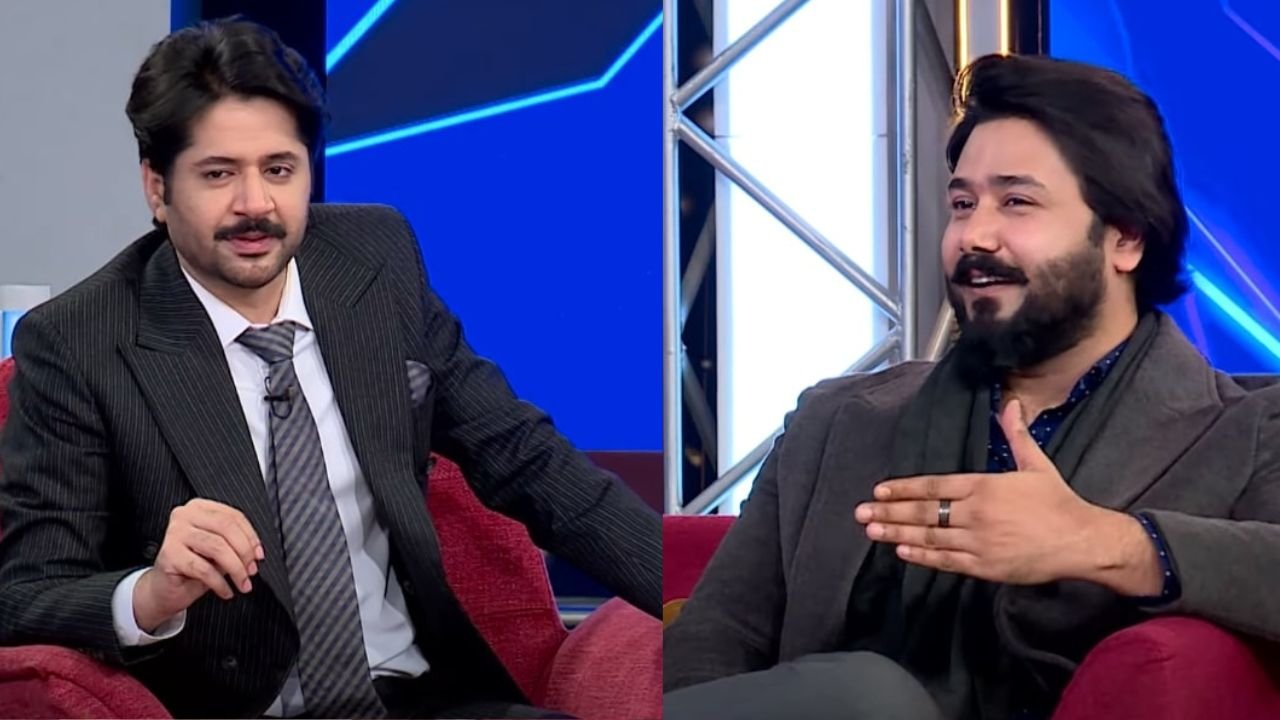
    Actor Ali Abbas is well-known for his strong work ethic and professionalism. During an appearance on ‘Mazaq Raat’, his colleague and host Imran Ashraf revealed that Ali seems to attract a lot of female attention, and almost everyone he meets develops feelings for him. Imran was curious to understand why Ali always comes across as the good guy.

    Ali said, “I have always respected women and I am very chivalrous around them, which warms everyone up around me. I am also very intense in romantic acting, but I make my co-stars comfortable. All these factors combined have endeared me to everyone.”
    Ali further shared, “I also have one-sided love, and that is for Mahira Khan. I have always admired the superstar since her days as a VJ, and that fan love will always remain.”

    This is what he said:

  • Maryam Nafees will not work with Khalil Ur- Rehman Qamar

    Maryam Nafees will not work with Khalil Ur- Rehman Qamar

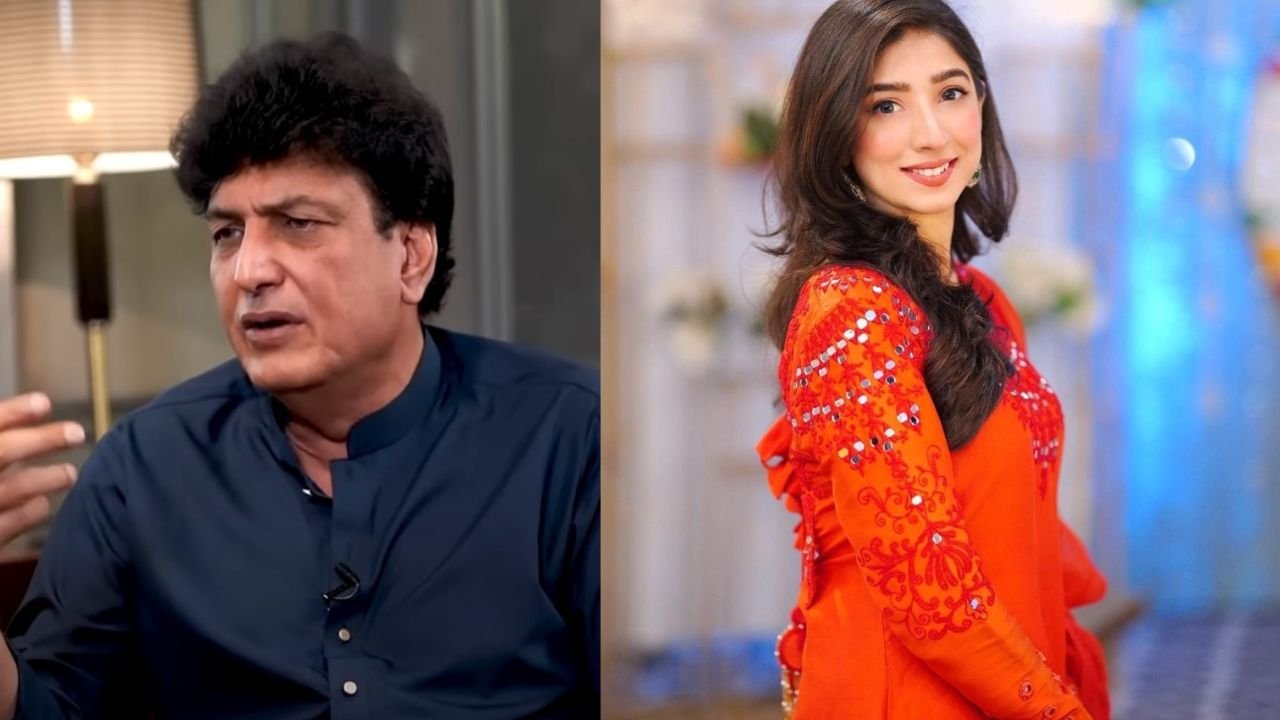
    Actress Maryam Nafees recently took the decision of not working with controversial script writer Khalil Ur Rehman Qamar. “I won’t work on any TV drama written by Khalil Ur Rehman Qamar,” she said, explaining her choice on a TV show. “It’s because of different beliefs, not because Qamar isn’t talented. I wants to work on projects that match my values.”

    She’s worried about how Qamar shows women in his dramas, even though she respects his skills. Nafees wants to support women’s rights and feels she can’t do that by working with him.

    Qamar has often picked fights with actresses and female analysts over his misogynistic comments. Actress and former supermodel Iffat Umar recently refused to engage with him, criticizing Qamar for his narrow-mindedness and bitterness. This confrontation reflects mounting industry frustration with Qamar’s controversial remarks and treatment of women. In a TV appearance, Qamar dismissed Miss Pakistan 2022 winner Sana Hayat’s experiences, sparking further debate about gender equality and respect in the entertainment industry. Women are hesitant to work with him because they believe his beliefs and comments harm women’s progress and representation in the industry.

  • ‘Didn’t mean to cause offence’, Adnan Siddiqui in sticky situation after ‘women like makhis’ comment, apologies

    ‘Didn’t mean to cause offence’, Adnan Siddiqui in sticky situation after ‘women like makhis’ comment, apologies

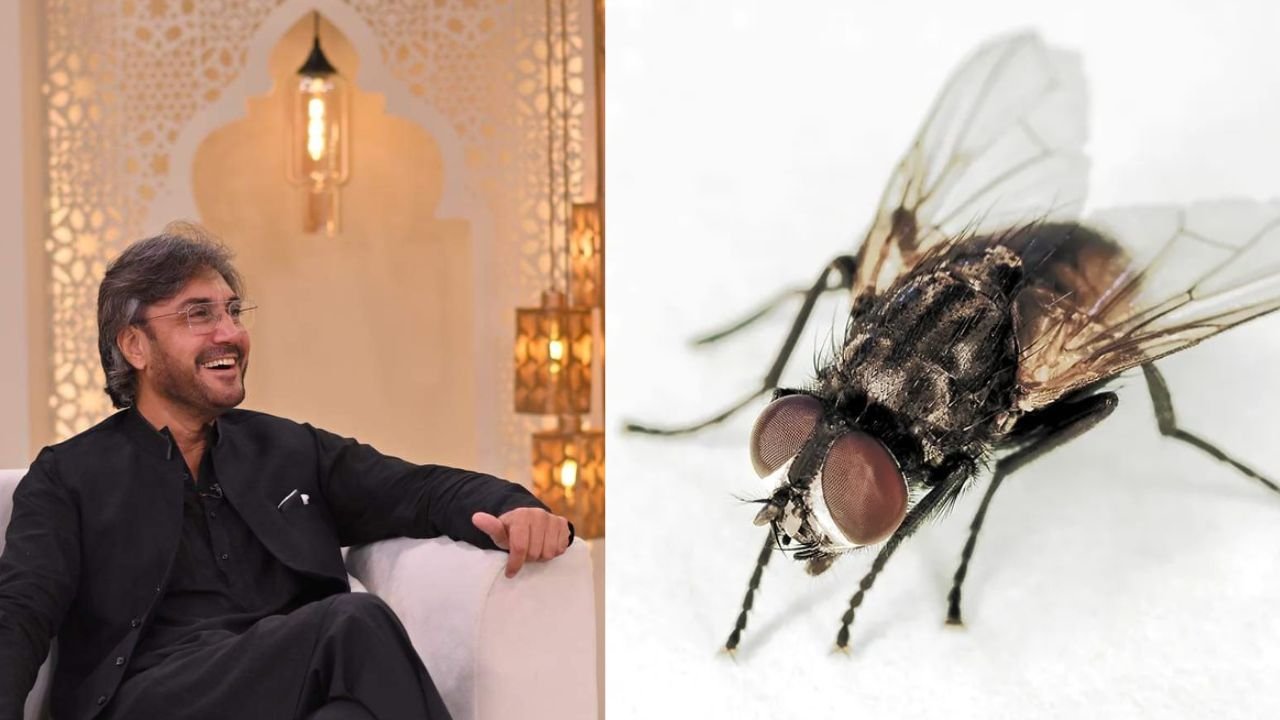
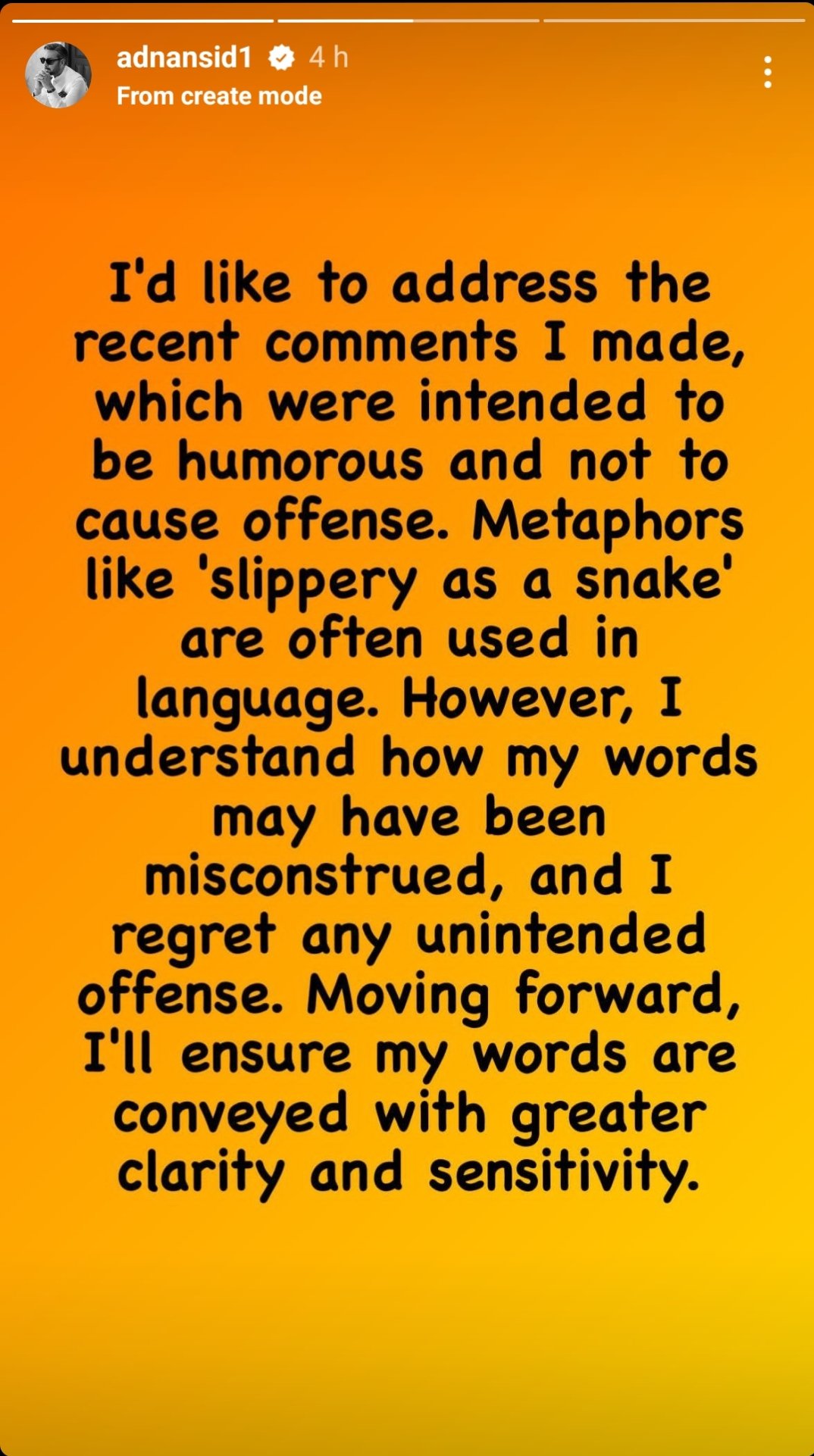
    Update: After the internet slammed Adnan Siddiqui’s comments comparing women to flies, the actor has issued an apology. In an Instagram story he said, “I regret any unintended offence. I hope to speak with greater clarity and sensitivity in the future.”

    Veteran TV actor Adnan Siddiqui has landed in hot waters due to a comment he made on a show, a statement perceived as misogynistic. As a guest on Nida Yasir’s show ‘Shan e Suhoor’, Adnan made a strange comment that made the host uncomfortable. Nida distanced herself from Adnan’s comment, but he stood by his words. “Women are like bees, the more you chase them, the further they’ll fly away, but when you sit calmly, they will come to you on their own.” He continued, “When I was trying to catch a bee, it wasn’t coming to my hand, but when I sat down calmly, it came and sat on me.”

    Notably, Siddiqui used the word ‘makhi’ that could mean a house fly or a honey bee.

    The Internet is reacting to the video and there is a lot of negative commentary on the video

  • Women ask me to make them Deepika, Alia: Designer Nomi Ansari

    Women ask me to make them Deepika, Alia: Designer Nomi Ansari

    Pakistani women are asking Nomi Ansari to transform them into Bollywood’s Deepika Padukone and Alia Bhatt.
    Nomi Ansari, a top designer from Pakistan, dresses many celebrities and stars. He counts Mahira Khan, Iqra Aziz, and Kubra Khan among the big names he has dressed. Recently, he appeared as a guest on Hasna Mana Hai, where he discussed fashion, business, and life.
    An audience member asked him if he would provide an outfit for his female friend.

    He said, “My outfits are expensive because I have to pay many workers their wages and cover various bills. That’s how my brand operates. I’ve worked for years to establish myself as a luxury brand.”
    He said, “A lot of women come to me, and they all want to look like Bollywood stars Deepika Padukone or Alia Bhatt. I can accommodate this if they want it, but often there are differences in physique, budget, or personality. Still, I receive these requests.”

  • Where are women in the Pakistani news media industry?

    Where are women in the Pakistani news media industry?

    In a groundbreaking study conducted by the Women Journalists Association of Pakistan (WJAP) and Freedom Network, the Pakistani media industry has been thrust into a state of gender emergency due to the stark under-representation of women journalists in newsrooms and the absence of gender-sensitive policies.

    Titled “Unequal Newsrooms: A Gender Audit of Pakistani Media Organizations,” the study was unveiled ahead of International Women’s Day on March 8th.

    The comprehensive gender audit surveyed 15 news organizations in Islamabad, focusing on workforce representation, organizational policies, anti-harassment measures, working conditions, and wages. Among the audited organizations were six TV channels, four newspapers, three news agencies, and two news websites.

    The audit findings reveal that the average share of women journalists at the news outlets is only 11 percent. Majority of news organisations have no woman journalists in a leadership position.

    Only two out of the 15 media houses have an anti-harassment inquiry committee despite a federal law making it mandatory for employers. Most media organizations do not offer paid maternity or paternity leave even though it is now legally required.

    The gender sensitivity assessment of the audit report found that overall around 75 percent of the 15 news outlets were gender blind, meaning their organisational policies and practices do not identify or address specific gender-based issues that can affect men, women, and other gender minorities differently at the workplace.

    The findings also revealed that the majority of the news organisations do not have documented policies regarding employee conduct, salaries, and promotions. At nearly half of the organisations, salaries are paid late, and the wages of female journalists are lower than their male counterparts at a quarter of the organisations.

    As per the study, almost 75 percent of news outlets did not have even one woman journalist in an influential or leadership role at their Islamabad offices. The remaining
    four outlets had at most two women journalists involved in news decision-making.

    In response, the study offers a set of recommendations directed at news organizations, media managers, civil society, journalist unions, and policymakers. These include implementing gender equality strategies in hiring, promotions, and workplace conduct, conducting capacity-building training and awareness on gender for journalists and newsrooms, demanding transparency in contracts and wage structures, and seeking legal recourse against violations of gender protection laws.

  • Mark your calendars: Aurat March is around the corner!

    Mark your calendars: Aurat March is around the corner!

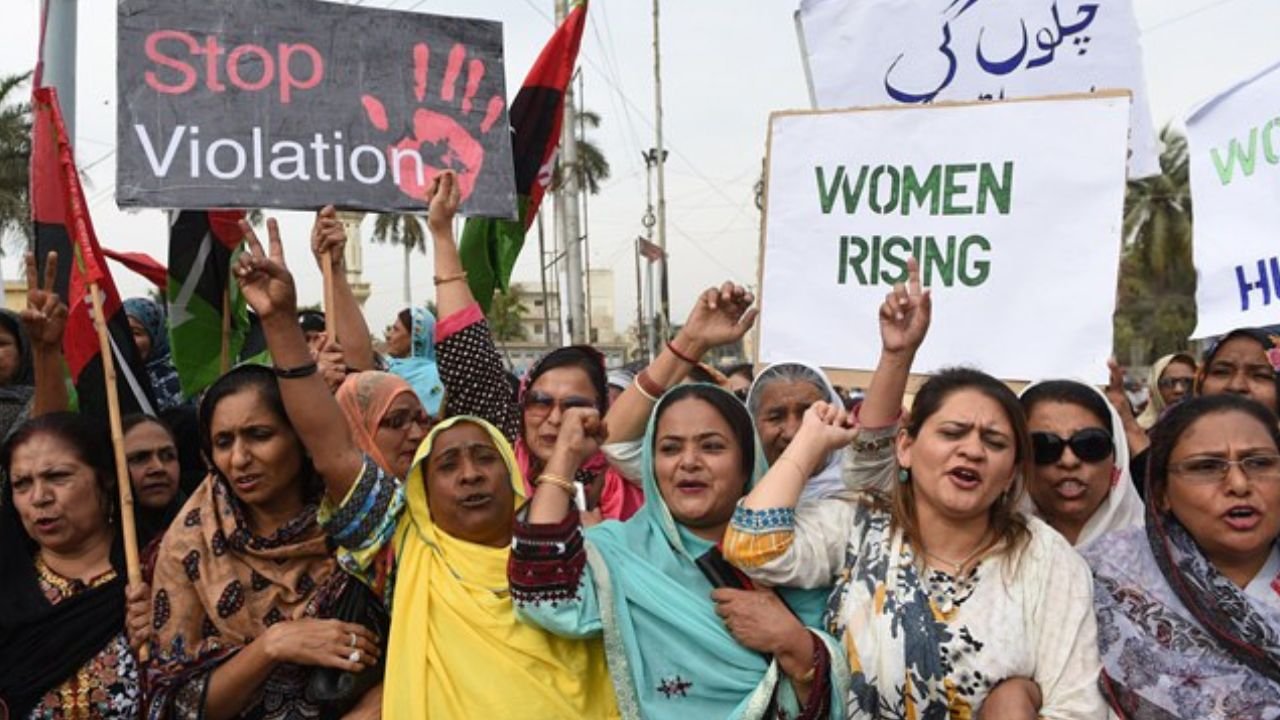
    March is finally here which means that 8th of the month is Women’s Day around the world and in Pakistan, Aurat March in major cities will walk through the streets to remind the state and the society of the due rights of women and minorities of the country.

    Where and when to join Aurat March?

    Lahore
    Time: 8th March, 2 pm
    Place: Lahore Press Club

    Karachi
    Time: 2:30 pm
    Place: Frere Hall

    Islamabad
    Time: 2 pm
    Place: Islamabad Press Club

    Multan
    Time: 3 pm
    Place: Nawan Shehar Chowk

    What are the demands this year?

    Lahore

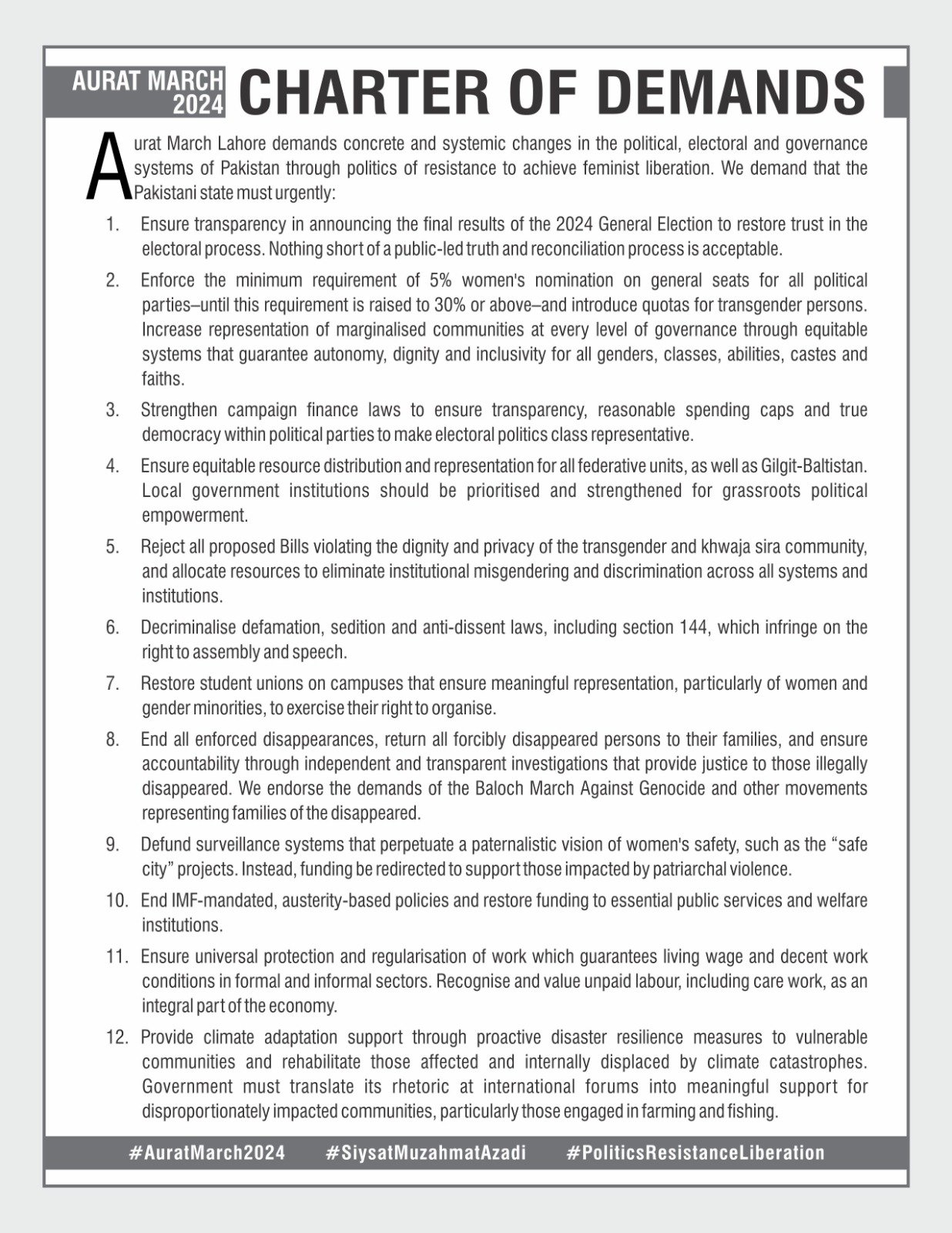
    This year, Lahore based its theme on “Siyasat, Muzahamat aur Azadi” which means that the manifesto addresses the electoral politics (in the light of the recent General Elections of Pakistan back in February 8), as well as asserts on the re-envisioning political participation where “oppressed groups and communities on the margin take center stage.”

    Here are the demands by Aurat March Lahore:

    Karachi

    In Karachi, Aurat March will focus on domestic violence, sexual violence, enforced disappearances, extrajudicial killings, land grabbing, state-sponsored poverty, religious extremism, repression of gender and body politics, fascistic capture of politics and everything “the patriarchy subjects us to under its militaristic control of our bodies.”

    Islamabad

    The capital’s theme this year is Resistance and Hope:

    Calling on to end enforced disappearances; promoting “hope and world peace” in light of Israeli genocide in Gaza; end to gender-based violence; to take action against cyber harassment targeting women, minorities, and children with effective legislation; end to period poverty by making period products accessible for all and provind period education in school; economic justice i.e. integrating women’s reproductive labour into country’s Gross Domestic Product (GDP), formalisation of informal sector to ensure work standards and safe working environment, action against child labour, wage regularisation, right to unionisation, and allocation of funds to rehabilitate women farmers, shopkeepers, small landlords; improved access to universal education and healthcare; political rights of women; as well as rights of religious minorities.

    Read the details on the demands by Islamabad here:

    Multan

    With the main focus on climate justice right and economic liberation, here are the demands by the city of Multan this year:

    1. Education for All: Guarantee education for girls up to the age of 16, ensuring equal access to knowledge and opportunities.
    2. Right to Identity: Ensure that all men, women, and transgender people in Siraiki Wasaib have their identity cards without any hindrance from the state.
    3. Combat Harassment: Form active committees against sexual harassment in educational institutions and workplaces, enforcing strict adherence to anti-harassment laws.
    4. Student Empowerment: Lift the ban on student unions in universities across Pakistan, allowing students to exercise their rights and have a say in their education. Also, Establish new colleges and universities with equitable access for all, fostering an environment of learning and growth.
    5. Inclusive Infrastructure: Implement accessible architecture in schools, government offices, and public spaces, catering to the needs of people with disabilities.
    6. Fair Wages: Enforce inflation-adjusted and gender-conscious minimum wage policies, promoting economic justice for all.
    7. Protect Domestic and Small Industry Workers: Safeguard the rights of domestic workers, particularly young girls, from exploitation and abuse.
    8. End Early Marriage: Enact laws against early marriage and forced religious conversion, setting the legal marriage age to 18.
    9. Transgender Rights: Implement the Transgender Rights Act 2018, ensuring equality and protection for transgender individuals.
    10. Political Victimisation: Stop the unjust targeting and unlawful detention, especially of women, for political reasons.
    11. Women’s Protection: Fully implement the Women Protection Bill and expedite the completion of Women Crisis Centers in Multan.
    12. Holistic Education: Incorporate human rights, climate change, and gender education into the high school curriculum, fostering awareness and understanding.
    13. Healthcare Access: Ensure accessible healthcare and employment opportunities, along with childcare facilities for women in both government and non-government sectors.
    14. Remove Taxes: Eliminate taxes on women’s hygiene products and essential items, relieving financial burdens on women.
    15. Worker Rights: Abolish the exploitation of various marginalized groups, including brick kiln workers, farmers, journalists, and factory workers.
    16. Combat Terrorism: Take legal action against activities that terrorize women, ensuring the rule of law prevails.
    17. Judicial Representation: Increase the number of women judges, particularly in the Lahore High Court, Multan, and Bahawalpur Benches, promoting gender parity in the judiciary.
    18. End Corruption: Eradicate corruption and mistreatment of women in social support programs.
    19. Report Mechanisms: Establish effective portals to report incidents of harassment and violence against women, ensuring swift action and justice.
    20. Religious Freedom: Protect religious places and minorities from desecration and criminal acts, upholding fundamental freedoms for all.
    21. Child Protection: Implement stringent measures to prevent the sexual abuse of children, safeguarding the innocence and well-being of our youth.
    22. Safe Spaces: Ensure the fundamental freedoms and protection of women in Dar ul Aman and working women hostels, providing safe havens for those in need.
    23. Digital Access: Declare internet access as a fundamental right and bridge the digital divide, ensuring equitable access to technology for all.
    24. Combat Stereotypes: Eliminate gender stereotypes in educational materials, electronic media, and social platforms, promoting equality and diversity.
    25. Justice for All: Pay homage to human rights leaders like Rashid Rehman and demand justice for those who have sacrificed for the cause of equality and justice.
  • Rates of violence against women, children remain alarming in 2023

    Rates of violence against women, children remain alarming in 2023

    2023 was another difficult year for the women of Pakistan who routinely have to battle against violence and discrimination. 

    In November, UN Women’s Gender Snapshot 2023 report revealed that 245 million women and girls are subjected to physical and/or sexual violence from their intimate partners each year, adding that a “staggering 86pc of women and girls live in countries without robust legal protections against violence, or in countries where data are not available”.

    This violence is not limited to women and girls but extends to boys as well. Back in August, Sahil, an NGO, reported that an average of 12 children per day (or one every two hours) faced sexual abuse in Pakistan in 2023 whereas 2,227 cases of child sexual abuse were traced between January and June this year.

    Here are some of the pertinent cases from the year 2023 that took over the headlines:

    1. Fatima Case

    A domestic maid, 10-year-old Fatima Phuriro, was found dead under suspicious circumstances in Ranipur.

    The child had been working as a domestic worker at a haveli owned by an influential local, Pir Asad Shah Jilani.

    It was not until videos of the child were leaked by an unknown source and circulated in social media that the case caught the media’s eye. By then, the family had buried Fatima on August 15.

    The body was later exhumed and sent for an autopsy which revealed that the girl had been raped both vaginally and anally.

    The suspects are in custody. 

    2.  Rizwana

    Rizwana, 14, had been allegedly assaulted and abused while working at a civil judge’s home in Islamabad, after she was accused of stealing jewellery. Rizwana’s family revealed that the girl was not paid a single penny by the family for the extensive workload she was doing and was instead subjected to violence.

    Islamabad Police recorded Rizwana’s statement at the Child Protection Bureau in Lahore where she alleged that the judge himself beat her up, hitting her head against the wall, while his wife and children would also assault her.

    3. F9 park incident

    In February, a girl went to Islamabad’s F-9 park along with her male colleague when two men stopped them at gunpoint and took them to a heavily wooded area where they beat her, raped her and told her to “not come to the park at this time”.

    In her FIR, the girl said that the men told her to “not come to the park at this time”.

    The incident sparked anger and protests as women questioned the security in the capital of the country.

    4. Sara Malik

    The year started with the news that a body was found near Farhan Shaheed Park at Seaview, Karachi, in January. Identified as Sara Malik, the 23-year-old employee worked at a veterinary hospital in DHA 8. Registration of a murder case was recorded under Section 302 (premeditated murder) of the Pakistan Penal Code after further investigations.

    Malik initially went missing from Karachi’s Seaview beach and the police reportedly claimed that she might have committed suicide by jumping into the sea but according to police officials, Dr Shan Saleem, who was nominated in the case, confessed to killing her after sexually assaulting her.

    5. Principal raping women

    The principal of a private school in Gulshan-i-Hadeed, Karachi, was taken into custody in September after allegations of raping and blackmailing women.

    Steel Town police Station House Officer (SHO) Nand Lal told media that the school principal was detained as videos of the alleged rape incidents made rounds on social media.

    The principal has admitted to the allegations that he raped women after promising them job opportunities, then recording their videos to blackmail them.

    It was also revealed that more than 45 women were identified in connection with the case as Irfan allegedly blackmailed the women in order to commit these crimes.

    The public prosecutor contended that the case is indicative of a planned scheme.

    6. Andaleeb Fatima

    Andaleeb Fatima, 13, was named as the victim in an FIR filed by her mother, Khalida Bibi, a resident of Chiniot in Punjab. Andaleeb had been working for the female suspect since July of this year and according to her mother, she was unable to talk to her daughter since was not allowed to do so by her employer.

    It was only when Khalida Bibi visited Fatima after several unanswered calls that she found out about the torture inflicted upon her daughter. She found bruises on different parts of her daughter’s body. Fatima told her mother that her employer routinely beat her and tormented her with a hot spoon. She also locked her up and did not feed her food.

    7. Special needs children

    A nine-year old child with special needs was raped and murdered in Korangi, Karachi.

    According to Zaman Town police, the body was found in the “rear seat of a parked Suzuki Cultus car. The body was bluish and foaming from the mouth”.

    Police surgeon Dr Summaiya Syed reported that the child was differently abled with a right hand deformity. “There were multiple injuries all over the body and findings are suggestive of anal sexual abuse,” she revealed.

    Similarly, a 12-year-old student with special needs was sexually assaulted in a school for special children in Rawalpindi.

    8. Raped during job application

    In January, a woman in Lahore was gang-raped after being lured for a job. The culprits recorded videos of the immoral act to blackmail the victim.

    The defendant, Khalil, had invited the woman to travel to Kot Khawaja Saeed Hospital for a meeting and had given her a job. As soon as she arrived, the suspect led her to a house where he and two other accomplices forced her into a room and raped her on gun point.

    According to the FIR, the woman alleged that the suspect had also videotaped the immoral behaviour and had told her not to call the police.

    9. Burnt alive

    Shumaila, the woman who was burnt alive by her husband Naseer and his first wife Robina died in a hospital in Lahore. She was admitted to a hospital but could not survive the severity of her burns. The incident happened in a village near Gujranwala, Chak Behlol.

    Further investigation revealed that she got divorced from her first husband to marry Naseer who was already married. The constant tussle between the two wives led to this tragic situation where she was burnt alive by Naseer and his first wife in the presence of a crowd of villagers who kept making videos.

    Naseer was taken into custody by the police.

    10. Boys

    In June, a cleric in Lahore’s Raiwind area tried strangling an eight-year-old to death after after he had repeatedly raped him in his madrassah.

    The FIR, revealed that the accused Qari Muhammad Rizwan fractured the child’s arm while he was torturing him and had then pushed the boy down stairs from the first floor to the ground floor, which led to severe head injuries that made the boy unconscious.

    11. Honour Killing

    In September, a married woman from the Alkani tribe was allegedly killed by her husband and his allies over ‘honour’. The stoning took place in the limits of Chucha Border Military Police (BMP) station in the tribal area of Rajanpur district after the woman was accused of adultery with a man, leading to her husband killing her, along with her brother-in-law and their accomplice. They reportedly smashed her head with stones and clubs.

    In October, a newlywed couple was shot dead inside a mosque in Jhelum.

    Rehman Rasool and Safia recently eloped to get married of their own free will. They were then called in by the girl’s family for reconciliation. Sensing the possible threat, the two of them took refuge in a mosque’s courtyard but got gunned down by the family, nevertheless.

  • Chief Traffic Officer Amara Athar has good news for women

    Chief Traffic Officer Amara Athar has good news for women

    Amara Athar, the first woman chief traffic officer of Lahore, has announced good news for women.

    After taking over the post, she has asserted that the department’s priority will be to get more girls to ride motorcycles and increase the capacity of women drivers.

    Pointing out that traffic jams are a major problem in the city, Athar said that her aim is to improve traffic flow within limited resources.

    Who is Amara Athar?

    Amara Athar was appointed as the Chief Traffic Officer (CTO) of Lahore by Punjab government on December 12.

    The BS-19 police officer is the first woman police officer on central traffic control assignment in the provincial capital and the fourth woman police officer posted in Lahore.

    Dawn reports that according to an official, under Punjab Inspector General of Police (IGP) Dr Usman Anwar’s policy, female officers have been prioritised for field assignments to counter the “decades-old tradition of ‘male dominant’ policing in the province”.

    An official claims that while there were a number of male contenders for the top position of the Lahore traffic police, the IGP preferred a woman officer, especially after the outstanding performance of another female officer, Aysha Butt, who was posted as Gujranwala CTO who has reportedly bring about significant reforms in a short period since her appointment.

    Butt has built Pakistan’s first traffic theme park at Gujranwala with a long walking track that has traffic signs on both sides to create public awareness about traffic rules.