Tag: women

  • ‘Mera Jism Meri Marzi is more than just being about clothes’: Amna Ilyas

    Actor Amna Ilyas was a guest on “The Talk Talk Show’ where she opened up about being a feminist, and clarified the misinformation around the Aurat March slogan ‘Mera Jism Meri Marzi’.

    When the placcard was raised at the 2018 Aurat March, it caused outrage after many right-wing critics said that the chant supports promiscuity and challenges family values in Pakistan. Many religious clerics had used the placard as justification to call ‘Aurat March’ un-Islamic and accused it of promoting a Western agenda in Pakistan.

    Many feminist activists have defended the slogan for protecting women’s bodily autonomy, and now Ilyas has also done the same, as she explained that the slogan ‘Mera Jism Meri Marzi’ was more than about clothes, it’s about protecting the rights of women:

    “It’s about having body autonomy rights and consent. It’s about harassment, domestic violence, and concepts like, ‘No one has the right to touch me without my consent, even if I’m married to you’.”

    Ilyas went on to debunk the stereotype associated with feminism that women who support this ideology are promoting vulgarity, when in reality the ideology supports the rights of women to have the same opportunities as men:

    “Whenever I talk about feminism, people always object by saying ‘Oh, Amna is bold, of course, she will spread vulgarity as she’s from the industry, she wants all our daughters to be like her’. No, I don’t want that, I only do what I want to for myself.”

    “When we speak of equal rights, it’s about having the same opportunities to thrive in my career as the man beside me. If you’re a father of four children who excel in your profession, why can’t I do the same? Honestly, it’s not about whether you’re getting permission to wear jeans or not. What we truly need, is the space to work in a cerebral capacity,” she explained.

    Watch the complete interview here:

  • 2 underaged girls married off by jigra as tribal fine in Jacobabad

    A jirga in Thull, Jacobabad decided to marry off two minor girls as punishment for their parents’ elopment. According to Aaj News, both the girls are seven years old.

    The jirga had decided on the case of Hajira Mangi, a 30-years-old widow and mother, had eloped with a man, Dadu Mangi, who was also married and had daughters. They were accused of committing karo kari.

    In order to appease Hajira’s family who said that she had gotten married without their permission, village head Zukfiqar Khan Sarqi was asked to step in and resolve the issue. It was decided that both Hajira’s and Dadu’s daughters from their previous marriages would be wedded off to Hajira’s brothers. Furthermore, the couple were ordered to pay Rs 200,000 as a fine. They paid Rs 50,000 and promised to pay the rest in installments.

    According to Aaj News, although jirgas were banned by the Supreme Court in 2019, there has not been a police case filed against the village head or the family for this forced marriage.

  • TRIGGER WARNING: Woman left with 17 stitches in head after being attacked by father-in-law for wanting to work

    A 26 year old woman named Kajol from Delhi was seen being attacked by her father-in-law on Tuesday morning while she was heading for a job interview. The culprit was against her decision to get a job.

    According to police officials, Kajol wanted to work in order to help her husband Praveen Kumar support their family but the father-in-law was against her decision and wanted her to stay at home.

    According to the released footage which is now going viral on the internet, Kajol can be seen being approached by her father-in-law, who is holding a brick in his hand. When she tried to escape the attack, the father-in-law repeatedly hit her on the head with a brick.

    Kajol was taken by her husband to Sanjay Gandhi Hospital where she received 17 stitches on her head.

    Meanwhile, a case has been filed against the father-in-law by Kajol’s parents who live in Faridabad, according to the officials.

  • Mira Sethi meets boy who stood up to misogynist reporter at Aurat March

    At this year’s Aurat March, a boy went viral on Twitter when he was seen schooling a reporter by explaining to him why marching for women’s rights is incredibly important.

    Actress and writer Mira Sethi revealed yesterday that she had met the boy by tracing him down on Twitter, and described him as her ‘hero’.

    “Remember the kid who stood up to that vile reporter at Aurat March Lahore?” she wrote, “I found him on Twitter, asked if I could come over to express my gratitude and met his whole family. Muhammad Ali is only 20, but he radiates clarity and courage. I’m going to do whatever it takes to make sure his light is never dimmed. So full of gratitude today.”

    Syed Aly Jaffery also shared the interaction on his Twitter page and called her a ‘nice and amazing person’

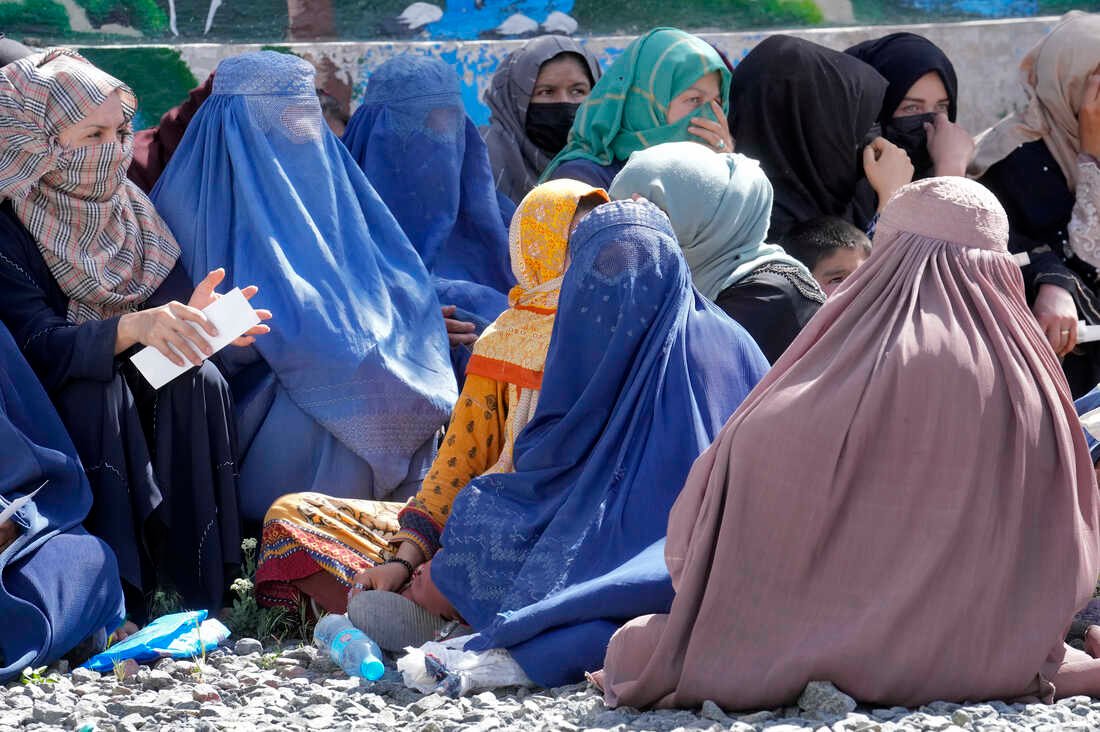
  • Divorced women fear imprisonment under Taliban regime

    The Taliban regime in Afghanistan has modified divorce laws, now requiring both parties, husband and wife, to be present in court in order to get a divorce.

    Under the previous Afghan government, women were granted the right to get ‘one-sided divorces’ in order to help them escape abusive marriages, according to The Washington Post.

    Women could testify about suffering abuse at the hands of their husband, even if he had refused to make an appearance in court.

    The Post clarified that the Taliban had not commented on ‘one-sided divorces’ being nulled or whether a woman can be married after gaining a divorce in such a manner. However, Taliban spokesperson Zabihullah Mujahid has said that both parties must appear before a judge to request a divorce under the Taliban’s interpretation of Islamic law.

    Under the Taliban regime, it has become more difficult for women to seek refuge after escaping an abusive marriage. A psychologist told The Post that local aid groups providing counselling and relief to abused women have been shut down. She also elaborated that under the new law, it has become more difficult to prove domestic violence.

    “Under the new law, women need to first go to the police station and provide multiple witnesses to prove abuse or if their husband is addicted to drugs,” she said.

    Women face more problems to find legal counseling as the Taliban have banned women from working as lawyers and judges. A lawyer speaking to the Post revealed that more women will find it harder to leave their abusive marriages if they cannot find proper legal representation to help them escape domestic violence:

    “The Taliban have created the perfect situation for men seeking revenge. The courts have lost their effectiveness and instead we see on the news women receiving [public] lashings for adultery.”

    Previously the Taliban regime caused international outcry after enforcing a policies that restricted women’s movement. Women were banned from attending high school and college, couldn’t travel anywhere without a male guardian and were restricted from attending parks, fairs or gyms.

    The United Nations received a report on the state of human rights in Afghanistan, which had criticized the Taliban regime for pursuing a policy ‘tantamount to gender apartheid’.

  • Local man mansplains to woman on how long household chores take, gives Twitter some hilarious content

    It’s a tale as old as time, a song as old as rhyme, that men will never stop mansplaining to women about their lived experiences.

    Whether you’re a professional or not, men will consistently assume they know better about the topics you have spent your entire life actually doing.

    A hilarious exchange took place on Twitter when a woman pointed out how much time and energy is expected from them to complete their household chores but in return they are denied their right to property or receive wages from their husband as compensation.
    In jumps Bashir who proudly declares uss ko sab kuch pata hai.

    And then to further prove his point, the man decides to make an excel chart of the numerous chores women must complete on a daily basis and the amount of time it takes to complete them. His source: the little angry man screaming inside his brain.

    As shocking as that sounds, Twitter took delight in the opportunity to roast mediocre men. Soon users on the app responded with some hilarious memes.

    le sigh

    No you’re wrong! Brother must have a super cleaning robot in his home and now expects women to act like robots as well!

    Wish house chores were finished this quickly as this man assumes

    Oh, we’re laughing

    Men reading this, khuda ka wasta delusion mein say niklo and come into the real world. Women aren’t robots and it’s not their job to cater to your needs every day. If you’re so desperate to marry, then learn to properly finish household chores and listen to what women have to say.

  • Iran: Hundreds of schoolgirls poisoned to stop them from getting education

    A top Iranian health official informed the semi-official said on Sunday that a recent wave of widespread illnesses at girls’ schools in Iran were brought on by intentional poisoning using “chemical chemicals.”

    Iran’s deputy education minister, Younes Panahi , on Sunday said that , “It was found that some people wanted all schools, especially girls’ schools, to be closed.”

    “It has been revealed that the chemical compounds used to poison students are not war chemicals, and the poisoned students do not need aggressive treatment, and a large percentage of the chemical agents used are treatable,” he told a press conference.

  • Gomal University, are you listening? Women deserve the same education as men

    Gomal University, are you listening? Women deserve the same education as men

    Gomal University in Khyber Pakhtunkhwa’s (KP) Dera Ismail Khan implemented a total ban on joint gatherings of male and female students on campus. The university issued a notification in this regard on Wednesday, which stated: “Gathering/coupling (male and female) is totally banned in any ground, roads etc. beyond the premises of department. Female students are directed to be careful and limit themselves just in their class rooms and department common rooms.” Interestingly, the notification was issued a day after Valentine’s Day.

    The Human Rights Commission of Pakistan (HRCP) rightly demanded that the notification must be withdrawn immediately. HRCP said that it takes strong exception to the said notification and that “segregation will reinforce a culture of ignorance and inequality”. This notification reminds us of the Afghan Taliban and their regressive mindset. Universities are not supposed to ask women to restrict themselves or limit themselves. In fact, universities are the learning grounds for both men and women so that they are prepared to go out into the world once they finish their education. This is the year 2023, a world where that is progressing rapidly and then comes such actions and/or notifications that make us question our choices towards education and developing critical mindsets. Are we against women’s education or moves like these are done just for restricting and policing women? We must not forget that in a patriarchal society like ours, females are told how to sit how to speak, how to dress. Policing of women’s behaviour is quite common in our country. Every year at Aurat March, the women are told not to raise slogans that challenge patriarchy, that challenge their own lived experiences. They are told by men, who have no idea what it is to be a woman in Pakistan, on what to do, what to say, what words to use for their slogans, what tone to take when they chant those slogans, how to ask for their rights, etc.

    According to the university administration, the decision would help provide a better and safer environment for female students. If it is all about safety, then one thinks of how is it logical that restricting the movement of women would help in providing security. The regressive outlook makes us one wonder if the male-dominated university administration would enforce the same or stricter curbs on the movement of male students and will the same kinds of bans and limitation be put on male students?

    In 2018, the KP government called for banning the entry of male MPs and politicians in girls’ schools as guest speakers. In 2019, the provincial government decided to make the wearing of an abaya or burka mandatory. And now a ban on joint gatherings by a university. We can only hope that those who make such rules understand that universities are a place for education. They act as places where individuals are trained, developed and prepared to be change-makers, influencers and leaders. Imagine how such restrictions and bans will hamper students’ growth and evolution. We hope these regressive double standards end, and both our men and women are treated equally.

  • US restricts visa for Taliban for anti-women policies

    US restricts visa for Taliban for anti-women policies

    United States (US) Secretary of State Antony Blinken announced new visa restrictions against the Taliban on Wednesday in response to the Afghan administration’s prohibitions on women’s employment and education.

    “I am taking action today to impose additional visa restrictions on certain current or former Taliban members, members of non-state security groups, and other individuals believed to be responsible for, or complicit in, repressing women and girls in Afghanistan,” Blinken said in a statement.

    The Taliban have put several limitations on Afghan women since regaining power in August 2021, including prohibiting them from holding public office, going to secondary and higher education institutions, or visiting parks.

    They forbade NGOs from working with Afghan women towards the end of December, causing a number of organisations to halt their operations.

  • South Asian women most vulnerable to human trafficking: UN

    South Asian women most vulnerable to human trafficking: UN

    According to a recent UN report, women continue to make up the majority of trafficking victims in South Asia.

    However, compared to other years, more men were identified as trafficking victims in the area in 2020, according to the UN Office of Drugs and Crime study (UNODC).
    Even while pandemics and catastrophes made populations more vulnerable to trafficking, the “Global Report on Trafficking in Persons 2022” also revealed a drop in the crime.
    In 2020, there were 11% fewer victims worldwide than there were in 2019.

    Over the same time period, the number of convictions for trafficking offences decreased by 27 percent as well, strengthening the downward trend that UNODC has been tracking since 2017.
    South Asia (by 56%), Central America and the Caribbean (by 54%), and South America all had declines (46pc).

    The report also stated that both men and women were trafficked in South Asia for the purposes of forced labour, sexual exploitation, and to a lesser extent, forced marriage.