Tag: Women's day

  • Women lawyers file plea against Aurat March

    Women lawyers file plea against Aurat March

    Notices have been issued to the provincial government and other concerned parties by Sindh High Court (SHC) in the light of a petition filed against this year’s Aurat March.

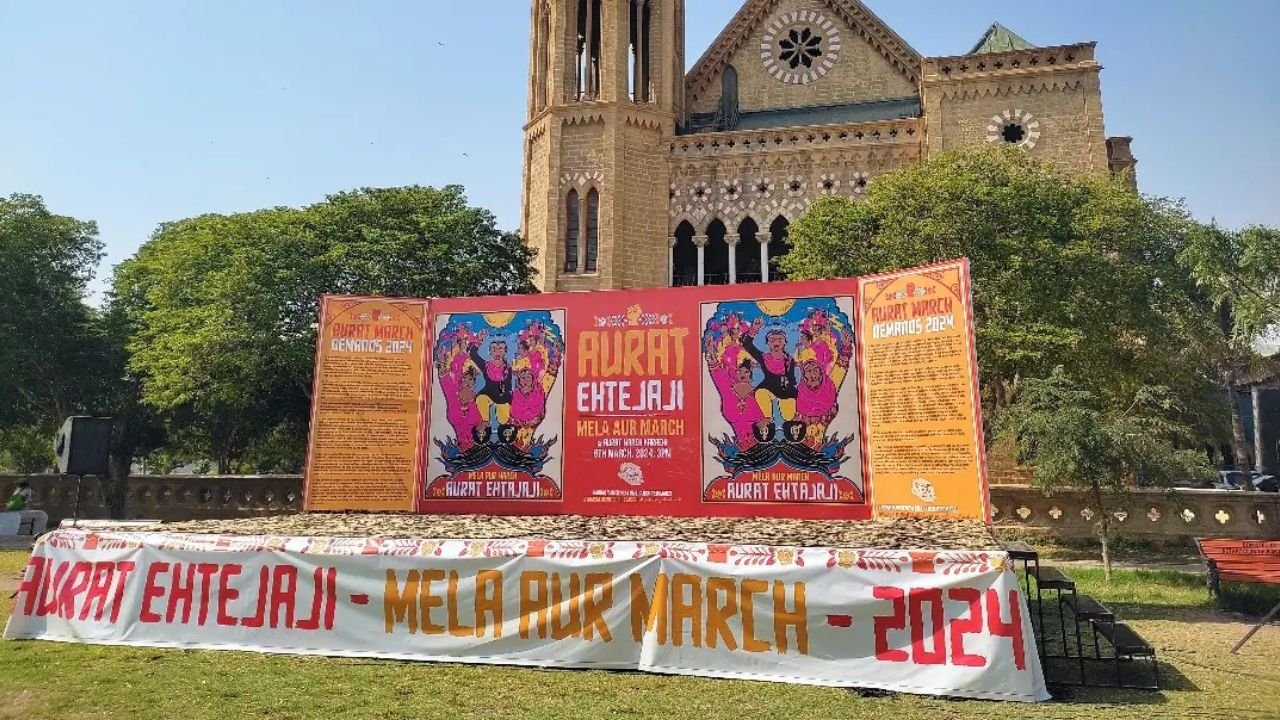
    Aurat March was held on March 8 on International Women’s Day. The petition was filed by women lawyers who deemed the movement damaging to society, adding that the “dance and nudity were being promoted in the name of women’s freedom, and organisations such as the Arts Council were allowing it to happen”.

    A two-judge bench headed by Chief Justice SHC Justice Aqeel Ahmad Abbasi heard the case, filed before March 8.

    While the court affirmed that under Islamic Law, women have freedom, it nonetheless stated that certain negative acts can be detrimental to society.

    The petitioners highlighted that Aurat March is held at cultural centres and parks and similar events should be stopped.

    The SHC then issued notices to the Pakistan Electronic Media Regulatory Authority (PEMRA), the federal and provincial governments, the Arts Council and other organisations linked to Aurat March. The concerned parties have been asked to submit their response by March 19.

  • Women’s Day: Palestinian Journalists that we need to know about

    Women’s Day: Palestinian Journalists that we need to know about

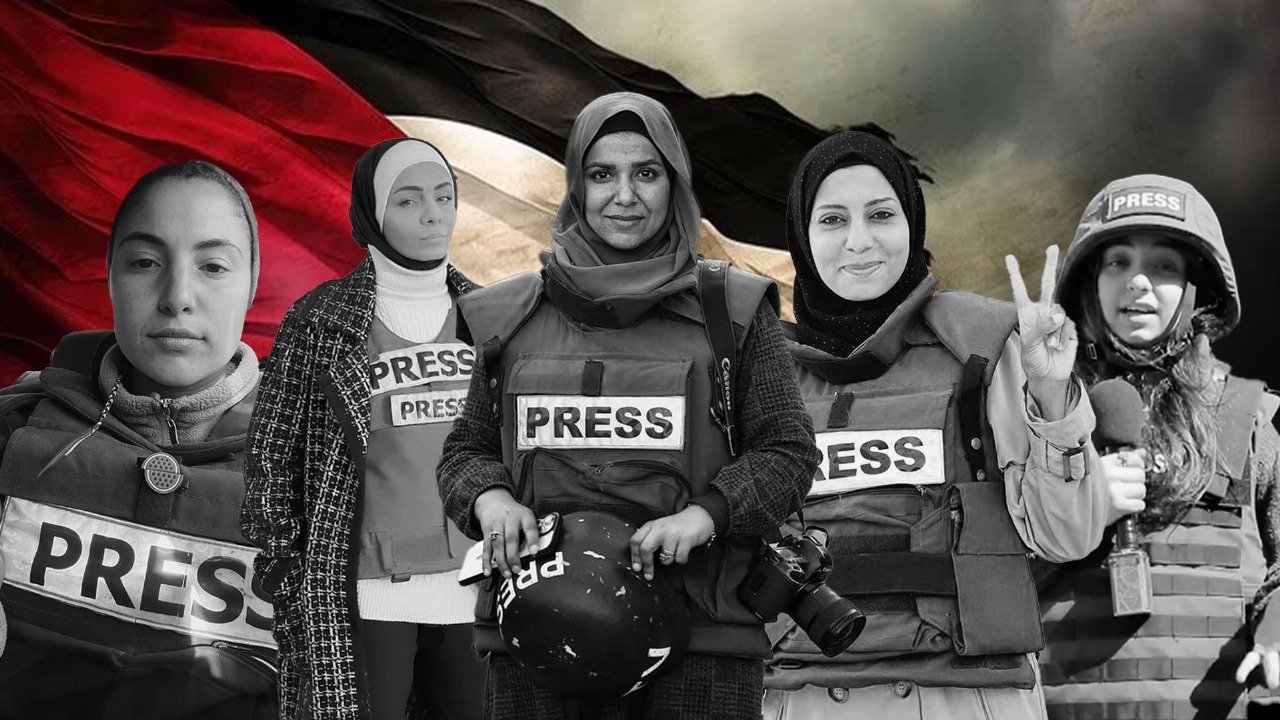
    Palestinian women in general and journalists, in particular, have set the bar with their resilience against what is now largely perceived as the most well-documented genocide of this century.

    This Women’s Day, the world paid tribute to their untiring efforts, yet it is important to mention here that it is not enough since the besieged strip has been wreaked for more than six months now.

    Palestinian journalists observed in real time the tragedy that women and children are experiencing due to the devastating war since October 7 last year.
    At least 63 women in Gaza are killed daily as a result of the Israeli war, with the majority being mothers, The UN Relief and Works Agency for Palestinian Refugees (UNRWA) reported on Friday.

    “On International Women’s Day, the women in Gaza continue to endure the consequences of this brutal war,” the agency shared. “At least 9,000 women have been killed, and many more are under the rubble,” the statement added.

    Hind Khoudary

    Hind Khoudary is one such face the world is now fully familiar with because of her on-ground reporting and the compassion she has shown over time. She was paid tribute to by her fellow journalist Ali Jadallah in an Instagram post where he praised her for her commitment to her profession and towards Gaza.

    However, he added, “As the ‘International Women’s Day’ is celebrated around the world on March 8th, Palestinian women start to work with the first hours of the day to provide for their families despite the difficulties experienced amid Israeli attacks.”

    Hind, 28-years-old, has been working in the media since 2017. In an interview with Anadolu, she pointed out that the current situation in the Gaza Strip affects all Palestinian women regardless of their professions.

    “While the world celebrates Women’s Day, Palestinian women are being displaced from their homes,” she said. “I am not just a journalist covering the war. Rather, I am a displaced person. I left my family and my husband and chose, despite the circumstances, to remain in Gaza and cover the war,” she added further.

    In one of her posts on Instagram, she shared how she doesn’t have clean clothes to wear anymore and how she struggles hard during her periods. “I am also wearing two pants above each other because I don’t have any joggers anymore. The last time I showered was ten days ago. On my period for the second time during the past 30 days and yet I am still standing despite all the cramps,” Hind wrote.

    Noor Hrazeen

    Noor is a TV presenter and a reporter who has been reporting about the ongoing situation in Gaza. She made a huge sacrifice by evacuating her children from Gaza just for them to be able to have food and water but she remained in Gaza to continue reporting about the havoc endured by Palestinians.

    In one of her posts, she wrote: “It’s hard to work in a location, where you know that there is dead bodies still stuck under the rubble. But it’s a story that should be told.”

    Roba Khaled

    Roba is a Palestinian journalist who has shown sheer commitment to her job even when her children were sick or when Israel was bombing buildings in real-time.

    Doaa Albaaz

    Doaa, 27, a photographer, reports the horrors befallen upon Gazans by the Israeli forces. “On International Women’s Day, we want to convey the image of women who are subjected to the most horrific massacres in Gaza,” she said in an interview with Anadolu.

    “During this war, the occupation targeted women, children, and innocent people,” she pointed out. “We lack everything, including privacy. There are no bathrooms, and we struggle to convey the real picture,” Baz asserted.

    Duaa Tuaima

    Duaa Tuaima is a photojournalist whose Instagram is a window that opens into the reality of the suffering in Gaza.

    She mostly documents the women and children of Gaza and how they are struggling to grapple with starvation and siege.

    Bisan Owda

    Bisan is another popular name. A storyteller and filmmaker by profession from northern Gaza, Bisan has been documenting the displacements, bombings, and genocide in Gaza from day one. Her vlogs and videos in collaboration with different platforms are raw and insightful. “Hi, this Is Bisan from Gaza and I am still alive” is the line she says at the beginning of every vlog and it is ironically sad and hopeful at the same time.

    In one of her videos, she featured an Israeli jet and said, “I grew up with this sound, it’s not new…”

    In another, she posted about living in fear since the war started. “For 150 days, I have been afraid of cement ceilings. I do not want to be crushed to death when a missile lands. I sleep in a tent, and I am like hundreds of thousands suffering cold at times, heat at times, and disease and hunger at other times,” she wrote in an Instagram post.

    Sumayya Wushah

    11-year-old war reporter Sumayya Wushah was featured in Al Jazeera’s videos as Gaza’s youngest journalist reporting about the destruction in a confident tone. She is inspired by Shireen Abu Akleh, the Al-Jazeera journalist who was killed by the Israeli army in 2022.

    The list could be longer. These journalists are inspiring women from all around the world for their strength and the cause they stand for.
  • Pakistan’s women ‘Rowdy Riders’ take on traffic and tradition

    Pakistan’s women ‘Rowdy Riders’ take on traffic and tradition

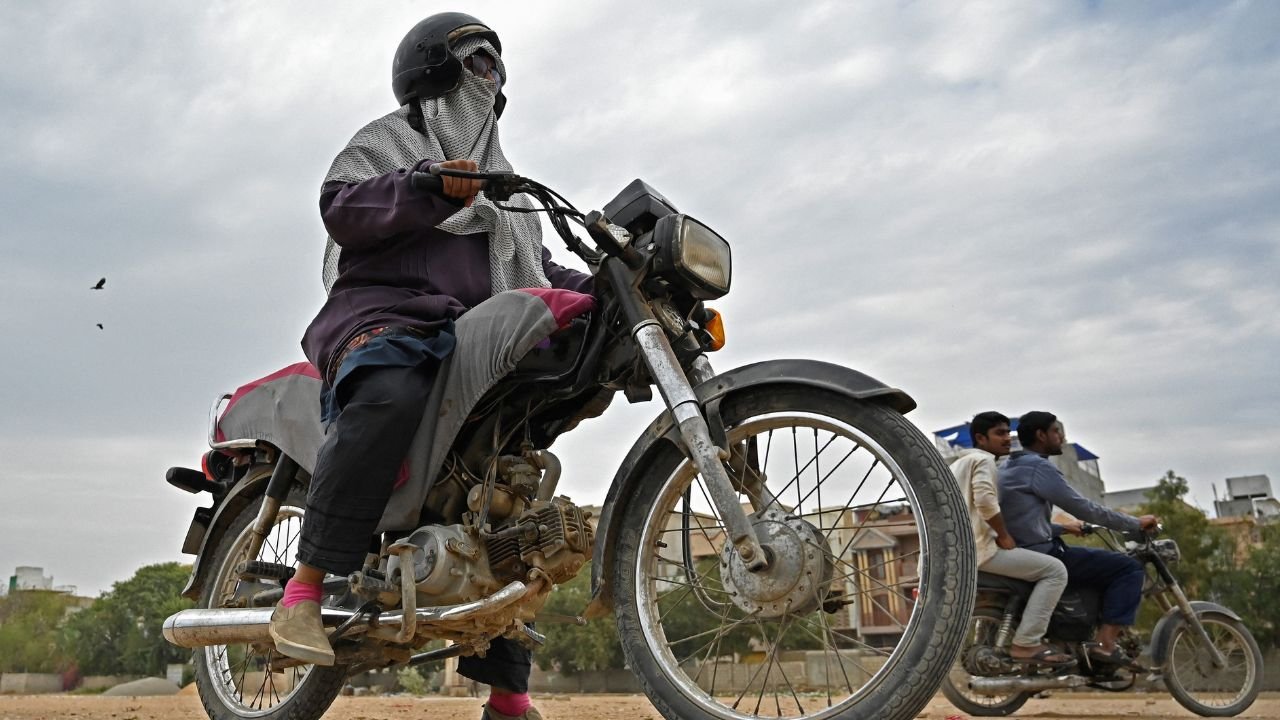
    Karachi (AFP) – Revving round a dusty oval in the heart of Pakistan’s largest city, women on motorbikes practise looping a row of safety cones, their helmets securing colourful headscarves in place.

    It is a rare sight in the culturally conservative country, where women are typically relegated to the back seats of cars or to riding side-saddle on motorbikes, ferried by a male relative.

    “Change is under way,” says Zainab Safdar, demonstrating how to mount a two-wheeler while cloaked in a pink body-covering abaya.

    The 40-year-old is an instructor for the “Rowdy Riders”, a women-only group teaching novices in Karachi everything from the basics of balancing on a bicycle to high-octane gear changing and negotiating traffic.

    Since being founded in 2017 by a handful of pioneering riders, the self-described “Rowdies” have swollen in number to more than 1,500 housewives, students and professionals.

    “In the past, there were misconceptions about girls riding bikes,” Safdar said, referring to doubts about their abilities.

    “Fortunately, with greater awareness, these notions have been dispelled.”

    Women’s participation in the workforce is impacted by the limited availability of public transport services that ensure their safety.

    In the sprawling megacity, granting women the skill and confidence to join legions of male bikers in the helter-skelter of congestion unlocks a new tier of freedom.

    Most of the riders hail from Karachi’s middle class, but rigid gender norms often still hold sway.

    University lecturer Shafaq Zaman said “it took a while to get permission” from her family to start classes to master a pedal bike two months ago.

    Among the few dozen bikers assembled under the mid-afternoon sun, she looks on with her seven-year-old daughter Aleesha as a convoy of women open up their engines and rip past in a haze of dust.

    “I am so inspired that now I have my own dream for me, that I want to ride on a heavy bike. I want to ride the whole of Pakistan,” 30-year-old Zaman said.

    Her story is not unusual. In Pakistan, very young boys are often seen steering motorbikes, but many of the “Rowdies” did not learn to ride a bicycle until well into adulthood.

    “There should be a bike in every house, and usually there is, but it’s rotting because men do not use it and women don’t know how to,” said Sana Kamran, sitting confidently astride a 110cc Suzuki.

    “If women can manage household responsibilities and earn a living, why can’t they ride a bike for their convenience?” the 41-year-old asked.

    Motorbikes are ubiquitous across Pakistan — most commonly red Honda models or cheaper Chinese reproductions, considered capable of mastering any terrain.

    The quest to conquer a bike has seen 26-year-old Farwa Zaidi suffer multiple bone fractures — but the injuries are a badge of honour she wears as proudly as the “Rowdy Riders” crest on her jacket.

    “Here I am, standing strong,” she said alongside her 70cc electric scooter.

    At four feet and six inches (137 centimetres) tall, Zaidi said her small stature made it difficult to claim a spot on crammed city buses.

    Learning to ride gave her a new sense of possibility.

    “Once we master cycling, it instils a new-found confidence in our ability to conquer other challenges,” she says.

  • Why did Aurat March hold a Feminist Press Conference?

    Why did Aurat March hold a Feminist Press Conference?

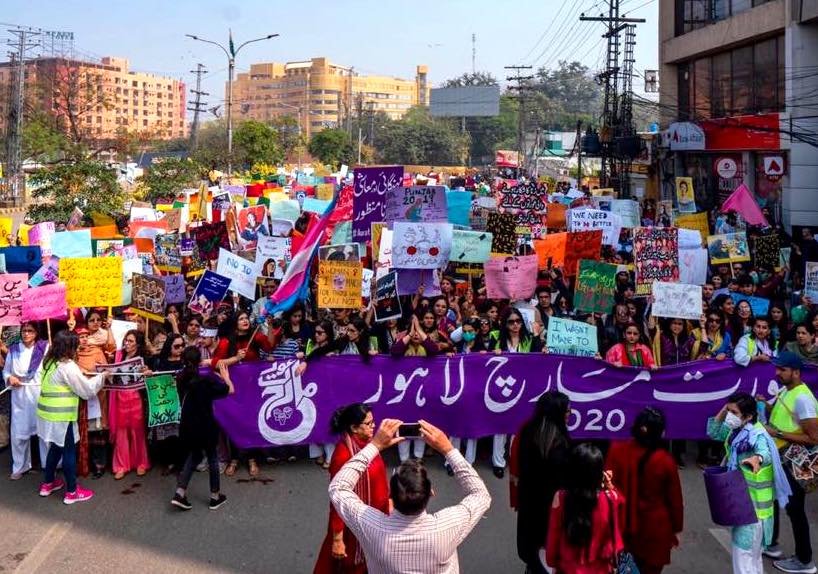
    This Friday, on March 8, as the world will celebrate Women’s Day, Aurat March will take to the streets in Lahore, Karachi, Islamabad and Multan.

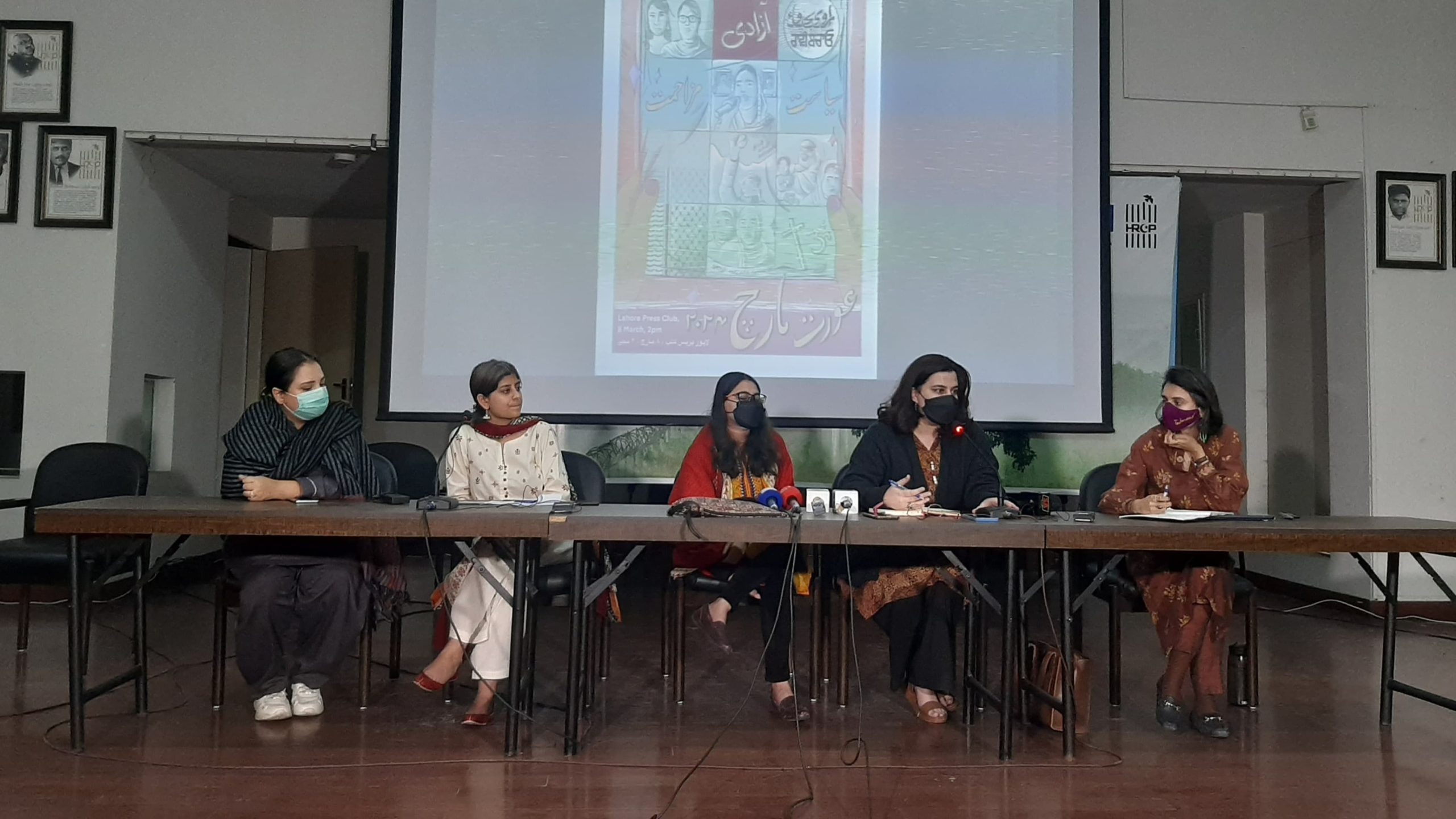
    The Current attended this year’s Aurat March press conference and got details about how this year is different from the ones before.

    Every year, the press conference is dominated by men from media platforms, leaving little or no room for women and transgender journalists to interact with Aurat March members.

    Moreover, coming with preconceived notions and biases, male journalists reportedly have been condescending and aggressive towards Aurat March members who conduct the conference with the aim to explain their manifesto and charter of demands prior to the big day.

    To counter this issue, this year Aurat March decided to hold a Feminist Press Conference.

    The purpose of a Feminist Press Conference was to provide a space to women, transgender, and minorities where they can get a fair chance to not just raise questions in respect to the March, but meaningfully engage with members.

    “This year’s press conference, in comparison to previous ones, was definitely much better,” said one of the representatives (who requested to remain anonymous).

    “Today, we were able to talk about our manifesto, we took questions from the reporters, and the interaction was respectful.”

    The member further denoted that this has never happened before. She explained that in the past, no reporter would come having read Aurat March’s charter of demands and the manifesto and instead, would resort to stereotypical questions.

    “When we would try to counter their queries, they wouldn’t listen to us because they wanted to hear the preconceptions they came with.

    “In fact, we are happy that this year, because the conference was conducted peacefully, we even got suggestions from journalists – which will, of course, help us as well”, she added.

    On Youtubers

    Last year, Youtubers disrupted the press conference, and media journalists stated that they do not consider YouTubers as journalists. “I am glad this year, we talked about [YouTuber disruption] as well”, the members highlighted.

    “The journalist community should think through ways to distance themselves from or critique YouTubers who are badmouthing their profession.”

    Some YouTubers, who attend the March as independent journalists, are known for their alleged misconduct at Aurat March. They have also been called out for spreading disinformation about performances and placards at the marches, and also harassing marchers with irrelevant and demeaning questions.

    This poses a threat to Aurat March members as well as attendees, and above all, the propaganda hinders socio-political awareness that the March intends to raise.

    The irony of today’s feminist press conference was when a YouTuber reached out to Aurat March members, upset for not getting a chance to ask his questions during the session. Well, I hope he realized how women feel when men take up their rightful space.

  • Mark your calendars: Aurat March is around the corner!

    Mark your calendars: Aurat March is around the corner!

    March is finally here which means that 8th of the month is Women’s Day around the world and in Pakistan, Aurat March in major cities will walk through the streets to remind the state and the society of the due rights of women and minorities of the country.

    Where and when to join Aurat March?

    Lahore
    Time: 8th March, 2 pm
    Place: Lahore Press Club

    Karachi
    Time: 2:30 pm
    Place: Frere Hall

    Islamabad
    Time: 2 pm
    Place: Islamabad Press Club

    Multan
    Time: 3 pm
    Place: Nawan Shehar Chowk

    What are the demands this year?

    Lahore

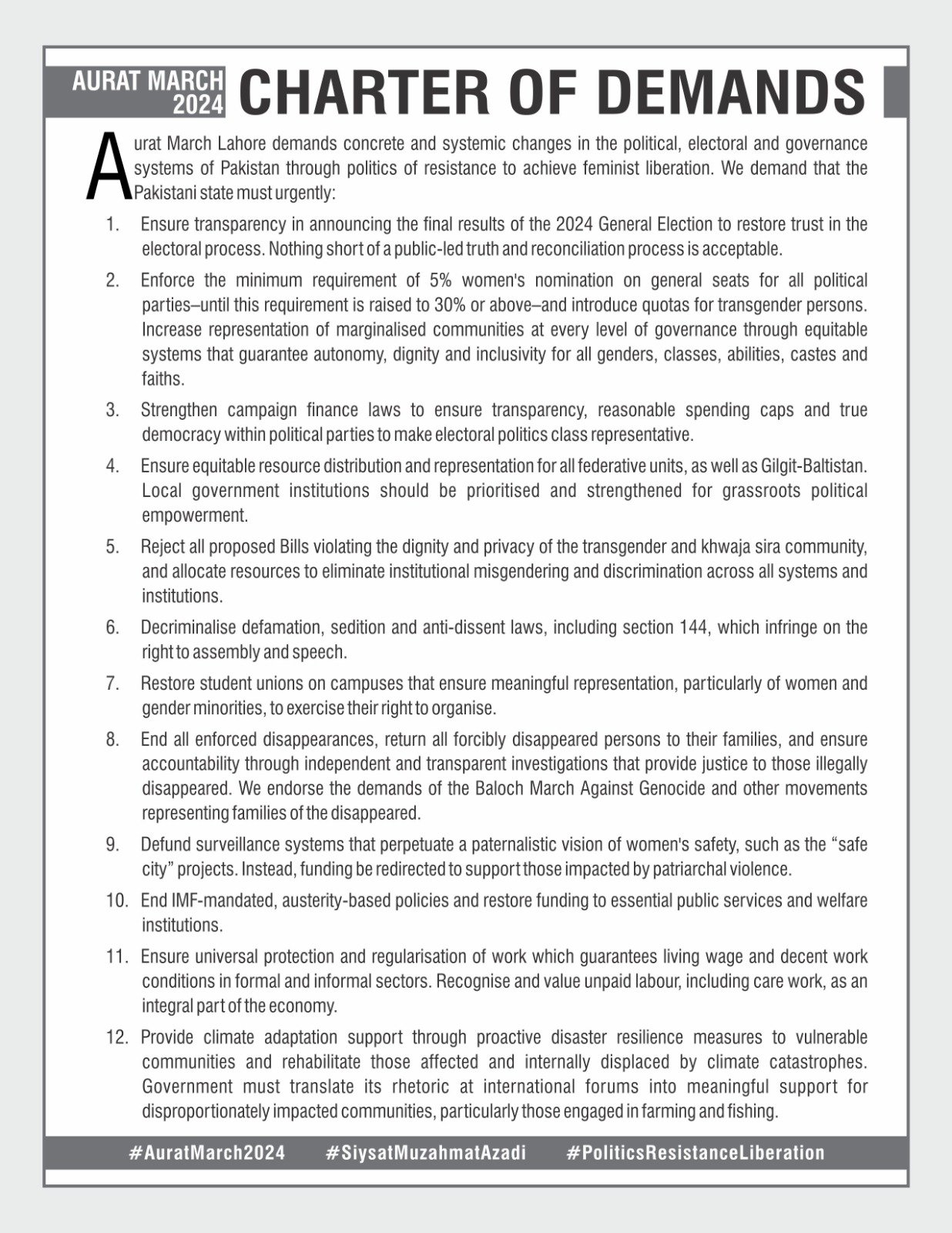
    This year, Lahore based its theme on “Siyasat, Muzahamat aur Azadi” which means that the manifesto addresses the electoral politics (in the light of the recent General Elections of Pakistan back in February 8), as well as asserts on the re-envisioning political participation where “oppressed groups and communities on the margin take center stage.”

    Here are the demands by Aurat March Lahore:

    Karachi

    In Karachi, Aurat March will focus on domestic violence, sexual violence, enforced disappearances, extrajudicial killings, land grabbing, state-sponsored poverty, religious extremism, repression of gender and body politics, fascistic capture of politics and everything “the patriarchy subjects us to under its militaristic control of our bodies.”

    Islamabad

    The capital’s theme this year is Resistance and Hope:

    Calling on to end enforced disappearances; promoting “hope and world peace” in light of Israeli genocide in Gaza; end to gender-based violence; to take action against cyber harassment targeting women, minorities, and children with effective legislation; end to period poverty by making period products accessible for all and provind period education in school; economic justice i.e. integrating women’s reproductive labour into country’s Gross Domestic Product (GDP), formalisation of informal sector to ensure work standards and safe working environment, action against child labour, wage regularisation, right to unionisation, and allocation of funds to rehabilitate women farmers, shopkeepers, small landlords; improved access to universal education and healthcare; political rights of women; as well as rights of religious minorities.

    Read the details on the demands by Islamabad here:

    Multan

    With the main focus on climate justice right and economic liberation, here are the demands by the city of Multan this year:

    1. Education for All: Guarantee education for girls up to the age of 16, ensuring equal access to knowledge and opportunities.
    2. Right to Identity: Ensure that all men, women, and transgender people in Siraiki Wasaib have their identity cards without any hindrance from the state.
    3. Combat Harassment: Form active committees against sexual harassment in educational institutions and workplaces, enforcing strict adherence to anti-harassment laws.
    4. Student Empowerment: Lift the ban on student unions in universities across Pakistan, allowing students to exercise their rights and have a say in their education. Also, Establish new colleges and universities with equitable access for all, fostering an environment of learning and growth.
    5. Inclusive Infrastructure: Implement accessible architecture in schools, government offices, and public spaces, catering to the needs of people with disabilities.
    6. Fair Wages: Enforce inflation-adjusted and gender-conscious minimum wage policies, promoting economic justice for all.
    7. Protect Domestic and Small Industry Workers: Safeguard the rights of domestic workers, particularly young girls, from exploitation and abuse.
    8. End Early Marriage: Enact laws against early marriage and forced religious conversion, setting the legal marriage age to 18.
    9. Transgender Rights: Implement the Transgender Rights Act 2018, ensuring equality and protection for transgender individuals.
    10. Political Victimisation: Stop the unjust targeting and unlawful detention, especially of women, for political reasons.
    11. Women’s Protection: Fully implement the Women Protection Bill and expedite the completion of Women Crisis Centers in Multan.
    12. Holistic Education: Incorporate human rights, climate change, and gender education into the high school curriculum, fostering awareness and understanding.
    13. Healthcare Access: Ensure accessible healthcare and employment opportunities, along with childcare facilities for women in both government and non-government sectors.
    14. Remove Taxes: Eliminate taxes on women’s hygiene products and essential items, relieving financial burdens on women.
    15. Worker Rights: Abolish the exploitation of various marginalized groups, including brick kiln workers, farmers, journalists, and factory workers.
    16. Combat Terrorism: Take legal action against activities that terrorize women, ensuring the rule of law prevails.
    17. Judicial Representation: Increase the number of women judges, particularly in the Lahore High Court, Multan, and Bahawalpur Benches, promoting gender parity in the judiciary.
    18. End Corruption: Eradicate corruption and mistreatment of women in social support programs.
    19. Report Mechanisms: Establish effective portals to report incidents of harassment and violence against women, ensuring swift action and justice.
    20. Religious Freedom: Protect religious places and minorities from desecration and criminal acts, upholding fundamental freedoms for all.
    21. Child Protection: Implement stringent measures to prevent the sexual abuse of children, safeguarding the innocence and well-being of our youth.
    22. Safe Spaces: Ensure the fundamental freedoms and protection of women in Dar ul Aman and working women hostels, providing safe havens for those in need.
    23. Digital Access: Declare internet access as a fundamental right and bridge the digital divide, ensuring equitable access to technology for all.
    24. Combat Stereotypes: Eliminate gender stereotypes in educational materials, electronic media, and social platforms, promoting equality and diversity.
    25. Justice for All: Pay homage to human rights leaders like Rashid Rehman and demand justice for those who have sacrificed for the cause of equality and justice.
  • ‘As a woman, it is insulting that I have to take Imran Khan’s name’: Maryam Nawaz

    ‘As a woman, it is insulting that I have to take Imran Khan’s name’: Maryam Nawaz

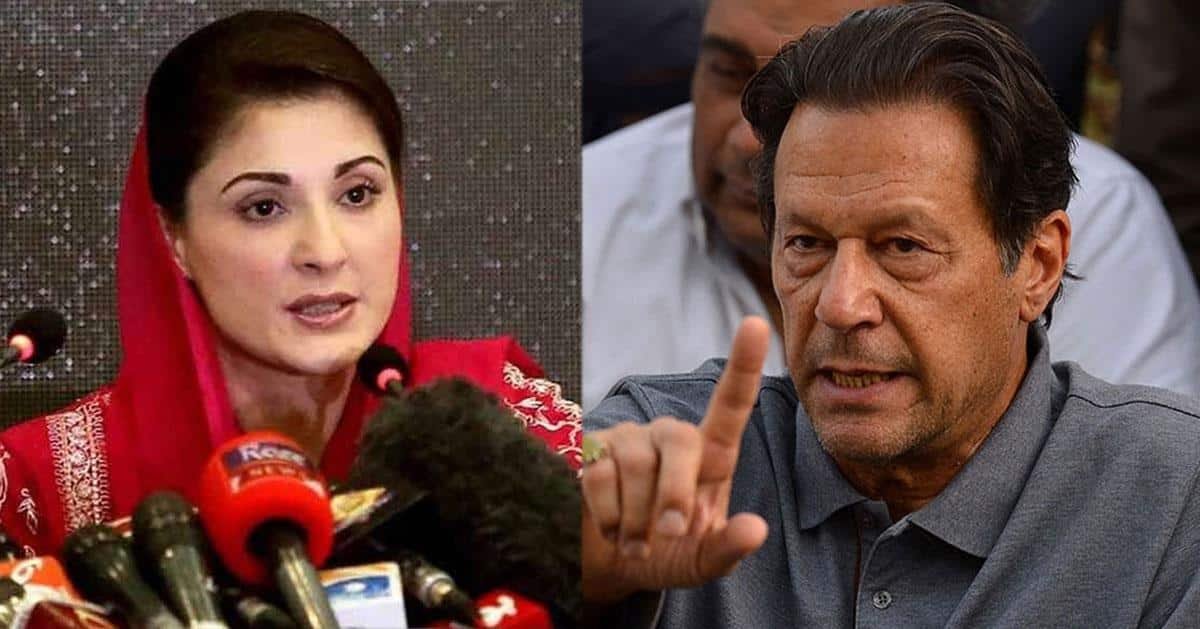
    Pakistan Muslim League-Nawaz (PML-N) Senior Vice President Maryam Nawaz has said that she, too, has faced harassment even though she hails from a privileged background and has a powerful father.

    Addressing a PML-N women workers convention in Lahore on International Woman’s Day, Maryam said that the Pakistan Tehreek-e-Insaf (PTI) Chairman Imran Khan and his party has always targeted her with “personal attacks” when she says something political.

    “They talk about my marriage. My wedding was done with alot of love and festivities by my parents and grandparents. And I am still married to the same person. I don’t want to attack anyone personally,” said Maryam.

    “As a woman, it is insulting that I have to take Imran Khan’s name. Due to the current situation in the country, I have to take his name. Being a woman, I have said this many times, I would never let a person like Imran Khan inside my house,” said Maryam, adding that when Imran is asked about politics, he never gives a political answer. Instead, he, in his jalsa says, “Maryam Nawaz, you say my name so many times, be careful; your husband might get angry with you.”

    Khan in May last year made misogynistic remarks about Maryam Nawaz.

    “In that speech, she took my name with such passion that I would like to tell her: Maryam, please be careful, your husband may get upset because you were constantly repeating my name,” said IK during the speech.

    “I am like a daughter to him [Imran Khan], and now because of the fear of arrest, he has become old and is 72 years old, but when it comes to slurs and personally attacking me, where does his old age go?” questioned Maryam.

  • The Minister for Human Rights Should Resign: Here is His Resignation Letter

    The Minister for Human Rights Should Resign: Here is His Resignation Letter

    Last month, a 24-year-old woman was gang-raped at gun point by two men in Islamabad’s F9 park. The First Information Report (FIR) filed by the victim stated that after she was raped, the assailants gave her Rs1,000 and told her that she should not have been in the park at night.

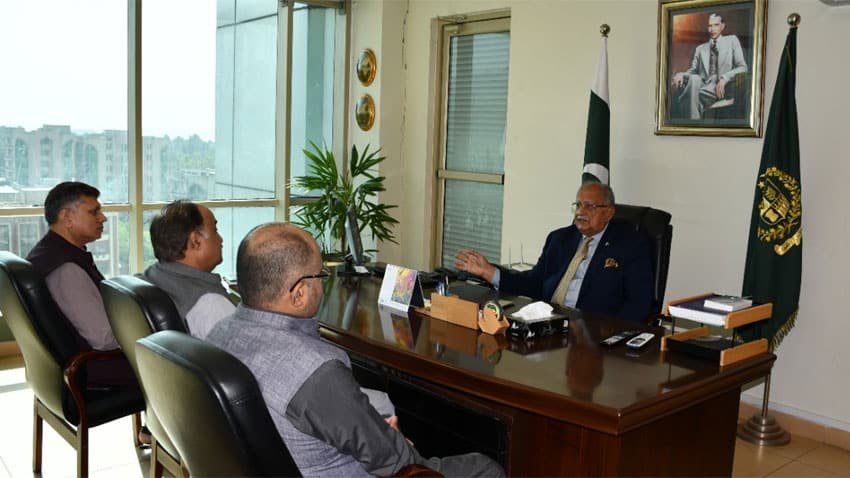
    How did the federal Minister for Human Rights react to this heinous crime? Almost three weeks later, in a televised interview with Nadir Guramani, on the topic of the F9 rape case, Mian Riaz Hussain Pirzada said that mothers of ‘tarbiyat’ (good upbringing) do not let their children go out at night. In one breath, Mr Pirzada not only victim-shamed the victim of the rape but he also blamed her mother for not having “properly reared” her daughter.

    Clearly, Mr Pirzada has no understanding of what his job entails as the federal Minister for Human Rights. Here is a tailor-made letter of resignation he can sign on his way out.

    TO:​​ Prime Minister Shehbaz Sharif
    FROM:​​ Mian Riaz Hussain Pirzada
    RE:​​ Letter of Resignation (Federal Minister for Human Rights)

    Dear Excellency,

    I write to you with the heavy weight of self-awareness on my shoulders. I have come to see that I am a misogynist and therefore I cannot represent fairly and equally the rights of all the citizens of Pakistan.

    The term “misogyny” is often linked to woman-hating. The problem with this outdated view of misogyny is that, when it is used like this, it is a circuitous nonsense. As soon as I tell you that I love my mother and my wife, which I do, I have proven to you that I simply cannot be a misogynist.

    What I have come to learn is that misogyny is an enforcement system that keeps women in gendered roles. A woman who carves out her own path, or steps outside the role of being a well-behaved, supportive, giving woman, is disrespectable in the eyes of a misogynist and he (or she) is then entitled to put that woman back in “her place” to ensure she complies with the norms and expectations of patriarchy.

    In my interview with Mr Guramani, I concurred with the F9 rapists: the woman who got raped had it coming because good girls do not venture out at night. I went one step further and I also blamed the victim’s mother because, clearly, she has not raised a good girl. This justification of rape makes me a misogynist. I wonder if the rapists’ criminal defence will quote my words and use my line of reasoning?

    As the Minister for Human Rights, I should have known that Chapter 1 (Fundamental Rights) of the Constitution of Pakistan provides for equality of citizens and “no discrimination on the basis of sex” (Article 25) and that security of person entails that no person shall be deprived of life or liberty (Article 9).

    As the Minister for Human Rights, I should have demanded that my own government (and the police) do more to protect our citizens, who have every right to enjoy their liberties, which include taking in the night air, free of fear and discrimination, whether man or woman.

    As the Minister for Human Rights, I should have made clear that the rapists are the real and only culprits of the F9 rape and that I stand firmly with the victims, enraged at the violation of their human rights.

    I am an embarrassment to the Ministry of Human Rights and I hereby resign, with immediate effect.

    Mian Riaz Hussain Pirzada

  • Aurat March not allowed to take place at same venue as Haya March, security to be withdrawn if location not changed, warns administration

    Aurat March not allowed to take place at same venue as Haya March, security to be withdrawn if location not changed, warns administration

    Aurat March, scheduled to take place on March 8 to protest injustices against women and minorities has been denied permission to hold a public rally by Deputy Commissioner (DC) Rafia Haider.

    While talking exclusively to The Current, activist and one of the volunteers of Aurat March, Leena Ghani, said that they had applied for a Non-Objection Certificate (NOC) on February 13 for the march to be held on the decided date. However, the administration backed out at the last moment.

    “At the time, in a meeting with deputy commissioner Rafia, she assured us. However, later she sent a rejection letter,” Ghani revealed.

    She said that in the letter, the administration has also banned them from gathering at Lahore Press Club, from where the march typically starts every year.

    About the meeting they had with Deputy Inspector General of Police (DIG) Operations on Friday, she mentioned that they kept on insisting on changing Aurat March venue. “It seems like they have promised Nasir Bagh to Haya March organisers for a gathering, that’s why they want us to pressurise now.”

    She also added that police have said that security won’t be provided if they don’t change the venue. However, the organisers remained adamant that security should be provided regardless of the fact that where they want to protest.

    Moreover, she mentioned that NOC is just a formality, and in the past, a verbal agreement used to take place.

    “NOC is not needed in order to exercise your constitutional right to march,” said Ghani.

    Now, she said that they are going to move Lahore High Court (LHC) to challenge the decision.

    Sabahat Rizvi challenges denial of NOC to Aurat March

    Earlier, the Lahore High Court Bar Association (LHCBA) Secretary Sabahat Rizvi challenged the decision of DC Haider.

    The development took place after DC’s decision was condemned and criticised by organisations including the Human Rights Commission of Pakistan (HRCP).

    Many people have argued that it is an attempt to suppress women’s voices and prevent them from exercising their constitutional rights.

    ‘We will march’: Aurat March determined despite NOC denial

    NOC was denied on the grounds of “security concerns, controversial banners and posters, strong reservations by the general public and religious organisations and the likelihood of clashes with members of Jamaat-i-Islami’s Haya March.”

    Reacting to the denial of the NOC, organisers have remained adamant that they will march on the decided date as they don’t require a NOC to exercise their constitutional rights.

    “Women, khawaja sara community, transgender persons, gender non-conforming people, and allies of the Aurat March have the right to assembly under Article 16 of the Constitution of Pakistan,” they said.

    They highlighted that “large crowds are allowed to gather for PSL, but a peaceful gathering of women and gender minorities is being silenced and denied their constitutional right to assembly.”

    They added the administration has forgotten that the courts have already upheld their right to hold Aurat March in 2020. 

    It is not the first time that the city’s authorities have imposed such a restriction. Last year, the organisers in Lahore had been urged to cancel the rally over safety concerns. The march was also arbitrarily cut short by the district administration despite being given permission.

  • Being a father of 5 wonderful girls, I can proudly say women have the strength to move the world: Shahid Afridi

    Being a father of 5 wonderful girls, I can proudly say women have the strength to move the world: Shahid Afridi

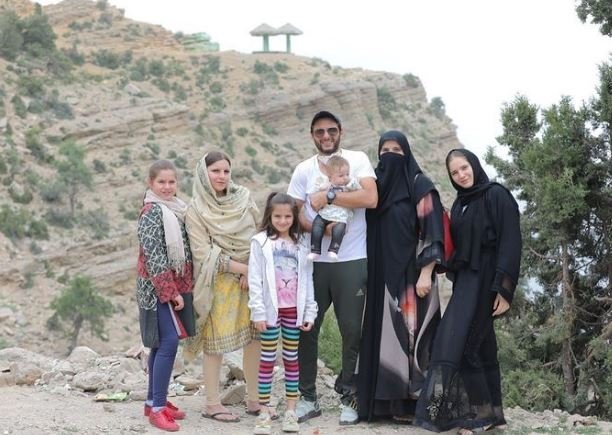
    Former Pakistan captain Shahid Afridi has shared a special message on International Women’s Day. Afridi shared a picture with his wife and daughters on his Instagram along with a special message.

    “You are the nourishing power of the Universe, You make it come alive, more colourful & inspirational. Being a father of 5 wonderful girls, I can proudly say women have the strength to move the world; let’s celebrate them every day & support them to #BreakTheBias. Happy WomensDay,” wrote Boom Boom Afridi.

    International Women’s Day is being observed worldwide to honour the outstanding contributions and achievements of women, who constitute a major part of society in all fields of life.

  • Aurat March Lahore announces ‘Charter of Demands’ for 2021

    Aurat March Lahore has unveiled its charter of demands for 2021. This year’s charter of demands is based on 15 points with a special focus on women’s healthcare, which is also the theme of this year’s march.

    As per the official Twitter account of Aurat March Lahore, the charter “is centred on our theme of healthcare which intersects with the issues of gender-based violence, the dehumanisation and sexualisation of our bodies, safety, environmental justice and our fraught relationship with the state.”

    “Some of our demands are immediate, some of them are from the state — but we recognise that our long-term struggle and means of emancipation lie outside the patriarchal state and exploitative economic system we’re currently in,” read the official statement.

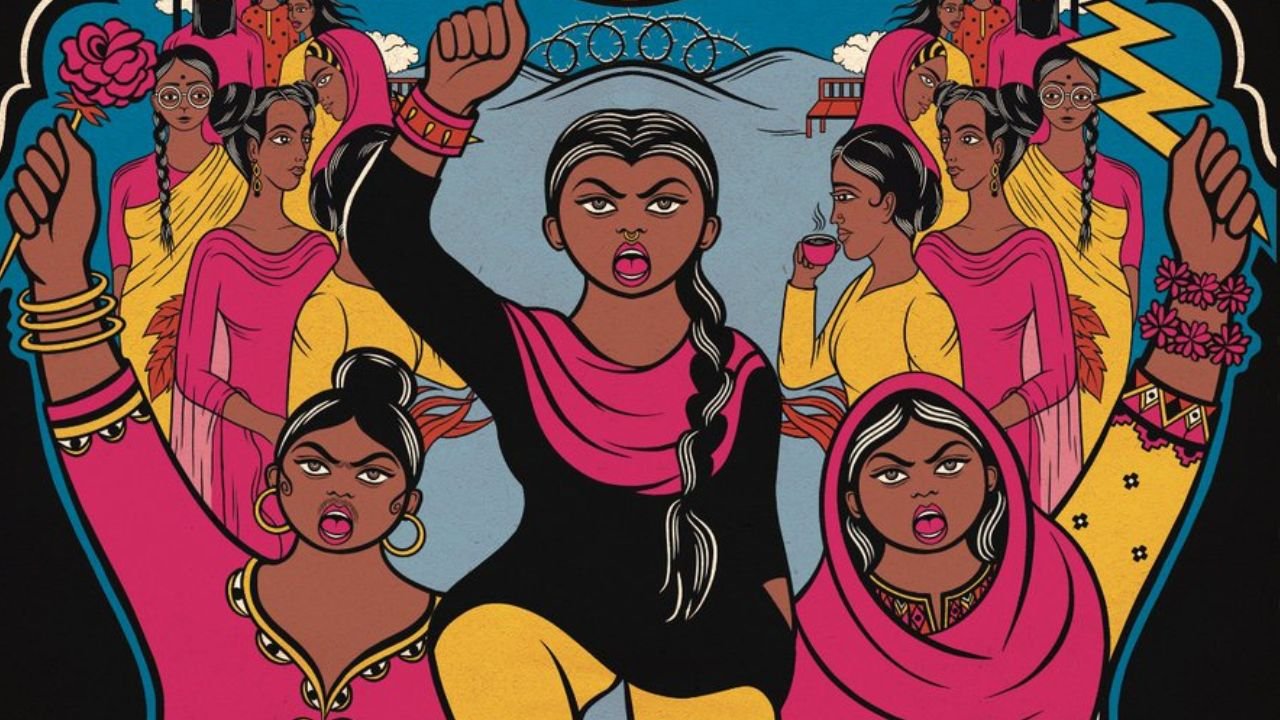
    Earlier, the organisers of Aurat March Lahore released the poster and theme for this year’s march.

    Speaking exclusively to The Current, Shehzil Malik who designed the poster, talked about the thought process behind designing the poster.

    “To know more about women’s health crisis, I reached out to a friend who works in public health which really gave me an insight into the subject,” shared Malik.

    Aurat March is scheduled to take place on March 8 on the occasion of International Women’s Day.

    Meanwhile, expressing her views on the Aurat March, Sarah Khan in an exclusive interview with The Current said: “I think, instead of fight for the rights, we should educate our sons. Don’t teach your daughters to go to ‘Aurat March’, educate your sons and teach them that their mother is also a woman.

    “[A] woman is the one who runs the house, does the house chores and supports the man. If your wife is not helpful, then how will you be happy? Allah has already granted status to the woman, but I think men should be given the same rights. They deserve the same, not only women,” she added.

    On the other hand, actor Mahira Khan who attends the Aurat March every year revealed her reason for going to the event, saying: “I think it is necessary for me [to go to Aurat March] because I think when I do something, no matter how small it is, it leaves an impact.”

    “So when I go to Aurat March, what I’m actually trying to say is ‘Look, if you like me and if you think what I say means something if you think I that I’m on the right side of history, or whatever you think of me, this is also what I believe in, this is why I’m here,” she added.