Tag: women's rights

  • Mira Sethi meets boy who stood up to misogynist reporter at Aurat March

    At this year’s Aurat March, a boy went viral on Twitter when he was seen schooling a reporter by explaining to him why marching for women’s rights is incredibly important.

    Actress and writer Mira Sethi revealed yesterday that she had met the boy by tracing him down on Twitter, and described him as her ‘hero’.

    “Remember the kid who stood up to that vile reporter at Aurat March Lahore?” she wrote, “I found him on Twitter, asked if I could come over to express my gratitude and met his whole family. Muhammad Ali is only 20, but he radiates clarity and courage. I’m going to do whatever it takes to make sure his light is never dimmed. So full of gratitude today.”

    Syed Aly Jaffery also shared the interaction on his Twitter page and called her a ‘nice and amazing person’

  • Man behind viral Aurat March poster shares inspiring story about his mother

    Man behind viral Aurat March poster shares inspiring story about his mother

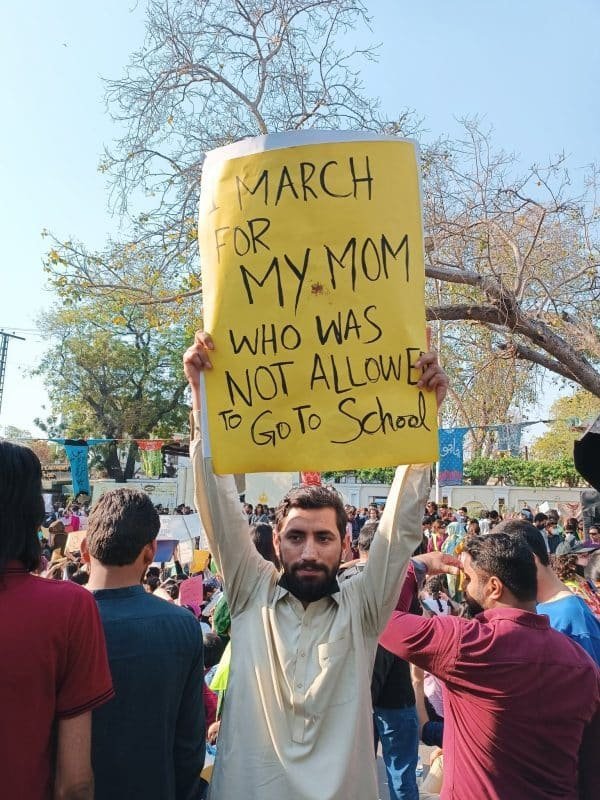
    ‘I march for my mom who was not allowed to go to school’; so stated a placard at the Aurat March, pictures of which went viral on Twitter.

    Now Ehtesham Hassan, the man behind the poster, has taken to Twitter to share the inspiring story of his mother.

    Hassan revealed that since the age of 10, his mother was fond of reading and writing and had wanted to go to school like her brothers did.

    When his mother expressed her desire to her grandmother, she purchased a takhti for her because of which the mother was able to go two school for two days. Hassan revealed that every night, his mother would clean the takhti with mud so that she could use it again the next day.

    However, Hassan said it was Maulana Fazal Rehman heard about his mother going to school and forbade her family from sending her because this way the girl would write letters to the men and violate the honor of her family.

    Hassan narrated that his mother was restricted from going to school, a fact that she is sorrowful about to this day. Hassan said that being deprived of her fundamental right to receive an education, and not being supported by her family is the reason why he choose to march today so that no other woman would be treated this way.

    Since the story was posted yesterday, women on Twitter have praised Hassan for pasionately defending the right of women to receive education, calling his thread a moving tribute to his mother.

    Many women said they had witnessed the same in their families.

    “This is the story of both my maternal & paternal grandmothers. They were both not allowed to go to school after 8th grade. They made sure their daughters were highly educated – they advocated for them against hell or high water,” this user wrote.

    Another user wrote: “Mother’s carried the burden of thier broken dreams and planted seeds of hope for future generations. She might not have gone to school but her son’s daughter would! Women have been forebearers of a silent revolution for generations.”

    We hope that more men out there step out of their bubble and follow the lead of Hassan to empower the women of their lives to never stop reaching for their dreams.
  • ‘As a woman, it is insulting that I have to take Imran Khan’s name’: Maryam Nawaz

    ‘As a woman, it is insulting that I have to take Imran Khan’s name’: Maryam Nawaz

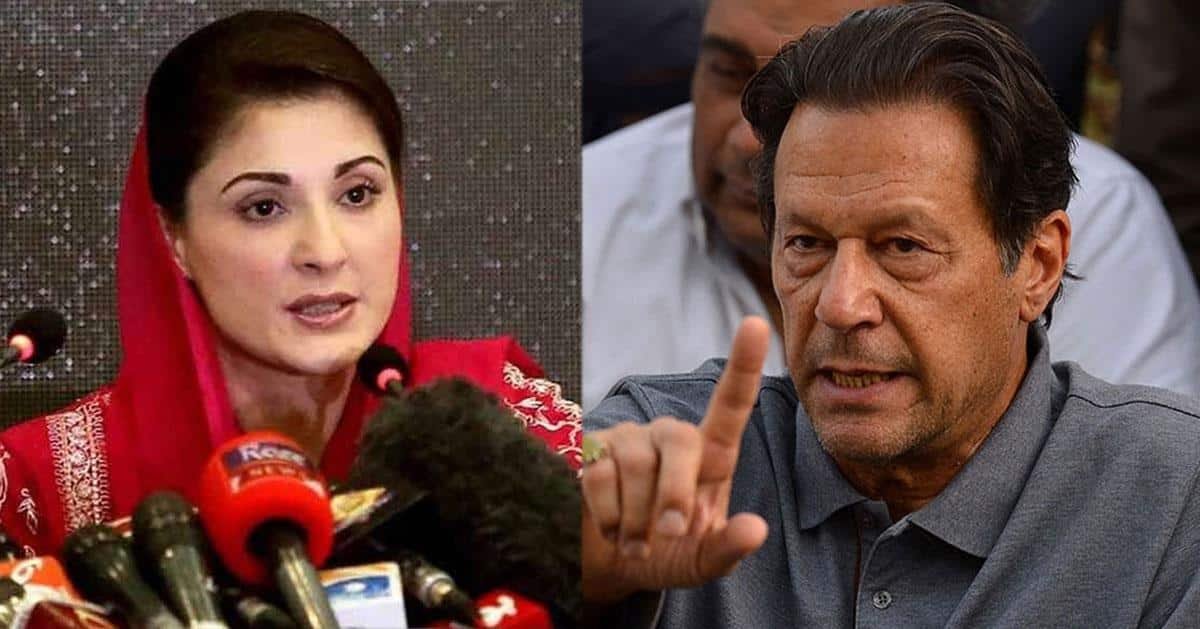
    Pakistan Muslim League-Nawaz (PML-N) Senior Vice President Maryam Nawaz has said that she, too, has faced harassment even though she hails from a privileged background and has a powerful father.

    Addressing a PML-N women workers convention in Lahore on International Woman’s Day, Maryam said that the Pakistan Tehreek-e-Insaf (PTI) Chairman Imran Khan and his party has always targeted her with “personal attacks” when she says something political.

    “They talk about my marriage. My wedding was done with alot of love and festivities by my parents and grandparents. And I am still married to the same person. I don’t want to attack anyone personally,” said Maryam.

    “As a woman, it is insulting that I have to take Imran Khan’s name. Due to the current situation in the country, I have to take his name. Being a woman, I have said this many times, I would never let a person like Imran Khan inside my house,” said Maryam, adding that when Imran is asked about politics, he never gives a political answer. Instead, he, in his jalsa says, “Maryam Nawaz, you say my name so many times, be careful; your husband might get angry with you.”

    Khan in May last year made misogynistic remarks about Maryam Nawaz.

    “In that speech, she took my name with such passion that I would like to tell her: Maryam, please be careful, your husband may get upset because you were constantly repeating my name,” said IK during the speech.

    “I am like a daughter to him [Imran Khan], and now because of the fear of arrest, he has become old and is 72 years old, but when it comes to slurs and personally attacking me, where does his old age go?” questioned Maryam.

  • Divorced women fear imprisonment under Taliban regime

    The Taliban regime in Afghanistan has modified divorce laws, now requiring both parties, husband and wife, to be present in court in order to get a divorce.

    Under the previous Afghan government, women were granted the right to get ‘one-sided divorces’ in order to help them escape abusive marriages, according to The Washington Post.

    Women could testify about suffering abuse at the hands of their husband, even if he had refused to make an appearance in court.

    The Post clarified that the Taliban had not commented on ‘one-sided divorces’ being nulled or whether a woman can be married after gaining a divorce in such a manner. However, Taliban spokesperson Zabihullah Mujahid has said that both parties must appear before a judge to request a divorce under the Taliban’s interpretation of Islamic law.

    Under the Taliban regime, it has become more difficult for women to seek refuge after escaping an abusive marriage. A psychologist told The Post that local aid groups providing counselling and relief to abused women have been shut down. She also elaborated that under the new law, it has become more difficult to prove domestic violence.

    “Under the new law, women need to first go to the police station and provide multiple witnesses to prove abuse or if their husband is addicted to drugs,” she said.

    Women face more problems to find legal counseling as the Taliban have banned women from working as lawyers and judges. A lawyer speaking to the Post revealed that more women will find it harder to leave their abusive marriages if they cannot find proper legal representation to help them escape domestic violence:

    “The Taliban have created the perfect situation for men seeking revenge. The courts have lost their effectiveness and instead we see on the news women receiving [public] lashings for adultery.”

    Previously the Taliban regime caused international outcry after enforcing a policies that restricted women’s movement. Women were banned from attending high school and college, couldn’t travel anywhere without a male guardian and were restricted from attending parks, fairs or gyms.

    The United Nations received a report on the state of human rights in Afghanistan, which had criticized the Taliban regime for pursuing a policy ‘tantamount to gender apartheid’.

  • Economy is a feminist issue, Aurat March releases its manifesto (and we couldn’t agree more)

    Aurat March has selected it’s theme for this year: Feminism in the Times of Crisis, and the social movement has released a statement on their Instagram page detailing their demands from the government to improve the economic conditions of the country.
    “The economic crisis in Pakistan is not just a financial problem, it is a humanitarian crisis that affects the most vulnerable people in our society. The government’s reliance on Western lenders is a short-term solution that will have long-term consequences for the poor and marginalized. The current economic policies of the government are exacerbating inequality and perpetuating the cycle of poverty. We must prioritize pro-poor growth and invest in the well-being of its most marginalized citizens,” the statement reads.

    The manifesto went on to address current talks between the Pakistani government and the International Monetary Fund (IMF), stating how the measures implemented due to these loans will impact women, working class and the rural poor directly:
    “The government is relying on bailout loans from Western lenders like IMF to starve off an impending economic collapse. These loans come with conditions like privaitization of public institutions and services, removal of electricity and fuel subsidies, increase in indirect taxes, and cuts in social expenditures. These measures will impact those who are already marginalized. Women, working-class people, and rural poor are already caught up in the crushing cycles of poverty, struggling to survive amidst structural issues like mounting debt, and situational economic blows like COVID-19, the Russia-Ukraine conflict, and unprecedented destruction in the wake of the 2022 floods.”
    The movement went on to reveal that global rankings show Pakistan ranks the lowest regarding per capita income, health, and education in South Asia, and needs to introduce economic policies that prioritize the poor and marginalized of the country:
    “Global rankings increasingly evidence the need for Pakistan to prioritize pro-poor growth that ensures the wellbring of its most marginalized. The country has the lowest HDI rankings for per capita income, health, and education in South Asia. Even Bangladesh and Nepal, two of the least developed countries in the region, have better rankings. Pakistan’s expenditure on defense is higher than the combined expenditure on health and education.”
    The note ended with the movement demanding that the government introduce economic policies that prioritized the well being of the working class and poor of Pakistan:
    “We demand decent work and living wages for all residents, including regularization of temporary work and the expansion of social protection coverage. Secondly, IMF-driven policies that benefit polices that benefit global capitalism at the expense of all the poor and marginalized should be stopped. Finally, we demand rollback of budget cuts in public institutions, the reinstallment of HEC scholarships, and the implementation of survivor-centric welfare systemsn as well as quality education and healthcare for all.”

    Read their complete statement here:

  • Aurat March 2023: Feminism in the time of crisis

    Aurat March 2023: Feminism in the time of crisis

    Feminist social movement Aurat March has unveiled their theme for this year: Feminism in the time of crisis.

    The movement elaborated on the significance behind this theme on Twitter, revealing that it will address the ongoing security, climate and economic issues currently plaguing the country.

    “We demand a feminist response to these crisis: one that centers the voices and experiences of one of the most affected and prioritizes justice and equity for all.

    These responses must be democratic and equitable. A Pakistan plagued by regional, ethnic and class inequity is unacceptable. We cannot afford to ignore the intersectional impacts of these crises any longer.

    Pakistan is plagued with challenges on multiple fronts including security and safety crisis, economic crisis, climate crisis and a relentless crisis of gendered violence. We know that these issues are deeply rooted in the patriarchal system that prioritize masculine politics and ignores the needs and rights of gender minorities and marginalized communities.

    It’s time to demand a better future for all.

    Join us on 8th March.”