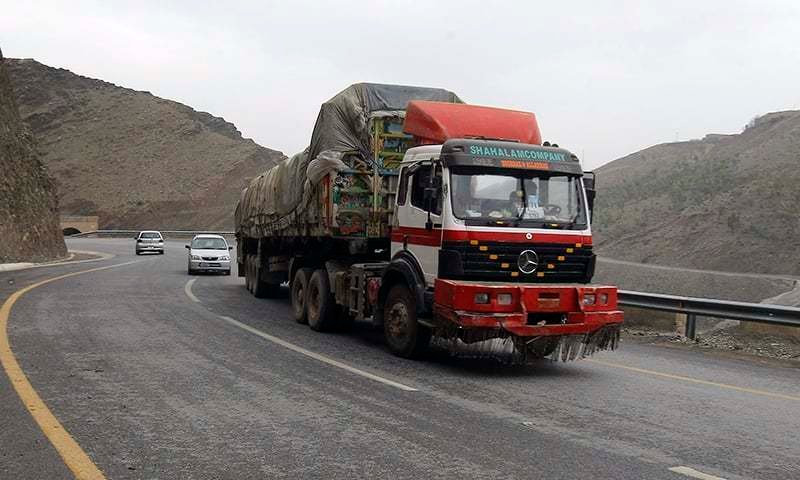
The World Bank has allocated a loan of $406.6 million to Pakistan for the development of the Khyber Pass Economic Corridor (KPEC) Project.
As per reports, Minister for Economic Affairs Hammad Azhar supervised the signing ceremony of the KPEC at the division.
According to the Economic Affairs Division, the project will construct a 48 km long 4-Lane, dual high-speed carriageway from Peshawar to Torkham. This project will boost economic development and improve areas adjoining expressway falling in Khyber Pakhtunkhwa province.
The government is also planning to develop special economic zones around the corridor.
The Khyber Pass has long been one of the most important trade routes and strategic military locations. Settled in the mountains, Khyber Pass divides Pakistan and Afghanistan forming the bridge between Central and South Asia.
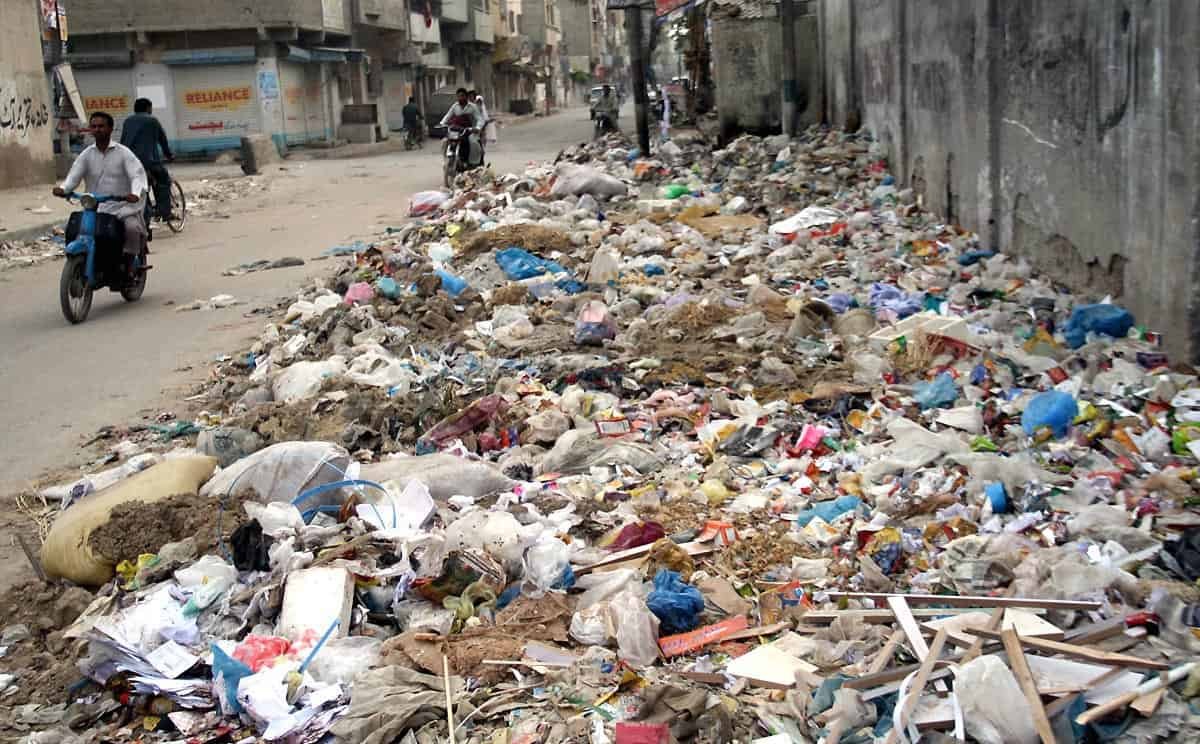
The World Bank (WB), on the recommendation of Sindh Chief Minister (CM) Murad Ali Shah, has allocated $10 million to help solve Karachi’s garbage problem through the Sindh Solid Waste Management Authority (SSWMA), Profit reported.
According to the details, the allocated amount will be used for capacity building, technical expertise and construction of a new landfill site for the SSWMA.
CM Murad held a meeting with an eight-member WB delegation on Wednesday, where he said, “It is a new organisation and would definitely take time to achieve expertise, but even then there is a dire need to operate in a scientific manner and make it a leading SWM organisation in the country.”
At this, WB Global Director Dr Dameh said that in Karachi Neighbourhood Improvement Programme (KNIP) there was a provision for solid waste management and agreed to help in solving the city’s waste problem.
The provincial chief executive also said that he was keen to develop a most modern and environment-friendly landfill site on the outskirts of the city.
“This landfill site must be equipped with all the necessary machinery, gadgets, equipment and technical staff and useful for power generation,” he added.
Moreover, on the request of the CM, the World Bank agreed to construct a landfill site over an area of 500 acres in the outskirts of the city for which the government would provide land.
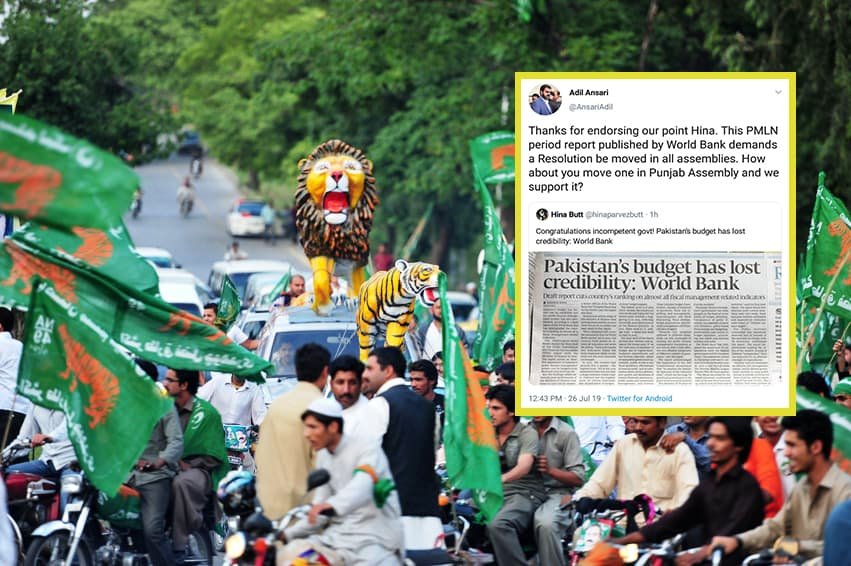
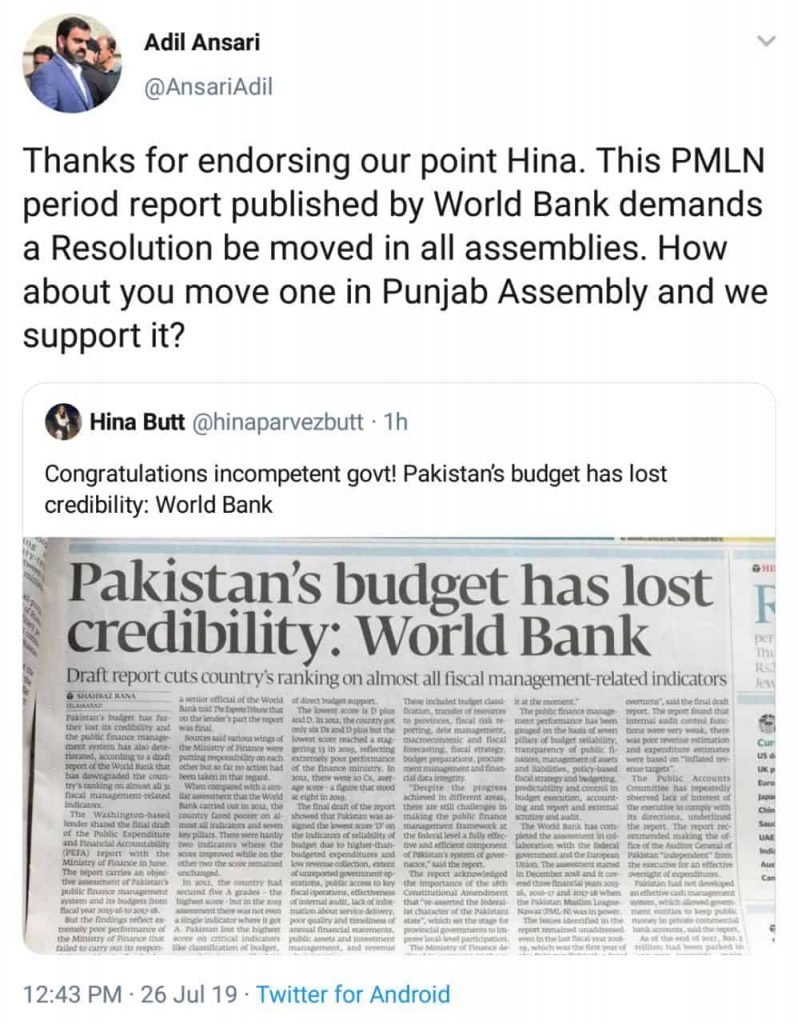
In a rather hilarious development, leaders of the Pakistan Muslim League-Nawaz (PML-N) have misread a World Bank (WB) report criticising their government’s economic policies and have attacked the ruling Pakistan Tehreek-e-Insaf (PTI) instead.
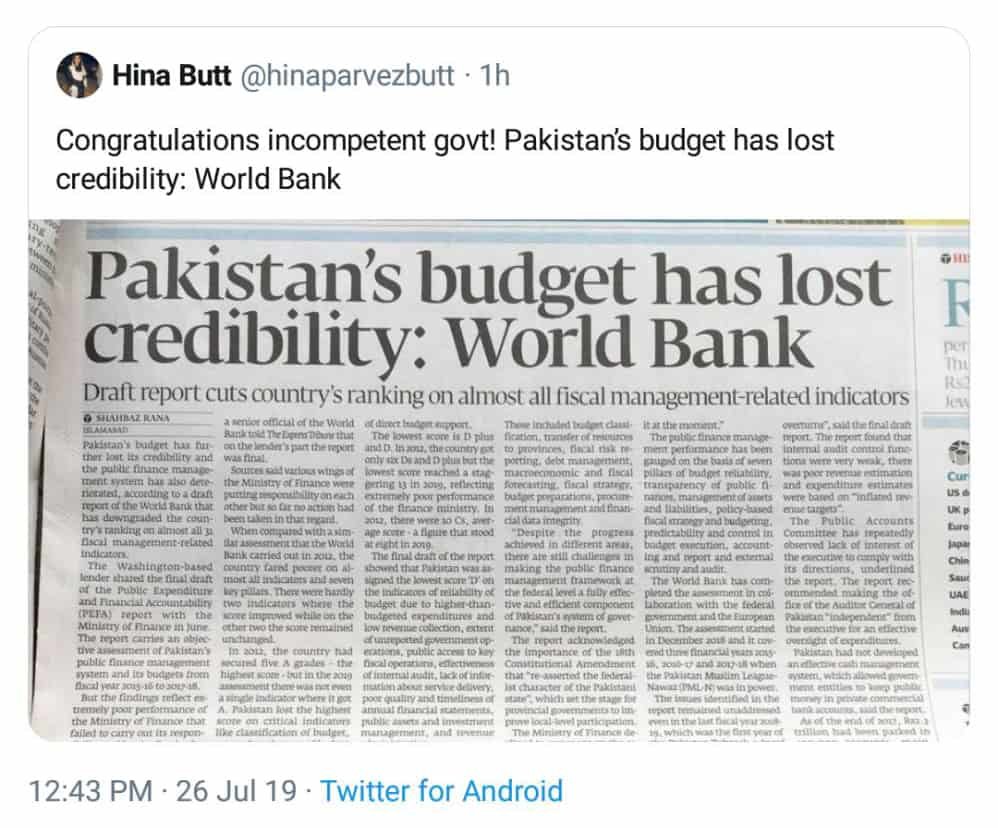
According to a draft report by the WB, Pakistan’s budget has lost its credibility and the public finance management has further weakened.
The Public Expenditure and Financial Accountability (PEFA) report, the final draft of which was shared with the Finance Ministry in June, contains findings that reflect the poor performance of the Finance Ministry and how it failed to uphold fiscal rules.
The report was widely shared by PML-N leaders and supporters, who held the incumbent PTI government responsible for the mismanagement of the country’s economic affairs.
The catch, however, is that the report assesses Pakistan’s public finance management system and an analysis of its annual budgets from 2015 to 2018 — a time period when the PML-N was in power.
Twitterati were quick to point out the blunder following which PML-N leaders, including Vice President Maryam Nawaz, deleted their tweets.
According to The Express Tribune, when compared with a similar assessment that the WB carried out in 2012, the country fared poorer on almost all indicators and seven key pillars.
There were hardly two indicators where the score improved while on the other two the score remained unchanged. In 2012, the country had secured five A grades – the highest score – but in the 2019 assessment, there was not even a single indicator where it got an A.
Pakistan lost the highest score on critical indicators like the classification of budget, comprehensiveness of budget information, transparency in inter-governmental fiscal operations, participation in budget process and predictability of direct budget support.
The lowest score is D plus and D. In 2012, the country got only six Ds and D plus but the lowest score reached a staggering 13 in 2019, reflecting the extremely poor performance of the Finance Ministry from 2015 to 2018.