
Tag: World Health Organisation

  • Last functional hospital in Gaza under attack as medical personnel toll hits 192

    Last functional hospital in Gaza under attack as medical personnel toll hits 192

    The United Nations has said that heavy fighting has “encircled” two hospitals in Khan Younis – Nasser and Al-Amal – leaving thousands of “terrified staff, patients and displaced people trapped inside”.

    The World Health Organization (WHO) has said that seven out of 24 hospitals are “partially functioning” in northern Gaza and suffering a shortage of personnel and supplies.

    Journalist Bisan shared a recent post detailing an attack on the Khan Yones camp by the Israeli occupation forces. Consequently, the last functioning hospital in Gaza- Al Nasser Medical Hospital- was under attack as well. Videos of gunfire surfaced on various social media platforms as well.

    The health scenario in Gaza is nearing collapse. Al Jazeera shared a report titled, ‘Against every instinct: How doctors in Gaza persevere amid Israel attacks’, in which it was revealed that almost 192 doctors were killed in Gaza between October 7 and November 8, 2023.

    According to the WHO, only 15 of Gaza’s 36 hospitals are partially functional – nine in the south and six in the north. The hospitals in the south are operating at three times their capacity while facing critical shortages of basic supplies and fuel.
    The facilities are “without enough specialized medical staff to manage the volume and range of injuries, nor sufficient medicines and medical supplies, fuel, clean water, or food for patients or staff”, the WHO said in a statement.

    The Ministry of Health in Gaza says occupancy rates are reaching 206 percent in inpatient departments and 250 percent in intensive care units.

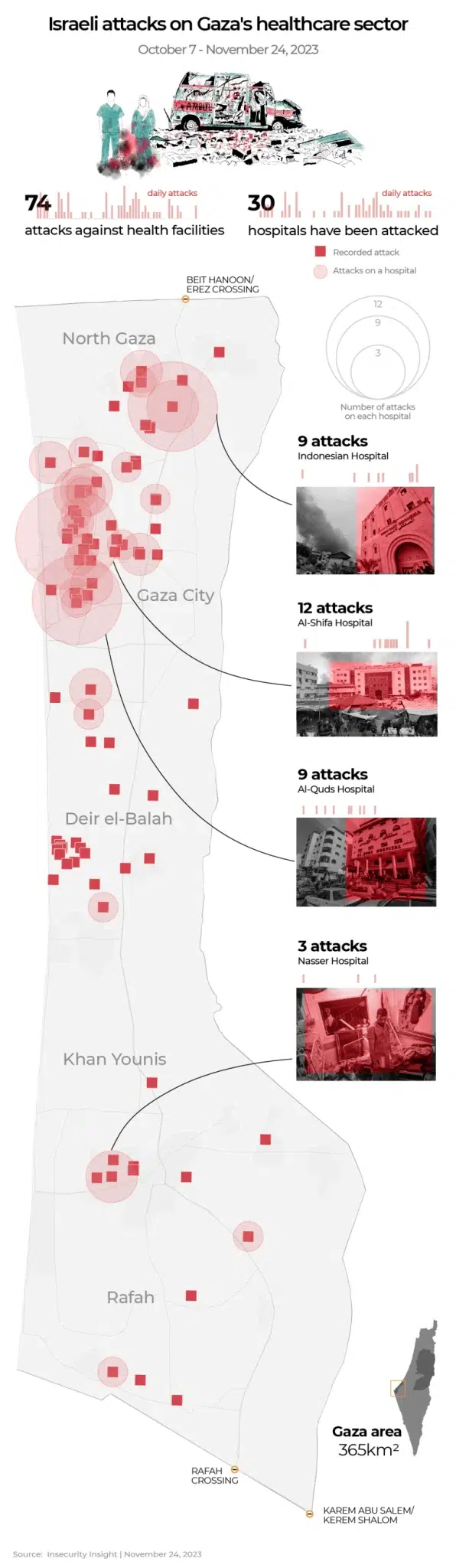
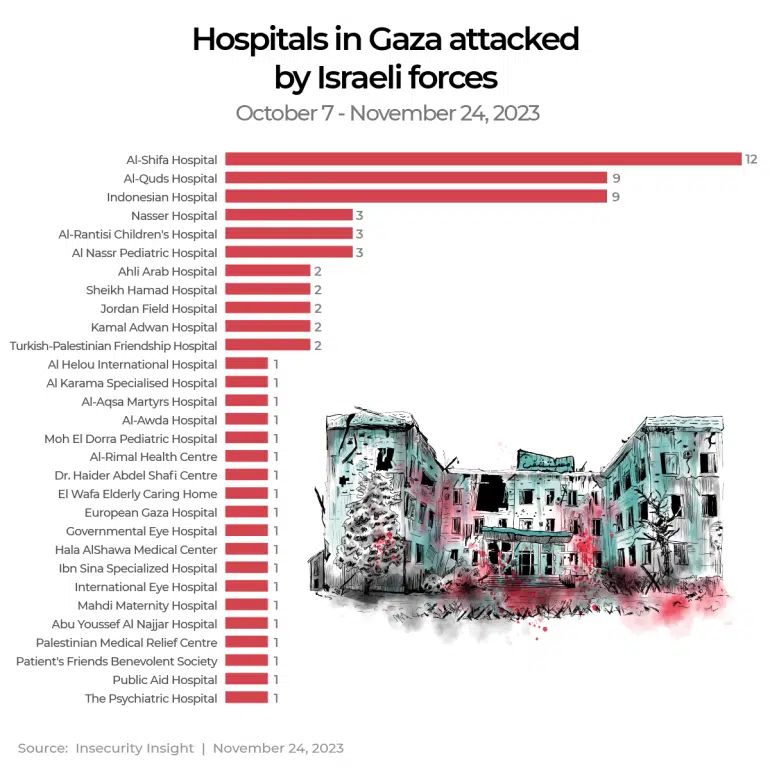
    From October 7 to November 24, there were 74 Israeli assaults on health facilities with 30 hospitals attacked in Gaza, according to Insecurity Insight, a humanitarian association that collates data on threats facing people in dangerous environments. It delivered 19,000 litres (5,000 gallons) of fuel to al-Shifa Hospital on Tuesday after facing delays at a checkpoint and on damaged roads.

    There have been 212 attacks on medical personnel.

    Attack on Hospitals

    The hospitals that have been attacked most often include:

    1. al-Shifa Hospital – attacked 12 times
    2. al-Quds Hospital – attacked nine times
    3. Indonesian Hospital – attacked nine times
    4. Nasser Hospital – attacked three times

    Insecurity Insight documented at least 26 other hospitals from across the Gaza Strip that were attacked by Israeli forces over the same period.
    How Gaza’s healthcare system has been destroyed?

    Mohamed S Ziara, a Palestinian doctor, talked to Al Jazeera and explained in a tone that is soft and unaffected by the rumbling explosions and pop of gunfire that can be heard in the background.

    He is a plastic surgeon working 12- to 14-hour shifts, six days a week at the European Gaza Hospital (EGH) in Khan Younis, where he treats up to 15 cases a day. Ziara describes the healthcare situation as “catastrophic”.

    “It doesn’t match anything I’ve seen before, even with previous escalations and war,” says Ziara, who has worked during Israel’s assaults on Gaza since 2014.

    He has been posting about Israeli attacks near the EGH and the conditions inside on his Instagram account.

    “No doctor wakes up in the morning and says: ‘I’m going to amputate a child’s leg without anesthesia.’”

    “You don’t want to watch children suffer,” Dr Amber Alayyan with Doctors Without Borders, known by its French initials MSF, told Al Jazeera.

    Chronically ill patients

    In addition to immediate injuries from Israeli air strikes and artillery, patients with prior and long-term illnesses and vulnerable health conditions are faced with not being treated. According to WHO, they include:

    • 1,100 patients in need of kidney dialysis
    • 71,000 patients living with diabetes
    • 225,000 patients with high blood pressure requiring medication
    • 485,000 people with mental health disorders
    • cancer patients, 2,000 of whom are diagnosed each year, including 122 children
    • 45,000 patients with cardiovascular disease.

    A grim prospect for the future

    On January 7, exactly three months into the war on Gaza, WHO Director-General Tedros Adhanom Ghebreyesus said: “It is inconceivable that this most essential need – the protection of healthcare – is not assured.”
  • Red alert: WHO, UNICEF say largest decline in childhood vaccinations in almost 30 years

    Red alert: WHO, UNICEF say largest decline in childhood vaccinations in almost 30 years

    The largest sustained decline in childhood vaccinations in approximately 30 years has been recorded in official data published by the World Health Organization (WHO) and the United Nations International Children’s Emergency Fund (UNICEF).

    According to WHO, 18 million children did not receive a single vaccine in 2021, which is the largest decline in 29 years, due to Covid-related disruptions, emergencies and misinformation. Around 25 million children around the world missed out on routine vaccinations in 2021, which is two million more than those who missed out in 2020 and six million more than in 2019, highlighting the growing number of children at risk from devastating but preventable diseases. The percentage of children who received three doses of the vaccine against diphtheria, tetanus and pertussis (DTP3) – a marker for immunisation coverage within and across countries – fell 5 percentage points between 2019 and 2021 to 81 per cent.

    The decline was due to many factors including an increased number of children living in conflict and fragile settings, increased misinformation and Covid-related issues such as service and supply chain disruptions.

    However, Pakistan returned to pre-pandemic levels of vaccination coverage due to high-level government commitment and significant catch-up immunisation efforts. WHO and UNICEF applauded Pakistan’s efforts to achieve this in the midst of a pandemic, when healthcare systems and health workers were under significant strain.

    “This is a red alert for child health. We are witnessing the largest sustained drop in childhood immunisation in a generation. The consequences will be measured in lives,” said Catherine Russell, UNICEF Executive Director.

    “While a pandemic hangover was expected last year as a result of Covid-19 disruptions and lockdowns, what we are seeing now is a continued decline. Covid-19 is not an excuse. We need immunisation catch-ups for the missing millions or we will inevitably witness more outbreaks, more sick children and greater pressure on already strained health systems,” added Russell.

  • World treats crises affecting blacks, whites unequally, regrets WHO chief

    The WHO chief said on Wednesday that the world was treating humanitarian crises affecting black and white lives unequally, with only a “fraction” of the attention on Ukraine given elsewhere.

    According to the AFP, World Health Organisation’s director-general Tedros Adhanom Ghebreyesus said the emergencies happening in other parts of the world were not being taken as seriously and hoped the international community “comes back to its senses”.

    “I don’t know if the world really gives equal attention to black and white lives,” Tedros told a news conference. “The whole attention to Ukraine is very important of course, because it impacts the whole world.

    “But even a fraction of it is not being given to Tigray, Yemen, Afghanistan and Syria and the rest. A fraction.

    “I need to be blunt and honest that the world is not treating the human race the same way. Some are more equal than others. And when I say this, it pains me. Because I see it. Very difficult to accept but it’s happening.”

    Tedros, who is himself from Tigray, said the United Nations had determined that 100 trucks per day of life-saving humanitarian supplies needed to be going into the besieged northern region of Ethiopia.

    The country’s former health and foreign minister said that since a truce was declared, at least 2,000 trucks should have gone in, but only 20 have done so thus far.

    Tedros said he was worried that the 20 trucks going in could be just a “diplomatic manoeuvre” on the part of the government in Addis Ababa.

    “In effect, the siege by the Ethiopian and Eritrean forces continues,” he said.

    “To avert the humanitarian calamity and hundreds of thousands more people from dying, we need unfettered humanitarian access from those reinforcing the siege.” But Tedros said global attention was simply not being placed on such humanitarian crises.

    “I hope the world comes back to its senses and treats all human life equally,” he said.

    “What is happening in Ethiopia is a tragic situation. People are being burned alive… because of their ethnicity…. Without any crime. “So we need to balance. We need to take every life seriously because every life is precious.”

    The UN says hundreds of thousands of people are at risk of starvation in Tigray, where people have for months also faced fuel shortages and a lack of basic services such as electricity, telecommunications, internet and banking.

    Across northern Ethiopia, the 17-month conflict has driven more than two million people from their homes, according to the UN, and left more than nine million people in need of food aid.

  • WHO experts say repeating booster shots not appropriate

    WHO experts say repeating booster shots not appropriate

    World Health Organisation experts warned on Tuesday that repeating booster doses of the original Covid vaccines is not a viable strategy against emerging variants.

    “A vaccination strategy based on repeated booster doses of the original vaccine composition is unlikely to be appropriate or sustainable,” the WHO Technical Advisory Group on Covid-19 Vaccine Composition (TAG-Co-VAC) said in a statement.

    It said preliminary data indicates that the existing vaccines were less effective at preventing symptomatic Covid disease in people who have contracted the new Omicron variant, currently spreading like wildfire around the world.

    It recommended developing vaccines that not only protect people against falling seriously ill but could also better prevent infection and transmission in the first place.