Tag: World Health Organization

  • WHO looking forward to oral, nasal Covid-19 vaccines

    The World Health Organization’s (WHO) chief scientist said Tuesday she was looking forward to the “second generation” of Covid-19 vaccines, which could comprise nasal sprays and oral versions, AFP reported.

    Soumya Swaminathan said such vaccines could have benefits over the current crop as they would be easier to deliver than injections and could even be self-administered.

    Swaminathan said there were 129 different candidate vaccines that have got as far as clinical trials and are being tested on humans — while a further 194 are not yet in the phase in their development and are still being worked on in laboratories.

    “This covers the entire range of technologies,” she told a live interaction on WHO social media channels.

    “They’re still in development. I’m sure some of them will prove to be very safe and efficacious and others may not.”

    “There could be advantages to some of the second-generation vaccines… clearly if you have an oral vaccine or an intra-nasal vaccine this is easier to deliver than an injectable.”

    Soumya Swaminathan added, “Ultimately we’ll be able to choose the ones that are most appropriate. If not for Covid-19, we’re going to use these platforms for other infections in the future.”

    “If there’s a local immune response then it will take care of the virus before it even goes and establishes itself in the lungs and starts causing a problem,” she said.

    WHO has only given emergency use authorisation to seven Covid-19 vaccines: those created by Pfizer/BioNTech, Moderna, AstraZeneca, Johnson & Johnson, Sinopharm, Sinovac and last week Bharat Biotech.

    “None of the vaccines are 100%. Nobody has ever claimed that the vaccines are going to be 100% protective. But 90% is a wonderful amount of protection to have, compared to zero,” Swaminathan said.

    “Till now, with the vaccines that we have approved, there has not been any signal which has been so worrying that we need to say, well, we need to re-think this vaccine.”

    More than 7.25 billion vaccine doses have been administered around the world, according to an AFP count

  • WHO approves world’s first Malaria vaccine

    The World Health Organization (WHO) has endorsed the widespread rollout of the first malaria vaccine with the experts hoping that it could save tens of thousands of children’s lives each year across Africa.

    Hailing it as “an historic day”, WHO Director-General Dr Tedros Adhanom Ghebreyesus said that after a successful pilot programme in three African countries, the RTS,S vaccine should be made available more widely.

    The WHO recommendation is for RTS,S – or Mosquirix – a vaccine developed by British drugmaker GlaxoSmithKline.

    “This is a vaccine developed in Africa by African scientists and we’re very proud,” said Ghebreyesus.

    According to European Medicines Agency, Mosquirix is a vaccine that can be administered to children aged 6 weeks to 17 months to help protect against malaria.

     It also helps protect against infection of the liver with the hepatitis B virus, but European Medicines Agency warns that the vaccine should not be used only for this purpose.

    The vaccine was developed by GlaxoSmithKline in 1987. However, it does face challenges: Mosquirix requires up to four doses, and its protection fades after several months.

    Still, scientists hope that the vaccine could have a major impact against malaria in Africa.

    Since 2019, 2.3 million doses of Mosquirix have been administered to infants in Ghana, Kenya and Malawi in a large-scale pilot programme coordinated by WHO.

  • WHO study shows long working hours are a killer

    WHO study shows long working hours are a killer

    Working long hours is killing hundreds of thousands of people a year in a worsening trend that may speed up further due to the current pandemic, the World Health Organisation said on Monday.

    In the first global study of the loss of life linked with longer working hours, the paper in the journal Environment International showed that 745,000 people died from a stroke and heart disease associated with long working hours in 2016. That was an increase of nearly 30% from 2000.

    “Working 55 hours or more per week is a serious health hazard,” said Maria Neira, director of the WHO’s Department of Environment, Climate Change and Health.

    “What we want to do with this information is promote more action [and] more protection of workers,” she said.

    According to details, the joint study done by the WHO and the International Labour Organisation showed that most victims (72%) were men and were middle-aged or older.

    Read more – People who use social media for news more susceptible to rumours: study

    It also showed that people living in Southeast Asia and the Western Pacific region, a WHO-defined region including China, Japan and Australia were the most affected.

    Overall, the study collecting data from 194 countries revealed that working 55 hours or more a week is associated with a 35% higher risk of stroke and a 17% higher risk of dying from ischemic heart disease compared with a 35-40 hour working week.

    The study covered the years from 2000 to 2016 so did not include the COVID-19 pandemic but WHO officials said the surge in remote working and the global economic slowdown resulting from the coronavirus emergency may have increased the risks.

    “The pandemic is accelerating developments that could feed the trend towards increased working time,” the WHO said, estimating that at least 9% of people work long hours.

  • WHO praises Pakistan’s COVID-19 vaccination arrangements

    WHO praises Pakistan’s COVID-19 vaccination arrangements

    World Health Organisation (WHO) representative in Pakistan Dr Palitha Mahipala on Wednesday praised Pakistan’s efforts for coronavirus vaccination.

    “I appreciate efforts of the Government of Pakistan for rolling out COVID-19 vaccination including vaccination of foreigners in the National Vaccine Deployment Plan and making excellent arrangements at the vaccination centres across Pakistan, with COVID-19 Standard Operating Procedures (SOPs) in place.”

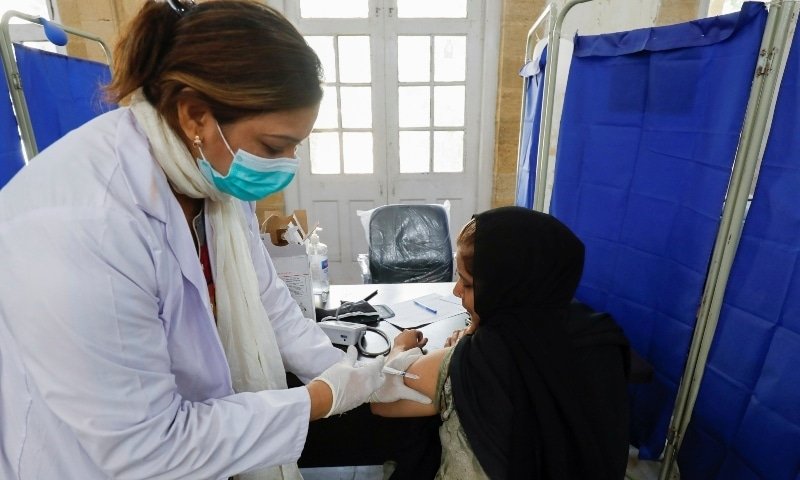
    Pakistan started the COVID-19 vaccination drive of people in the age group 50-59 today (April 21). Registrations for those 50 and above commenced on March 30. Those who haven’t registered can send their CNIC number to 1166 to register or can register online.

    Read more – Here’s where you can find COVID-19 vaccine in Karachi, Lahore

    Pakistan is likely to receive two million doses of COVID-19 vaccine from China by April 24.

    As per reports, the country will receive the vaccination batch on April 21 (today) and out of those two million doses, 1.5 million would be purchased from China while 500,000 doses would be gifted to Pakistan from the neighbouring country.

  • World can start dreaming of pandemic’s end, says UN health chief

    World can start dreaming of pandemic’s end, says UN health chief

    The UN health chief on Friday said that positive results from COVID-19 vaccine trials mean the world “can begin to dream about the end of the pandemic,” but he said rich and powerful nations must not ignore the poor and marginalized “in the stampede for vaccines.”

    In an address to the UN general assembly’s session on the pandemic, World Health Organisation Director-General Tedros Adhanom Ghebreyesus cautioned that while the virus can be stopped, “the path ahead remains deceitful.”

    The pandemic has shown humanity at “its best and worst,” he said, pointing to “inspiring acts of compassion and self-sacrifice, breathtaking feats of science and innovation, and heartwarming demonstrations of solidarity, but also disturbing signs of self-interest, blame-shifting and divisions.”

    Referring to the current increase in infections and deaths, Tedros, without naming any countries, said that “where science is drowned out by conspiracy theories, where solidarity is undermined by division, where sacrifice is substituted with self-interest, the virus thrives, the virus spreads.”

    In his virtual address, he warned that a vaccine “will not address the vulnerabilities that lie at its root” — poverty, hunger, inequality and climate change, which he said must be tackled once the pandemic ends.

    “We cannot and we must not go back to the same exploitative patterns of production and consumption, the same disregard for the planet that sustains all life, the same cycle of panic and meddling and the same divisive politics that fuelled this pandemic,” he said.

    On vaccines, Tedros said, “the light at the end of the tunnel is growing steadily brighter,” but vaccines “must be shared equally as global public goods, not as private commodities that widen inequalities and become yet another reason some people are left behind.”

    Earlier, WHO warned people ‘vaccines do not equal zero Covid’ and asked governments and citizens not to drop their guard over the pandemic and urged people to follow all the virus SOPs.

  • COVID-19: WHO recommends adults to workout for 150 minutes per week

    All adults should do a minimum of 150 minutes of vigorous physical activity per week, even more, for well-being and mental health in the COVID-19 era, the World Health Organisation (WHO) has said.

    WHO also recommended that children and adolescents have an average of one hour of daily physical exercise and limit time in front of electronic screens.

    People of all ages must compensate for growing sedentary behaviour with physical activity to ward off disease and add years to their lives, it added.

    “Increasing physical activity not only helps prevent and manage heart disease, type-2 diabetes and cancer, it also reduces symptoms of depression and anxiety, reduces cognitive decline including Alzheimer’s and improves memory,” Ruediger Krech, WHO director for health promotion said.

    Yet one in four adults and a “staggering” four out of five adolescents do not get enough physical activity, which can include walking, cycling, gardening and cleaning, the WHO said.

    “These guidelines emphasise what many are experiencing during the COVID restrictions that are applied all over the world. And that is that being active every day is good not only our bodies but also our mental health,” said Fiona Bull, head of WHO’s physical activity unit.

    “Phone a friend and do classes online together, help your family members, do it as a family. And when you can, get outside,” she said.

    Read more – Workout at home with Katrina Kaif’s routine

    Research into the ill-effects of sedentary behaviour has grown in the past decade, leading to the new advice, Bull said.

    “That is limit sedentary time, and do more activity to offset sedentary time, particularly for those who do long hours of sedentary, which includes a lot of people who have got office-based work environments,” she said. “For children we also recommend they limit sedentary time, particularly screen time.”

    Pregnant women and postpartum mothers are now included in the recommendations of 150 to 300 minutes of moderate to vigorous aerobic activity per week for adults.

    This brings health benefits for both the mother and baby, according to Juana Willumsen, a WHO technical officer.

    “For example there is a 30% reduction in gestational diabetes amongst women who are physically active during pregnancy,” she said.

    Adults above 65 are advised to add muscle strengthening and activities focusing on balance and coordination to help prevent falls later.

    Devices worn on the wrist or hip that track physical activity are helpful for all, Bull said.

    “Monitoring how active you are is very good feedback,” she said. “That is important because we tend to think we might be more active. We tend to underestimate how much time we spend sedentary.”

  • WHO fears spike in deaths after COVID-19 cases surge

    WHO fears spike in deaths after COVID-19 cases surge

    The World Health Organisation (WHO) warned against any complacency in the coronavirus death rate, saying with the increasing number of cases, the death rate would also increase.

    New cases are hitting 100,000 daily in Europe. Nearly 20,000 infections were reported in Britain, while Italy, Switzerland and Russia were among nations with record case numbers.

    While deaths globally have fallen to around 5,000 per day from April’s peak exceeding 7,500, WHO Chief Scientist Soumya Swaminathan said caseloads were rising in ICU (intensive care units).

    “Mortality increases always lag behind increasing cases by a couple of weeks,” Swaminathan said during a WHO social media event. “We shouldn’t be complacent that death rates are coming down.”

    More than 38 million people have been reported infected globally and 1.1 million have died.

    Despite the global push for a COVID-19 vaccine, with dozens in clinical trials and hopes for initial vaccinations this year, Swaminathan reiterated that speedy, mass shots were unlikely.

    “Most people agree, it’s starting with health care workers, and front-line workers, but even there, you need to define which of them are at highest risk, and then the elderly, and so on,” Swaminathan said.

    “A healthy young person might have to wait until 2022.”

    The WHO has said letting infection spread in hopes of achieving “herd immunity” is unethical and would cause unnecessary deaths. It urges hand-washing, social distancing, masks and — when unavoidable, limited and targeted restrictions on movements — to control disease spread.

    “People talk about herd immunity. We should only talk about it in the context of a vaccine,” Swaminathan said. “You need to vaccinate at least 70% of people … to really break transmission.”

    Minister for Planning Development and Special Initiatives Asad Umar, who also chairs the National Command and Operations Centre (NCOC) to deal with COVID-19 in the country, has highlighted the rise in the number of infections in Pakistan. The Minister urged people to take COVID-19 SOPs seriously.

  • Coronavirus may never go away, WHO says

    Coronavirus may never go away, WHO says

    The new coronavirus may never go away and populations around the world will have to learn to live with it, the World Health Organization (WHO) has warned.

    As some countries around the world begin gradually easing lockdown restrictions imposed in a bid to stop the novel coronavirus from spreading, the WHO said it may never be wiped out entirely, AFP reported.

    The virus first emerged in Wuhan in China late last year and has since infected more than 4.2 million people and killed nearly 300,000 worldwide.

    “We have a new virus entering the human population for the first time and therefore it is very hard to predict when we will prevail over it,” said Michael Ryan, the WHO’s emergencies director.

    “This virus may become just another endemic virus in our communities and this virus may never go away,” he told a virtual press conference in Geneva. “HIV has not gone away — but we have come to terms with the virus.”

    More than half of humanity has been put under some form of lockdown since the coronavirus crisis began.

    But the WHO warned there was no way to guarantee that easing the restrictions would not trigger a second wave of infections. “Many countries would like to get out of the different measures,” said WHO chief Tedros Adhanom Ghebreyesus.

    “But our recommendation is still the alert at any country should be at the highest level possible.”

    ‘LONG WAY TO GO’:

    Ryan added that there was a “long, long way to go” on the path to returning to normal, insisting that countries would have to stay the course.

    “There is some magical thinking going on that lockdowns work perfectly and that unlocking lockdowns will go great. Both are fraught with dangers,” the Irish epidemiologist said.

    Ryan also condemned attacks on healthcare workers that were linked to the pandemic, saying more than 35 “quite serious” such incidents were recorded in April alone in 11 countries.

    He said the attacks were often over-reactions from ill-informed communities — while others were more sinister.

    “Covid-19 is bringing out the best in us, but it’s also bringing out some of the worst,” he said. “People feel empowered to take out their frustrations on individuals who are purely trying to help.

    “These are senseless acts of violence and discrimination that must be resisted.”

    But he insisted that in finding a way to conquer the virus was a chance for humanity to take major steps forward by finding a vaccine and making it widely accessible.

    “It’s a massive opportunity for the world,” Ryan said.

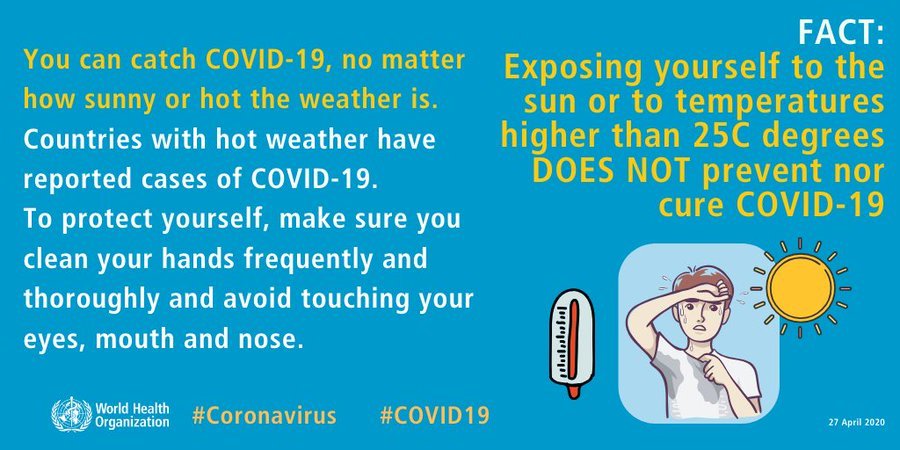
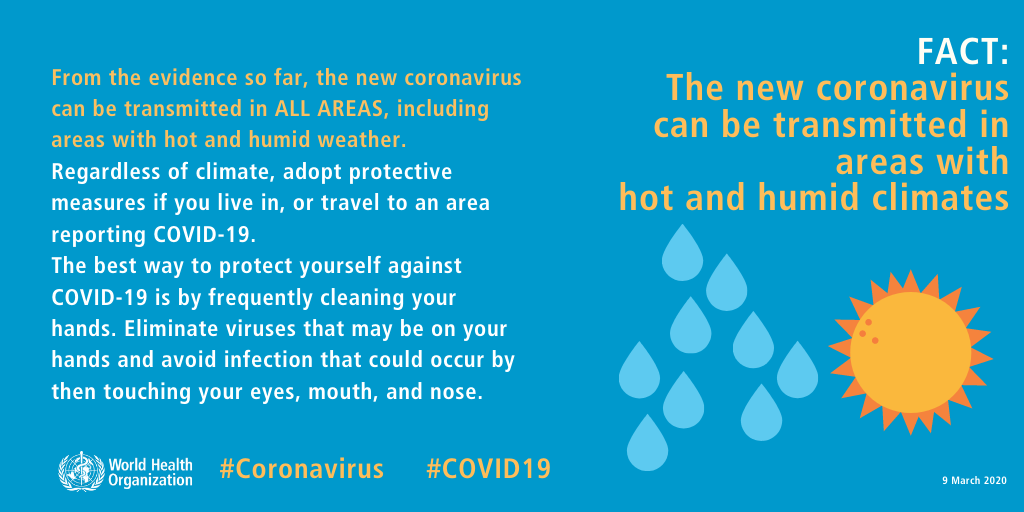
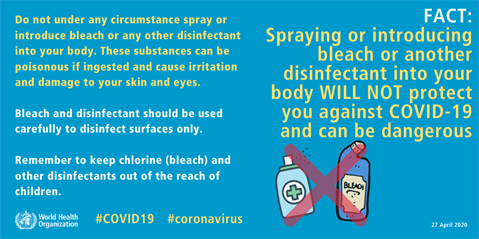
  • Myth Buster: Can sitting in the sun save you from COVID-19?

    Myth Buster: Can sitting in the sun save you from COVID-19?

    Myths and misinformation related to COVID-19 are abundantly available on social media. This means that every piece of information you read regarding the virus may or may not be true. The best is to go to a trusted source like the World Health Organisation (WHO) to check any remedy or cure that might come up these days.

    Fact 1: Exposing yourself to the sun or temperature higher than 25C degrees does not prevent nor cure coronavirus.

    Fact 2: COVID-19 is not transmitted through houseflies.

    Fact 3: Spraying or introducing bleach or another disinfectant into your body will not protect you against COVID-19 and can be dangerous.

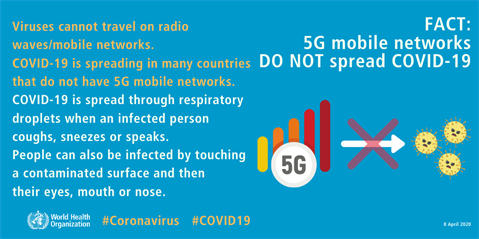
    Fact 4: 5G mobile networks do not spread COVID-19.

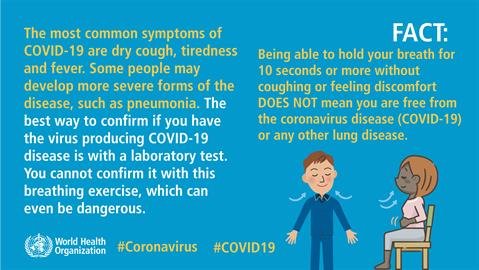
    Fact 5: Being able to hold your breath for 10 seconds or more without coughing or feeling discomfort DOES NOT mean you are free from the infection.

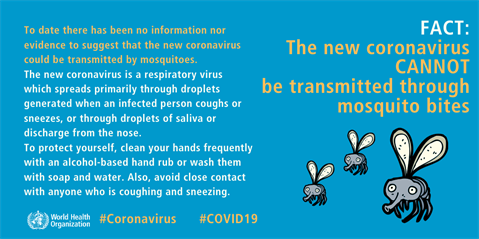
    Fact 6: The new coronavirus cannot be transmitted through mosquito bites.

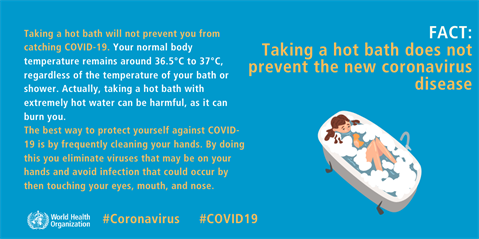
    Fact 7: Taking a hot bath does not prevent the new coronavirus disease.

  • COVID-19 cases in Pakistan can rise to 200,000 by July, warns World Health Organization

    COVID-19 cases in Pakistan can rise to 200,000 by July, warns World Health Organization

    The number of estimated coronavirus cases in Pakistan can rise to 200,000 by mid-July if “effective interventions” are not taken, the World Health Organisation (WHO) has warned.

    According to WHO Director General (DG) Dr Tedros Adhanom, who was speaking at the launch of a virtual conference titled “Pakistan National Strategic Preparedness and Response Plan”, without effective interventions, there could be an estimated 200,000 cases by mid-July, the impacts of which on the economy could be devastating and double the number of people living in poverty.

    He said that the required funding for the plan was $595 million, which would be allocated to support various measures.

    “We must act in solidarity, with a coherent, coordinated approach,” Dr Tedros was quoted as saying.

    The statement from the global health body comes at a time when coronavirus cases in Pakistan have reached 10,982 with at least 230 fatalities.