Tag: WWF

  • 27-feet-long Bryde’s whale found dead on seashore in Balochistan

    27-feet-long Bryde’s whale found dead on seashore in Balochistan

    A 27-feet-long whale has washed up on a remote seashore in Balochistan. The animal was identified as Bryde’s whale, a rare species present mostly in tropical waters. The carcass was found in the Pasni region, specifically in Sarbandan.

    There are signs of entrapment on its body, leading to speculation that the whale either got trapped in a fishing net or a fisherman tried to ensnare it, Deputy Director of Environment Department Abdul Raheem Baloch has said.

    Sightings of Bryde’s whale and their entrapment have become frequent in recent times. Detailed records from 2022 indicate that four such whales were entangled along the coast of Pakistan during that year, as reported by the Tribune.

    Technical advisor at WWF, Moazzam Khan, expressed concerns over the rise in the incidents and the threat the species is facing in the Arabian Sea. Solid measures need to be taken to minimise the factors contributing to the vulnerability of Bryde’s whale as well as for its conversation.

  • ‘Recharge Pakistan’ climate resilience project approved for funding

    ‘Recharge Pakistan’ climate resilience project approved for funding

    Pakistan’s Federal Minister for Climate Change, Sherry Rehman, tweeted her joy on Tuesday at the ‘Recharge Pakistan’ project receiving approval for funding. A joint collaboration by Global Climate Fund (GCF), WWF and the Government of Pakistan, the project aims to build climate resilience through multiple Ecosystem-Based Adaptation (EBA) interventions.

    The project is said to be implemented over the next seven years and will be receiving resources of $66 million from GCF, and $11.8 million from co-financing organisations. 

    The EBA interventions are comprised of three components: firstly, to store flood water in wetlands, floodplains, and depressions (also known as green infrastructure) at several priority sites. 

    Secondly, the project is designed to build community resilience amongst those Pakistani communities particularly vulnerable to climate change. 

    Lastly, and perhaps most importantly, the project aims to enable a paradigm shift towards ecosystem-based adaptation in Pakistan in order to scale up more projects with this approach.

    As Senator Rehman also said, the project is aimed to enable the Government of Pakistan, “including all lead provinces and stakeholders”, to implement and replicate nature-based solutions for climate change.

    The tentative goal is that by 2030, there would be a reduction of flood risk, with enhanced water recharge at six sites in the Indus Basin, building resilience amongst 10 million people and vulnerable ecosystems. 

    In order to ensure that the aforementioned EBA interventions are sustained and continue to function effectively, WWF states that the project will ensure that climate-adapted, community-based natural resource management is implemented locally. 

    Thus, Recharge Pakistan will hopefully contribute towards improving water and food security at a national level, and climate-adapted livelihoods locally, increasing resilience through the protection and restoration of ecosystems and building the climate resilience of vulnerable communities in the Indus Basin.

    As one of the countries most threatened by climate change, the approved funding for Recharge Pakistan is definitely a win. More nature-based solutions for climate change could help our country escape imminent disaster while preserving and rebuilding what’s left of our environment.


  • WWF releases rare video of snow leopard hunting ibex

    WWF releases rare video of snow leopard hunting ibex

    Viewer discretion is advised.

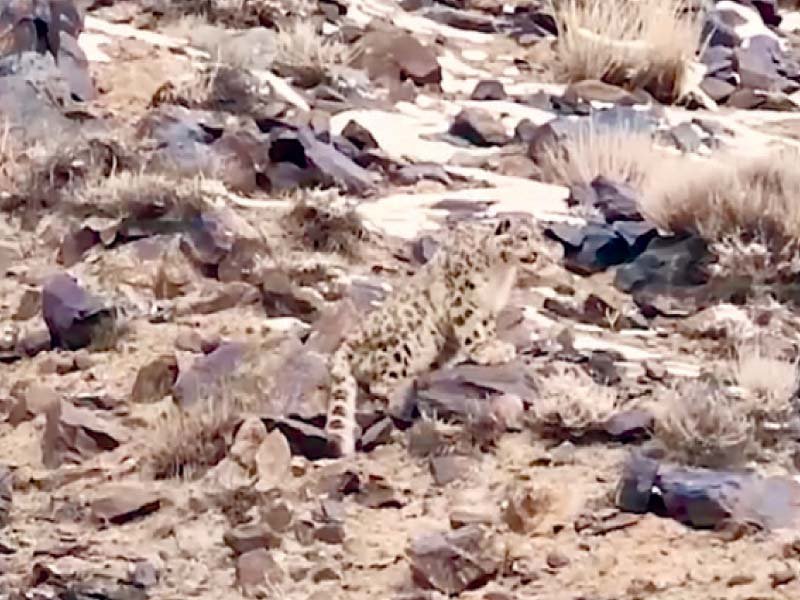
    The World Wildlife Fund-Pakistan (WWF-P) released rare footage of a snow leopard hunting a Himalayan ibex in Khunjerab National Park, located at a distance of approximately 15 kilometres from the Pakistan-China border.

    The footage was released on March 3 to mark the annual World Wildlife Day. According to details, the video is aimed to raise awareness about wildlife protection and threats to their survival.

    The gripping video shows a snow leopard silently chasing a herd of Himalayan ibex on steep cliffs. After successfully hunting an ibex, the snow leopard can be seen feasting on it. Two other cats joined the leopard later.

    The video was recorded by wildlife photographer Muhammad Osama.

    According to Osama, he followed the herd of the ibex in severe cold, with the temperature as low as – 18 degrees Celsius, looking for fresh snow leopard pugmarks.

    “Capturing this hunt was once in a lifetime experience as it involved hours of tireless tracking, climbing mountains and withstanding freezing cold temperatures,” he said.

    VIDEO: Himalayan lynx attacks Markhor in Chitral

    WWF-P director general Hammad Naqi Khan also expressed hope that the video would help in raising awareness about wildlife in Pakistan and the need to guard it.

    He said wildlife in Pakistan and in the rest of the world faced increasing threats due to deforestation and human encroachment, which led to habitat degradation, while new threats such as unsustainable infrastructure and climate change were also emerging.

    As a result, the survival of wildlife, such as snow leopards, Indus River dolphins, common leopards, pangolins, brown bear and white-backed vultures, hangs in the balance, he added.

    Khan requested the government to ensure that existing protected areas in the country were restored so that wildlife could flourish in healthy landscapes.

  • VIDEO: Himalayan lynx attacks Markhor in Chitral

    With a decrease in human activity all over the world, animals, some which have rarely been seen before, are coming out of their hiding places and exploring their surroundings without an interference.

    Recently, WWF-Pakistan released a never seen before footage of the Himalayan lynx, captured on the steep rocky cliffs of Chitral Valley, Pakistan. According to officials, this is the first time that the nocturnal hunter and highly elusive animal has been filmed in the area.

    The video which is intense and chilling shows the cat observe and successfully hunt her prey.

    “While filming a group of markhor grazing in the Tooshi-Shasha Wildlife Conservancy recently, our field production team and the Khyber Pakhtunkhwa Wildlife Department spotted this lynx crouching in a camouflaged position behind a rock, about to begin a hunt,” shared the animal protection organisation. “What followed was a dramatic scene few have ever witnessed – a lynx stalking and successfully killing a yearling markhor.”

    Watch the full video here:

    According to WWF, “the Himalayan lynx is one of the most elusive and powerful cats living in these mountains, rivaled only by the famous snow leopard. As an apex predator, the lynx plays an essential role in maintaining the balance and health of this complex mountain ecosystem.”

    The lynx is considered to be rare species and is known to be present in Chitral and other northern areas of Pakistan, including Gilgit-Baltistan, although its exact distribution and range are not known.

    Earlier, a brown bear was also spotted in Laspur Valley in Chitral by the locals.