Tag: Zong

  • PTA reveals drop in mobile data users amid increasing complaints

    PTA reveals drop in mobile data users amid increasing complaints

    In November 2023, data from the Pakistan Telecommunication Authority (PTA) indicates a decline in various telecom metrics and an increase in user complaints compared to October 2023.

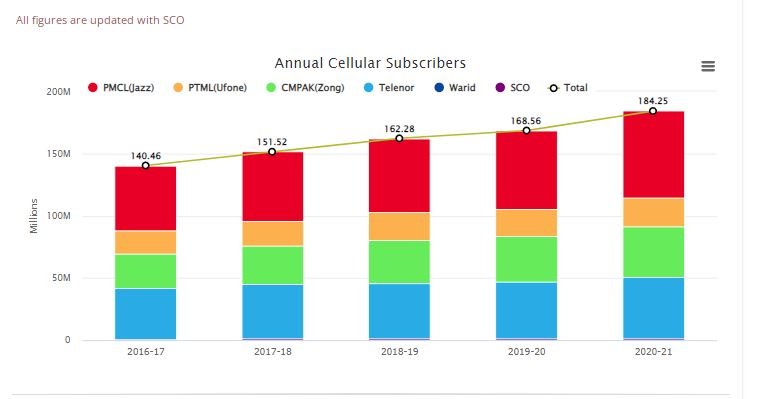
    The total number of cellular subscribers saw a decrease from 189.77 million at the end of October to 189.26 million at the end of November. Additionally, 3G and 4G users in Pakistan decreased from 126.92 million to 126.24 million during the same period.

    Cellular teledensity witnessed a decline from 79.32 per cent in October to 78.98 per cent in November, contributing to the overall teledensity drop from 80.4 per cent to 80.06 per cent.

    Furthermore, Next Generation Mobile Service (NGMS) penetration decreased from 53.05 per cent to 52.68 per cent.

    Provider-specific data reveals a decline in Jazz’s 3G users from 3.731 million to 3.569 million and 4G users from 43.172 million to 42.754 million between October and November.

    Zong experienced a decrease in 3G subscribers but an increase in 4G users. Telenor observed a decline in both 3G and 4G users, while Ufone’s 3G users decreased but 4G users increased.

    User complaints against telecom operators surged in November, with the PTA receiving 14,471 complaints. Notably, 98.9 per cent of these complaints were successfully resolved.

    The complaints spanned various telecom operators, including cellular mobile operators (CMOs), Pakistan Telecommunication Company Limited (PTCL), long-distance international (LDI) operators, wireless local loop (WLL) operators, and internet service providers (ISPs).

    Cellular mobile subscribers constituted the majority of complaints, reaching 13,857, of which 99.1 per cent were addressed. Jazz, Telenor, Zong, and Ufone faced specific complaints, with resolution rates ranging from 98.2 to 99.7 per cent.

    Complaints against basic telephony and ISPs were also received, with resolution rates of 93.2 per cent and 95.2 per cent, respectively.


  • Cellular companies raise call and data bundle prices

    Cellular companies raise call and data bundle prices

    Telecommunications companies in Pakistan, such as Jazz, Telenor, and Ufone, have raised the prices of various call and data package offers.

    According to Propakistani, Jazz has notified its customers of the price increase, and the company has revised the subscription fees for the YouTube and social packages for one week from Rs115 to Rs120, while the price of the WhatsApp package has increased from Rs21 to Rs23 for one week.

    Jazz prepaid monthly premium, which includes 25GB of monthly data and 250 all-network minutes, remains unchanged at Rs650.

    Due to rising inflation, Ufone has also raised its prices. UPower is now priced at Rs120, up from Rs100 previously. The price of SuperCard Plus increased from Rs649 to Rs699 on June 29, 2022. The price of Super Card Gold has also risen by more than Rs100, from Rs999 to Rs1,099.

    Read more: Number of 3G, 4G users in Pakistan increases to 113.89 million

    Telenor package prices have also increased. On June 22, 2022, the price of EasyCard increased from 500 to Rs550; on June 29, 2022, the price of EasyCard increased from Rs650 to Rs700; and the monthly social pack plus increased to Rs100.

    Telecom companies claim that a price increase is required to maintain service quality as inflation rises.

  • Number of 3G, 4G users in Pakistan increases to 113.89 million

    Number of 3G, 4G users in Pakistan increases to 113.89 million

    The latest data from Pakistan Telecommunication Authority (PTA) reveals that the number of 3G and 4G users grew by 1.14 million from 112.75 million in April 2022 to 113.89 million in May 2022.

    Pakistan’s cellular subscriber base grew by 0.25 million to 193 million by the end of May 2022, up from 192.75 million at the end of April, according to Brecorder.

    By the end of May, cellular mobile teledensity had risen from 87.6 per cent to 87.67 per cent. By the end of May, the total teledensity had risen to 88.81 per cent, up from 88.74 per cent in April.

    The monthly penetration of Next Generation Mobile Services (NGMS) at the end of April had risen to 51.73 per cent, up from 51.24 per cent.

    Network providers

    The total number of 3G users on Jazz fell from 6.222 million at the end of April to 6.068 million at the end of May, a reduction of 0.154 million. By the end of May, the number of Jazz 4G users had risen from 36.567 million to 37.168 million.

    Zong 3G subscribers fell from 3.357 million at the end of April to 3.272 million at the end of May, while 4G users grew from 27.952 million at the end of April to 28.317 million at the end of May.

    Telenor 3G subscribers fell from 3.696 million at the end of April to 3.613 million at the end of May, whereas Telenor 4G users enhanced from 21.216 million at the end of April to 21.494 million at the end of May.

    By the end of May, there were 3.576 million Ufone 3G users, up from 3.673 million at the end of April. Ufone’s 4G users increased from 8.761 million at the end of April to 9.052 million at the end of May, a 0.291 million increase over the previous month.

  • Pakistan is finalising policy guidelines to launch 5G

    Pakistan is finalising policy guidelines to launch 5G

    The government intends to introduce 5G across the country, despite the fact that widespread 4G coverage is viewed as a major requirement before its launch. Also, 5G services can be offered in locations where 4G services are already available.

    Although all telcos in Pakistan have switched to 4G or LTE networks, a few companies are still unable to provide stable connectivity in a number of locations. Also, network providers frequently fail to deliver an acceptable, 4G standard connection speed despite hefty mobile data charges.

    To meet license requirements for the 5G network, cellular operators are forced to extend 4G coverage.

    According to Brecorder, the government of Pakistan is intending to introduce 5G in the country, according to official documents, and the Ministry of Information Technology and Telecommunication (MOIT&T) is in the phase of finalising policies for 5G in consultation with the Pakistan Telecommunication Authority (PTA) and relevant authorities.

    The former administration intended to offer 5G services in the country in the first quarter of 2023. Unfortunately, no consulting assistance has been utilised for this purpose thus far. The reports also revealed that the PTA spent no expenses as no consultancy services had been obtained for its deployment.

    The MOIT&T has analysed seven bands for the implementation of 5G services. As per official documents, the government is currently reviewing the possibilities available for the prompt deployment of 5G services in the ccountry.

    The following bands are being considered for 5G service adoption as low, mid and high bands:

    700 MHz; 2.3 GHz; 2.6 GHz; 3.5 GHz; MiIIimeter wavebands; C-Band (3.6-4.2) GHz; and Unlicensed Backhaul Frequency bands (P2P & P2MP).

    In light of these bands, the ministry has requested that the Frequency Allocation Board (FAB) share the present status and availability of all 5G spectrum in the above-mentioned frequency bands.

    Network providers are actively extending their infrastructures. Pakistan presently has 90 per cent teledensity and 89 per cent mobile penetration. The total number of cellphone consumers is 193.4 million. These figures are steadily rising. According to license terms, all CMOs are working to expand 4G coverage nationally.

    Approximately 60 per cent of the populace has access to 4G coverage. New rollout criteria have been imposed on operator licenses in order to accelerate 4G implementation in Pakistan.

    Furthermore, population-based rollout obligations are being implemented in order to give 4G coverage to the greatest number of Pakistanis.

  • PTA records 1.73 million new 3G, 4G users in one month

    PTA records 1.73 million new 3G, 4G users in one month

    The latest stats from Pakistan Telecommunication Authority (PTA) show that the number of 3G and 4G customers in Pakistan increased by 1.73 million to 113.11 million by the end of March 2022, up from 111.38 million at the end of February 2022.

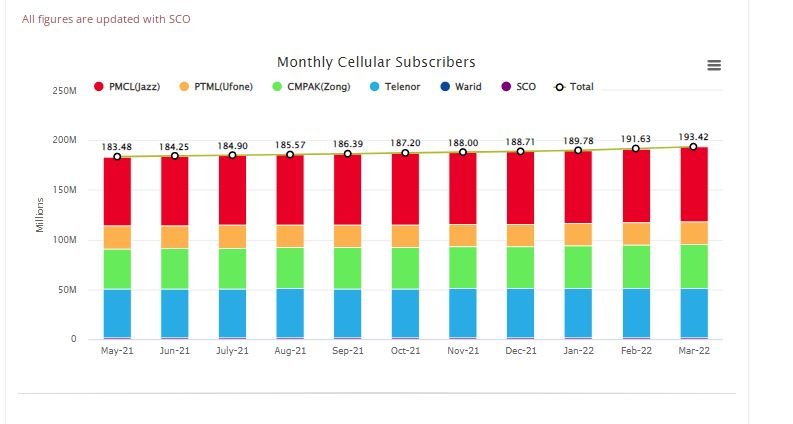
    By the end of March 2022, the number of mobile users in Pakistan had risen by 1.79 million to 193.42 million, up from 191.63 million at the end of February 2022. The cellular population climbed from 87.17 per cent in February 2022 to 87.95 per cent in March 2022.

    The entire teledensity had risen to 89.09 per cent, up from 88.31 per cent in February.

    The overall number of Jazz 3G users was 6.489 million at the end of March, down from 6.607 million at the end of February 2022, a fall of 0.118 million. By the end of March, the number of Jazz 4G users had risen from 35.822 million to 36.518 million.

    The number of Zong 3G customers fell from 3.501 million in February to 3.447 million in March, while the amount of 4G users increased from 27.483 million in February to 28.033 million in March.

    Telenor’s 3G users totaled 3.911 million at the end of March, which was the same as at the end of February. The graph, however, shows a downward trend. Its 4G subscribers increased from 20.801 million at the end of February to 21 million by the end of March 2022.

    Read more: Textile exports soared 25pc to $14.3b: PBS

    By the end of March, there were 3.809 million Ufone 3G users, up from 3.873 million at the end of February. Ufone’s 4G user base expanded from 8.099 million in February to 8.6 million by the end of March 2022, a 0.501 million growth in the time period under consideration.

  • Enjoy high-speed internet while travelling along Makran Coastal Highway, NH 10

    The Universal Service Fund (USF) has announced that high-speed internet is installed at National Highway-10 (NH 10) Makran Coastal Highway and National Highway-25 (NH 25) Uthal to Quetta Highway.

    USF Pakistan tweeted that: ” USF in partnership with Ufone continues to make progress in National Highway-10 (NH 10) Makran Coastal Highway and NH 25 Uthal to Quetta Highway. Computers are now reaping benefit from high-speed broadband over 640 Kilometre of road segment covering areas of Kech, Awaran, Gwadar, and Lasbella district.”

    Makran Coastal Highway stretches to 653 Kilometres (Km). The road also covers the Arabian sea coast of Pakistan from Karachi in Sindhi to Gawadar in Balochistan and passes through Omara and Pasni.

    Along with the Ministry of Information and Technology (MoIT) and Pakistan Telecommunications Limited (PTCL), the USF Pakistan has installed 85 kilometres of optic Fiber cable to connect nine unserved Tehsils in North Waziristan and South Waziristan.

    The Optical Fiber cable is going to provide high-speed broadband connectivity to regions like Spinwam, Wana, ToiKhulla, Jandola, Sarwakai, Sararogha, and Barwand Tehsil.

    Last week, The board approved contracts to Jazz — Pakistan Mobile Communications Limited (PMCL), Zong — China Mobile Pakistan (CMPAK), and Ufone — Pakistan Telecom Mobile Limited (PTML), for the provision of next-generation internet.

  • Jazz, Ufone, Zong to provide next-gen internet in remote areas of Balochistan, Sindh

    Government has given an approval to private companies for the provision of high-speed internet in the under-served areas of Balochistan and Sindh.

    The Federal Secretary of Ministry of Information technology (MoIT), Shoaib Ahmed Siddiqui chaired the 73rd board of directors meeting regarding Universal Service Fund earlier this week.

    The board approved contracts to Jazz — Pakistan Mobile Communications Limited (PMCL), Zong — China Mobile Pakistan (CMPAK), and Ufone — Pakistan Telecom Mobile Limited (PTML), for the provision of next-generation internet.

    Jazz Telecom has been awarded the contract of Ghotki, Zong is going to work in Jaffarabad, Sohbatpur, and Nasirabad district under the contract. In contrast, Ufone is being awarded the agreement of the Ziarat and Kalat region. The worth of this Sustainable Development Projects is Rs. 895 million in total.

    According to MoIT, Jazz is going to provide high-speed internet to about 2 million citizens residing in Ghotki, Sukkur, and Khairpur district. The approximate area that is going to be covered is 23,252 square kilometres.

    Similarly, under the contract, Zong is going to offer a high-speed broadband connection to 0.4 million people living in the Jaffarabad, Sohbatpur, and Nasirabad district. The approximate area covered via this contract is 3,431 square kilometres.

    Ufone will serve a speedy Broadband connection to a population of 17,406 in the Ziarat and Kalat region of Baluchistan. According to the contract, the telecom company is going to cover approximately 64 square kilometres.

    Other officials that attended the meeting are Maj Gen Amir Azeem Bajwa, the chairman of PTA, NITB CEO Shabahat Ali Shah, Telenor Pakistan CEO Irfan Wahab, PTCL CEO Rashid Khan and Consumer Association of Pakistan Chairperson Kaukab Iqbal.

  • Pakistan becomes first country in South East Asia to conduct successful 5G test

    Pakistan becomes first country in South East Asia to conduct successful 5G test

    Pakistan has become the first country in South East Asia to conduct a successful 5G network test, Dunya News has reported.

    According to the reports, Chinese telecom company Zong conducted the test on Pakistan’s Independence Day (August 14), paving way for a new digital revolution in the country.

    5G is the fifth generation of cellular network technology with 10 times faster data download and upload speeds as compared to 4G, with wider coverage and more stable connections.

    The network’s home router speed has been recorded as four 4 gigabytes (GB) per second, which means that with 5G you can download a 50 GB file in just two minutes.

    It is estimated that 5G technology will bring industrial opportunities worth $1.2 trillion to South Asia and South East Asia over the next five years.

    Pakistan Telecommunication Authority (PTA) had in June, invited applications for 5G wireless network trials in the country and presented the framework for test and development of future technologies.