Category: Business

The most important business news, explained in a young, easy to understand way. News that affects young career professionals.

  • ADB approves loan to help Pakistan deal with climate change

    ADB approves loan to help Pakistan deal with climate change

    The Asian Development Bank (ADB) has approved a $500 million policy-based loan to help Pakistan tackle climate change and improve disaster risk reduction and resilience.

    “The Climate and Disaster Resilience Enhancement Program (CDREP) will strengthen Pakistan’s institutional capacity for planning, preparedness, and response; increase inclusive investment in disaster risk reduction and climate resilience; and support the scale-up of disaster risk financing using a risk-layered approach,” ADB said.

    Besides funding for CDERP, the bank also approved a $1 million technical assistance grant for Pakistan to support the implementation of the programme.

    The ADB highlighted that Pakistan is one of the most vulnerable countries in Asia and the Pacific to climate change and natural disasters, with annual disaster-related losses averaging over $2 billion.

    “This program builds on ADB’s longstanding work in Pakistan to understand and reduce climate and disaster risks and support effective disaster response,” said ADB Director General Yevgeniy Zhukov.

    “We are proud to support an integrated and comprehensive approach to climate and disaster risk management, including a portfolio of disaster risk financing instruments for timely and adequate funding for disaster response.”

    The CDREP helps improve disaster risk mapping and modelling to guide investment and development decisions. It also boosts coordination for disaster monitoring and response.

    “It supports enhanced planning and prioritization of gender-sensitive and resilient public investments, including integrated flood risk management and nature-based solutions,” ADB said.

    It also helps raise climate finance from public and private sources, including the launch of a domestic green sukuk.

    “A key innovation of the program is the use of ADB’s Contingent Disaster Financing option for the first time in the Central and West Asia region. This will provide quick disbursing budget support in the event of a disaster,” the lender said.

    Furthermore, the programme will establish a solidarity fund to encourage the adoption of risk transfer solutions, such as agricultural insurance. It will also provide shock-responsive social protection to deliver cash assistance during disasters.

  • Can trade with India guide Pakistan out of the darkness?

    Can trade with India guide Pakistan out of the darkness?

    Independent power producers and business owners in the pharmaceutical industry worriedly watched the developments of the World Bank meetings on Sunday. This is because, during the IMF and World Bank meetings, Finance Minister Muhammad Aurangzeb stressed the importance of trade links with India.

    Pakistan is a net importer of power and pharmaceutical products, which ensures that businesses operating in these fields face little local competition. But if Islamabad lifts the red tape on trade with New Delhi, the Wagha-Attari border is bound to see major truck movement. This is because India is a net exporter of power and pharmaceuticals – which Pakistan could buy.

    If trade is to open up, importers in Pakistan might become inclined to purchase medicines from India as opposed to the United States – which is extremely far away compared to India. This is likely to reduce shipping times from 44 days down to under a day in optimal conditions. Due to reduced travel times and costs, there might be an increase in the import value of pharmaceutical products – a figure that stood at $1.38 billion in 2022.

    The Pakistani pharmaceutical industry saw a 15.3 per cent growth in 2023, with more growth projected for the near future. However, if trade restrictions are reduced, the current growth levels of the pharmaceutical sector could take a serious hit. This will be due to the world-class quality of the medicines of the well-established Indian pharmaceutical industry.

    Fewer restrictions on trade with India are likely to spell bad news for local pharmaceutical companies as the introduction of extra competition flooding the market with low-price medicine will reduce both growth rates and profit margins.

    Additionally, with Pakistan importing over $13 million in electricity in 2023, the possibility of importing Indian electricity is an attractive one. This is because India could offer more competitive rates on their electricity than our current trading partner, Iran.

    Moreover, if India is to sign power deals with Pakistan at beneficial rates, independent power producers might sense danger, too. This is due to the fact that earlier this month, five of them were let go as Islamabad terminated their contracts.

    However, if trade is to open up, it will significantly contribute towards a welfare increase for citizens. This is because consumers will have a wider variety of goods to choose from in addition to lower prices.

    Local businesses, however, will also have to reduce their prices accordingly if they want to ensure that a steady stream of customers purchase their products.

    A few local industries might be able to capitalize on normalizing trade relations with India. These could be the sports and cement industries. With Indian cement exports falling over 65 per cent from 2015-2022 to meet domestic demand, Pakistan’s cement industry could step in and capitalize on Indian demand.

    Most importantly, on a macro level, the normalization of trade and restoration of Pak-India relations will likely result in a great deal of prosperity for Pakistan. This is because the economic binding and strengthening of trade links between the two nations will reduce the political tensions – and the resources that are expended on said tensions.

    With Aurangzeb’s mindset on achieving economic prosperity, the main question on everyone’s minds is whether this plan will ever come to fruition. The answer can only be found with time.

  • Exchange rates: Rupee closes at Rs277.68 against US dollar

    Exchange rates: Rupee closes at Rs277.68 against US dollar

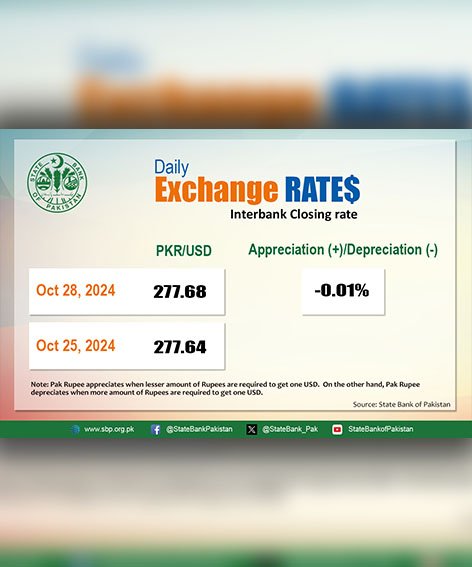
    The Pakistani rupee (PKR) recorded a marginal decline against the US dollar, depreciating 0.01 per cent in the interbank market on Monday.

    According to the State Bank of Pakistan (SBP), PKR wrapped up first trading day of the week at Rs277.68 after experiencing a loss of four paisa versus the greenback.

    SBP exchange rate: USD to PKR

    During the current fiscal year, Pakistani currency has gone up by 66 paisa or 0.24 per cent against the dollar. While it has appreciated more than Rs4 or 1.51 per cent so far this calendar year.

    During the previous week, PKR weakened marginally as it depreciated three paisa or 0.01 per cent against the US dollar.

    The dollar index has climbed 3.6 per cent to 104.49 during October, its sharpest monthly rise in more than two years.

    In the open market, local money exchangers quoted the American currency at Rs278.62 for selling and Rs276.75 for buying.

    As compared to other foreign currencies, the home unit remained largely stable despite minor fluctuations.

    Currency Change (Paisa) Change (%) Today’s rate (PKR) Last close (PKR)
    Euro 62.43 0.21 per cent 299.97 300.59
    Japanese Yen 1.64 0.90 per cent 1.8105 1.8269
    British Pound 14.39 0.04 per cent 360.06 360.20
    Chinese Yuan 2.85 0.07 per cent 38.95 38.98
    Saudi Riyal 1.82 0.02 per cent 73.94 73.96
    UAE Dirham 1.07 0.01 per cent 75.60 75.61
    Swiss Franc 36.12 0.11 per cent 320.00 320.36
    Exchange rates

    Against the Pound, PKR appreciated 14.39 paisa or 0.04 per cent and closed at Rs360.06.

    PKR increased 62.43 paisa or 0.21 per cent against the Euro, closing at Rs299.97.

    The local unit was reported 36.12 paisa or 0.11 per cent up against Swiss franc to end the session at Rs320.

    Pakistani currency fell by 1.07 paisa or 0.01 per cent against the UAE Dirham to close at Rs75.60.

    PKR’s value against the Japanese Yen rose 1.64 paisa or 0.90 per cent to close the day at Rs1.8105.

    The local unit increased 2.85 paisa or 0.07 per cent against Chinese Yuan to close at Rs38.95.

    The local currency shed 1.82 paisa or 0.02 per cent against Saudi Riyal to Rs73.94.

  • Textile manufacturers unhappy as government policy threatens 18 billion dollar export sector

    Textile manufacturers unhappy as government policy threatens 18 billion dollar export sector

    Textile exporters expressed great displeasure over the government’s decision to stop the supply of natural gas to their power plants. Islamabad’s decision puts the USD 18 billion textile export industry at risk by leaving it to function on the national power grid.

    While the motivations are not entirely clear, experts believe that by cutting the gas supply to these independent power plants, the government is trying to increase its power supply revenues. This is because these power producers operate outside of the national grid, which makes it a tough activity to tax and regulate.

    For business owners in the textile sector, reverting to the national grid is a huge setback. This is due to the unreliability of the distribution companies that are infamous for power outages and fluctuations. While fluctuations might not be an alarming issue in residential areas, for the textile industry, they can render expensive machinery useless.

    This is primarily the reason why many textile manufacturers banded together to set up these independent power plants, as they were a stable source of power. However, with the government’s metaphorical axe coming down on these power plants, textile business owners will have no choice but to comply.

    Moreover, as per the Pakistan Textile Exporters Association (PTEA), the national grid will result in higher production costs due to transmission and distribution losses – inefficiencies the grid is known for.

    For exporters, this spells bad news as a rise in production costs will result in a loss in the competitive edge that Pakistan’s textiles have in international markets. This is because Pakistani textiles will not be as attractive to competitors due to the higher price tag when compared to other countries offering the same product for less.

    With Pakistani textile company Keywin Trading Ltd and other local players signing USD 40 million worth of agreements with Chinese firms at TEXPO 2024 (Textile Expo), the decision to cut gas supply to independent power plants comes at a bad time.

    This is primarily because, aside from switching to the costlier national grid, textile manufacturers have no real alternative to turn to anymore. Exporters who lose out on international contracts due to higher prices might have to shut their factories down and lay off thousands of workers.

    Is the crusade against these power plants even worth it if it means that the textile sector gets caught in the crossfire? Before anyone jumps to answer this question, perhaps it is best to note that the textile sector is singlehandedly responsible for 60% of the country’s exports.

  • BYD Seal EV launched in Pakistan with starting price of Rs14.79 million

    BYD Seal EV launched in Pakistan with starting price of Rs14.79 million

    BYD, a leading electric vehicle (EV) company, has introduced its new models, the Seal and Atto 3, in Pakistan, according to PakWheels.

    In Pakistan, the BYD Seal’s Dynamic model is priced at Rs14.79 million (ex-showroom), while the BYD Atto 3 Advance model is available at Rs8.9 million.

    The BYD Seal comes with a powerful 82.56 kWh battery, providing an impressive range of up to 650 km. The car also uses BYD’s signature Blade Battery, which powers the four-wheel-drive version to go from 0 to 100 km/h in just 5.9 seconds.

    For added convenience, the Seal’s high-speed charging allows it to go from 30 per cent to 80 per cent charge in about 30 minutes. The performance variant of the Seal can accelerate from 0 to 100 km/h in just 3.8 seconds, according to BYD’s official website.

    The BYD Atto 3 comes with a 49.92 kWh battery and has a range of 410 km. It can accelerate from 0 to 100 km/h in 7.9 seconds and also includes the Blade Battery, allowing it to charge from 30 per cent to 80 per cent in half an hour.

    Last year, BYD sold over 412,000 units of the Yuan Plus EV – known as the Atto 3 in global markets – with around 100,000 of these being exported. This means the Atto 3 made up 42 per cent of BYD’s total car exports last year.

  • Bullish trend persists: PSX closes just under 90,000 points amid strong investor confidence

    Bullish trend persists: PSX closes just under 90,000 points amid strong investor confidence

    Traders on the floor of the Pakistan Stock Exchange (PSX) rode on a wave of joy today as they witnessed the market break yet another record.

    During day trading, the KSE-100 index crossed the 90,000 mark for the first time ever, and it stayed that way until the trading day was about to close.

    At the end of the trading day, however, KSE-100, the benchmark of the PSX that includes the top 100 companies, settled at a respectable 89,993.96 points. This is a huge leap of 1,047.98 points, which translates into a 1.16 per cent increase from when the market opened.

    The ALLSHR (All Share) Index, which tracks the performance of all companies listed on the PSX, did really well, too. ALLSHR gained 495.83 points throughout the day, which is 0.86 per cent from the time it opened, to close at an impressive 57,461.53 points.

    While all indexes were in the green, the KSE-30 index, which focuses on the top 30 companies listed on the exchange, performed the best by closing at a remarkable 28,395.15 points. KSE-30 had gone up by 352.45 points at closing time, which is a massive 1.24 per cent increase in the index value.

    The driving factor behind this bullish trend is a rise in investor confidence. Investors in the market are making large gains due to the hot streak PSX has been for a while now.

    This enthusiasm has attracted foreign investors, as the percentage of all shares held by foreign investors jumped from 14.49 per cent at the start of the month to 15.22 per cent currently.

    It’s a great time for the market and a great opportunity for those looking to invest in Pakistan’s financial future. Can the bullish trend continue? It certainly is possible, but only time will tell.

  • What Punjab’s 182 billion rupee missed IMF target means for local businesses

    What Punjab’s 182 billion rupee missed IMF target means for local businesses

    Business owners in Punjab are preparing for tough times ahead as the provincial government of Punjab missed the budget surplus goal set by the International Monetary Fund (IMF) for this quarter by a staggering 182 billion rupees. Not meeting the IMF stipulated objectives might foster bad will as international lenders will be weary of extending loans to Pakistan in the future.

    Suppose lawmakers in Islamabad direct Punjab’s provincial government to meet the budget surplus goal at any cost. In that case, it will likely spell bad news for the businesses and people that call it home. This is because a budget surplus can be increased via either reducing government expenditure or levying higher taxes: Neither of which are optimal.

    While customs duties and corporate taxes remain under Islamabad’s control, the provincial government in Punjab has the authority to raise service and property taxes. This is likely to happen as the surplus goal for this quarter was missed by a margin of an uneasy 53%.

    According to Punjab’s Housing, Urban Development, and Public Health Engineering Department (HUDPHED), there were 1,680 approved construction companies in 2022, with many more operating unofficially without approval. If property taxes rise, the construction companies are expected to suffer as their clients will be stuck paying the higher taxes leaving less money for the owners of the companies.

    Moreover, an increase in services tax will cause businesses to lose out on either profits or customers. This is because businesses will have to make the tough decision of either absorbing the higher sales tax while holding prices constant or passing on the tax to their customers in the form of higher prices – which might turn customers away.

    If the government of Punjab decides to raise the surplus by decreasing its expenditures on projects, this will be bad news, too.

    This is because businesses that rely on public contracts will suddenly not be able to secure new contracts. And with the provincial government tightening its metaphorical belt, the employees of these businesses will be pushed to do the same too.

    This is because the loss of contracts might cause businesses to lay their employees off. The result of this decision can only be negative as laid-off workers will think twice before spending money, which will translate into a loss of sales for local businesses.

    While experts believe that following the conditions of the IMF is necessary, this discipline might stir up some issues for businesses. For now, all eyes are on the government of Punjab, and only time will tell what is to happen next.

  • Experts predict two per cent rate cut as inflation plummets to 44-month low

    Experts predict two per cent rate cut as inflation plummets to 44-month low

    Business owners look towards the State Bank of Pakistan (SBP) to cut interest rates yet again as the inflation rate reached a low of 6.9 per cent in September 2024. The interest rate is expected to fall around two per cent to 15.5 per cent – the lowest in around four years.

    The SBP, like other national central banks, uses the interest rate as a tool to control the inflation rate. With annual inflation rates touching 29.18 per cent in 2023, the SBP set an interest rate of 22 per cent to maintain skyrocketing price levels.

    With inflation rates touching a 44-month low, however, economic experts believe that the state bank will reduce the policy rate.

    Recently, inflation rates have been dropping steadily and September’s sharp decline of 28 per cent in the monthly inflation rate is proof of just that. This is certainly good news for businesses that have been affected by high inflation rates.

    This is because they had been suffering from having to pay extortionate “menu costs”. Menu cost refers to the expense a business has to pay to order new price tags, put up new billboards, and as the name suggests, print new menus.

    Aside from these costs, the previous year saw a slowdown in sales as customers experienced a “sticker shock” factor every time they found out that prices had increased. However, with inflation rates expected to fall to as low as six per cent in October, businesses are expected to recover even faster than last year’s surge in inflation.

    This expected drop in interest rates is likely to spell great news for businesses. This is because investors who had their money parked in savings accounts in banks will find it more profitable to invest in actual businesses.

    This will create a huge shift in funds from savings accounts to business projects.

    For reference, the average return to the sugar industry, considered to be extremely profitable, in 2023 was 18 per cent while interest rates sat at over 20%. A rational businessman would not forgo a risk-free return in favour of a risky investment that has a lower return.

    With interest rates projected to drop to 15.5 per cent, however, a shift in funds will likely be seen from banks to businesses.

    Moreover, the PSX (Pakistan Stock Exchange) has seen an incredible year, sitting at just under 89,000 points. Increased investor confidence is likely to continue with dropping interest rates as more money will pour into the stock exchange from banks.

    Aside from the increase in projected investment levels by external investors, business owners will probably be more inclined to finance projects using debt if interest rates drop. This is because they will know that they now have to pay much lower interest payments if they borrow money.

    Likewise, consumers might also take up these cheaper loans to buy items from businesses – increasing the sales of business owners. If SBP slashes interest rates, businesses are set to profit enormously.

  • Foreign exchange reserves surge $18 million in a week

    Foreign exchange reserves surge $18 million in a week

    Pakistan’s foreign exchange reserves have witnessed a slight increase of $18 million in one week.

    The latest data released by the State Bank of Pakistan (SBP) shows that this increase was witnessed in the week ending on October 18, which has pushed the central bank-held reserves to 11.04 billion.

    Total reserves held by the country dropped by more than $94 million to $16.02 billion on a weekly basis.

    The reason behind this reduction can be attributed to the commercial bank holdings, which dropped 2.20 per cent, or $112.2 million, to $4.98 billion in the week under review.

    This fiscal year, the reserves held by the SBP have increased approximately 34 per cent, or $2.82 billion.

    During the same period, the Pakistani rupee has remained largely unchanged against the US dollar, apart from minor gains and losses of a few paisas. 

    As of today, the PKR stands at Rs277.84 per US dollar, while one British Pound holds a value of Rs360 against the Pakistani currency.

  • Power play: Hope for businesses with 8.55 billion rupee reduction in bills

    Power play: Hope for businesses with 8.55 billion rupee reduction in bills

    Businesses and consumers prepare to celebrate as they may soon see a reduction in their utility bills of up to PKR 8.55 billion. This is because the Central Power Purchasing Agency-Guaranteed (CPPA-G) has proposed for Discos (electricity distribution companies) to decrease the per unit price of electricity by PKR 0.7.

    The lower cost of electricity will serve to greatly benefit households and industries, which consume 47 per cent and 28 per cent of the electricity used, respectively. Businesses in the cement, steel and textiles sectors stand to benefit in the form of higher profits, as they are large consumers of electricity.

    Textile exporters stand to benefit the most as their products will become more attractive to customers in international markets due to their lower prices. Textile exports already stand at an impressive USD 16.655 billion in 2023, with more to gain if the proposal goes through.

    While discos are to return this amount, this won’t be too tough on most of them as they are owned by the government directly. However, the owners of K-electric will not be too thrilled if the proposal is accepted, as it is privately owned, and it will reduce earnings due to the PKR 0.7 negative adjustment.

    For average households and above, this adjustment will reduce the monthly electricity bill by about PKR 150 to PKR 450, resulting in them having more money available. When this money is available to consumers, it will likely create more sales for the goods and services of local businesses.

    Aside from the negative adjustment charges, the coming of winter will also greatly reduce the average electricity bills, allowing local businesses to cash in on consumers having more money available.

    The reduced electricity bills are likely to help grow local businesses while also improving the overall standard of living for Pakistanis. However, businesses are experiencing uncertainty in decision-making with the constantly changing electricity tariffs and adjustment charges.

    While there is a negative adjust charge right now, many speculate that discos are likely to advocate for higher tariffs in the near future to recuperate any losses.

    Businesses are aware of this potential scheme and are weary of the constant changes in electricity, which is a major input in the production of most goods.