Category: Business

The most important business news, explained in a young, easy to understand way. News that affects young career professionals.

  • PSX closes at new record high of 86,466 points

    PSX closes at new record high of 86,466 points

    Pakistan Stock Exchange (PSX) opened Tuesday on a positive note and managed stay nearly 600 points up throughout the trading session.

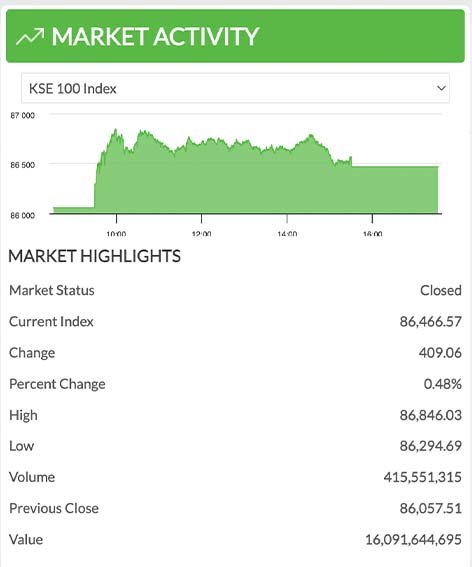
    The benchmark KSE-100 index was seen at its highest level during the day session when it surged to record peak of 86,846.03 points at 9:59 AM after rising by 788 points from its last close of 86,057. This occurred when the volume stood at 36,842,210.

    Interestingly, the lowest point PSX witnessed was also recorded at the opening hour, around 9:30 AM, when the stock market was seen at its lowest point for day, reaching 86,294.69.
    Pakistan Stock Exchange

    Still, throughout the day, the KSE-100 index managed to stay in in the positive territory and ended the second trading session of the week in green with a new record high of 86,466.57.

    The total volume of the KSE-100 index was 415.551 million shares.

    The PSX closed with a gain of 409 points or 0.48 per cent.

    Market summary Details
    Overall performance 63 companies closed up, 34 closed down, 3 were unchanged.
    Top gainers KEL (+13.41%), ATRL (+8.28%), SYS (+7.44%), CHCC (+6.03%), MEHT (+5.19%)
    Top decliners PAKT (-6.18%), PGLC (-5.41%), PIBTL (-4.40%), EPCL (-2.95%), YOUW (-2.42%)
    Index-point contributors (Up) SYS (+174.04 points), LUCK (+62.46 points), HUBC (+51.71 points), ATRL (+48.33 points), KEL (+44.48 points)
    Index-point contributors (Down) FFC (-108.64 points), PAKT (-29.07 points), PSO (-21.78 points), BAHL (-20.80 points), EFERT (-17.23 points)
  • Gold price in Pakistan increases Rs6,300 in a week

    Gold price in Pakistan increases Rs6,300 in a week

    Gold price in Pakistan witnessed an increase of Rs6,300 per tola within six trading sessions during the week ending on October 19, 2024.

    On a week-over-week basis, the price of 24-karat gold surged by Rs6,300, breaking all-time high record and ending the week at a new record high rate of Rs281,800 per tola as compared to its price recorded on October 12, when the yellow metal was priced at Rs275,500 per tola in the local gold market.

    A number of experts have attributed the latest surge in local and international gold prices to escalating tensions in the Middle East, along with uncertainties regarding US elections, coupled with relaxed monetary policy expectations.

    The latest increase in gold’s rate was witnessed on Saturday, when gold prices saw an increase of Rs900 per tola ad closed at new historic high.

    According to All-Pakistan Gems and Jewellers Sarafa Association (APGJSA), which shares gold prices on a daily basis, the ten-gramme gold also witnessed a single-day surge of Rs772, clocking in at Rs241,598.

    The recent surge in local gold rates comes after gold prices, in the international market, were seen at their highest level after rising by $9. As per APGJSA, the price of gold was recorded at $2,721 per ounce, including a premium of $20.

    Silver prices in the local market were also up for the second straight session. According to the associaton, silver rate was recorded about Rs50 up, settling the week at Rs3,150 per tola.

  • Cotton’s potential revival: Strong harvest drives 52 per cent increase in ginning factories

    Cotton’s potential revival: Strong harvest drives 52 per cent increase in ginning factories

    Cotton farmers breathed a sigh of relief as the final bale of their successful harvest was loaded onto trucks en route to the ginning factories. After a 48 per cent decline in cotton output from last year, the first fortnight of October recorded an 8.87 per cent increase compared to the same period last year, reigniting the hopes of many in the cotton industry.

    The cotton harvest crossed the one million bale mark compared to the same time last year. This increase in the yields, amounting to an extra 90 thousand bales of cotton, resulted in 184 ginning factories reopening. That is an incredible 52.27 per cent increase in the number of operational factories. The owners of these factories are set to benefit as the factories have gone from collecting dust to receiving cotton trucks.

    At these factories, cotton is cleaned and refined by separating it from impurities such as leaves, dirt and, most importantly, cotton seeds. These seeds are a major byproduct of the purification process and a source of profit for the factory. If farmers manage to increase yields, factory owners can count on getting more seeds with each additional deposit of raw cotton to the factory.

    The availability of these extra seeds will likely translate into an increase in the production of cottonseed oil and animal feed. This is going to spell good news for businesses involved in poultry as the increased supply of animal feed in the market will potentially result in lower feed prices for their hens.

    Due to lower cotton production levels earlier in the year, import deals to bring in approximately 3 million bales of raw cotton have been formalised. However, the cotton is still not on Pakistani shores.

    The wait times associated with the import of cotton by Pakistan from the United States, which sources most of Pakistani cotton imports, is a staggering 44 days. If this cotton was sourced internally from local farmers, however, this time could be cut down to just 2-3 days. Unfortunately though, farmers cannot currently scale up production to meet the domestic demand of cotton.

    If cotton farmers can continue to ramp up production, the business community will not be the sole beneficiary. Pakistan has been importing billions of dollars of cotton, recently being the 5th largest importer of the raw material in 2022. If local farmers can meet domestic demand, the economy will be spared a huge import bill, thereby reducing the balance of the trade deficit, which stood at a glaring $24.8 billion in FY 2023.

    October may mark the end of the woes faced by farmers this year. However, only time will tell if they can reach the level of production they enjoyed just a year prior.

  • Experts believe SBP has more room to cut policy rate as inflation declines

    Experts believe SBP has more room to cut policy rate as inflation declines

    The State Bank of Pakistan (SBP) is likely to reduce policy rate by 400 basis points this year, as a notable drop in the country’s inflation gives room for continued monetary easing to support economic growth.

    According to Topline Securities, inflation in Pakistan is expected to remain low in October but may rise a little on a monthly basis.

    The Consumer Price Index (CPI) for this month is estimated to stay between 6.5 per cent and 7.0 per cent year-on-year, with a 0.9 per cent rise month-on-month. This can bring the average inflation rate for first four months of FY25 to 8.6 per cent compared to 28.5 per cent during the same period in 2023.

    What experts are calling “the faster-than-expected ease in inflation” is largely because of the delays in raising administered electricity prices, somewhat favourable global oil and food prices, and a stable Pakistani rupee.

    Recent estimates suggest headline inflation will drop from 23.4 per cent in FY24 to around 9 per cent in FY25. In response to this trend, the SBP has already cut its policy rate by 450 basis points, lowering it to 17.5 per cent in September from 22 per cent in May 2024.

    Read more: Gold hits historic peak of Rs280,900 per tola in Pakistan

    To note, inflation in the previous month crashed to its lowest level in nearly four years, with consumer prices rising by 6.9 per cent year-on-year, within the central bank’s target range of 5-7 per cent. However, economic growth remains modest.

    The Gross Domestic Product (GDP) rose 2.5 per cent in FY24, after a contraction the previous year, but this is still below the long-term average growth rate.

  • Reko Diq to possibly secure $4.5 billion in loans and investments

    Reko Diq to possibly secure $4.5 billion in loans and investments

    Bilateral sources line up to extend loans totalling USD 4.5 billion to Pakistan for the Reko Diq mining operation. Business owners surrounding the mining facility prepare to celebrate as the influx of funds will serve to promote business activity in the region.

    The greatest potential lender is the EXIM (Export-Import) Bank of the United States, which is interested in lending USD 1.5 billion to the Reko Diq mining operation.

    Other lenders like the World Bank, Asian Development Bank and bilateral sources like Canada, Japan, and Germany, among many others also expressed their interest in the project by offering to pitch in the combined value of three billion dollars in loans.

    The inflow of foreign investments and loans is bound to improve the transportation infrastructure of the area around the extraction site – primarily roads. Saudi Arabia has already offered to invest USD 150 million in infrastructure as part of the Saudi investment package into Reko Diq, which has still not been accepted by Pakistan.

    The new roads that will get paved for transporting gold and copper out of the mines will also be used by local businesses to move goods from warehouses to stores. Travel times and costs will witness a drop, helping businesses in the area improve their supply chain.

    This will also make the area around Reko Diq more accessible to tourists and travellers, which will rake in more traffic. With the increase in visitors, local shops, restaurants, rest stops, and other businesses will have the chance to attract more customers.

    Moreover, foreign investments will bring foreign workers to the mining zone who will need housing, food, and other services. New businesses could spring up to meet these needs, which will likely create jobs and reduce the current unemployment rate of 9.13 per cent, which is second only to Kashmir.

    The Government of Balochistan owns a 25 per cent stake in the mining operation. If the loans flow in, Balochistan’s economy will likely see an improvement along with the businesses that call it home.

  • Iran-Pakistan trade talks could yield sugar exporters a 500 million dollar sweet deal

    Iran-Pakistan trade talks could yield sugar exporters a 500 million dollar sweet deal

    Businessmen across Pakistan watched the developments of the meeting between Iran’s Minister of Trade, Mohammad Atabak, and Pakistan’s Commerce Minister, Jam Kamal Khan.

    The meeting ended with an agreement to remove the existing barriers to trade that could greatly increase trade and business activities on both sides of the border.

    The meeting in Islamabad sparked hope for future trade with Iran as the delegation from Tehran invited Pakistan to attend further talks regarding the improvement of economic ties.

    Pakistani sugar exporters would benefit enormously if talks between Islamabad and Tehran led to trade deals. This is because Iran currently spends over half a billion dollars annually to meet its sugar demand – a potential market for Pakistani exporters.

    This is prime time for sugar producers to capture lucrative export deals as the ECC (Economic Coordination Committee) has already directed banks to facilitate the export of an additional half a million tons of sugar.

    Currently, Iran imports sugar from as far away as Belgium and Brazil, a process that can take a staggering 40 days. The Pakistani market, however, could supply sugar to Iran within just 3-4 days due to the fact that the two countries are neighbours. 

    Pakistani businessmen in the agricultural sector will also reap a lot from this potential partnership, just like sugar producers. That’s because in 2023 alone, Pakistan imported nearly half a billion dollars worth of fertilisers, and Iran is a net exporter, so a trade deal between the two neighbours is possible.

    If realised, the import of Iranian fertilisers is likely to drive down fertiliser prices locally, which would benefit farmers. The lower production costs would help increase profitability for farmers and could also make Pakistani agricultural exports even more competitive than they already are in the global market.

    Perhaps the most exciting possibility, however, is the potential for the export of Iranian petroleum to Pakistan. With petrol prices sitting at an uneasy PKR 247 per litre, importing oil from Iran at special rates due to “special clauses” in trade deals could provide relief to both businesses and consumers.

    Atabak has extended an invitation to Jam Kamal Khan for further talks in Tehran, sparking speculation that a trade deal could soon become a reality, which would mark a major step forward in bilateral relations.

    If the discussions result in trade agreements, businesses from both nations will benefit. Industries and citizens are expected to enjoy lower costs and shorter delivery times for imports. The future could very well see Iranian fertilisers being used to grow Pakistani sugarcane, only for that same sugar to make its way back to Iran – a sweet cycle of trade.

  • Taxed for holding back: Banks face 197 billion rupee bill for avoiding private sector loans

    Taxed for holding back: Banks face 197 billion rupee bill for avoiding private sector loans

    Bankers across Pakistan grow uneasy as their pleas to get tax exemptions fall on deaf ears.

    The government, as per the conditions attached to the IMF loan, can not exempt banks from the “additional” tax of PKR 197 billion.

    The reason why banks find themselves in this situation is because of their excessive lending to the government. As per lending regulations, banks are not supposed to withhold loans from the private sector while extending credit to the government.

    To discourage this practice, the government introduced a tax rule in 2022 to encourage banks to increase the number of loans to the private sector. Three major banks alone face a staggering PKR 71 billion tax bill alongside other banks that did not comply with this rule.

    While lawmakers in Islamabad have expressed interest to relieve banks of these additional taxes, IMF rules have their hands tied. Earlier in the year, tax exemptions were in the works. However, Prime Minister Shehbaz Sharif scrapped the idea.

    Following the glaring silence and lack of action regarding the exemption of additional taxes, banks might now scramble to give out billions in loans to the private sector to avoid the tax.

    This spells great news for businesses who are seeking loans as the current situation will likely ease borrowing. With the two per cent State bank slash in interest rates last month and the possibility of future decreases, it seems like high time for businesses to start expanding using debt.

    The primary beneficiaries of the potential loans will most likely be small businesses. The reason behind this is their lack of assets to pledge as collateral to secure funding alongside the lack of good will that currently exists as a result of a non-existent credit history.

    Ultimately, though, through paying taxes or extending loans, the banks will have to contribute. Either way, the economy is likely to benefit – whether by reducing the federal budget deficit or by fueling business activity.

    The choice may not favour the banks, but the country is likely to benefit regardless.

  • Foreign currency deposits rise to nearly $6.7 billion in September

    Foreign currency deposits rise to nearly $6.7 billion in September

    Foreign currency deposits witnessed slight increase of $55 million, or 0.83 per cent, reaching $6.69 billion as of September 2024, according to the latest data released by the State Bank of Pakistan. 

    On an annual basis, deposits surged by $303 million, showing a 4.75 per cent rise. 

    The data shows that resident foreign currency deposits stood at $5.84 billion during the month under review, marking a 1.05 per cent increase from the previous month’s total of $5.78 billion. Compared to the same period last year, the rise was 4.15 per cent, up from deposits of $5.6 billion. 

    For those unaware, these deposits play a crucial role in financing Pakistan’s fiscal and external current account deficits. In September 2024, $647 million was utilised to support the country’s exports, while $1.38 billion went towards import financing.

    Read more: Gold price jumps to record high of Rs277,200 per tola

    Furthermore, $1.06 billion was placed with the SBP, with $84 million and $393 million held within Pakistani banks and abroad, respectively.

  • Blackboards to profit boards: Defunding public universities can save 61 billion rupees

    Blackboards to profit boards: Defunding public universities can save 61 billion rupees

    International lenders have informed lawmakers in Islamabad to defund public universities as part of the austerity measures of the new loan agreements. Businesses engaged in the provision of higher education are likely to eye these negotiations with great interest as they stand to benefit enormously if these measures are to be implemented by the government.

    If the Ministry of Finance makes this budget cut, large sums of money can be freed up for cash-strapped Pakistan. This is because the current budget to fund public universities stands at a staggering PKR 61 billion annually.

    While unpopular, the argument for budget cuts does have its merits: 80 per cent of public universities are expected to default in 3-4 years.

    Is it better to just cut losses and let the universities fend for themselves?

    International lenders certainly think so as they suggest that universities, after being defunded, should boost enrollment levels, fire unwanted staff and most importantly, increase tuition fees to stay afloat.

    In the absence of government funding, will these measures alone save public universities from going bankrupt?

    The provision of education is a multibillion-rupee business in Pakistan. Following these new developments, education businesses are preparing to mint money off of the wave of students that will likely come their way.

    If public universities are to implement fee hikes, students are likely to opt for private universities. This is due to the fact that private universities are more likely to possess better facilities than their public counterparts.

    Furthermore, if public universities start to default, private universities will get a further boost in enrollment levels, as students will be forced to switch institutions to continue their education. This migration of students from public to private universities will result in higher profit levels.

    This influx of students into these private institutions will serve to benefit their owners directly. However, the same cannot be said for students who will have to bear a higher cost to earn their degree. More concerningly, the closure of public universities might result in the monopolisation of the education sector as public institutions will cease to be valid alternatives.

    For now, all eyes are on the Ministry of Finance. Will public universities be defunded to appease international lenders, or will budget cuts be sought elsewhere?