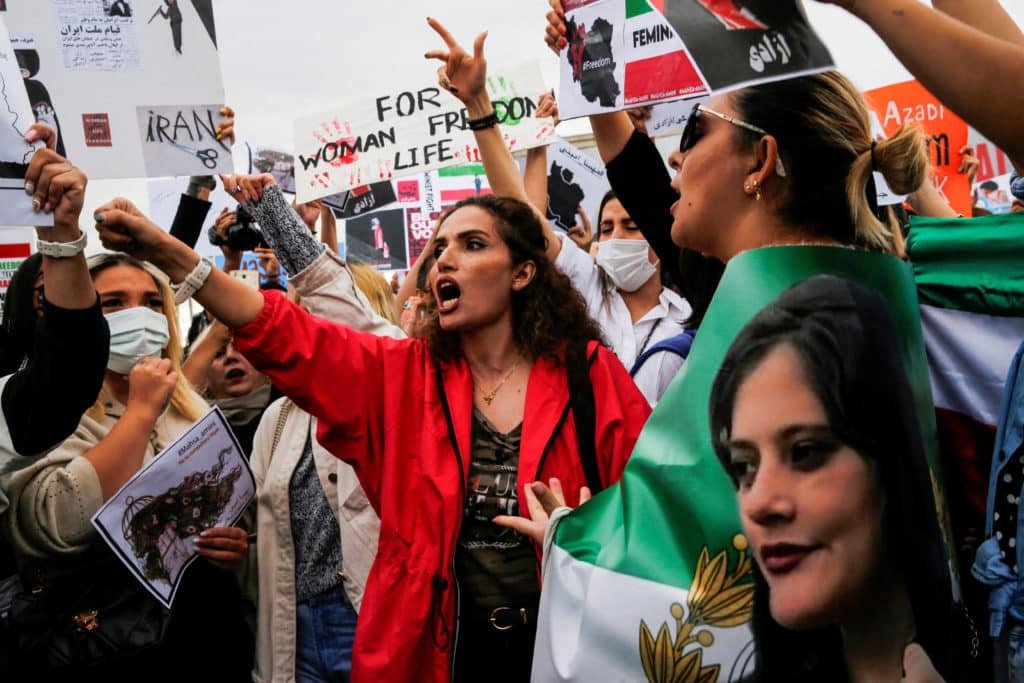
The police in Iran have announced a new measure to enforce the country’s mandatory dress code for women. Cameras will be installed in public areas and streets to identify and punish women who do not wear veils. Those who violate the dress code will be sent warning messages about the consequences of their actions. This move is an attempt to control the growing number of women who are choosing to not follow the compulsory dress code. The violators will receive “warning text messages as to the consequences”, said the police statement. The move is aimed at “preventing resistance against the hijab law”, it said.
Iran has seen widespread demonstrations since the September 16, 2022, death of 22-year old Mahsa Amini after she was arrested in Tehran. She was taken into custody for not wearing the hijab, thus, breaching Iran’s strict dress code for women.
Iran has an official law that requires females, including girls as young as seven years old, to wear a hijab. The law was introduced after the year 1979 and has resulted in approximately 40 million women and girls being under continuous observation.
A Kuwaiti media organisation has introduced a virtual news anchor created through AI, with plans in place to use it for presenting online news reports. The AI news anchor, named “Fedha”, was presented on Kuwait News website’s Twitter account.
The Kuwait News website is linked to the Kuwait Times, which was established in 1961 as the first English-language daily in the Gulf region. Abdullah Boftain, who serves as the deputy editor in chief for both outlets, has stated that the creation of the AI news anchor “Fedha” was an experiment to explore the possibilities of AI in delivering fresh and innovative content.
According to Abdullah Boftain, in the future, “Fedha” the AI news anchor could potentially use a Kuwaiti accent and read news reports on the Kuwait News website’s Twitter account. The account currently has 1.2 million followers.
“I’m Fedha, the first presenter in Kuwait who works with artificial intelligence at Kuwait News. What kind of news do you prefer? Let’s hear your opinions,” she said in Arabic
The use of artificial intelligence (AI) technology has become increasingly prevalent in a wide range of sectors, and it is anticipated that its impact will continue to expand in the near future.
The Dalai Lama has apologised for kissing a young boy on the lips and asking him to “suck his tongue” at a public event in India.
The incident happened on February 28 at the Dalai Lama’s temple in Dharamshala.
Video of the event show the recipient of the Nobel Peace Prize seated in a chair, while the unnamed youngster is standing in front of him, surrounded by numerous people.
The video shows the Dalai Lama kissing the youngster on the lips while holding the boy’s hand. The spiritual leader then places his forehead on the boy’s forehead and says, “And suck my tongue,” while sticking out his tongue.
“A video clip has been circulating that shows a recent meeting when a young boy who asked his Holiness, the Dalai Lama, if he could give him a hug,” said a statement from the leader’s Twitter account said.
“His Holiness wishes to apologise to the boy and his family, as well as his many friends across the world, for the hurt his words may have caused,” the statement read, adding that the spiritual leader “often teases people he meets in an innocent and playful way, even in public and before cameras. He regrets the incident”.
An imam was stabbed during Fajr prayers in Paterson, New Jersey, on Sunday, Geo has reported. The attacker was apprehended by worshippers present at the scene. The imam, Elnakib, is presently receiving medical treatment for a punctured lung and is in stable condition, as per local officials.
“Imam Sayed Elnakib was stabbed during the first prayer of the day, around 5:30am, at Omar Mosque in south Paterson while the congregation was kneeling for prayer,” said mosque spokesperson Abdul Hamdan. Reportedly, the individual accused of the attack was present among the 200 worshippers praying at the mosque on Sunday.
Mayor Andre Sayegh of New Jersey said that he paid a visit to the imam, who was in a better condition than before. Sayegh disclosed that Elnakib was receiving medical attention for a punctured lung, and that the attacker has been arrested, though the reason behind the attack is not yet evident.
A group of healthcare professionals have demanded that England’s Home Secretary Suella Braverman issue an apology to British Pakistanis for levelling baseless accusations of racism, Islamophobia and other falsehoods against them, endangering their safety in the UK, Murtaza Ali Shah has reported for Geo.
Several healthcare organizations, comprising a significant number of healthcare professionals from diverse backgrounds, have appealed to Prime Minister Rishi Sunak to acknowledge the unfounded and discriminatory accusations made by the Home Secretary, connecting Pakistanis to sexual grooming gangs, despite contradicting evidence from the government.
During an interview with Sky News last week, Braverman claimed that British Pakistani men were involved in child abuse rings or networks that specifically targeted vulnerable white English girls.
“(We see) a practice whereby vulnerable white English girls – sometimes in care, sometimes in challenging circumstances – being pursued, raped, drugged, and harmed by gangs of British Pakistani men, who work in child abuse rings or networks,” Braverman said while speaking to the news channel.
These professionals have cited a Home Office-commissioned report from 2020, which stated that “research has shown that white individuals are the most common perpetrators of group-based child sexual exploitation,” and that it could not be determined that any specific ethnic group was significantly overrepresented.
The letter further states, “We demand an apology from the Home Secretary and an honest commitment to meaningfully tackling this vital issue which has ruined the lives of thousands of young people. We must also remind the Home Secretary that words have consequences; in 2014, Boris Johnson’s comments on women in niqabs resembling letterboxes directly resulted in a 375% increase in hate crimes targeting Muslim women.”
“Language that empowers racist hate crime has no place in modern British society. We urge the Home Secretary to reflect on her grossly irresponsible framing of this complex and serious issue and commit to working with members from all communities to address the urgent issue of CSE together. A retraction of her statement and apology is sought.”
Earlier, Pakistan’s foreign office also criticised Suella Braverman for “discriminatory and xenophobic” comments.
The Ba-Ikhtiyar Naujawan Internship Program (BNIP) was established by the Ministry of Planning, Development, and Special Initiatives at the request of Prime Minister (PM) Shehbaz Sharif, to ensure Pakistani youth is economically empowered.
The program aims to provide 60,000 paid internships to recent graduates across Pakistan.
“Despite lengthy stints at educational institutes, gaps remain among Pakistan’s young graduates in terms of marketable skills and practical experience. This serves as a barrier to their entry in the job market and underlies their high unemployment rate. The Prime Minister’s Ba-Ikhtiyar Naujawan Internship Program is breaking these barriers for young graduates by equipping them with requisite skills through off-job and on-job training, and providing them with the work experience they require for entering the job market. Please create an account on this portal through the ‘Register’ feature, login to your personalised dashboard, and apply to internship opportunities available in various fields.”
Who is eligible for the program?
Graduates up to the age of 30 holding a Diploma, Bachelor’s degree, or higher from an HEC-recognized university or institution in Pakistan, or abroad are eligible to apply for BNIP internships.
Is the internship paid?
The monthly stipend for the internship is Rs25,000-40,000.
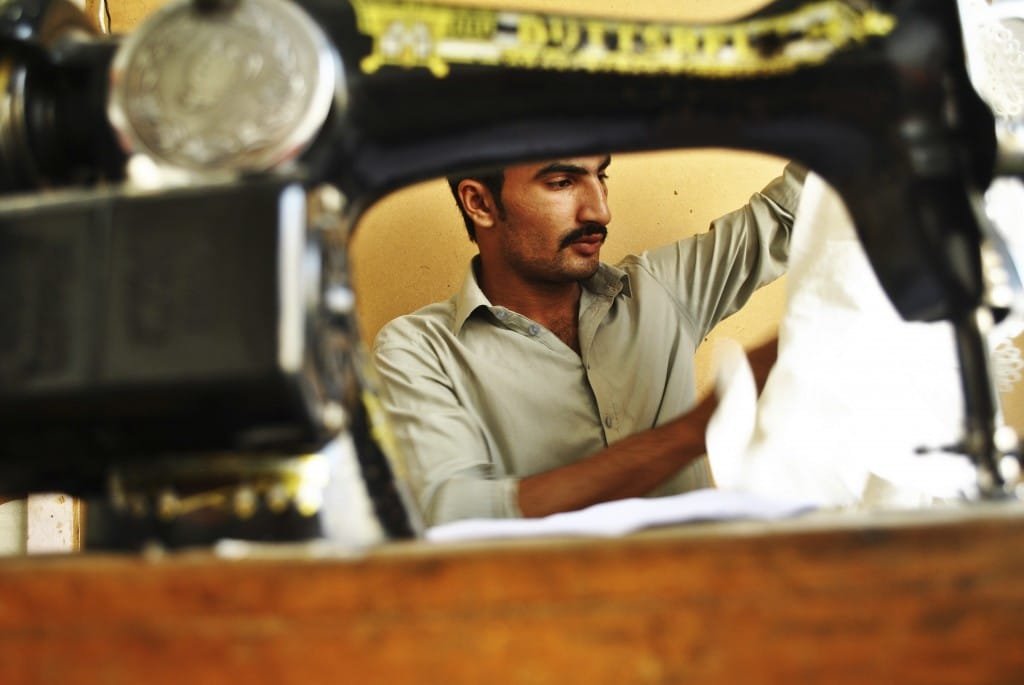
Twenty-five outfits were stolen from a tailor’s shop in a unique robbery case.
As per the details, the incident took place in Rahwali, Gujranwala.
The thieves entered the shop pretending to be customers and then held the tailor and his employees hostage at gunpoint.
Twenty-five outfits that were given to the tailor by various customers for stitching were stolen by the criminals. Additionally, they took away the employees’ cell phones before running away from the crime scene.
The shopkeeper has requested authorities to act quickly and bring the thieves to justice.
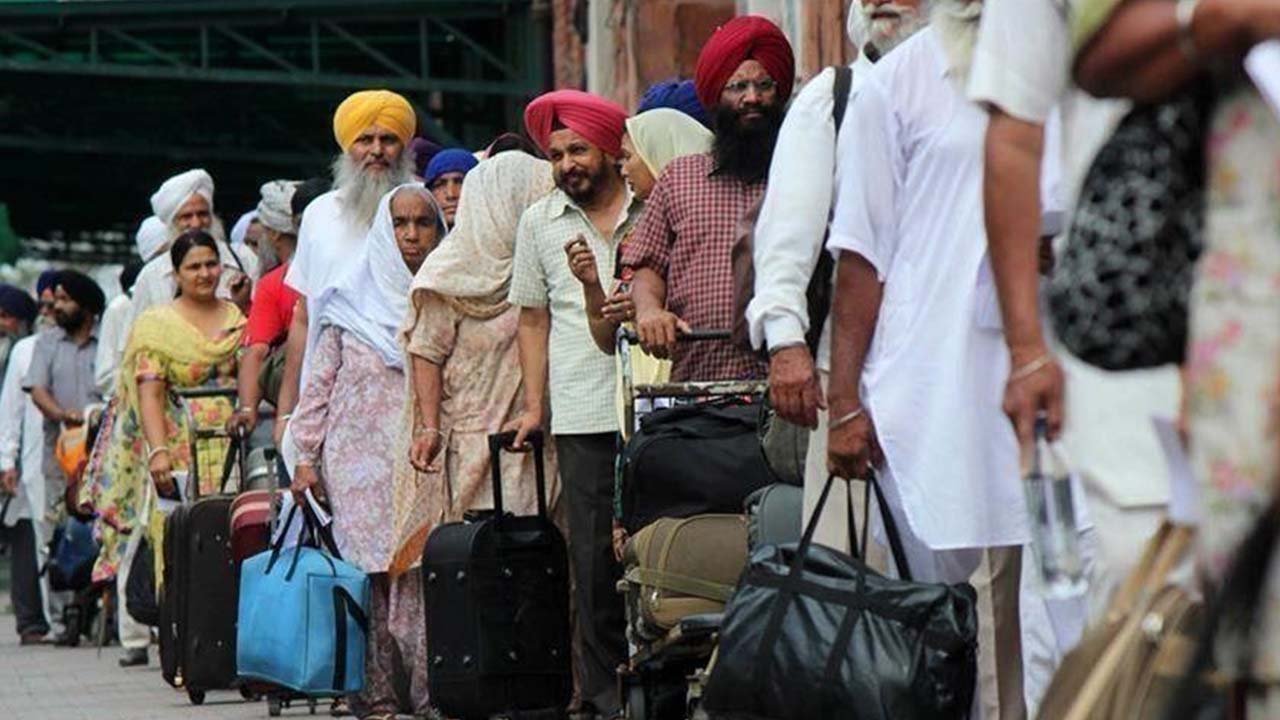
Pakistan’s High Commission in New Delhi has announced that it has issued 2,856 visas to Sikh pilgrims from India. The visas will allow the pilgrims to travel to Pakistan and participate in the annual Baisakhi festivities, which are set to take place from April 9-18, 2023. The issuance of these visas falls under the Pakistan-India Protocol on Visits to Religious Shrines of 1974.
Every year, many Sikh Yatrees from India travel to Pakistan to observe different religious festivals and occasions. The High Commission’s issuance of visas to these religious pilgrims is in accordance with the Pakistani government’s commitment to fully implement the Bilateral Protocol on Visits to Religious Shrines between the two countries.
Pakistan’s Charge d’Affaires, Salman Sharif, congratulated the pilgrims on the occasion and wished them a fulfilling journey. He added that Pakistan is dedicated to preserving sacred religious places and ensuring that visiting pilgrims are provided with necessary facilitation.
The pilgrims will visit several sites, including Dera Sahib, Panja Sahib, Nankana Sahib, and Kartarpur Sahib. They will arrive Pakistan on April 9 and return to India on April 18.
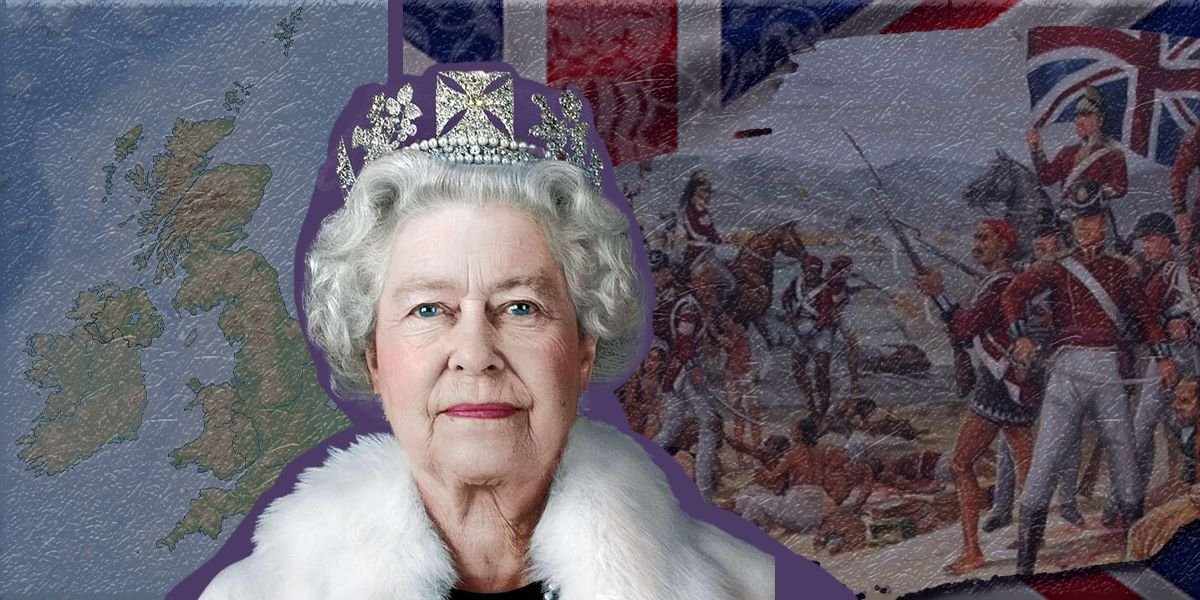
As part of their ‘Cost Of The Crown’ series, investigating the British Royal Family’s wealth and finances, The Guardian has extracted a 46 page report from the Indian government which provided details of jewelry and other precious items stolen by the colonial British Empire during their reign over the sub-continent. Most of the gifts were handed over as gifts to Queen Victoria, the reigning monarch at the time.
The investigation was commanded by the late Queen Elizabeth II’s grandmother, Queen Mary, to find out about the origins of her jewels.
The report details the names of the jewels as well as their colonial origins and how they were stolen by the East India Company.
1 Koh-i-Noor
The legendary diamond Koh-i-Noor was taken from Maharaja Ranjit Singh’s kitty. The ruler of Lahorr had signed a treaty of friendship with the British in 1831, and six years later the then Governer-General of India, George Eden, and his sister, Fanny, visited him at his palace. The Guardian writes that Fanny had later written about Singh’s diamond collection, detailing how he decorated his horses with the finest diamonds she had ever seen:
“If ever we are allowed to plunder this kingdom, I shall go straight to their stables.”
in 1849, Singh and his heir, Duleep, were forced to sign over Punjab to the British army, who stole all of his jewels as a part of their conquest, along with the Koh-i-Noor.
The diamond is part of the Imperial Collection, imbedded into Queen Elizabeth, the Queen Mother’s crown, worn by consorts.
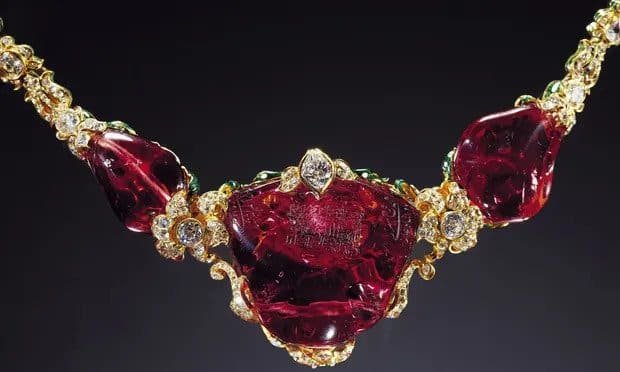
2 The Timur Ruby gemstone
Named after Timur, the founder of Timurind Empire in Central Asia, the gemstone is etched with the names of the five men who owned it: Jahangir (1569-1627), the 4th Mughal Emperor, Shah Jehan (1592-1666), the 5th Mughal Emperor, Farrukhsiyar (1685-1719), the 10th Mughal Emperor; Nader Shah (1688-1747), Shah of Iran; and Ahmad Shah Durrani (1722-1772), King of Afghanistan.
By 1813, the gemstone was under the possession of Maharaja Ranjit Singh, who ruled over the Sikh Empire, and later was passed down to his heir Maharaja Sher Singh. From there, the necklace was inherited by his brother Duleep Singh, who became Maharaja when he was only five years old.
During 1948- 49, when the British Empire waged wars over the Sikh Empire, the East India Company took over Punjab and forced the then ten-year-old Maharaja to hand over his possessions. Duleep Singh was placed under a Scottish guardian, isolated from contacting his fellow countrymen.
3 Pearl necklace
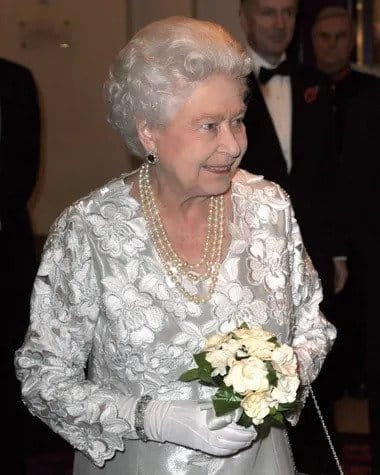
Comprising of 244 pearls and a clasp of two magnificent rubies, the necklace had originally belonged to a ruler in Punjab, until it was stolen by the British. Queen Elizabeth II was spotted wearing this necklace at the Royal Opera House in London to celebrate her diamond jubilee.
4 Emerald girdle of Maharaja Sher Singh
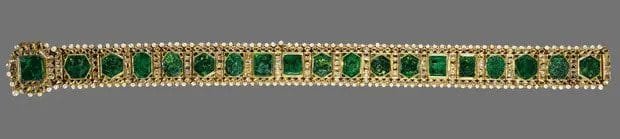
The gold girdle inlaid with 19 emeralds first came to the public’s attention during Buckingham Palace’s celebration of Prince Charles’ 70th birthday, with a display of his favorite pieces from the royal collection. The item had previously belonged to an Indian Maharaja, Sher Singh, who used it to decorate his precious horses.
A 13-year-old boy in India has committed suicide after a barber cut his hair extremely short.
As per Indian media news reports, the incident took place in Indian state Maharashtra.
The boy committed suicide by jumping from the window of a bathroom.
Media reports state that the boy was unhappy about his hair being cut short and not according to what he wanted. His parents tried to calm him down but the boy remained unsatisfied.
The boy went to the bathroom and allegedly jumped out of the windo when all the family members of his family had gone to sleep.