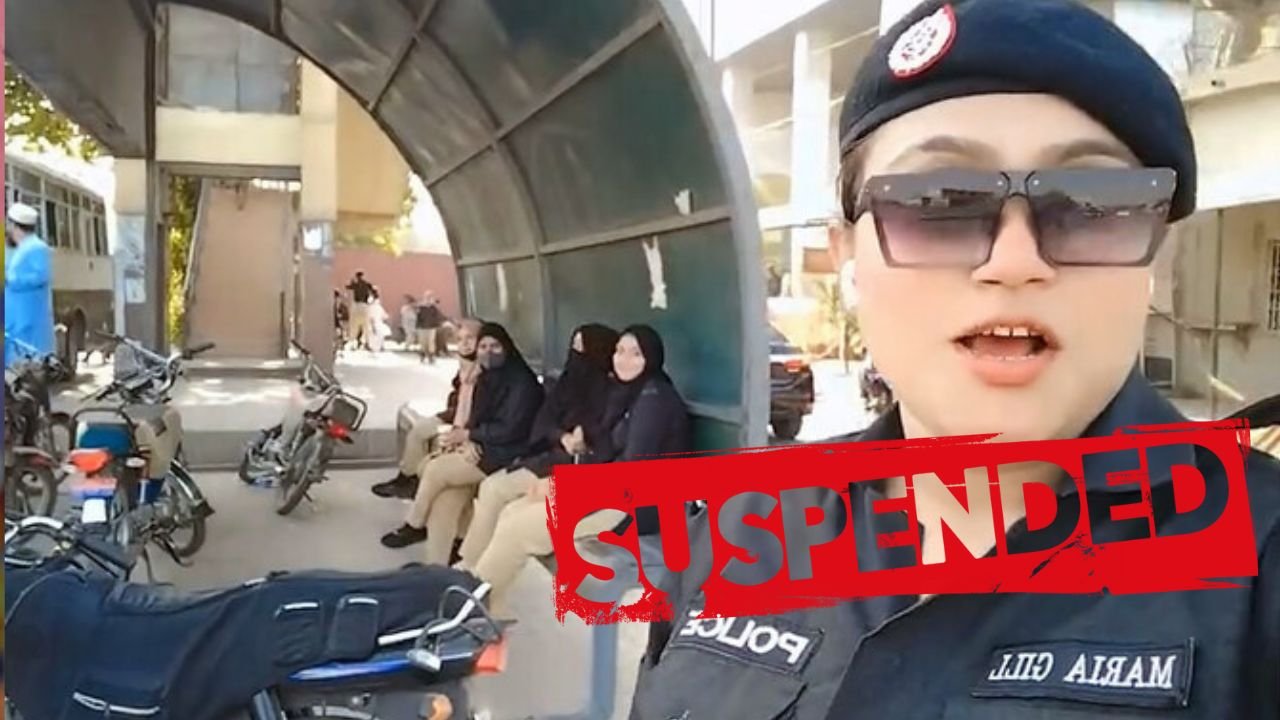
A female police officer in Karachi was suspended for posting a TikTok video while on duty, revealing her team’s location, Sindh Police has said in a notification.
Police Constable (PC) Maria Gill was posted at the Gizri Police Station District South, Karachi.
The police notification said that she was suspended immediately “due to improper and irresponsible behaviour towards the performance of official duties at place of deployment, leading to negligence and dereliction of duty.” Dawn reported.
In the video, Maria addressed her followers on TikTok by saying, “Hello guys, Assalamoalikum. Today, I am posted for duty at the Mai Kolachi Road outside Bahria College.
“As you can see, there’s a heavy police presence here,” she says while pointing towards four other police officers seated at a bus stop. To this, one of them waved at the camera. “Whoever wants to meet me, you can come here and meet me. I am posted on duty here today,” she said while saying goodbye.
The notification said that Gill would undergo a counselling session by Station House Officer Women South Zone. She would also be shifted to Police Headquarters South Zone, where she would have to “attend daily roll call/parade.” However, it mentioned that Maria will be able to draw pay and allowances as “admissible under the rules”.
The Lahore Board has announced the 12th class results on September 4th at 10:00 AM. Students can check their results online Here.
You can find your BISE Lahore Intermediate Part II Result 2024 on the board’s official website. The board usually posts this online after they announce the results. You can search for your roll number or name in the Gazette to check your result.
Sweden’s Public Health Agency told parents on Monday that toddlers should not be allowed to watch screens at all. Children under the age of two should be kept away from digital media and television.
Kids between the ages of two and five should be limited to a maximum of one hour of screen time a day, it said in new recommendations, while those aged six to 12 should spend no more than an hour or two a day in front of a screen.
Teenagers aged 13 to 18 should be limited to two to three hours per day, the agency said. “For too long, smartphones and other screens have been allowed to enter every aspect of our children’s lives,” Public Health Minister Jakob Forssmed told reporters.
The minister said that Swedish teens aged 13 to 16 spend six and a half hours a day on average in front of their screens, outside of school hours. Forssmed said that didn’t leave “a lot of time for communal activities, physical activity or adequate sleep”, and lamented a Swedish “sleep crisis” noting that more than half of 15-year-olds did not get enough sleep.
The health agency also recommended that kids not use screens before going to bed and that phones and tablets be kept out of the bedroom at night.
It cited research showing that excessive screen use can lead to poor sleep, depression and body dissatisfaction. Sweden’s government has previously said it is looking at a ban on smartphones in primary schools.
The Pakistan Telecommunication Authority (PTA) will begin suspending mobile SIMs of users with expired Computerised National Identity Cards (CNIC).
PTA has also started the second phase of its operation to stop the illegal use of SIM cards across the country.
A statement issued by the PTA on Monday read, “Those whose ID cards expired before 2017 and have not been renewed will have their SIMs suspended. ” The statement also urged users to renew their ID cards to avoid blocking their SIMs.
Results from the first phase
Notably, the PTA blocked fake SIMs and cancelled the CNICs during the first phase of the operation.
“Since August 16, more than 69,000 illegal SIMs have been blocked,” the statement read, adding that the illegal SIMs are being blocked based on data obtained from the National Database and Registration Authority (NADRA).
Goals for the third phase
PTA will terminate SIMs registered in the name of deceased persons during the third phase.
Awareness messages were sent to users before the blocking of mobile SIMs, asking them to update relevant data.
PTA, however, maintains that fake SIMs are being used in various illegal activities, including terrorism, financial fraud and other scams.
Blocking illegal URLs
The authorities have blocked more than 363,000 URLs in the category of illegal content in the last three and a half years.
From January 2021 to June 2024, defamatory or impersonating content had the lowest blocking rate. Social media platforms blocked 307,610 of these URLs. The overall blocking rate was 84.72%.
Blocking URLs involved in contempt of court
The PTA is taking action on 2,480 URLs related to contempt of court, and social media platforms blocked 1,496. The blocking rate is 60.32 per cent.
The rate of blocking content against security and defence is slightly higher.
Blocking un-Islamic content
The rate of blocking un-Islamic content is also high, with action taken against 46,103 URLs and 37,479 blocked.
34,673 URLs were examined, and 28,922 were blocked for sectarianism and hate speech content.
Blocking proxy-related content
The unethical category has documented the highest blocking rate, with 158,054 URLs examined and 152,646 blocked. Its content blocking rate is 96.46 per cent, with all 51 URLs related to proxy content blocked.
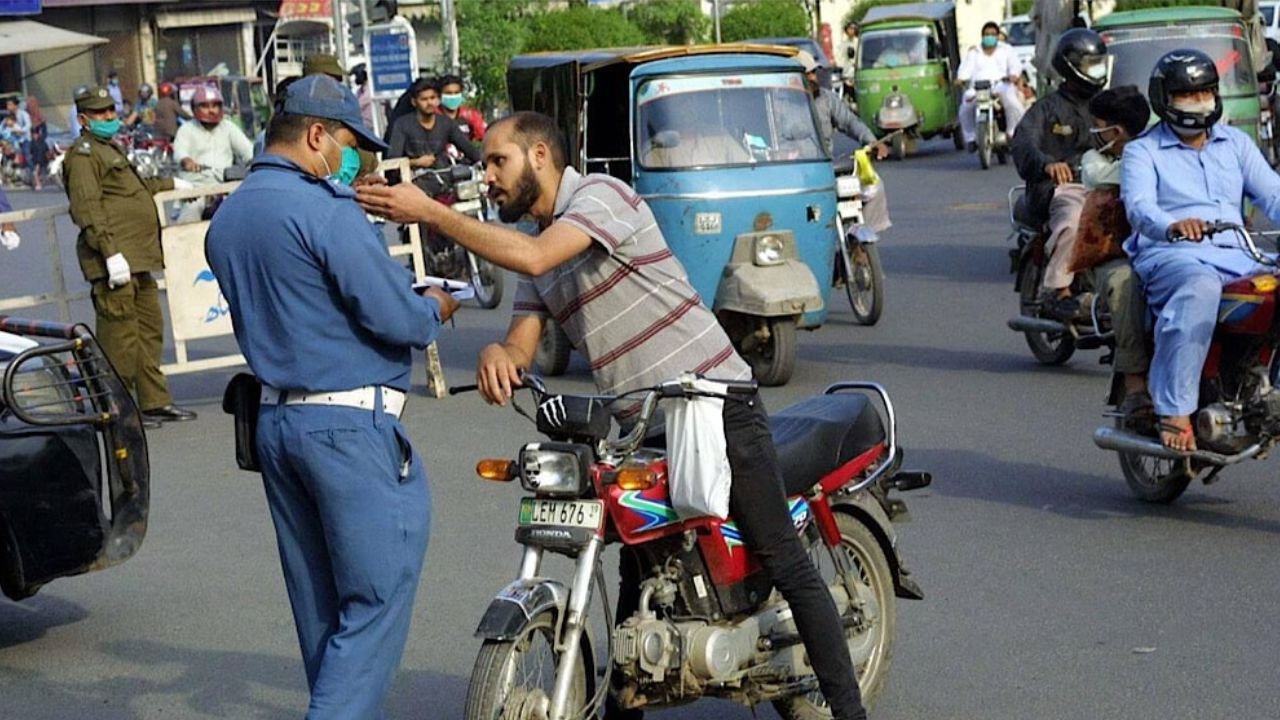
Karachi traffic police have extracted Rs1.2 billion from citizens as fines over different traffic violations during the past one year, official data reveals.
3.5 million worth of tickets issued per day
Over the past year, from July 1, 2023, to the end of July 2024, over two million Karachiites were issued tickets, and the total fine stood at Rs1,294,886,450—which is around Rs3.5 million per day.
Fines of 100 million are yet to be paid
Of the total Rs1.2bn fine amount, citizens have paid Rs1.19bn, while 114,142 traffic rule violators have yet to pay over Rs100m in fines.
This year alone, from January to July, traffic police issued 992,576 challans, which amount to Rs699,813,650 (over Rs699m).
While incumbent Sindh Inspector General of Police Ghulam Nabi Memon have time and again made it clear that the traffic police were not a revenue-generating agency, the huge number of fines and challan amount shows that this might not be the case as traffic police is entitled to 30 per cent of the challan’s total amount and the remaining 70 percent goes to the provincial government. This means the traffic cops could get a Rs360m share from the Rs1.2bn amount.
On the contrary, DIG-Traffic Ahmed Nawaz Cheema said that the traffic police had not been paid their “due amount” for the past four to five years.
“Of the 30 percent amount, 15 percent is for [cash] rewards for traffic police officers, while the remaining amount is for the procurement of equipment,” he said.
He said that it was a clear policy of the IGP-Sindh and Karachi police chief Javed Odho that the traffic police should mainly issue challans for moving traffic violations like wrong-way, one-way driving, violation of traffic lights, vehicles without number plates, etc.
He claimed that, after the IGP’s direction, the traffic challan rate had dropped to one-third of what it was before his fresh stint.
District-wise details
District East tops the chart with a fine amounting to Rs240,260,100 (over Rs240m) against 357,374 tickets, followed by District West with a fine worth Rs224,790,700 (over Rs224m) against 309,170 tickets and District Malir Rs207,635,350 (over Rs207m) against 317,310 tickets.
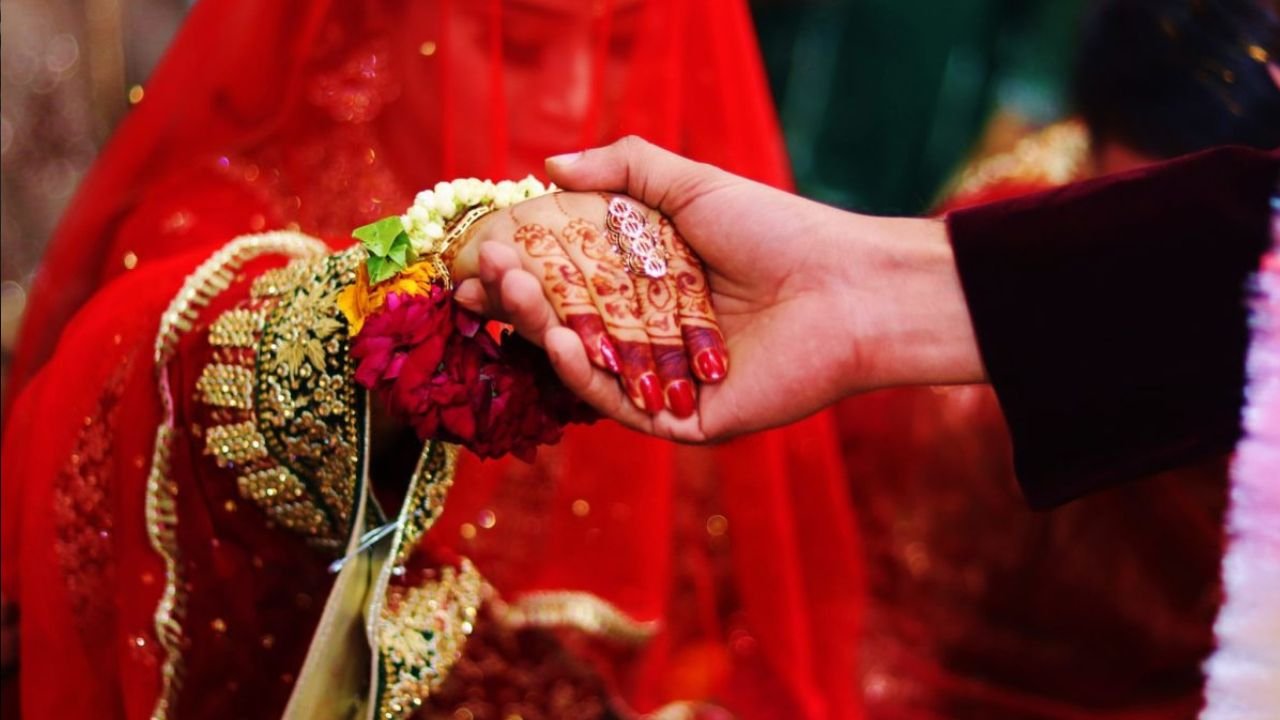
Gallup Pakistan, an opinion poll agency, has released a new survey on marital status in the country.
The survey was conducted via telephone from June 28 to July 10, and 755 men and women from all four provinces participated.
Four out of every five Pakistanis, i.e. 80 per cent, are married, while 20 per cent are unmarried.
The rate of married Pakistanis is higher among women and the rural population, with the rate of married women being 12 per cent higher than that of men.
75 per cent of urban and 83 per cent of rural women were identified as married.
Notably, in the survey, 56 per cent of Pakistanis aged 30 and 96 per cent of Pakistanis above 50 said they were married.
As for the duration of marriages, 30 per cent have been married for five to 10 years, 17 per cent fall between two to five years, 17 per cent were married for 10 to 15 years, and 13 per cent have been together for more than 25 years of marriage.
IPSOS Pakistan has revealed the details of downward trend of confidence of Pakistanis over the government despite some positive indicators.
IPSOS, a multinational market research and consulting firm, has surveyed more than 1,000 people from across the country.
Difficulty in buying basic essentials
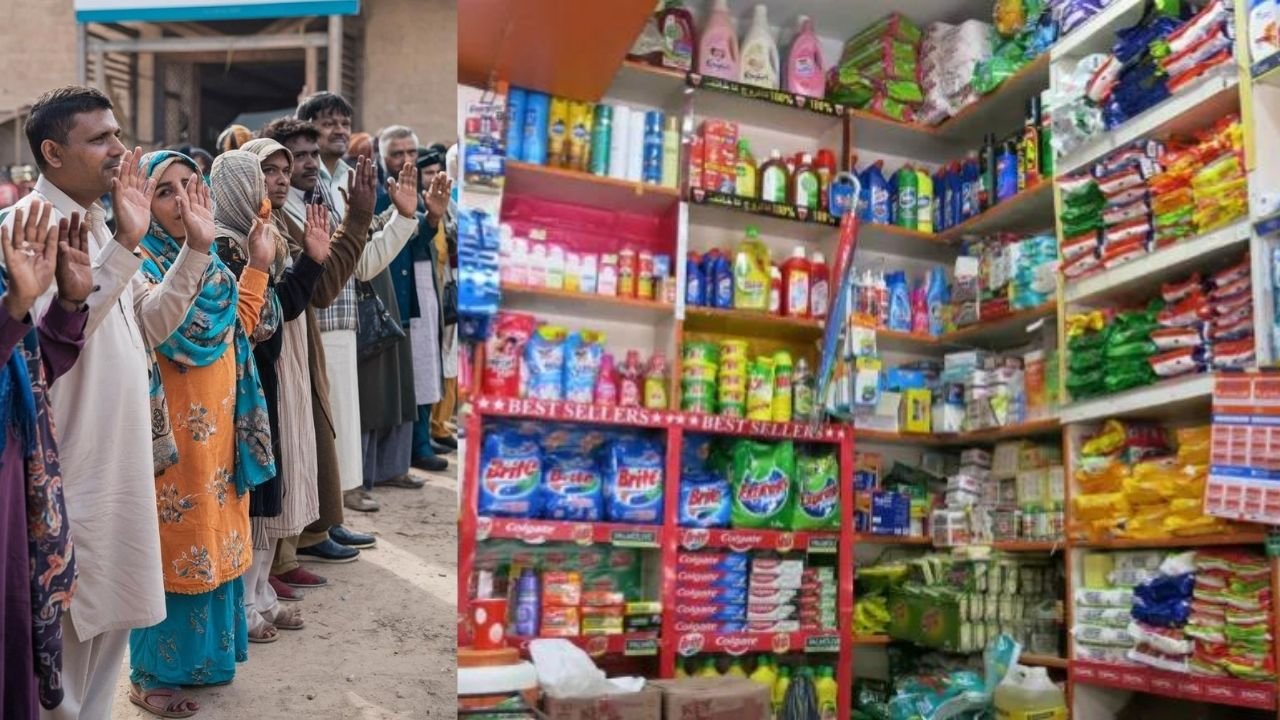
The rate of Pakistanis who said they had difficulties in purchasing household items for daily use rose to 94 percent after a 4 percent increase, while the rate of Pakistanis who said they had no ability to save was seen at 90 percent after a five percent increase.
The number of people who said the economy is strong was seen at 13 percent after a decrease of three percent, while the number of those who said the economic situation was weak increased by one percent. 69 percent people expressed concern about the economic situation. However, 17 percent said there was no difference.
Disappointment with the future
The survey also noted a considerable increase in the percentage of people disappointed with the economic future. The rate of pessimistic Pakistanis increased by 19 percent and 70 percent expressed thay the economic situation would remain weak in the next six weeks.
A ten percent decrease was seen in the percentage of Pakistanis optimistic about the improvement of the economy. On the other hand, 18 percent of people said that there was no difference.
Hopes of improvement
IPSOS also asked Pakistanis about their views on the improvement in their financial conditions in the next six months, to which an increase of 19 percent was seen in the percentage of people who said that their financial conditions were getting weaker and 67 percent said that there would be no improvement.
While the number of optimistic Pakistanis about the improvement in financial conditions was also seen at 13 percent after a 15 percent decrease. However, 20 percent said that there would be no difference.
Saving up money
The percentage of Pakistanis who expressed their inability to save money also increased by five percent to 90 percent.
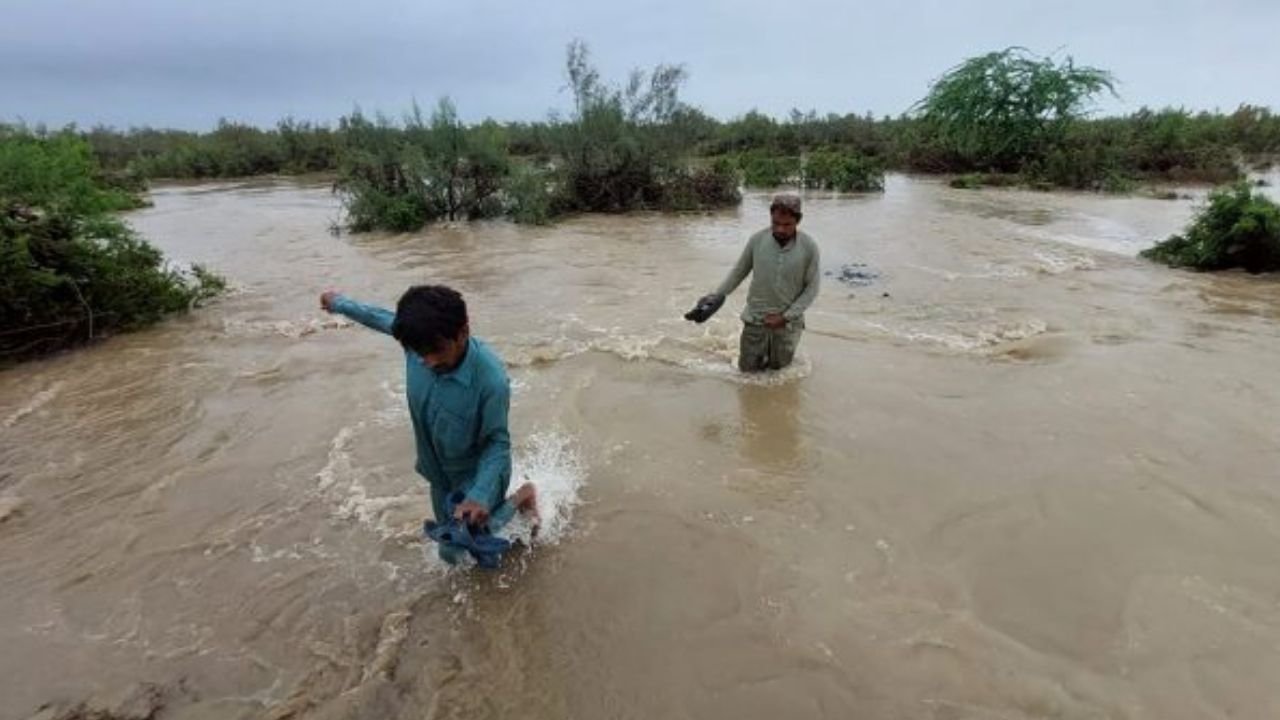
Torrential rains are wreaking havoc across Balochistan, with at least 29 people killed and 15 injured in the province, ARY News reported, quoting the Provincial Disaster Management Authority (PDMA).
The monsoon season, which started on July 1, has caused widespread damage to infrastructure and crops in Balochistan, says a PDMA report.
Rainfall has caused damage to several houses, with 858 completely destroyed and 13896 partially damaged.
In addition to the loss of life and property, the rains have also caused significant damage to 58799 acres of crops and 41 kilometres of roads.
The PDMA report also stated that seven bridges have been damaged, while 373 animals have died due to the heavy rains.
A gas pipeline also washed away due to flood in Mutch area of Balochistan after which gas supply was suspended in many areas including Quetta.
An 18-inch gas pipeline in Mach has been affected by the flood, informed the spokesperson of Sui Southern Gas.
The supply of gas to various areas including Quetta, Mastung, Kalat, Pishin and Ziarat has been suspended due to the gas pipeline being affected, reports Geo News.
The spokesman said that the repair of the affected gas pipeline will be started after security clearance.
The Inter Boards Coordination Commission (IBCC) announced that from the next academic year passing marks will be increased from 33 to 40.
Addressing a press conference at his office, IBCC Executive Director Dr Ghulam Ali Mallah also announced the decision to grant grace marks to students in exams as part of an educational reform initiative.
While talking to ARY News, Mallah said that seven grace marks would be awarded to students, and the board has also decided to go forward with the idea of the same paper from all across the board. “The passing marks will be increased from 33 to 40 for the next academic year. The commission has also decided to shift from an open-choice exam format to a close-choice format, offering 100 per cent options to students.”
Upon inquiry regarding the execution of this plan, Dr Mallah said that this will be done by the end of this year in December.
He also said that a policy is being developed to bring “uniformity” to the paper-making system across the 29 boards in the country.
He said that a sub-committee meeting at the Karachi Secondary Education Board deliberated on different proposals and concluded that all educational boards in the country would now be required to provide seven passing marks.
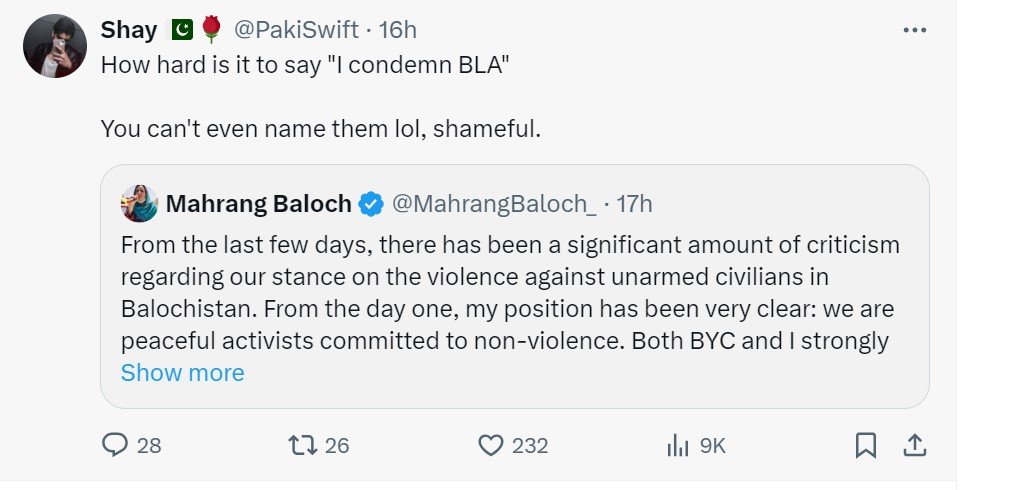
Days after the deadly Sunday militant attacks in Balochistan, social media called on Baloch human rights activists to condemn the senseless and horrific violence committed against innocent people on August 26.
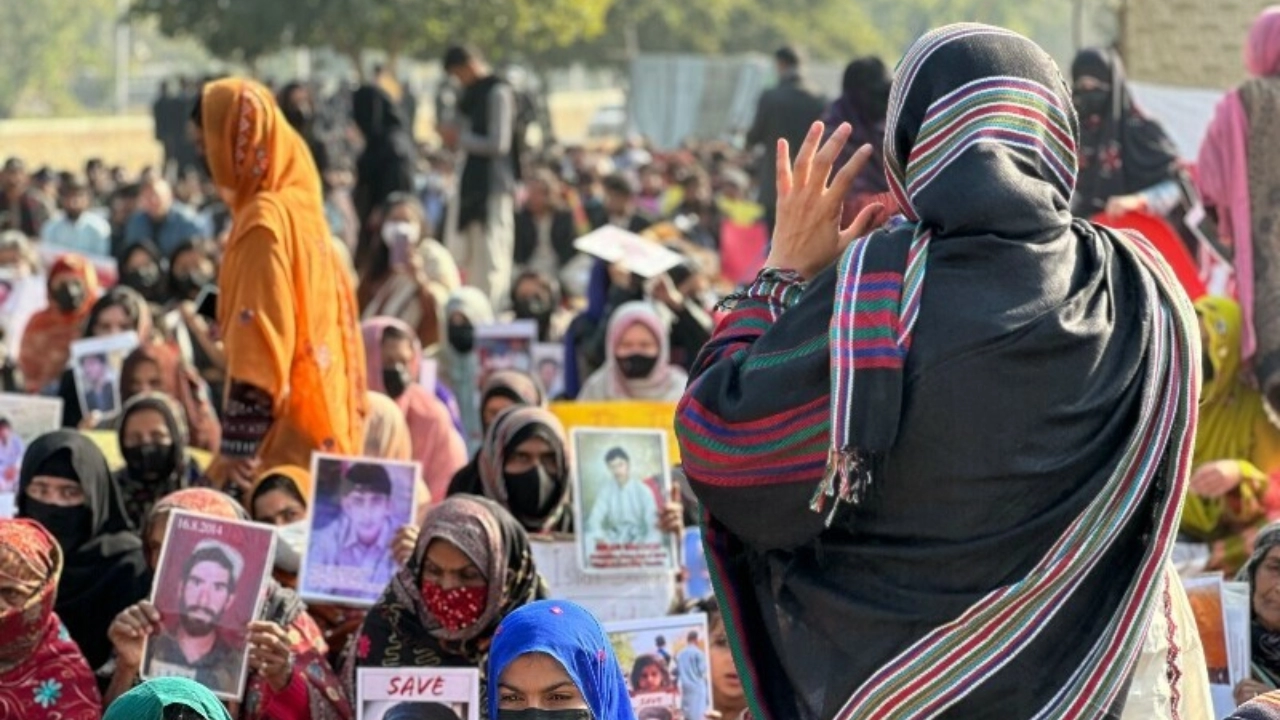
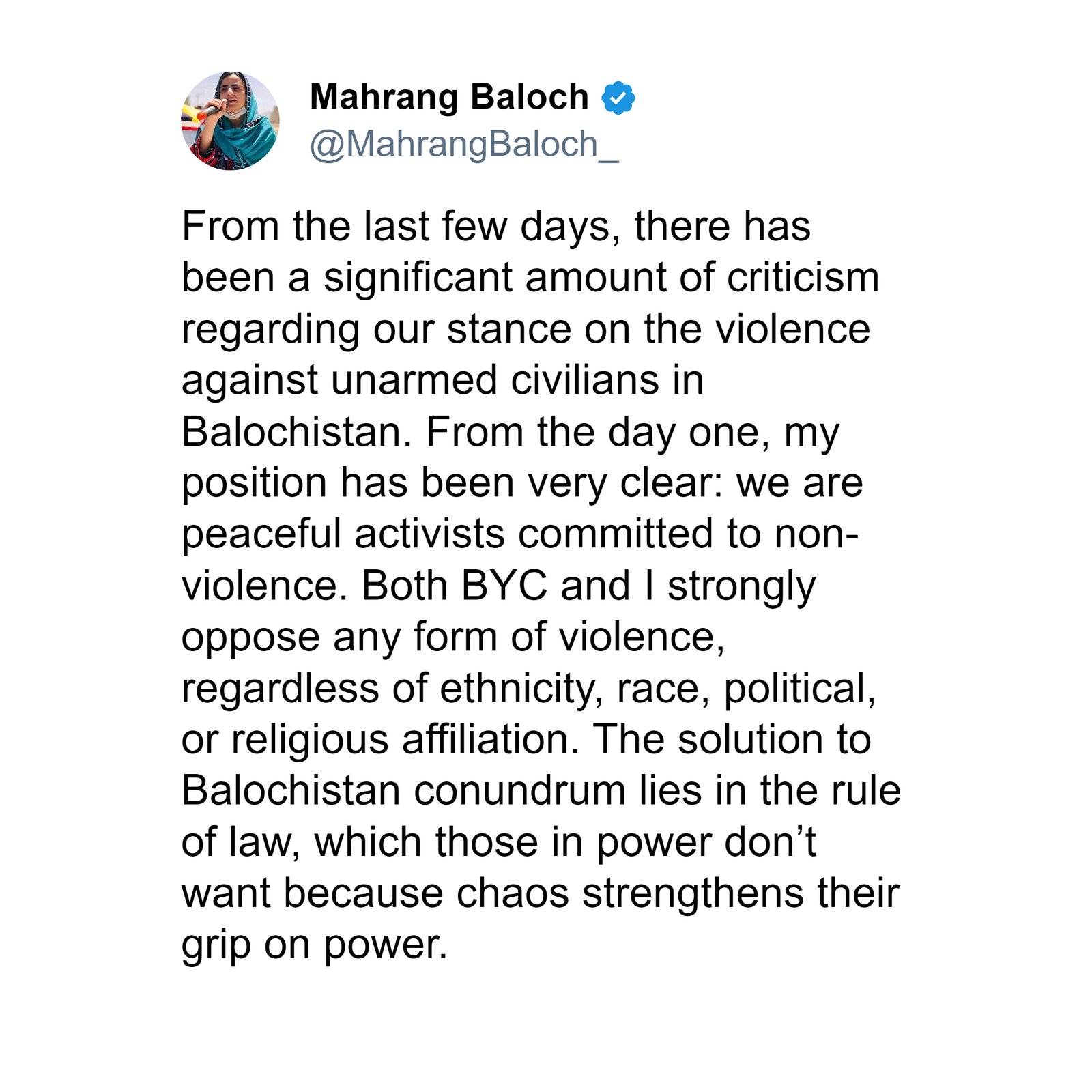
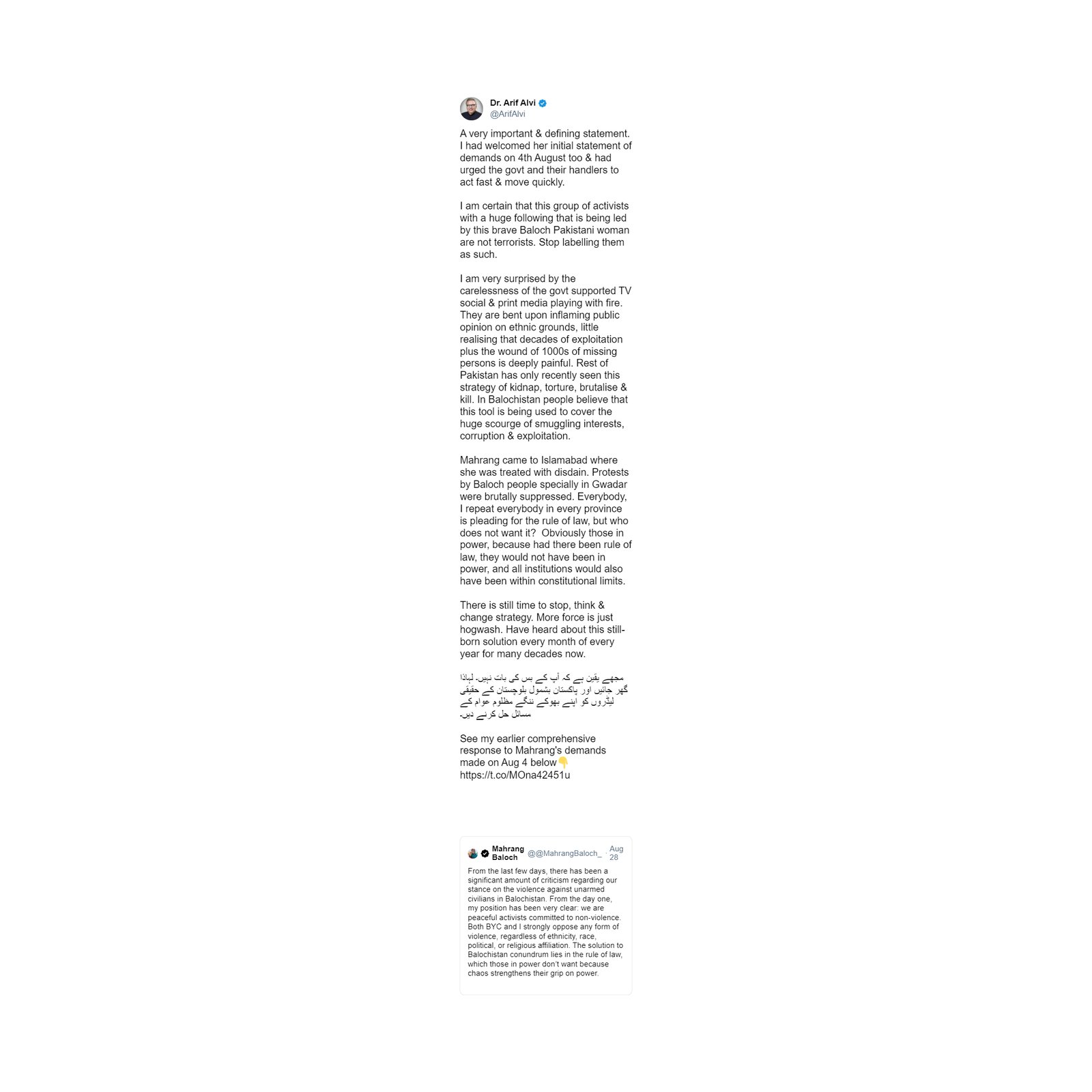
Mahrang Baloch, the chief organiser of the human rights movement Baloch Yakjehti Committee (BYC), took to social media to announce that she “opposes any form of violence, regardless of ethnicity, race, political, or religious affiliation.”
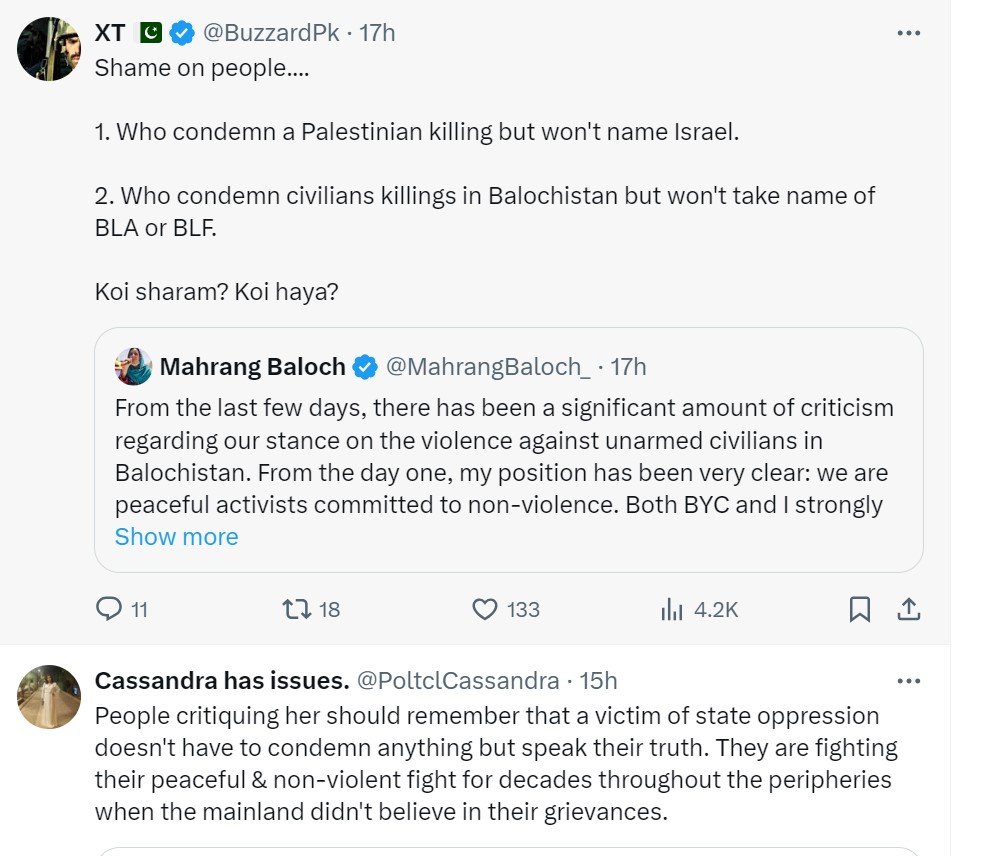
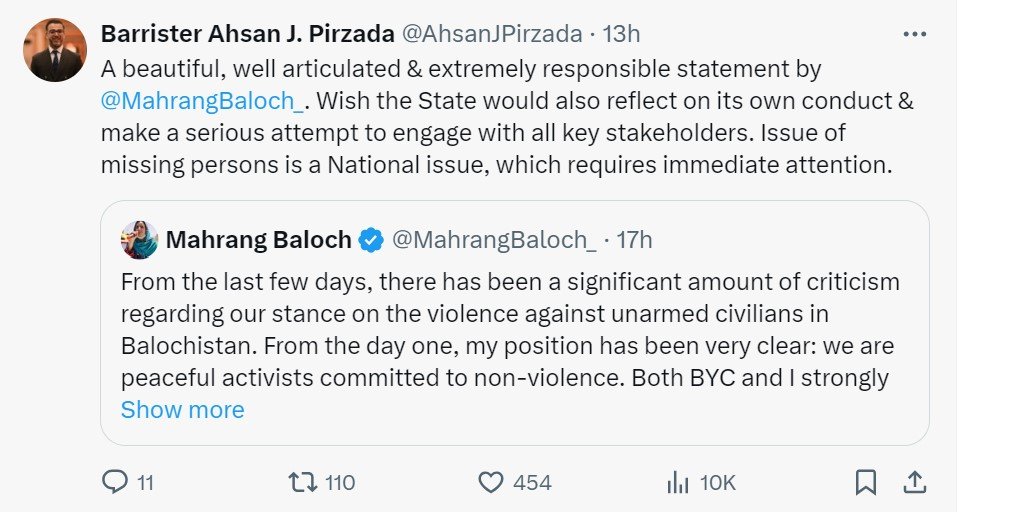
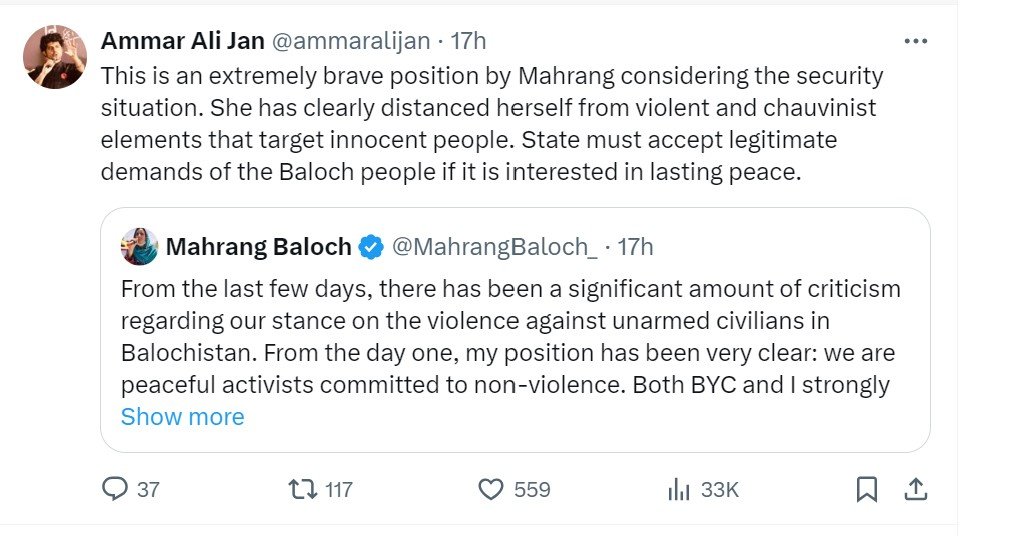
Social media is divided on Mahrang’s post, with some pointing out that she did not name the Balochistan Liberation Army (BLA), the terrorist group responsible for killing innocent people.
However, many social media users also applauded her position calling it “brave and extremely responsible.”
Interestingly, former President Arif Alvi took to X, formerly Twitter, to write a comprehensive note welcoming Mahrang’s position: “I am certain that this group of activists with a huge following that is being led by this brave Baloch Pakistani woman are not terrorists. Stop labelling them as such.”
It should be highlighted when Pakistan Tehreek-e-Insaf was in power, then-Prime Minister Imran Khan drew widespread criticism in 2021 when he stated that he wouldn’t be “blackmailed into coming to Quetta” after the Hazara community refused to bury their loved ones killed in a terrorist attack.
Previous
As Balochistan reels from a series of coordinated attacks across the province, which left more than 45 civilians and security personnel dead, a debate erupted among netizens on the matter of condemnation.
Social media wants condemnation of the terrorist organisation Baloch Liberation Army (BLA) from Baloch human rights activists and organisations for the senseless and brutal killing of citizens.
Many have called out the double standards of followers of Baloch human rights movements as terrorist groups like BLA continue to execute innocent citizens based on their ethnicity.
At least 23 people, mainly from Punjab, were killed in the Musakhel district of Balochistan early on Monday morning after armed men checked the identities of victims on buses and trucks, shooting them to death.
Imaan Zainab Mazari, a human rights lawyer, took to X (formerly Twitter) to chastise those demanding condemnation from Baloch rights activists. “Why would their peaceful efforts for human rights be undermined by actions of a group that has nth to do w/ them? This is exactly what the State wants – it wants to continue targeting peaceful dissidents because it clearly cannot (or does not want to) fight grps like BLA.”
Social media users pointed out that those who lost their lives to terrorism belonged to low-income groups and had left their homes in search of livelihood.
Senior journalist Abbas Nasir defended Mahrang Baloch – a prominent Baloch human rights activist, writing, “Those demanding Mahrang Baloch condemn yesterday’s bloodletting should first return her father to her and then make the demand by all means. Why should the onus of condemnation be on one woman struggling peacefully for her and her people’s rights.”
One X user posted an alleged picture of one of the victims, saying, “This is one of the victims. He was there to sell fruits as a lot of people from South Punjab go to these areas to sell fruits, but of course, the privileged aunties who are living outside Pakistan or living in their 2-3 kanal houses in their AC room in DHA would not know about them.”
Another social media user by the handle @bluemagicboxes said that labourers from Punjab travelling to remote Balochistan is ‘weird’ because it made no sense to leave their own communities with a constant threat to their lives.
The majority of people criticised this point of view, with one user writing, “Pakistani ‘Punjabi’ labour can’t leave their province for work-often compelled by political and economic realities- but Afghans should be allowed everywhere in the country, and their deportation is cruel. Make it make sense people. We can all see through your bias.”
Another user pointed out that the majority of labourers killed in Balochsitan were Saraikis, from South Punjab, an area with more poverty than the rest of the province.
Similarly, one social media user criticised this perspective by writing, “My father, a Kashmiri born in Nowshera and raised in different parts of Punjab, worked in Balochistan for three years. Do you think that his presence from one part of Pakistan to another part of Pakistan was “a little weird”? You aren’t fooling anyone.”
Muhammad Ismail, the father of prominent human rights activist Gulalai Ismail, took a relatively insensitive perspective on the incident, posting, “Why do these Punjabi barbers go to Balochistan in such large numbers?”
This tweet was about yet another dreadful incident in May of this year when seven barbers who belonged to Punjab were killed by unknown gunmen in a targeted attack.
The terrible incidents in Balochistan have struck the social fabric of Pakistani society, fueling divisions based on ethnicity and provincialism.
The human rights problems, including the missing persons issue, in Balochistan are genuinely concerning and must be addressed by authorities.
However, militant organisations targeting ordinary citizens after checking their identities deserve collective condemnation.