Blog

  • Russian oil imports expected to reduce fuel prices slowly, says Musadik Malik

    Russian oil imports expected to reduce fuel prices slowly, says Musadik Malik

    At the Pakistan Energy Conference 2023, Minister of State for Petroleum, Musadik Malik, reassured the nation that the arrival of cheap oil from Russia would eventually lead to a decline in fuel prices. However, he cautioned that an immediate decrease should not be expected until a continuous supply of oil from Moscow is established.

    Minister Malik said that the import of Russian oil was not merely a promise or rhetoric. He confirmed that ships carrying the much-anticipated oil had already reached Oman and would commence supply to Pakistan within a week. While acknowledging that a single shipment would not significantly impact fuel costs, Malik expressed confidence that once a persistent supply was established, the price of fuel would gradually decrease.

    The government’s ambitious objective is to fulfill one-third of Pakistan’s crude oil requirements with affordable oil sources, including imports from Russia. The aim is to address the chronic energy shortages that Pakistan, the world’s fifth most populous country, has been grappling with. Currently, Pakistan imports 84 per cent of its petroleum products, primarily from Gulf Arab allies Saudi Arabia and the United Arab Emirates.

    The import of cheap Russian oil represents one of Pakistan’s strategies to alleviate its energy crisis, as global efforts are underway to restrict Russia’s oil exports due to its invasion of Ukraine. During a visit to the United States earlier this month, Minister Malik confirmed that Pakistan had placed its first order for Russian oil, which is expected to arrive within a month. Upon evaluating the impact of this initial shipment, Pakistan will decide on the extent of future imports.

    When asked about the possibility of pursuing more Russian imports, Malik responded that Pakistan would prioritise cheaper energy sources to meet its energy requirements. The minister further emphasised that the government’s objective was to ensure a sustainable and affordable supply of low-cost energy, highlighting accessibility, sustainability, and affordability as the key pillars of this vision.

    In addition to the import of Russian oil, Malik mentioned the Iran-Pakistan Gas Pipeline project as another avenue to address the country’s energy needs. The government has conveyed to Iran its intention to access energy through the pipeline while remaining responsible and avoiding potential sanctions. Talks are underway with both sanctioning countries and Iran to find a creative solution to this matter.

    With Pakistan eagerly awaiting the arrival of cheap Russian oil, the government remains committed to securing a sustainable and affordable energy supply to meet the needs of its citizens. The gradual decline in fuel prices is expected to provide much-needed relief to the nation, addressing its chronic energy shortages and boosting economic growth in the process.
  • Will PCB lose right to hosting Asia Cup 2023?

    Will PCB lose right to hosting Asia Cup 2023?

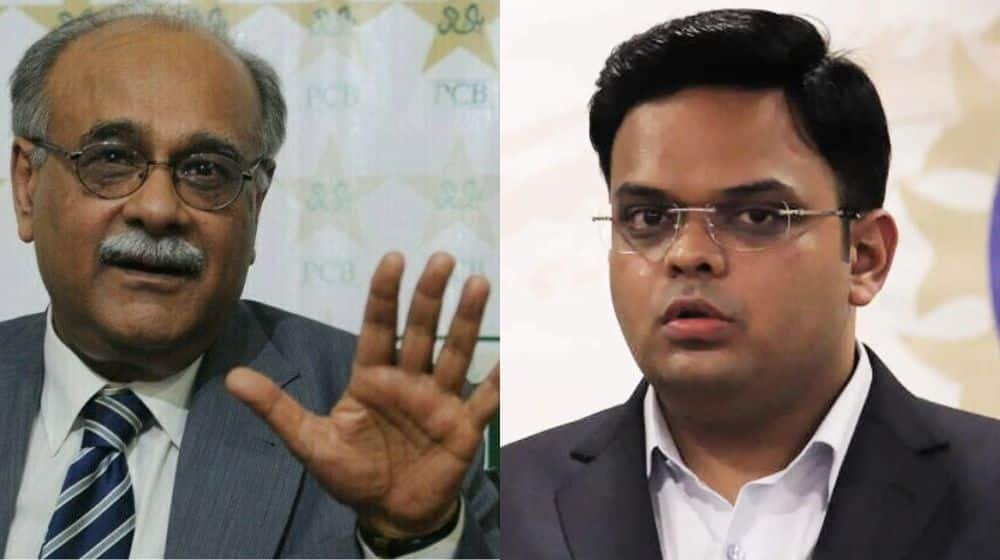
    The Asia Cup controversy is showing no sign of ending, as the Board of Control for Cricket in India (BCCI) does not want to end the stalemate with Pakistan Cricket Board (PCB).

    BCCI has rejected the proposal of a hybrid model proposed by PCB, with Indian officials rejecting the offer to play in Dubai. The Indian government’s rigid influence did not let Asian Cricket Council (ACC) solve the dispute amicably.

    As of PCB’s proposed hybrid model, which suggested that the first four matches will be played in Pakistan and the rest of the tournament moves to a neutral venue, Pakistan demanded that India first accepts it, then Board officials will decide which country will host the rest of the matches.

    Revenue concerns are the first priority of Pakistan, with Dubai being the favorite choice.

    Bangladesh and Sri Lanka have expressed concerns over weather conditions in Dubai. Sri Lanka is up in line for hosting Asia Cup 2023.

    Media speculation suggests that they secretly shook hands with BCCI and hinted to ACC that the weather is also suitable there.

    As time passes, Pakistan is losing its grip on hosting Asia Cup 2023 with Asian teams looking to favour India. PCB Chairman Najam Sethi has said that if the hosting rights will be stolen from the country, then Pakistan will also not play World Cup 2023 in India.

  • Saqib Nisar son’s audio leak: ‘Who records these audios?’ IHC asks government

    Saqib Nisar son’s audio leak: ‘Who records these audios?’ IHC asks government

    Justice Babar Sattar of the Islamabad High Court on Wednesday heard a plea filed by Najam Saqib, son of former chief justice of Pakistan (CJP) Mian Saqib Nisar, against a special committee formed by the National Assembly speaker to probe into audio clips allegedly featuring his voice.

    During the hearing Babar Sattar asked the federal government, “Who records these audios?”, while suspending the summon notice issued to Najam by the special committee.

    “There is no relevant ministry in this matter, but we will do so,” Khosa said.

    “We only challenged that the speaker and the assembly do not have the authority to look into private matters. The petition does not challenge the matter which is pending in the Supreme Court,” said Latif Khosa, on behalf of the petitioner.

    “The audio leak is an alleged conversation between two private individuals that Parliament has no right to see,” he added.

    Sattar further said, “You have also been a governor. Tell me, who records these audios?”

    “Let the parties answer first, then everything will be clear,” Latif responded.

    On May 2, the National Assembly passed a motion demanding formation of a special parliamentary committee to investigate the audios, while on May 3, National Assembly Speaker Raja Pervaiz Ashraf constituted the committee.

  • SpaceX introduces internet service allowing customers to connect ‘anywhere on Earth’

    SpaceX introduces internet service allowing customers to connect ‘anywhere on Earth’

    SpaceX, the renowned aerospace company led by Elon Musk, has introduced a groundbreaking service called Starlink Mobility. This innovative offering allows customers to access SpaceX’s space-based Starlink internet service from almost anywhere on the planet, even while in motion.

    Starlink Mobility harnesses a receiver with an expansive field of view and enhanced GPS capabilities, connecting users to SpaceX’s vast constellation of over 4,000 low-Earth orbit satellites. Elon Musk took to Twitter, stating that this service functions “almost everywhere on Earth,” including remote areas like the middle of oceans and deserts.

    The initial beneficiaries of Starlink Mobility are a fleet of school buses in Arizona. By utilizing this service, students can now stay connected and complete their homework while commuting to and from school, revolutionizing their learning experience.

    SpaceX emphasized that Starlink Mobility is particularly well-suited for mobile businesses and various public sector use cases, such as trucking, buses, shuttles, and emergency response services. By subscribing to Starlink Mobility, users gain network priority during peak hours, ensuring uninterrupted internet connectivity. This priority access holds significant value for emergency responders, as it helps them maintain vital connections when it matters most.

    SpaceX’s website asserts, “Starlink Mobility provides 100 percent coverage in your country and every country where Starlink service is available across the globe.” Moreover, the service extends its reach to the vast majority of the Earth’s oceans and seas, offering connectivity even in maritime environments.

    To access Starlink Mobility, customers need to invest $250 per month, along with a one-time hardware fee of $2,500. The Starlink satellite dish, an advanced iteration of SpaceX’s standard hardware, is designed to be permanently installed on vehicles, offering impressive download speeds of up to 220 Mbps.

    SpaceX achieved the milestone of global coverage for its Starlink internet network last year, marking four years since the launch of its first satellite batch. However, certain countries like China and Iran have prohibited Starlink from operating within their borders, hindering their citizens’ access to this cutting-edge technology.

    Looking to the future, SpaceX aims to launch a satellite-to-cellphone service that would eliminate the need for additional hardware to connect to its internet constellation. Nevertheless, concerns have been raised by existing wireless service providers. AT&T in the US, for example, has urged the Federal Communications Commission (FCC) to reject SpaceX and T-Mobile’s proposal, citing potential interference with their terrestrial services.

    Testing of the satellite-to-cell service is slated to commence later this year, and its outcome will likely shape the landscape of global internet connectivity. SpaceX continues to push boundaries, innovating in the realm of space technology and revolutionizing the way people connect and access the internet worldwide.

  • Women not being mistreated in Punjab jails: IG Punjab

    Punjab Inspector General (IG) Dr Usman Anwar held a joint press conference with SSP Dr Anoush Chaudhry on Tuesday, to dismiss allegations of mistreatment of women in jails.

    He said that people should have trust in their institutions, adding that there are more than 150 cameras inside Kot Lak Pat jail.

    Dr Anoush said that women were being provided facilities as per rules. She said that she had met with the detained women herself and inquired about any issues they were facing.

    The IG also said that old pictures and videos were being posted to propagate a false narrative.

    Pakistan Tehreek-e-Insaf chairman Imran Khan, in a televised address to the nation on Sunday, claimed that he had received reports that women belonging to his party are being harassed in jails.

    He requested the judiciary to take suo motu action against the arrests.

  • IMF’s conditions for agreement: Pakistan must arrange foreign loans and restore foreign exchange market

    IMF’s conditions for agreement: Pakistan must arrange foreign loans and restore foreign exchange market

    In a recent development, the International Monetary Fund (IMF) has urged Pakistan to address its political disputes in accordance with the constitution. This statement came after Prime Minister Shehbaz Sharif reached out to IMF Managing Director Kristalina Georgieva in a last-ditch effort to revive the derailed $6.5 billion bailout package and avoid default.

    Following the conversation between Shehbaz and Georgieva, IMF Mission Chief to Pakistan Nathan Porter made an unusual statement, expanding the IMF’s focus to the political arena.

    While the IMF typically refrains from commenting on domestic politics, Porter emphasised the importance of finding a peaceful way forward in line with the constitution and the rule of law. This statement comes in the midst of an ongoing crackdown against PTI workers, abductions of individuals, and other political issues.

    Responding to questions from The Express Tribune, Porter outlined the conditions Pakistan must fulfill to reach an agreement with the IMF. These conditions include arranging foreign loans, approving a new budget in line with the IMF framework, and restoring proper functioning to the foreign exchange market.

    Prime Minister Shehbaz sees the IMF as the last resort to avoid default and thus decided to intervene. Following the conversation with the IMF chief, he instructed the finance ministry to share details of the next budget with the IMF.

    Meanwhile, Finance Minister Ishaq Dar criticised the IMF again, stating that it would be biased and shameful if the 9th review did not take place. However, a top finance ministry official confirmed that the prime minister had contacted the IMF managing director to break the deadlock.

    Time is running out for Pakistan, as there is only one month left before the program expires. Pakistani authorities still believe that the IMF can shorten the review completion period by calling a board meeting within two weeks of announcing the staff-level agreement.

    Porter emphasised that sustaining strong policies, obtaining sufficient financing from partners, and engaging in ongoing reforms are crucial for Pakistan to maintain macroeconomic stability. He also stressed the importance of strengthening domestic revenue mobilization, eliminating state-owned enterprise losses, reducing inefficiencies, and allowing for increased social and development spending.

    While Pakistan claims to have fulfilled all the conditions agreed upon in February, the sources indicate that Pakistan is currently not meeting all three conditions set by the IMF. The value of the rupee in the open market is significantly different from its value in the interbank market, and the new budget is not aligned with the IMF’s requirements.

    To bridge the financing gap until June this year, the IMF had asked Pakistan to arrange $6 billion in fresh loans. So far, Pakistan has obtained assurances for $3 billion from Saudi Arabia and the United Arab Emirates. The government is ready to share the details of the budget and the foreign exchange policy with the IMF.

    The $6.5 billion bailout package has been derailed since November last year and is set to expire on June 30. Of the total amount, the IMF has not disbursed $2.6 billion, including a $1.2 billion tranche linked to the completion of the 9th review. Pakistan’s foreign exchange reserves stand at $4.1 billion, which is not sufficient to cover the upcoming $25 billion in repayments.

    There are still differences of opinion regarding the current account deficit for this fiscal year. The government’s revised estimate of around $4 billion to $4.5 billion has not yet been accepted by the IMF.

    Initial reports suggest that the government intends to announce an expansionary budget of around Rs14.6 trillion with a deficit of around 7.4 per cent of the gross domestic product (GDP). However, this budget would need to be adjusted to align with the IMF’s requirements.

    The IMF’s Fiscal Monitor report projected a budget deficit as high as 8.3 per cent of the GDP for the next fiscal year, significantly higher than the government’s proposal. The finance ministry had initially proposed an overall budget deficit of around 6.9 per cent of the GDP or Rs7.3 trillion.

  • ‘People said I was making a mistake’: Director Abu Aleeha on casting Yasir Hussain for ‘Kukri’

    Director of the anticipated crime thriller ‘Kukri’, Ali Sajjad Shah aka Abu Aleeha, sat down for an interview with Geo Digital, where he opened up about his decision to cast actor Yasir Hussain for the film, revealing that initially people thought he was making a mistake with casting the actor:

    “They said I am committing suicide and Yasir can’t pull off this character, I received many calls from the people associated with our industry; however, the statements changed when the poster came out, and the very same people spoke to me again and said ‘Tum ne ye kiya bana diya hai!’”

    He further praised the ‘Badshah Begum’ actor for being one of the finest in the industry:

     “I have seen Yasir’s best work in the theatre, I know how far I can go with him. People have seen his work in dramas but that’s not his finest work.”

    Speaking on how Aleeha and Hussain built up the notorious serial killer Javed Iqbal’s character, who reportedly murdered and raped more than a 100 boys in Lahore giving himself up to the police, the director said that he and Hussain researched to get the accent right:

    “I took Yasir to many chai dhabbay in Androon–e –Lahore. There, I observed local people chatting in different Punjabi accents. I used to record their conversations and that’s how we picked one of the accents for Javed Iqbal. Later, Yasir practised it.”

    Aleeha also talked about why he had chosen to work on the serial killer, a topic that had intrigued audiences last year when the film was announced under the name ‘Javed Iqbal’. The ‘Taxali Gate’ director cited his stint working as a crime news reporter for ten years, which was when he heard about Javed Iqbal:

    “I’ve been working as a crime reporter for a private channel for 10 years. [I remember] a criminal was arrested in Lahore and accused of raping 100 children. It was around 1999 and since then, the character has been stuck in my mind.

    “Musharraf Sahab’s take over and Javed Iqbal were the two most sensational stories at that time.

    “The case was handed over to the honorary Supreme Court and Javed Iqbal was detained, where he committed suicide. 

    “I got a copy of the challan after a month, from a lawyer and decided to make a web series on the serial killer but no one took me seriously. Then, I published the first book about his crimes and it got a massive response.

    “The second edition I published was about the investigation and the back story of this notorious man; the book came out in eight editions and sold out in six months — which indicated that people are intrigued by the story.

    “Then I decided to make a film on Javed Iqbal.”


  • Abrar ul Haq apologises for London concert

    Former Pakistan Tehreek-e-Insaf (PTI) leader and singer Abrar ul Haq has apologised for performing at a property expo held in London, two days after he quit the party.

    “I shouldn’t be in London if Pakistanis are unhappy,” said Abrar.

    The singer stated that he went to the London ceremony for a hospital’s charity fundraising.

    Denying media reports that he was mobbed by PTI workers, Abrar said that the miscreants who targeted him were planted people.

    Haq further said that he is sorry if anyone’s sentiments were hurt.

    During the show, the anchor played a video chunk of Abrar’s 2019 statement in which he justified assassination attempt on his constituency rival Pakistan Muslim League-Nawaz (PML-N) leader Ahsan Iqbal. The host then asked Abrar if he regretted his statement. To which Abrar said that such acts should be condemned.

    Abrar ul Haq had announced on Friday that he is parting ways with PTI, saying he didn’t see any purpose in staying with the party. He was in tears as he made the announcement.

  • ‘Fashionable now to hate on Muslims’: Naseeruddin Shah slams Modi on Islamophobia

    Bollywood actor Naseeruddin Shah spoke to Indian Express about growing Islamaphobia under the rule of the right-wing Bharatiya Janata Party (BJP) and its influence on Bollywood.

    “Oh sure, these are worrying times absolutely,” the veteran actor said. “The kind of stuff that’s pure, undisguised propaganda is being lapped up and it’s a reflection of the zeitgeist of the times. Muslim hating is fashionable these days, even among educated people. It’s what the ruling party has very cleverly tapped into this nerve. We talk about secular this, democracy that, so why are you introducing religion into everything?.”

    The actor is well known for his out-spoken critique on Prime Minister Narendra Modi and the spread of fascism in India, especially on the Indian Premier’s silence on growing hate speech in India.

    “I mean how spineless is the election commission of ours? Who doesn’t even dare utter a word. If there had been a Muslim leader who had said, ‘Allah Hu Akbar bol ke button dabao’, sh*t would have hit the fan. But here our Prime Minister goes ahead and says things like this and yet he loses. So, I have hope that this will wear off. But it’s definitely, at the moment, at its peak. It’s been a very clever card played by this government, and it has worked. Let’s see how long it continues to work.”

    Speaking on the rise of state propaganda films like ‘Mission Majnu’ and ‘Kashmir Files’, Shah said that the best thing that actors can do in these times is stay quiet and not participate in any propaganda, because artists these days are scared to raise their voice or fear their movies will be boycotted by the masses.

    Further addressing the role of art in influencing society, Shah urged all artists to raise the right questions, but also stressed on the need to come from a place of fearlessness. He further said that words and no action will not resolve the issue, but one has to practice what they preach.

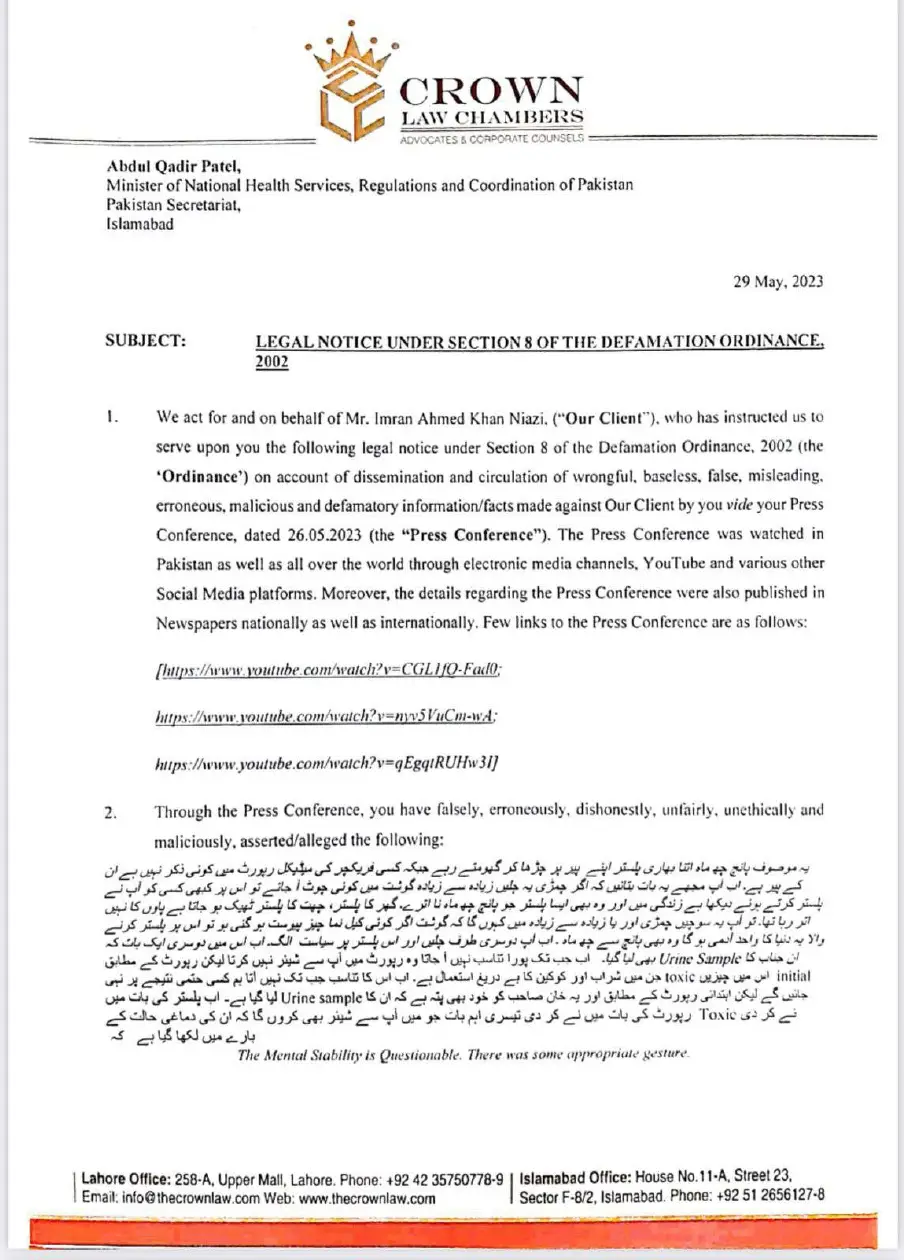
  • Imran Khan sends defamation notice to Abdul Qadir Patel for accusations of mental instability

    Imran Khan sends defamation notice to Abdul Qadir Patel for accusations of mental instability

    Pakistan Tehreek-e-Insaf (PTI) Chairman Imran Khan has sent a Rs10 Billion defamation notice to Health Minister Abdul Qadir Patel for sharing details about an alleged medical test conducted during his arrest, stating that the PTI chief had faked his fracture and that alleging that he is mentally unstable.

    Imran Khan asked the minister through the legal notice to, “retract his statements in the same mode and manner in which he made them in the first place”.

    The private medical reports of the tests that the government is said to have conducted on PTI leader Imran Khan earlier this month while he was under arrest were made public on Friday.

    The investigations stated that Imran Khan’s mental stability was under question and that while no leg fractures were found, there was evidence of alcohol and an illicit substance in his urine.